Most Christians assume the doctrine of the trinity is the original, self-evident teaching of the Bible — the faith of the apostles, handed down unbroken from the beginning. The historical record tells a different story. The developed dogma — that God is one essence in three co-equal, co-eternal persons — cannot be found stated in Scripture, was not the confession of the earliest church, and did not reach its finished form until the close of the fourth century. It was hammered out across roughly six decades of bitter controversy, settled at imperial councils, written into the creeds with a word that is not in the Bible, and enforced on a divided church by emperors wielding the threat of banishment. The trinity, in other words, has a traceable history — and a birthday.
This is not a fringe claim, and it does not require any hostile source to establish. The story can be assembled entirely from standard church history — Gibbon, Stanley, the surviving conciliar creeds themselves — and confirmed, on its most important point, by Rome's own theological reference works. What follows is that history, kept as close to the documented record as a short essay allows.
A doctrine with a birthday
One clarification first, because it is often muddled in arguments on both sides. The word “trinity” is older than the fourth century. Theophilus of Antioch used the Greek trias around 180 AD, and Tertullian of Carthage coined the Latin trinitas in the early third century. But a word is not a dogma. When those early writers used the term, they did not mean what the later creeds would mean by it — three co-equal, co-eternal persons of one identical substance. That specific architecture — the doctrine as it is now confessed — is what belongs to the fourth century. The vocabulary drifted into place first; the binding definition came later, by council and by edict.
What the church believed before the councils
The faith of the earliest post-apostolic writers was consistently a two-fold confession: one God, the Father, and His only-begotten Son, brought forth from the Father before all creation, through Whom the Father made all things. The Son was understood as truly divine — sharing the Father's own nature because He was begotten of the Father's own substance — and as deriving His existence from the Father, Who alone is without beginning. This is plain in the surviving texts.
Justin Martyr, writing around 160 AD, applied the “brought forth” language of Proverbs 8 to Christ and concluded that this “offspring was begotten by the Father before all things created, and that which is begotten is numerically distinct from that which begets.” Irenaeus, around 189, summarized the church's faith as being “in one God, the Father Almighty… and in one Christ Jesus, the Son of God.” Origen, around 225, taught that the Son “was born of the Father before all creatures.” Even Novatian's third-century Treatise on the Trinity— despite its title — calls the Father the one “who alone knows no beginning,” from whom “the Word was born, His Son,” a “second person after the Father.” The Son is divine; the Father is the source. There is an order, not an equality of origin.
What is absent from these writers is the later claim that the Son is unbegotten and without beginning in exactly the same sense as the Father — that there are, in effect, two Who never were brought forth. That idea, when it arrived, struck the church of the day as a novelty, and it is the novelty that the fourth-century councils were convened to impose.
The Arian controversy
The dispute that triggered everything broke out in Alexandria in the early 300s, between a bishop named Alexander and one of his presbyters, Arius. Reduced to its core, the question was whether the Son is of the same substance as the Father (Greek homoousios) or of like substance (homoiousios). As Gibbon famously observed, the entire Christian world was about to be convulsed over the presence or absence of a single Greek letter — the iota that separates those two words.
It is worth being precise about what Arius actually held, because the caricature has done a great deal of damage. He is usually remembered as teaching that Christ was a mere creature. But his own statements, and the later judgment of careful historians, indicate that the men branded “Arian” generally confessed the Son's divinity and that He was begotten, not made — their insistence was simply that the Son had a beginning in being brought forth from the Father, while the Father alone is without beginning. That was, very nearly, the older common faith described above. The label “Arian” was afterward applied so broadly, to so many who rejected the new formula for many different reasons, that it tells us little by itself.
The argument did not stay in the lecture halls. Arthur Stanley's history records that it spilled into the streets of the eastern cities — sailors, money-changers, and bath attendants debating generated and ungenerated being while they worked. To the emperor Constantine, newly master of a reunited empire and looking to Christianity as its unifying cement, this theological civil war was an intolerable threat to public order. His concern was political unity, not the metaphysics. He resolved to settle it by council.
The profane of every age have derided the furious contests which the difference of a single diphthong excited between the Homoousians and the Homoiousians.
Nicaea, 325
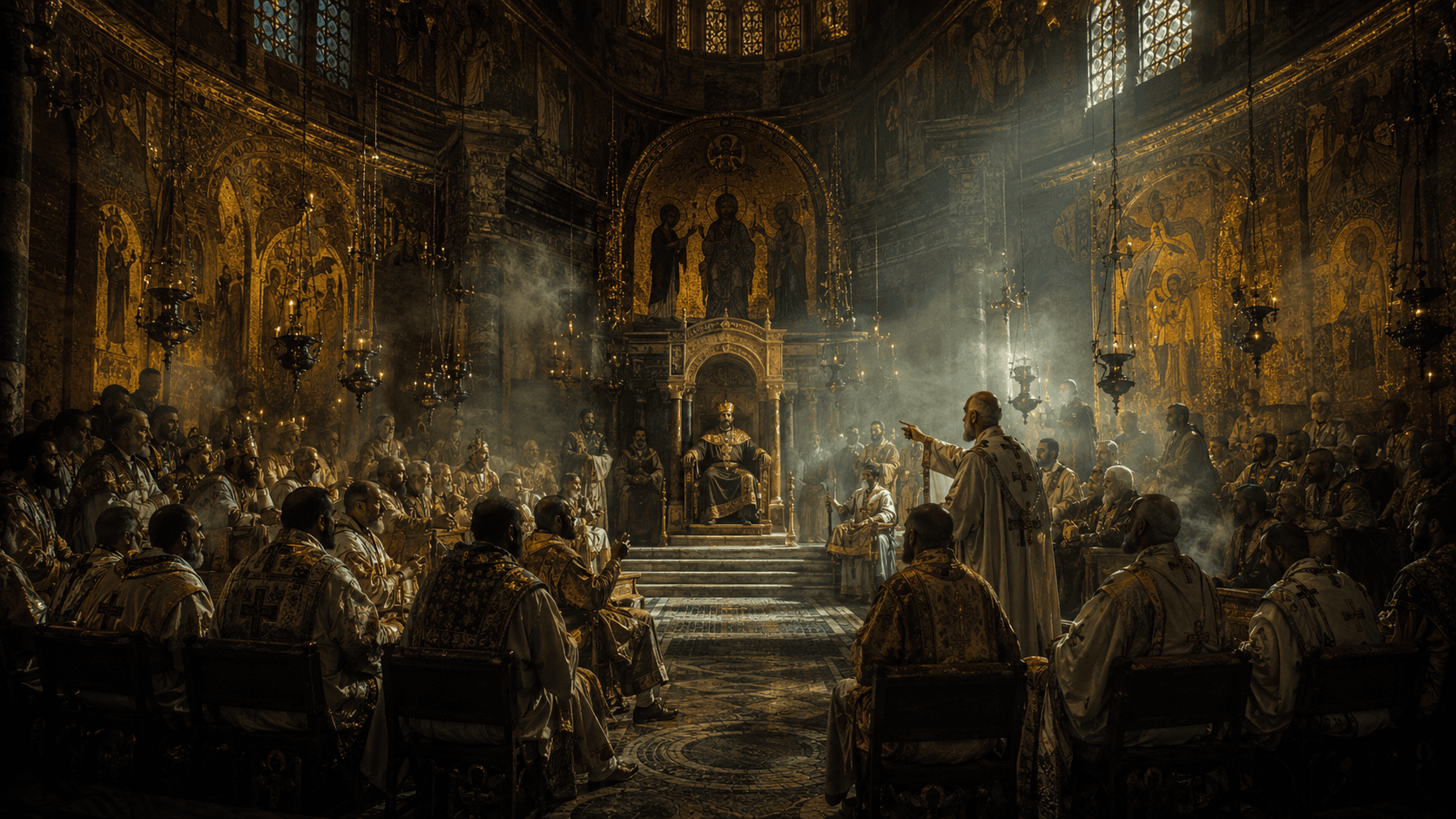
Constantine convened the first general council at Nicaea in 325 AD — a gathering traditionally numbered at 318 bishops. It is important to grasp who called it and why: a Roman emperor, not yet even baptized, summoned and presided over the assembly, and his governing interest was a single, enforceable answer that would quiet the empire. The council met under imperial sponsorship and imperial pressure.
There were three parties: the followers of Alexander (championed by the deacon Athanasius), the followers of Arius, and a large middle group hoping to mediate. Early in the proceedings, Eusebius of Caesarea — the era's leading church historian — offered a creed that had been in wide use as a baptismal confession before the controversy began. The moderates and the Arian party were willing to sign it. And that was precisely the problem for the Alexandrian party: they did not want a statement everyone could accept. By the account preserved in the histories, they were “determined to find some form of words which no Arian could receive.”
The word they fixed on was homoousios— “of one substance.” It had two decisive features. It excluded the Arian position, and it is not found anywhere in the Bible. Constantine himself, on the advice of his theological counselors, pressed for its insertion and personally undertook to interpret it. When the creed was finished, it confessed the Son as “begotten of the Father, only-begotten, that is, of the substance of the Father… begotten, not made, being of one substance with the Father,” and it anathematized any who said “there was a time when He was not.”
Notice what that original creed still retained: the Son is begotten, only-begotten, of the substance of the Father. The begetting was not yet denied; the new word was bolted on alongside it. Even Eusebius of Caesarea, defending his eventual signature to his own congregation, took pains to explain that “of the substance of the Father” meant the Son was truly from the Father — but not a part of the Father, and not the same being as the Father. The ambiguity was built in from the start, and it is what allowed the definition to be quietly hardened later.
The manner of adoption is as telling as the wording. Seventeen bishops at first refused to sign. Constantine then commanded all to subscribe under penalty of banishment; this brought all but a handful to terms. Arius and two bishops who held out were exiled, and the emperor ordered Arius's writings burned — decreeing death for anyone caught concealing them. A doctrine of God was being secured by the confiscation and burning of books and the exile of dissenters. Whatever else that is, it is not the method of the apostles.
The decades of reversal
If the trinity were simply the obvious apostolic faith, recognized by the whole church the moment it was stated, the decades after Nicaea are impossible to explain. They were a long see-saw, swinging with the politics of the imperial court rather than settling into any stable consensus.
Within two years Constantine recalled Arius from exile. Athanasius, the great champion of Nicaea, was himself banished five separate times as the favor of successive emperors shifted. Constantine, who had presided over Nicaea, was finally baptized on his deathbed in 337 — by Eusebius of Nicomedia, a leader of the very party Nicaea had condemned. His son Constantius II, who ruled the East, threw imperial power behind the anti-Nicene side, and by a series of councils around 359–360 the non-Nicene formula was made the official faith of the empire. The historian Jerome looked back on that moment and wrote one of the most quoted lines in all of church history:
The whole world groaned and was astonished to find itself Arian.
Read that plainly. A generation after Nicaea supposedly settled the matter, the official Christianity of the entire Roman world was, by Jerome's own description, on the other side. The question was not being decided by an unbroken apostolic consensus. It was being decided by whichever theology held the throne — and the throne changed hands.
Constantinople, 381 — the dogma completed
The final turn came with the emperor Theodosius. In 380 his Edict of Thessalonica made Nicene Christianity the official religion of the empire and commanded all subjects to hold it — branding everyone else “heretics” subject to punishment. This was not persuasion; it was law, backed by the power of the state.
Then, at the First Council of Constantinople in 381, the creed was reaffirmed and expanded. Up to this point the long quarrel had been almost entirely about the relationship of the Father and the Son; the Holy Spirit had scarcely figured in it. Constantinople added the clause confessing the Spirit as “the Lord, the giver of life… who with the Father and the Son together is worshipped and glorified.” Only here, more than three hundred and fifty years after Pentecost, was the third member added as a co-equal object of worship — and only here did the three-in-one formula reach the finished shape that has been called the trinity ever since. The doctrine did not descend from heaven with the apostles. It was assembled, clause by clause, across the fourth century, and signed into being under imperial sponsorship.
Rome's own admission
The most powerful witnesses on this point are not Protestant critics but the Roman Catholic Church's own scholarship. Rome does not generally dispute that the trinity is her formulation, developed over centuries; she presents it as a strength — a doctrine defined by the authority of the church rather than read off the surface of Scripture. Her reference works say so directly.
The formulation “one God in three Persons” was not solidly established, certainly not fully assimilated into Christian life and its profession of faith, prior to the end of the 4th century… Among the Apostolic Fathers, there had been nothing even remotely approaching such a mentality or perspective.
That is Rome describing her own central dogma — conceding that it was not in place until the end of the fourth century and that the earliest Christian writers show nothing approaching it. The Catholic Encyclopedia calls the trinity “the central doctrine of the Catholic religion” and frankly acknowledges that it is held on the authority of the church, not on the strength of an explicit scriptural statement. Catholic apologists have long pressed this very point against Protestants: that they accept the trinity, for which there is no precise biblical proof text, purely on the church's tradition — while claiming to follow Scripture alone. On the history, in other words, Rome and her honest critics agree. The disagreement is only over whether a doctrine the church invented after the apostles should be binding.
One related case deserves mention, because it is the closest thing to a trinitarian proof text. The words of 1 John 5:7 in the King James Bible — “the Father, the Word, and the Holy Ghost: and these three are one” — are not part of the original letter. This passage, the so-called Johannine Comma, is missing from every Greek manuscript of any antiquity; it survives only in the later Latin tradition and was inserted into the Greek text long afterward. Mainstream textual scholarship, summarized in Bruce Metzger's standard Textual Commentary on the Greek New Testament, treats it as a late addition, and modern translations either footnote it or drop it. The single verse that most plainly states the trinity is the one verse textual scholars agree was added in.
The faith that persisted
Through the long centuries that followed, the older confession never entirely disappeared. Bodies of Christians on the margins of Rome's reach — among them the Waldenses, who carried a simple gospel faith through the Dark Ages — are described by historians as differing profoundly from the papacy on its metaphysical doctrine of the Godhead, holding instead to the plainer biblical confession of the Father and His Son. The Reformation, for all that it recovered, mostly carried the inherited trinitarian formula across without re-examining it from the foundations.
That re-examination is exactly what the early Adventist movement undertook in the nineteenth century. Its founders were, almost to a man, non-trinitarian, classing the doctrine among the unexamined inheritances Protestants had carried out of Rome. As James White put it in 1854, listing the “fundamental errors” brought over from the Catholic church alongside the counterfeit sabbath and the consciousness of the dead: he named “the trinity” among them. The recovery of the apostolic faith — one God the Father and His only-begotten Son — is the older path, not a new invention.
Why it matters
None of this is mere historical trivia, and it is not raised for the sake of controversy. It matters because the heart of the gospel is at stake in how we understand the Son. The most beloved verse in Scripture is a statement about a real Father giving a real, only begotten Son: “For God so loved the world, that he gave his only begotten Son, that whosoever believeth in him should not perish, but have everlasting life” (John 3:16). The wonder of that gift — the Father surrendering the Son Who was truly His own, brought forth from His own being before all worlds — is flattened when “Son” is reduced to a role or a metaphor, as the developed dogma and its modern defenders tend to make it.
Eternal life, Christ said, is to know “the only true God, and Jesus Christ, whom thou hast sent” (John 17:3). Knowing them truly — the one God Who is the Father (1 Corinthians 8:6), and His only-begotten and fully divine Son — is not a side issue. It is the knowledge eternal life is made of. The history above is offered only to clear away a fourth-century overlay so that the apostolic confession underneath it can be seen plainly again: not the faith of Nicaea's emperors, but the faith of John's gospel.
Sources & further reading
- The Nicene Creed (325) and the Niceno-Constantinopolitan Creed (381) — primary conciliar texts
- Encyclopædia Britannica — Council of Nicaea (325), Constantine, and the Arian controversy
- Edward Gibbon — The History of the Decline and Fall of the Roman Empire, ch. 21 (the homoousios/homoiousios dispute)
- Jerome — Dialogue Against the Luciferians (c. 379): 'the whole world groaned and was astonished to find itself Arian'
- New Catholic Encyclopedia (1967), Vol. 14, p. 299 — 'the formulation one God in three Persons was not solidly established… prior to the end of the 4th century'
- Catholic Encyclopedia — 'The Blessed Trinity' (the central doctrine of the Catholic religion, held on the authority of the Church)
- Bruce M. Metzger — A Textual Commentary on the Greek New Testament (on the Johannine Comma, 1 John 5:7)
- Theophilus of Antioch — To Autolycus 2.15 (the earliest surviving use of the Greek 'trias', c. 180 AD)
- Tertullian — Against Praxeas (the Latin 'trinitas', early 3rd century)
- Justin Martyr — Dialogue with Trypho, ch. 129 (the Son 'begotten by the Father before all things created')
- Origen — De Principiis (the Son 'born of the Father before all creatures')
- John 3:16 (KJV) — 'God so loved the world, that he gave his only begotten Son'
- John 17:3 (KJV) — 'this is life eternal, that they might know thee the only true God, and Jesus Christ'
- 1 Corinthians 8:6 (KJV) — 'to us there is but one God, the Father… and one Lord Jesus Christ'