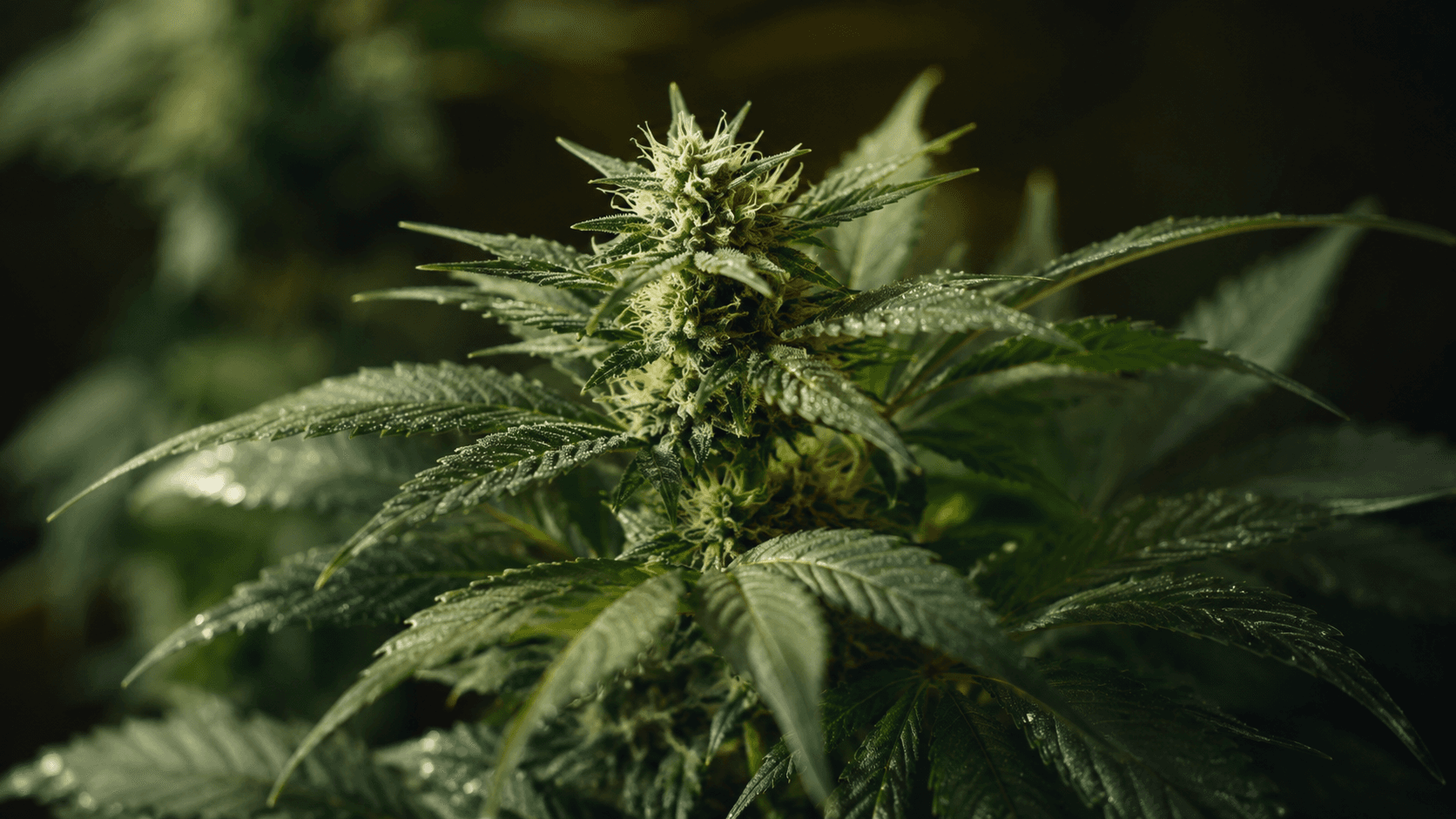
If you used to enjoy cannabis and can't anymore — if a few puffs now send your heart racing, tighten your chest, and drop you into the spinning dread of a panic attack — I want to tell you something that took me years to believe: you are not broken, and it is not a lost cause. Something real happened to you, but it is not what you think. It is not that your body suddenly turned against a plant humans have used peacefully for thousands of years. It is that the plant you were handed is not the plant your grandparents smoked. Over the last few decades cannabis was quietly re-engineered into something far more intense and far more lopsided than nature ever made it — and the very part of the plant that used to keep it gentle was bred almost completely out. Put that part back, and for a great many people the fear goes with it. This is the story of how the plant got out of balance, why that imbalance is what's spiking your anxiety, and exactly how to find your way back.
A word on where this comes from. The science here leans on the work of researchers like Roger Pertwee and Ethan Russo on how cannabis compounds actually behave in the body, on Robert Laprairie's work showing precisely how CBD calms the THC receptor, and on decades of potency data from the labs that have tracked what happened to the plant. The hope here comes from my own experience — years of assuming I'd have to white-knuckle a painful microdose climb back to any normal tolerance, and then discovering there was a much gentler door standing open the whole time.
When the plant turned on you
Let's name it plainly, because if this is you, you already know the feeling and you've probably been carrying a quiet shame about it. You take a hit — maybe the same amount that used to feel great — and instead of easing, everything tightens. Your heart pounds. Your thoughts start sprinting and looping. A wave of something is wrong rolls up your spine, and now you're watching yourself have a panic attack, convinced you've done something you can't undo. Afterward you feel foolish and defeated, and you file cannabis away under “things I used to be able to do.”
I spent a long time in exactly that place. I assumed the only way back was to somehow force my nervous system to tolerate the same overwhelming flower again — to microdose a crumb at a time and slowly, miserably climb my way up to a “normal” tolerance, white-knuckling the anxiety the whole way. It felt like a lost cause, and honestly, so I gave up on it for years. What I didn't understand then is that the problem was never really me. The problem was the chemistry of what I was smoking — and that chemistry can be changed.
The THC arms race
Here is the piece almost nobody explains to you. For the last several decades, commercial cannabis has been locked in a single-minded arms race with one goal: more THC. THC is the compound that gets you high, so more THC could be sold as a “stronger, better” product, and growers competed to push the number ever upward. It worked, spectacularly. In the 1960s and 70s, cannabis commonly carried something like one to three percent THC. By the mid-1990s the average was around four percent. Today the average is in the mid-teens, and boutique flower routinely advertises twenty-five to thirty percent or higher. That is not a small drift. That is the potency of the plant multiplied several times over in a single lifetime.
But the number that matters most for your anxiety is the one nobody was watching. As breeders chased THC, they crowded everything else out — and the biggest casualty was CBD. The plant only has so much room to make cannabinoids, and every gram of resource poured into THC is a gram not spent on CBD. Over the same span that THC exploded, average CBD in commercial cannabis collapsed from around a half percent down to a tenth of a percent or less — effectively gone. Nobody set out to remove it. It was collateral damage in the race for a bigger high.
The selective breeding that maximized THC quietly stripped out CBD — and CBD was the plant's own built-in brake. We didn't just make cannabis stronger. We removed its safety mechanism.
Sit with that, because it reframes the whole experience. The flower you're being handed today isn't just “stronger weed.” It is a chemically lopsided version of the plant — all accelerator, no brake — that would have been hard to even find a few decades ago. We were sold the idea that a higher THC number meant a better plant. It was never true. What it actually meant was a more extreme, more one-sided drug, stripped of the compound that used to keep it in check.
Why the imbalance triggers panic
To see why that lopsidedness produces anxiety, you only need one fact about THC: its effect is biphasic. That means a little does one thing and a lot does the opposite. At low doses THC tends to be calming and mildly euphoric. Push the dose up, and it flips — the same molecule that relaxed you now overstimulates the fear circuitry and produces racing heart, paranoia, and panic. There is a ceiling, and modern high-THC flower rockets you straight through it in a puff or two.
Underneath, this is happening at a receptor called CB1, part of your body's own endocannabinoid system — the network that helps regulate mood, stress, and a sense of calm. THC works by cramming itself onto CB1 and flooring the signal. In moderation that feels good. Overloaded — especially in the amygdala, the brain's alarm center — that same flooding tips over into acute anxiety. High-THC flower with no counterweight is a foot jammed on the accelerator of a system that was built to be modulated, not slammed.
CBD: the buffer that got bred out
Now here is the hopeful half, and it is the whole reason this article exists. The plant already makes its own brake, and its name is CBD. CBD is not intoxicating — it won't get you high — but it does something remarkable to THC. Researchers led by Robert Laprairie showed that CBD is a negative allosteric modulator of the CB1 receptor. In plain English: CBD attaches to a different spot on the same receptor THC uses and physically changes its shape, so that THC can no longer overstimulate it. It doesn't block the experience — it tempers it. It takes the sharp, panicky edge off and turns the accelerator back into something you can actually steer.
CBD does more than that, too. It nudges serotonin signaling in a calming direction and it helps your body hold on to its own natural “bliss” endocannabinoid a little longer — both of which pull against anxiety rather than toward it. This is one piece of what people mean by the entourage effect: the compounds in cannabis were designed to be taken together, and they balance one another. THC and CBD are not rivals. They are partners, and the plant made them to travel as a pair.
When CBD rides alongside THC, the study after study and the lived experience agree: less anxiety, less paranoia, less memory fog, and a far more manageable, functional experience.
So read the last few decades back the right way. We didn't just over-charge the plant with THC. We simultaneously deleted the exact compound that would have kept that THC from turning on us. The anxiety epidemic around modern cannabis isn't mysterious. It is the predictable result of removing the brake and flooring the gas at the same time.
Type II flower: the return to balance
This is where the vocabulary becomes your friend. Cannabis flower gets sorted into three chemotypes, which just means chemical types:
Type I is what the whole market became — THC-dominant, little to no CBD. This is “regular” dispensary flower, and it is the accelerator-with-no-brake we've been describing. Type III is the mirror image — CBD-dominant with only a trace of THC. It is calming and clear-headed, the hemp end of the spectrum. And in between sits the one that matters most for this whole conversation: Type II, flower that carries both THC and CBD in a genuine, meaningful balance — often close to one-to-one.
Type II flower is not some novelty or a watered-down compromise. It is a return to what cannabis naturally was before we bred it into a corner — a plant with its accelerator and its brake both intact. And it is precisely the profile that researchers and experienced users keep landing on as the sweet spot for exactly the people this article is for: those who've had rough, panicky experiences with modern high-THC flower. With the CBD riding shotgun, the THC still works — you still feel it, it's still genuinely enjoyable — but the sharp, fearful overshoot is buffered back down into something you can relax into. Functional relaxation instead of white-knuckle dread.
How to actually come back
If you've been away from cannabis because of anxiety, here is the gentle, honest on-ramp — the one I wish someone had handed me instead of the grim “microdose your way up over months” sentence I assumed was my only option.
One — stop reaching for Type I. The single biggest change isn't about willpower or tolerance; it's about chemistry. Set the high-THC, no-CBD flower down. It is the thing that was flooring you. Two — start with Type II. Begin with balanced flower where CBD is present in real measure alongside the THC, so the very first thing your nervous system meets on the way back is the buffered, balanced version of the plant. Three — still start low. A small amount of Type II, in a calm and safe setting, with nowhere you need to be. You are not trying to get as high as possible; you are re-teaching your body that cannabis can feel good and safe again. Four — let the good experiences stack. Confidence is part of the physiology here; a few calm, pleasant sessions do a great deal to quiet the anticipatory fear that a bad trip installed.
And you have two roads to that flower. You can buy it — the hemp market now sells genuine Type II and Type III flower direct, and it has come a very long way (more on that in a moment). Or, if it's legal for you to do so, you can grow it, choosing balanced or CBD-rich genetics from the start so that what comes off your own plants is the balanced medicine rather than the lopsided drug. Either way, the point is the same: you get to choose the chemistry now. You are no longer stuck taking whatever the arms race handed you.
The flower has quietly caught up
Here's the part that genuinely surprised me, and it's the thing that turns this from a grudging compromise into real good news. If your mental image of “CBD flower” is the sad, hempy, terpene-less stuff from five or six years ago — pale, harsh, smelling like a hay bale — throw that image out. It is badly out of date.
When the hemp market first opened, high-CBD flower really was unimpressive: the genetics simply hadn't caught up, and the terpenes — the aromatic compounds that give cannabis its smell, flavor, and much of its character — were thin and dull. That is no longer the case. Breeders went to work crossing those high-CBD lines back into elite, terpene-rich, top-shelf cultivars, then selecting the offspring that stayed CBD-forward while inheriting all the loud aroma and “bag appeal” of premium flower. (People sometimes loosely call this “reverse breeding”; more precisely it's patient backcrossing and selection — breeding the terpenes back in without letting the THC climb back up.) The result is that modern Type II and even pure Type III flower now carries rich, complex terpene profiles that simply did not exist a few years ago.
I can attest to this personally. There is a South Carolina hemp farm called Holy City Farms that sells a wide range of Type II and Type III flower, and when I open one of their packages, the flower one hundred percent looks and smells like dispensary Type I cannabis — the frost, the structure, the loud terpene punch, all of it. If you didn't test it in a lab you would never guess it wasn't the top-shelf Type I you remember. There are now even balanced and CBD-forward strains that carry every visual and aromatic characteristic of regular flower while keeping the calming cannabinoid profile underneath. (I have no affiliation with them; I'm just a customer who was impressed.) That is how far the market has come — and it's why “I'll just use CBD flower” is no longer a sacrifice. You genuinely don't have to give up the experience you loved. You only have to give up the imbalance that was hurting you.
The honest cautions
Because I want this to actually help you and not just cheer you on, a few straight words.
Balanced does not mean risk-free. Type II flower still contains THC, and if you take enough of it you can still push past your ceiling — CBD raises the buffer, it doesn't remove it. Respect the dose. This isn't a treatment for an anxiety disorder. If you live with clinical anxiety or panic disorder, cannabis of any type is not a cure, and for some people it is the wrong tool entirely; work with someone who knows your history. Mind the law and the source. Know what's legal where you live before you do anything — growing cannabis is still illegal in many states even where using it is legal, and possessing it in any form is still illegal outright in a few states. Don't put yourself on the wrong side of the law over this. And if you're buying hemp flower, buy from growers who publish real third-party lab results so you know exactly what's in it. And some people simply shouldn't use it— the disclaimer at the top of this page is not boilerplate. If you're in one of those groups, the honest answer is that this particular door may not be yours to walk through, and there is no shame in that.
Closing
For years I believed cannabis was simply over for me — that my only options were to suffer through the anxiety or give it up for good, and that clawing my way back would be so slow and painful it wasn't worth trying. That belief was based on a false premise: that the problem was my body failing to handle the plant. It wasn't. The problem was that the plant had been pulled out of balance, and nobody told me it could be put back.
That is the whole reason this section exists — not to sell you anything, but to point at the truth that so much of what we're handed as “stronger and better” is really just lopsided, and that a return to natural balance is often the way home. If cannabis started scaring you, you were probably never the problem. Set down the accelerator-only flower, pick up the balanced plant with its brake restored, start low, and let the good experiences teach your body it's safe again. The plant your grandparents knew — gentler, balanced, whole — is still available. It was just waiting for the market to remember why it mattered.
In a companion piece I'll go deeper into Type II and Type III flower on their own terms — the specific benefits of CBD, how to read a label and a lab report, and how to choose ratios for what you actually want. But if all you take from this one is permission to hope again, that's enough. It is not a lost cause. It never was.
Sources & further reading
This article reflects the research on cannabis chemistry and potency and the growing clinical interest in balanced, CBD-containing flower. Read it directly, and act in partnership with a practitioner who knows your history.
- Laprairie et al. — Cannabidiol is a negative allosteric modulator of the cannabinoid CB1 receptor (British Journal of Pharmacology, 2015)
- ElSohly et al. — Changes in Cannabis Potency Over the Last Two Decades: rising THC and declining CBD in the U.S. supply
- Ethan Russo — Taming THC: potential cannabis synergy and phytocannabinoid-terpenoid entourage effects
- Cannabis chemotypes explained — Type I, Type II, and Type III (THC:CBD) profiles
- Holy City Farms — Type 2 and Type 3 hemp flower (a source I've personally used; no affiliation)