Long before refrigeration, people kept their vegetables alive through the winter by handing them over to the right bacteria. The result — kimchi in Korea, sauerkraut in Germany, a hundred sour, living foods in between — was not just a way to keep cabbage from rotting. It was, it turns out, one of the most quietly powerful things a person can eat. A forkful of real, raw kimchi is a forkful of living culture: billions of beneficial bacteria, the enzymes and vitamins they make, and the pre-digested vegetables they leave behind. In an age of dead, shelf-stable, sterilized food, the simple act of eating something still alive is close to a lost art — and the gut has never forgotten what to do with it.
What fermentation actually is
First, clear up the confusion that ruins most people's understanding of this: lacto-fermented is not the same as pickled in vinegar. The jar of pickles in the supermarket aisle was almost certainly made by dumping cucumbers in hot vinegar and salt. It tastes sour, but nothing in it is alive — it never was. True fermentation is a different thing entirely. You take raw vegetables, which already carry beneficial bacteria on their skins — chiefly Lactobacillus species — add salt and water, and seal them away from oxygen. The bacteria go to work eating the natural sugars and producing lactic acid, which sours the food and, more importantly, makes it a hostile place for anything that would spoil it. The food preserves itself, and stays alive doing it.
Two things happen along the way that matter for your body. The bacteria pre-digest the vegetables, breaking down tough fibers and compounds that would otherwise be hard on the gut — which is why fermented cabbage sits easily where a raw bowl of it might not. And in the process they manufacture enzymes and B vitamins that weren't there before. The vegetable that goes into the jar is not the same food that comes out. It comes out richer, and it comes out living.
The gut is the whole point
The reason any of this matters comes down to the trillions of microbes living in your gut — the microbiome. We have learned in the last two decades that this inner ecosystem is not a passive tube for processing food. It trains the immune system, governs inflammation, manufactures neurotransmitters that reach the brain, and has a hand in how steadily you handle blood sugar. A gut crowded with diverse, beneficial bacteria tends to be a body that runs well. A gut wiped thin by antibiotics, sugar, and sterile processed food tends to be a body in low-grade trouble. Fermented foods are one of the few things that deliver living reinforcements straight into that ecosystem, along with the acidic, fibrous environment those reinforcements like.
This is not folklore. In 2021 a team at Stanford — Wastyk, Gardner, Sonnenburg and colleagues, published in Cell — put healthy adults on one of two diets for ten weeks: one high in fiber, the other high in fermented foods. The fermented-foods group saw their microbiome diversity increase and a broad panel of inflammatory markers drop. The striking part: fiber alone, in that study, didn't do it. Fiber feeds the bacteria you already have; fermented foods bring new ones to the table and calm the immune system in the bargain. Both belong in a diet, but only one of them is alive.
What kimchi brings to the table
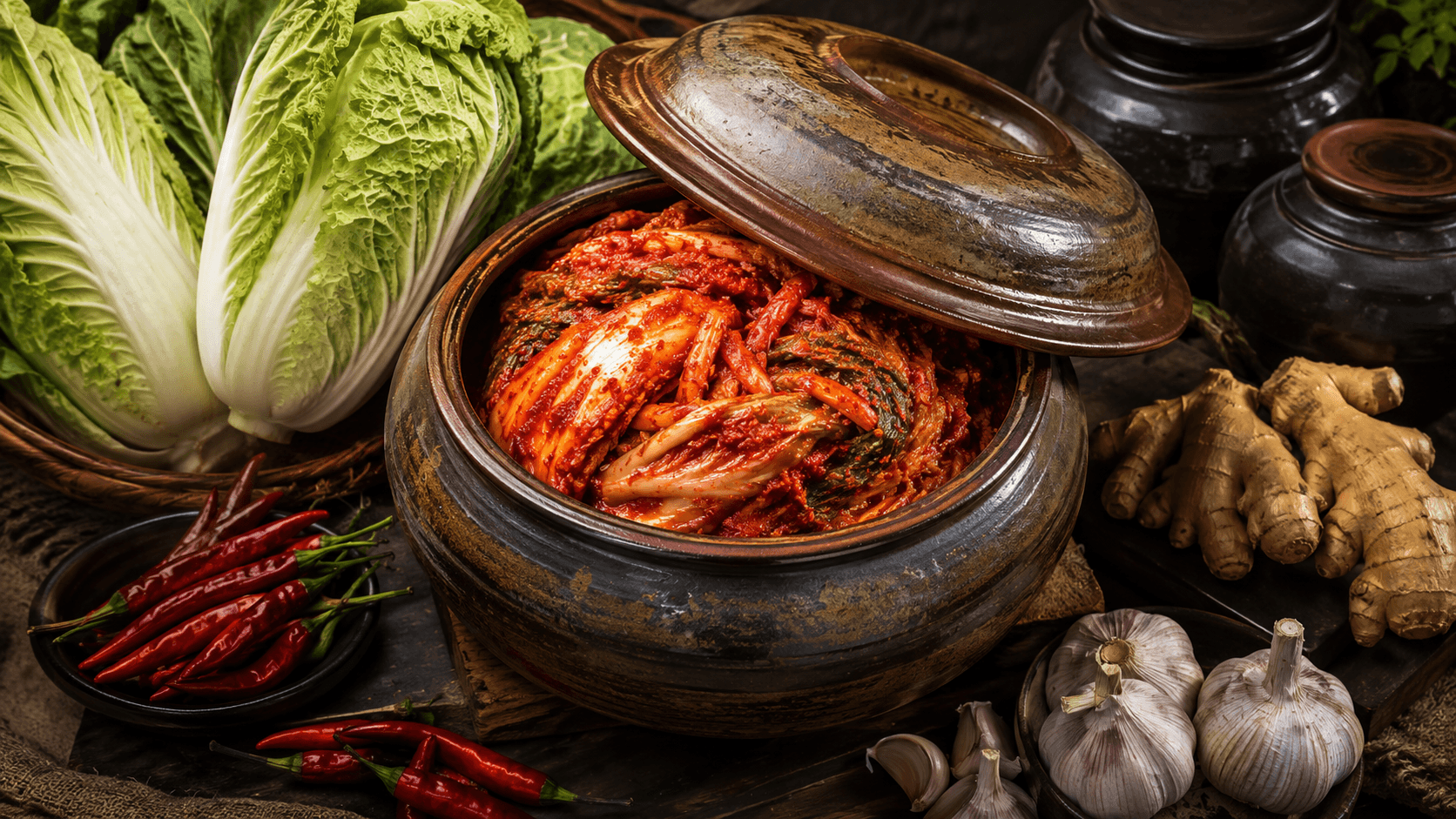
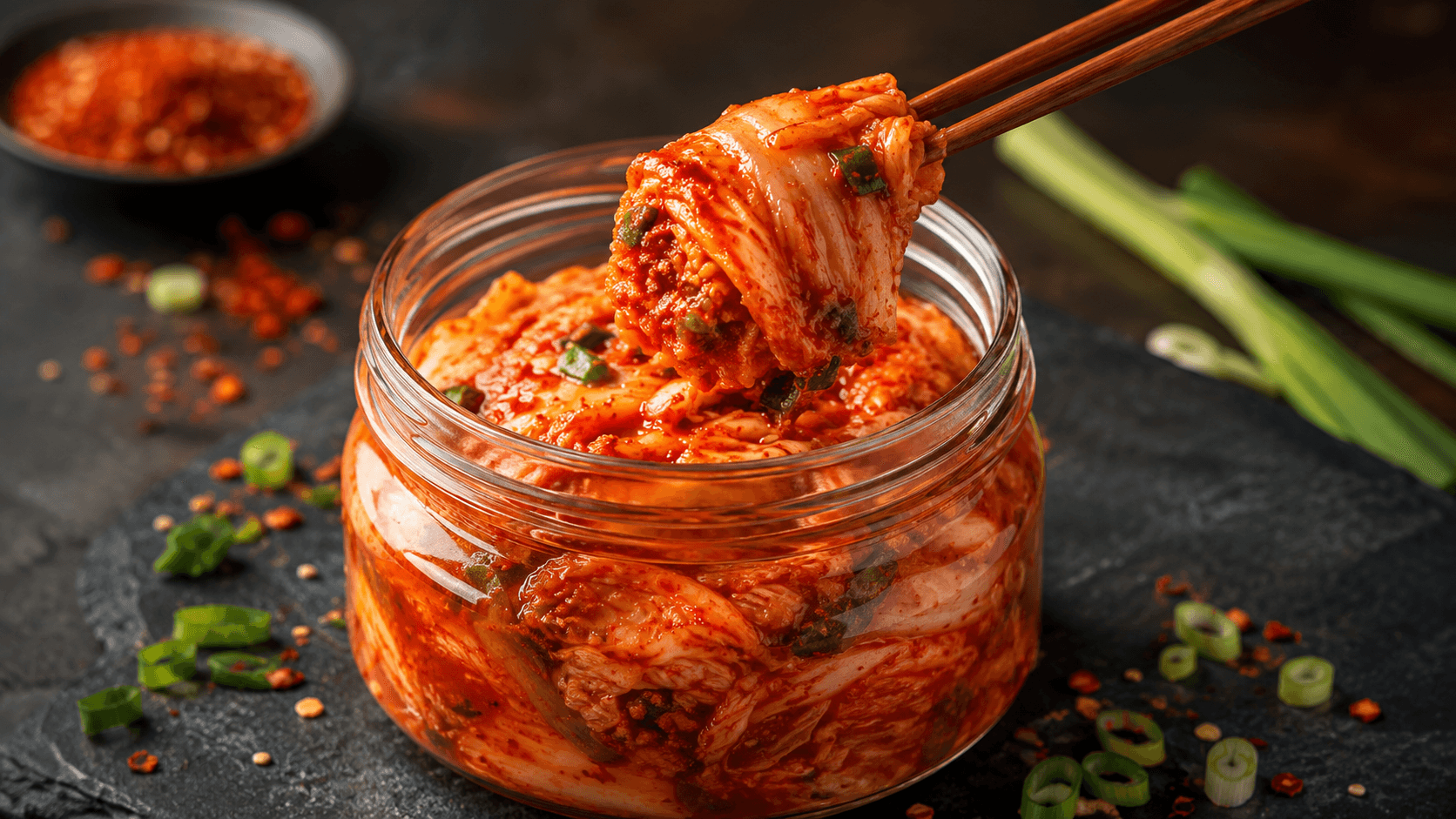
Kimchi earns its place because it is so much more than soured cabbage. A good jar carries:
Live cultures — many strains of Lactobacillus, including one named for the dish itself, Lactobacillus kimchii. Vitamins — A, C, K, and a spread of B vitamins, several of them boosted by the fermentation. Fiber and antioxidants — not only from the cabbage and radish but from the chili, garlic, and ginger worked through it, each a potent food in its own right. And all of it for almost no calories. It is, in a single cold forkful, a probiotic, a multivitamin, and a serving of vegetables at once. It is worth noting that kimchi is eaten at nearly every meal in a country that consistently posts some of the longest lifespans on earth — not proof of anything by itself, but a pattern worth respecting.
The wider family
Kimchi is the headline, but it has a large family, and the gut likes variety — different ferments carry different bacteria. Worth rotating through: sauerkraut (the simplest of all to make), lacto-fermented pickles (the kind made with salt and brine, not vinegar), kefir and live yogurt for those who do dairy, miso, natto, and tempeh from fermented soy, kombucha for a fermented drink, and real sourdough bread, which is simply flour fermented by wild cultures. No one of these is a magic bullet. The point is to keep something living on the plate, and to keep changing it.
Sauerkraut and the vitamin that won wars
There is a piece of history that makes the case better than any study. Scurvy — the slow, fatal collapse of the body from a lack of vitamin C — once killed more sailors than storms and battles combined. The fix turned out to be fermented cabbage. The acidic, oxygen-poor world inside a crock of sauerkraut preserves vitamin C beautifully, where most foods lose it. Captain James Cook famously carried barrels of the stuff on his long voyages of exploration and lost virtually no men to scurvy — at a time when other ships were burying half their crews.
That history carries a warning with it, and it is the single most important practical rule in this whole article: heat destroys vitamin C, and heat kills the probiotics. The moment you cook a live ferment — frying kimchi, simmering it in a stew, baking sauerkraut onto a dish — you have killed the cultures and driven off much of the vitamin content. It still tastes good, and cooked kimchi is a fine food, but understand what it has become: a flavoring, not a living medicine. To get what we have been talking about, it has to go in cold and raw.
The honest cautions
This is real food with real effects, so a few honest caveats. Fermented foods are naturally high in histamine, and people with a histamine intolerance can react to them with headaches, flushing, or digestive upset — if that is you, go very carefully or skip them. They are also high in salt, which is worth keeping in mind if you are managing kidney or heart conditions. And even for a healthy gut, the live cultures can cause a few days of bloating or gas as your microbiome adjusts to the new arrivals. The answer to that last one is simple: start with a tablespoon, not a bowl, and let your gut catch up.
Buying it without wasting your money
Most of the kimchi and sauerkraut sold in stores is dead, and the label rarely says so plainly. A short checklist keeps you from paying for sour, lifeless vegetables:
Buy only from the refrigerated section. If a jar of kimchi or kraut is sitting unrefrigerated on a shelf, it has been pasteurized — heated to make it shelf-stable — and the cultures are dead. Look for the words “raw,” “unpasteurized,” or “live cultures.” Read the ingredients — a real ferment is a short list: vegetables, salt, spices, maybe garlic and ginger. If you see vinegar, added sugar, MSG, or preservatives, put it back. One more note: traditional kimchi is usually made with a little salted shrimp or fish sauce, so committed vegetarians should look for a version that says so — they are easy to find.
Or just make it yourself
Here is the secret the price tag hides: this is some of the cheapest and easiest food you can make, and homemade is better than almost anything you can buy. Sauerkraut is the place to start, because it has only two ingredients.
The simplest sauerkraut
Shred a cabbage. Weigh it, and add roughly 2% of its weight in real salt (about a tablespoon of salt per medium cabbage). Massage the salt into the cabbage with your hands for a few minutes until it goes limp and releases its own liquid. Pack it tightly into a clean jar, pressing down until the brine rises and covers the cabbage completely — everything must stay under the liquid, away from the air. Cover loosely so gas can escape, and leave it at room temperature for one to four weeks. Taste it as it goes; when it is as sour as you like, move it to the fridge, where it will keep for months.
Kimchi is the same method with more personality: add daikon radish, scallion, garlic, ginger, and Korean chili flakes (gochugaru) to the salted cabbage before you pack it. That is the whole craft. People have been doing it in their kitchens for thousands of years, with no equipment and no expertise — only salt, vegetables, and a little patience.
Where to start
Keep it almost insultingly simple. Add a forkful of a live ferment to one meal a day — kimchi alongside eggs, sauerkraut on a plate of meat and greens, a small glass of kefir. Serve it cold and uncooked so the cultures survive. Start with a tablespoon while your gut adjusts, then build up. And rotate— kimchi some days, sauerkraut others, a fermented pickle now and then — so you are seeding your gut with a wide range of bacteria rather than the same one over and over. That is the entire protocol. There is nothing to buy that you couldn't make, and nothing to master.
Closing
There is a pattern worth noticing across this whole section of the site: the foods that turn out to matter most are rarely new, and almost never patented. They are the old, cheap, living things our great-grandparents ate without thinking about it — the honey, the organ meat, the cod liver oil, and the daily forkful of something fermented. The modern world sterilized its food for shelf life and convenience and quietly lost the living part in the trade. Getting it back costs almost nothing.
Eat something alive every day. The gut has always known what to do with it.
Sources & further reading
This article leans on the work of those who have studied fermentation and the gut far longer than I have. Read them directly, and weigh the honest cautions noted above against your own situation.
- Wastyk, Gardner, Sonnenburg et al. — 'Gut-microbiota-targeted diets modulate human immune status' (Cell, 2021): the fermented-foods study
- Sandor Katz — Wild Fermentation: the practical bible of home fermenting
- Dr. Eric Berg — on the microbiome and fermented foods
- The Weston A. Price Foundation — on traditional, nutrient-dense, living foods