Most people who feel quietly exhausted, mentally foggy, or unaccountably tired by 3 p.m. — even though they drink water all day and try to eat well — are not actually low on water. They are low on potassium. It is the most important electrolyte in the human body, the one we need by far the most of, and the one the modern diet provides the least of. Once you understand the size of the gap between what we need and what we actually get, almost every other "I just don't have energy" conversation starts to look different.
The number to remember is 4,700 milligrams a day — the adequate intake recommendation for adult potassium. Dr. Eric Berg, who has spent more time on this single mineral than almost anyone else in the alt-health space, puts the working range at 4,700 to 6,000 milligrams. The average American adult takes in about 1,900 milligrams. Over 75% of Americans fail to hit the requirement on any given day. The gap is not a rounding error. The gap is most of the way to where we should be.
Dr. Mark Sircus, working the same territory from a slightly different angle, ties it back to how the body is built: "Modern diets contain far less potassium, far more sodium" than the diets the human body was built around. We are running on the wrong fuel ratio. The body has been quietly compensating for decades, and the bill is now showing up as the high blood pressure, fatigue, sugar cravings, muscle cramps, and palpitations that we tend to blame on stress, age, or a hundred unrelated things.
Why fruits and vegetables aren't enough
The standard public-health line is "eat a banana." Berg is direct about how badly that advice misses the mark: a medium banana contains about 400 mg of potassium. To hit the 4,700 mg daily target from bananas alone, you would need to eat eleven to twelve bananas every single day. And not coincidentally, bananas are loaded with sugar — and high sugar intake is one of the things that actively depletes potassium from the body. Bananas are not just an inefficient source. They are a counterproductive one.
Even if you switch to the truly potassium-rich foods Berg ranks higher than bananas, the math is brutal. Per cup:
- Beet tops — 1,300 mg per cup (the highest plant source by a wide margin)
- Avocado — 975 mg per medium fruit
- Lima beans — 975 mg per cup
- Spinach — 839 mg per cup
- Salmon — 839 mg per 6 oz
- Winter squash — 800 mg per cup
- Brussels sprouts — 504 mg per cup
To hit 4,700 mg from whole food — even the better options — Berg notes you would need to eat seven to ten cups of vegetables every day, every day, with no off days. Most people who think of themselves as "eating healthy" are not eating remotely that much produce. Throw in soil depletion (the same problem that gutted the magnesium content of modern vegetables has gutted their potassium too), and the gap widens further. The honest conclusion is one most nutritionists won't say out loud: diet alone is not going to get most people to potassium sufficiency. Supplementation, for most of us, is not optional.
The sodium-potassium inversion
The picture gets worse when you look at potassium relative to sodium. The ancestral human diet — the one our cellular machinery was made to run on — was roughly four parts potassium to one part sodium. That is also the ratio Berg recommends today. The modern American diet has inverted this. We consume about twice as much sodium as potassium — a 1:2 ratio in the wrong direction, off by a factor of eight from where it should be.
That inversion is the engine behind a long list of "common" modern health problems. Sircus is blunt about the cardiovascular consequence: "Potassium depletion in normal humans increases blood pressure." A 12-week clinical trial he cites showed that participants taking potassium bicarbonate experienced a "significant decrease in stiffness of large elastic arteries" and improved heart function. The mainstream protocol for hypertension is to reduce sodium. The more accurate protocol — and the one Sircus and Berg both endorse — is to add potassium. Restoring the ratio matters more than restricting one side of it.
What potassium actually does
Potassium is the primary intracellular cation — the main positively charged ion inside every cell in the body. Sodium is its counterpart outside the cell. The pump that moves potassium in and sodium out — the famous sodium-potassium pump — is one of the most energy-intensive processes in biology. Berg puts a number on it: this single pump accounts for 20 to 40 percent of the brain's total energy consumption. Almost half of your brain's running cost goes to maintaining the potassium gradient.
Sircus calls this "human voltage." Every cell membrane is electrically polarized, and that polarization is what the body uses to transmit nerve signals, contract muscles, regulate heart rhythm, and move nutrients in and waste out. When the potassium side of the equation is starved, the voltage drops. When the voltage drops, every downstream process gets sluggish.
A short list of what adequate potassium actually powers:
- Heart rhythm. The heart is a muscle that depends on a clean potassium gradient for every beat. Palpitations, skipped beats, and irregular rhythms are classically — and frequently — early potassium signals.
- Blood pressure. Potassium is a vasodilator. Low potassium constricts vessels; restoring it relaxes them. The relationship is direct and well-documented.
- Muscle contraction and recovery. Sircus: "all body cells, especially muscle tissue, require a high content of potassium." Cramps, twitches, and the kind of fatigue that doesn't lift with rest are common deficiency tells.
- Nerve signaling. Every action potential — the electrical spike that lets a nerve fire — is a potassium-and- sodium event. Low potassium dulls everything downstream of a firing nerve.
- Blood sugar regulation. Insulin signalling depends on potassium availability. Low-potassium people tend to be insulin-resistant, even if they're not eating particularly badly.
- Brain function. Given that nearly half the brain's energy budget goes to the sodium-potassium pump, it should not be surprising that brain fog, slow recall, and that "I can't quite focus" feeling track tightly with low potassium.
Hydration — what water alone can't do
This is the most under-told part of the potassium story. Most people believe that hydration is a function of how much water they drink. It is not. Hydration is a function of how much water makes it inside your cells. Drinking plain water without sufficient electrolytes is roughly equivalent to trying to fill a leaky bucket without patching the leak first.
The mechanism is straightforward. Water moves into a cell along the osmotic gradient set up by minerals. Sodium handles the extracellular fluid; potassium handles the intracellular fluid. If potassium is low, the gradient that draws water into your cells is too weak. The water you drink stays in the bloodstream and the spaces between cells, and your kidneys efficiently eliminate it. You end up urinating clear, frequently, all day — and still feeling tired, dry-mouthed, and headachy by evening.
The person drinking a gallon of plain water a day and still feeling exhausted is not under-watered. They are under-electrolyte. The fix is not more water. The fix is potassium.
In extreme cases — endurance athletes, very heavy water drinkers — flushing water through the system without replacing electrolytes can actually cause hyponatremia, a dangerous drop in blood sodium. But long before anyone gets near that line, the ordinary version of the same problem shows up as fatigue, brain fog, mild headache, and the cellular dryness that paradoxically feels like dehydration even though the bladder is working overtime. Adding potassium to your water is the single most efficient hydration upgrade most people can make. Sodium (in the form of unrefined salt) and magnesium round out the electrolyte trio, but potassium is the pillar.
Why clear urine isn't proof of hydration
One of the most stubborn misconceptions in modern wellness is that clear, frequent urine means you're well hydrated. It usually means the opposite. If you are drinking water all day, getting up to pee every thirty minutes, and your urine is consistently the color of tap water — that is your body telling you the water isn't being held anywhere. It is passing through the bloodstream and out the kidneys without ever making it into the cells that actually needed it. The bladder fills, the kidneys flush, you stay thirsty.
Properly hydrated urine is a faint pale yellow, not clear. That subtle color is bilirubin and other waste compounds being efficiently eliminated in concentrated enough form to actually do the kidneys' job — which is what happens when the kidneys aren't drowning in plain unmineralized water. And when the electrolyte balance is right and water is actually entering your cells, you also urinate less often, not more. The pattern flips: a smaller number of normal-volume, faintly-colored bathroom trips instead of a constant trickle of crystal-clear water every half hour.
If you take nothing else from this article, take this: the bathroom trip every thirty minutes is not a badge of good hydration. It is a sign your kidneys are doing exactly what they're supposed to do with water your body cannot use. Adding potassium to that same glass of water is what closes the loop — it gives the water somewhere to go.
The deficiency picture
Once you understand what potassium does, the symptom list reads like the modern human condition. Berg lays it out:
- Fatigue — especially the persistent kind that doesn't lift with sleep
- High blood pressure
- Muscle cramps and twitches — often blamed on magnesium alone; potassium is the other half
- Brain fog and confusion
- Blood sugar imbalances and sugar cravings
- Kidney stones — low urinary potassium is a well-documented driver
- Irregular heartbeat / palpitations
- Digestive sluggishness — the gut is a muscle too
Three or more of those in the same person, simultaneously, and the working hypothesis should be potassium until proven otherwise.
The 99 mg supplement cap (and how to get around it)
Here is a small fact that takes some getting used to: over-the-counter potassium pills in the United States are capped at 99 mg per tablet — about two percent of the daily requirement. The cap is an FDA-era safety measure aimed at preventing potassium overdose from rapid-release pills, but the practical effect is that pill supplementation is almost useless. Closing a 2,800 mg/day gap from 99 mg pills would require thirty pills a day.
Powder is the answer. Potassium powders (gluconate, citrate, chloride) are sold per gram, not per pill, and let you actually dose the way the body needs. One teaspoon of NOW Foods Potassium Gluconate powder delivers about 540 mg of elemental potassium — more than five tablets' worth in a single spoonful. This is the cheap and effective way most people who are serious about potassium close the gap.
My protocol
Simple and daily. The whole thing fits in a glass of water.
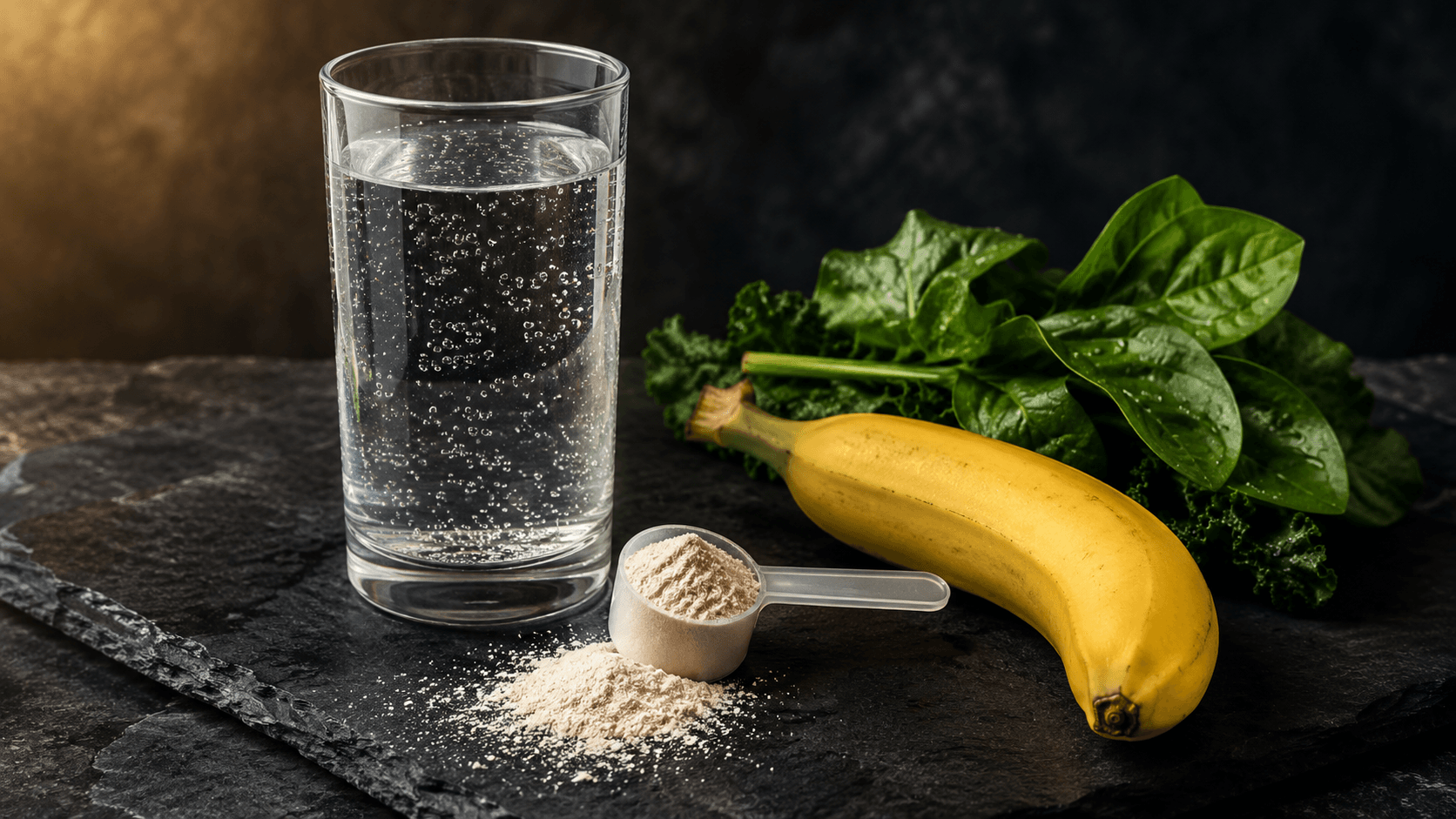
- One teaspoon of NOW Foods Potassium Gluconate powder stirred into a glass of water. That's about 540 mg of elemental potassium per teaspoon — clean, mild, no funky aftertaste. I drink this either in the morning or with a meal.
- On harder days — workouts, hot weather, or just when I want better hydration — I mix in Dr. Berg's Electrolyte Powder. His blend delivers about 1,000 mg of potassium per serving along with magnesium and unrefined salt for the sodium side of the ratio. Stirred into the same glass of water, this is the closest thing I've found to actually feeling hydration land.
Between the two, on a hydration-focused day, I'll cross 1,500 mg of potassium from supplementation alone — plus whatever I get from food. That puts me in shouting distance of the 4,700 mg target without having to eat ten cups of vegetables a day. On a plain day, the single teaspoon of gluconate is the floor.
How to start — slow, with real cautions
Potassium is one of the few supplements where the safety side is genuinely worth taking seriously — not because the mineral is dangerous (it isn't, in itself), but because some people cannot clear it efficiently, and in those people, blood potassium can rise to a level that affects the heart. The honest cautions:
- Kidney function. The kidneys are what excrete excess potassium. If your kidney function is impaired — chronic kidney disease, late-stage diabetes — talk to a doctor before you supplement.
- Certain medications. Potassium-sparing diuretics (spironolactone, eplerenone), ACE inhibitors (lisinopril, enalapril, etc.), and ARBs (losartan, valsartan, etc.) all reduce potassium excretion. Combining them with high-dose potassium supplementation without supervision is the scenario clinicians worry about.
- Start low. Half a teaspoon of gluconate (~270 mg) in water for the first week is plenty. Climb to a full teaspoon in week two. Add the electrolyte powder once you're comfortable.
- Spread it out. A big dose all at once is harder on the gut than the same dose split across the day. Half a teaspoon in the morning and half with dinner is gentler than a full teaspoon in one go.
- Mix it well. Potassium gluconate dissolves cleanly in water — stir or shake until you can't see grains. A half-dissolved spoonful sitting on the bottom of the glass is harsher on the stomach than a fully dissolved one.
What I actually take
Closing
Of all the things I take every day, potassium is the one whose absence I notice first. Skip it for two or three days and the energy drops — quietly at first, then unmistakably. Add it back and the recovery is fast: a single big glass with a full electrolyte mix, and the difference is noticeable within an hour. That's not a placebo effect. That's the sodium-potassium pump getting back to work.
If you're already taking magnesium and iodine, potassium is the natural next addition. The three of them together — plus unrefined salt for the sodium side of the ratio — cover the minerals that the modern food system has the worst track record of providing. Most of the "I just don't feel right" complaints I hear from friends end up being some combination of those four. Closing those four gaps is one of the cheapest, most consequential changes a person can make.
A teaspoon of powder in a glass of water once a day is not a dramatic intervention. But the cumulative effect of doing it every day for a year is the kind of thing you don't realize you needed until you stop and notice you feel different.
Sources & further reading