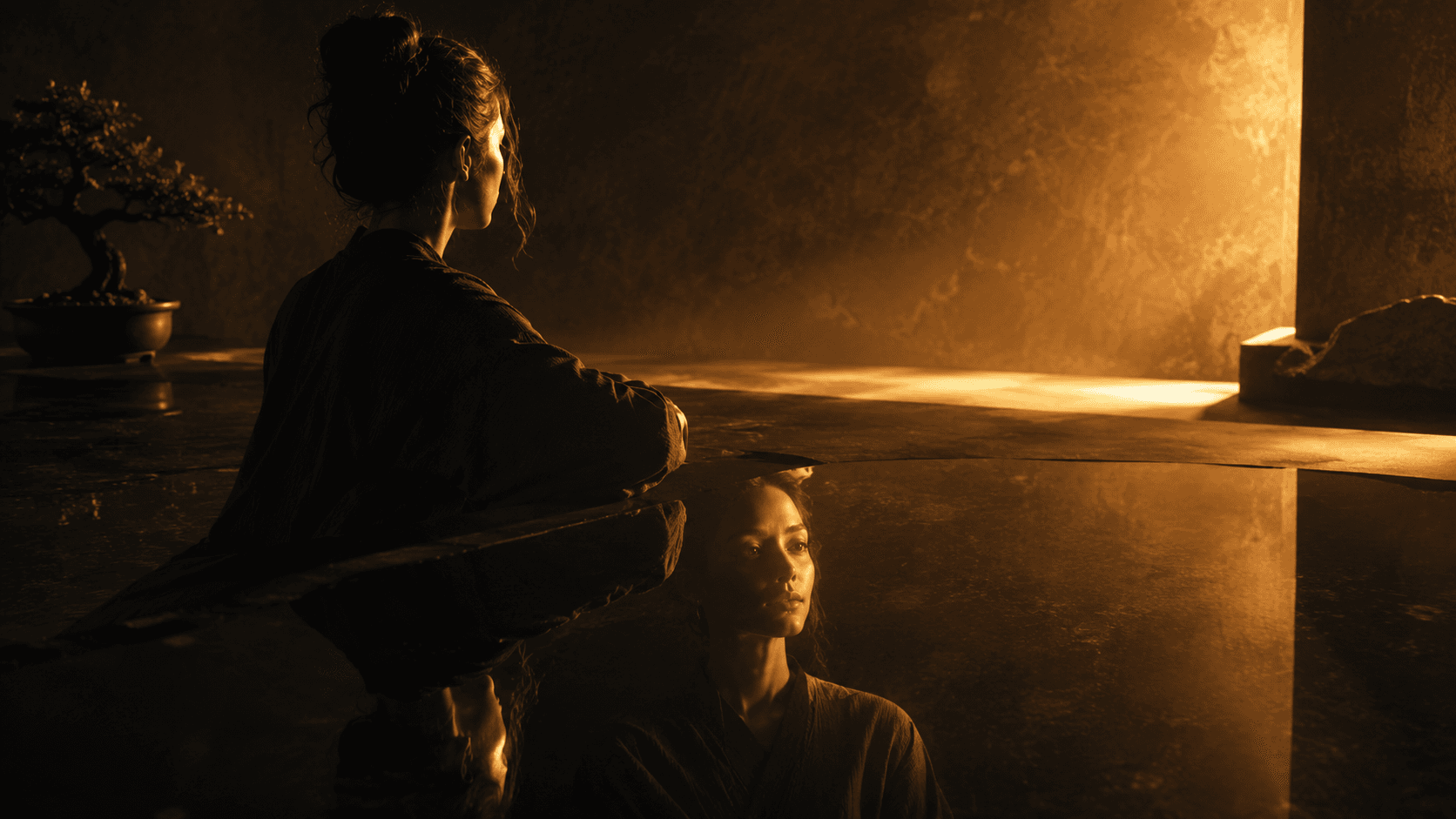
There's an old account of a man named Gideon, hiding in a winepress, threshing wheat in secret because he was afraid of the raiders who kept stealing his people's harvest. And the first thing the angel says to this frightened man in hiding is: “The Lord is with thee, thou mighty man of valour.” Mighty man of valor — said to a man cowering in a winepress. The identity was spoken over him before a single thing in his behavior justified it. And he became it. That's the whole principle of this article in one image: a person rises or falls to the picture of himself he's carrying, and the picture comes first. Maxwell Maltz spent a career proving the same thing from the other end — that you never, for long, outperform the self-image you hold. Change it, and the behavior changes downstream. Leave it untouched, and no amount of effort produces a different result.
This pairs closely with Changing your paradigm. The paradigm is the whole program running you; the self-image is the single most load-bearing belief inside it — the picture of who you are, which quietly sets the ceiling on what you'll attempt, tolerate, and allow yourself to become. If you only change one thing in the deep layer, this is the one to change.
The picture you hold of yourself
Maxwell Maltz was a plastic surgeon before he was a self-improvement writer, and that's where the whole idea came from. He kept noticing something strange: he'd give a patient a new face — fix the scar, straighten the nose — and a good number of them would feel exactly as ugly, as unworthy, as invisible as they had before the surgery. The outer change was real and the inner change never came. Meanwhile other patients transformed in days off a minor correction. The variable wasn't the face. It was the picture they carried of themselves, and the scalpel couldn't reach that. So he went looking for what could, and wrote Psycho-Cybernetics — one of the quietly most influential self-improvement books of the last century.
His conclusion is simple and, once you see it, hard to un-see. You have a mental picture of the kind of person you are — your capabilities, your worth, your station, what's “like you” and what isn't — and you behave like that person, automatically, all day, without deciding to. It's not arrogance or low confidence on the surface. It's deeper than mood. It's the settled sense of who you are that every action quietly checks itself against before it happens.
The self-image is the key to human personality and human behavior. Change the self-image and you change the personality and the behavior.
It's a governor, not a cheerleader
Here's the part people miss. The self-image doesn't just hold you up to a level — it holds you down to one too. It works like a thermostat, not a cheerleader. Set the thermostat at sixty-eight and it fights just as hard to cool a room that got too warm as to heat one that got too cold. The self-image does the same with your life: it pulls you back to the familiar level whether you've dropped below it or climbed above it.
That's why the lottery winner is usually broke again within a few years — the money rose above his financial self-image and the self-image corrected it back down. It's why the crash dieter regains the weight: the body changed but the picture of “a person who's heavy” didn't, so the behavior quietly rebuilt the body to match the picture. It's why people who get a promotion they don't feel like “the kind of person who” deserves will subtly sabotage it. The outer result moved. The inner picture didn't. And the picture always wins, because the picture is what's generating the thousand small daily behaviors that produce the result in the first place.
You don't rise to the level of your goals. You fall to the level of your self-image — and then your behavior quietly rebuilds your life to match the picture, in either direction.
How the self-image got set
The same way every other paradigm got set: repetition, early, before you could evaluate or reject it. A child is told he's clumsy, or shy, or bad at math, or “the difficult one,” or not as sharp as a sibling — not maliciously, usually, just casually, in passing, over and over — and the picture forms. Then something crueler happens: the picture starts gathering its own evidence. The kid who's decided he's “bad at math” stops trying at math, does worse at math, and points to the worse results as proof he was right. The self-image is self-confirming. It arranges your behavior to produce exactly the evidence that keeps it in place.
By adulthood you're walking around with a detailed, mostly invisible picture of who you are and what's realistic for “someone like me” — assembled from people you didn't choose, through a process you had no say in, and then reinforced by years of behavior the picture itself produced. Most people never question it. They experience it as plain realism. I'm just not a confident person. I'm not good with money. I'm not a leader. That's just who I am. None of those are facts. They're settings — and settings can be reset.
Why willpower loses to it every time
This is the part that explains a thousand failed self-improvement attempts. You can decide, consciously, with real determination, to act differently — and for a while you will. But willpower is the conscious mind, and the self-image is the deep layer, and the moment your attention lapses, the behavior snaps back to the picture. It has to. The whole system is built to keep you consistent with who you believe you are.
Maltz watched this in his patients constantly. A man who believed he was unlikable could be taught every social technique in the world and would still, the moment he stopped consciously performing them, behave like an unlikable man — because that's who the picture said he was, and the techniques never reached the picture. The lasting change never comes from forcing new behavior on top of an old self-image. It comes from changing the image, after which the new behavior is no longer forced — it's just what a person like that naturally does. You stop having to act confident once you've become someone who simply is.
How to reset the self-image
The self-image was installed by repetition and evidence, and it's changed the same way — by deliberately feeding the deep layer a new picture, often enough and vividly enough that it takes. Two tools do most of the work.
The first is the imagination. Maltz's central discovery — backed up by everything that's come since — is that the deep layer doesn't cleanly distinguish between a vividly imagined experience and a real one. Mentally rehearse yourself handling a situation as the person you intend to be — calm in the meeting, easy in the conversation, decisive with the money — and the deep layer files it as evidence, the same as if it had happened. Do it daily and you're feeding the new self-image a steady diet of “experiences” of being that person, until the picture starts to shift. This isn't fantasy or wishful thinking; it's rehearsal, the same way an athlete walks through the performance in his head before he ever does it with his body.
The second is the word. The picture responds to what you repeatedly tell yourself about who you are — which is why the affirmation work from Changing your paradigm and the speech discipline from You become what you say both feed straight into the self-image. Every time you say I'm so disorganized or I'm terrible with people, you re-paint the old picture. Every time you affirm the new identity instead, you paint the new one. The deep layer is taking dictation either way.
And this is squarely the creator principle, not new-age fantasy: you were made in the image of the One who creates, and you've been given real power to shape who you become. Reworking your own self-image is one of the most direct ways you exercise that — not by declaring yourself God or commanding reality, but by stewarding the picture-making faculty you were built with, and filling it with the person you're meant to be.
The two most important words you speak
Whatever follows “I am” goes almost straight into the self-image, because you're not describing your behavior — you're naming your identity, and the deep layer treats an identity claim as a setting to enforce. This is why identity-level affirmations outperform goal-level ones. I will try to be more confident is a wish about the future. I am a confident, capable man is a present-tense instruction about who you are, and the system goes to work making the behavior match.
It's worth noticing how seriously Scripture takes this. The identity gets renamed before the life catches up — Abram to Abraham, “father of many,” while he was still childless; Simon to Peter, “the rock,” while he was still the unstable one. God addresses people by who they're becoming, not by who they've been — exactly what He did with Gideon in the winepress. The new identity is spoken first; the life grows up into it. Run your own “I am” statements the same way: name the person you're becoming, in the present tense, and let the behavior grow up into the name.
The protocol
- Name the current picture. Get specific about the self-image you're actually running. “I'm not a disciplined person.” “I'm not someone people take seriously.” “I'm bad with money.” You can't reset a setting you haven't found.
- Write the new picture as present-tense “I am” statements. Three to five, short, identity-level — I am a disciplined, capable man. I am calm and clear under pressure. I handle money wisely and it grows. Not goals about the future; descriptions of who you are now.
- Rehearse it in the imagination daily. A few minutes, in the soft windows of the day (see The first hour), vividly walking through yourself being that person in real situations. The deep layer logs it as experience.
- Stop voicing the old picture. Catch and kill the casual that's just how I am lines. Every one is a brushstroke on the picture you're trying to repaint.
- Act, occasionally, from the new picture — and let the evidence accumulate. You don't have to overhaul your behavior by force. But when a moment comes to act like the new person, take it, and let the deep layer file the result as proof. Small confirming actions feed the new image the way small failures used to feed the old one.
- Give it ninety days. The picture doesn't repaint in a week. It repaints the way it was painted in the first place — gradually, through repetition, below the surface, until one day the new behavior just feels like you.
How I do this
For me the self-image work isn't a separate practice — it's the layer underneath the affirmation work I already do. The phrases I run on my DAW tracks are nearly all identity statements: I am a highly effective professional. I am highly skilled in everything that I do. I communicate with clarity and confidence. They're “I am,” present tense, on purpose — aimed at the picture, not at a future outcome. I rehearse those same identities in my head in the soft windows, especially before sleep and on the first stretch of a walk, seeing myself operating as that man. And I watch hard for the old that's not me talk, because a single careless line of it undoes a lot of quiet repainting. The Bible reading and prayer sit under all of it — the deepest identity I'm building on is the one Scripture already assigns: a new creature, not the old one. Everything else is built on that floor.
Closing
You will not, for any length of time, outperform the picture you hold of yourself. That's the humbling part and the hopeful part at once — humbling because it means willpower and technique won't carry you past it, hopeful because the picture isn't fixed. It was painted, mostly by other people, before you had a say. You have a say now.
Find the picture you're running. Write the truer one in present-tense “I am” language. Rehearse it in the imagination, feed it with your speech, act from it when you can, and give it the ninety days it takes to set. The behavior you've been trying to force will stop needing to be forced — because you'll have become the kind of person it belongs to. The identity comes first, and the life grows up into it. It always has — ask the mighty man of valor who started out hiding in a winepress.
Sources & further reading
- Maxwell Maltz — Psycho-Cybernetics (1960) — the foundational text on the self-image
- Judges 6:11-12 (KJV) — 'the Lord is with thee, thou mighty man of valour' (the identity spoken first)
- Genesis 17:5 (KJV) — Abram renamed Abraham, 'a father of many nations', while still childless
- 2 Corinthians 5:17 (KJV) — 'if any man be in Christ, he is a new creature'
- Companion article — Changing your paradigm
- Companion article — You become what you say
- Companion article — The first hour