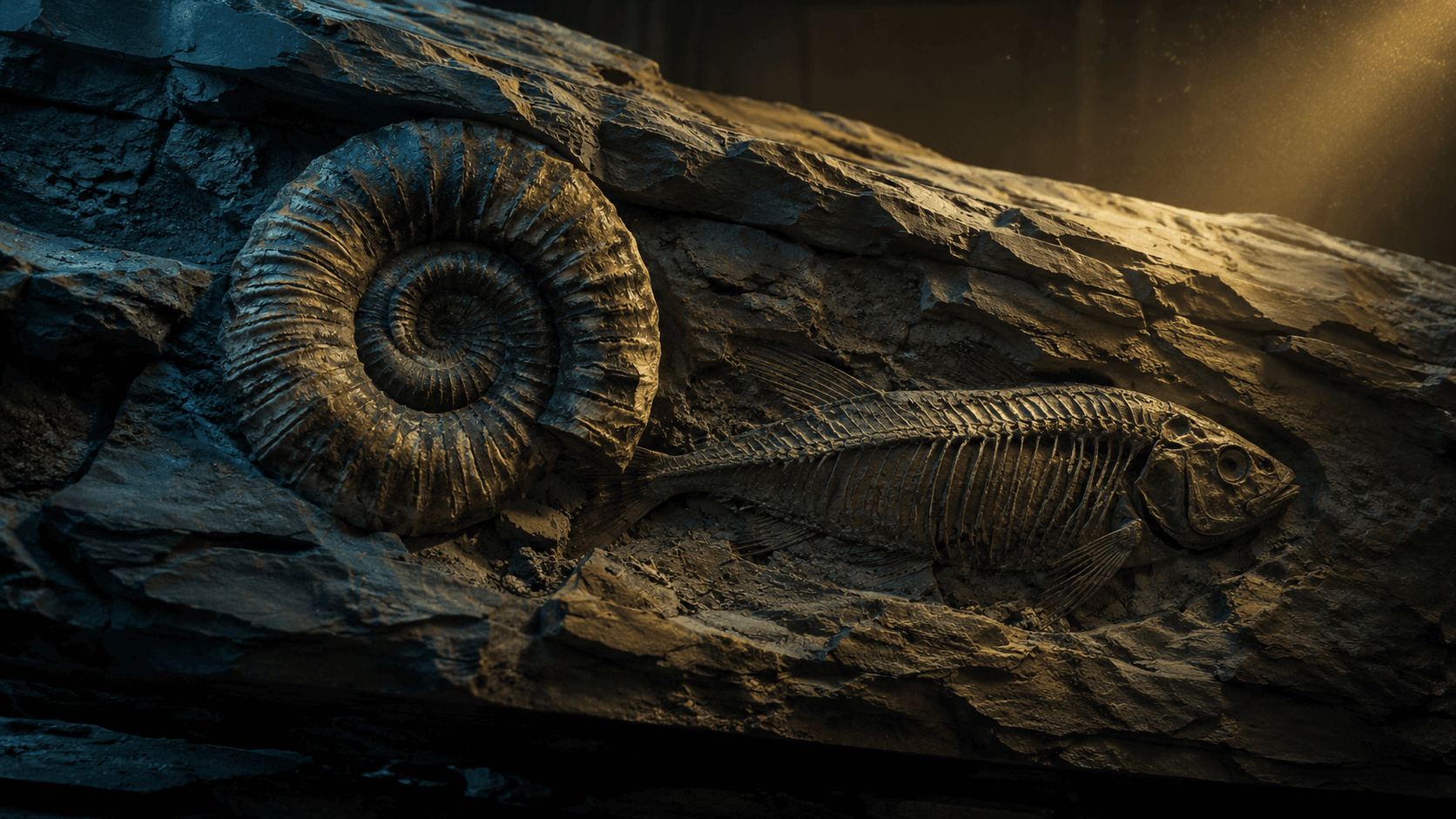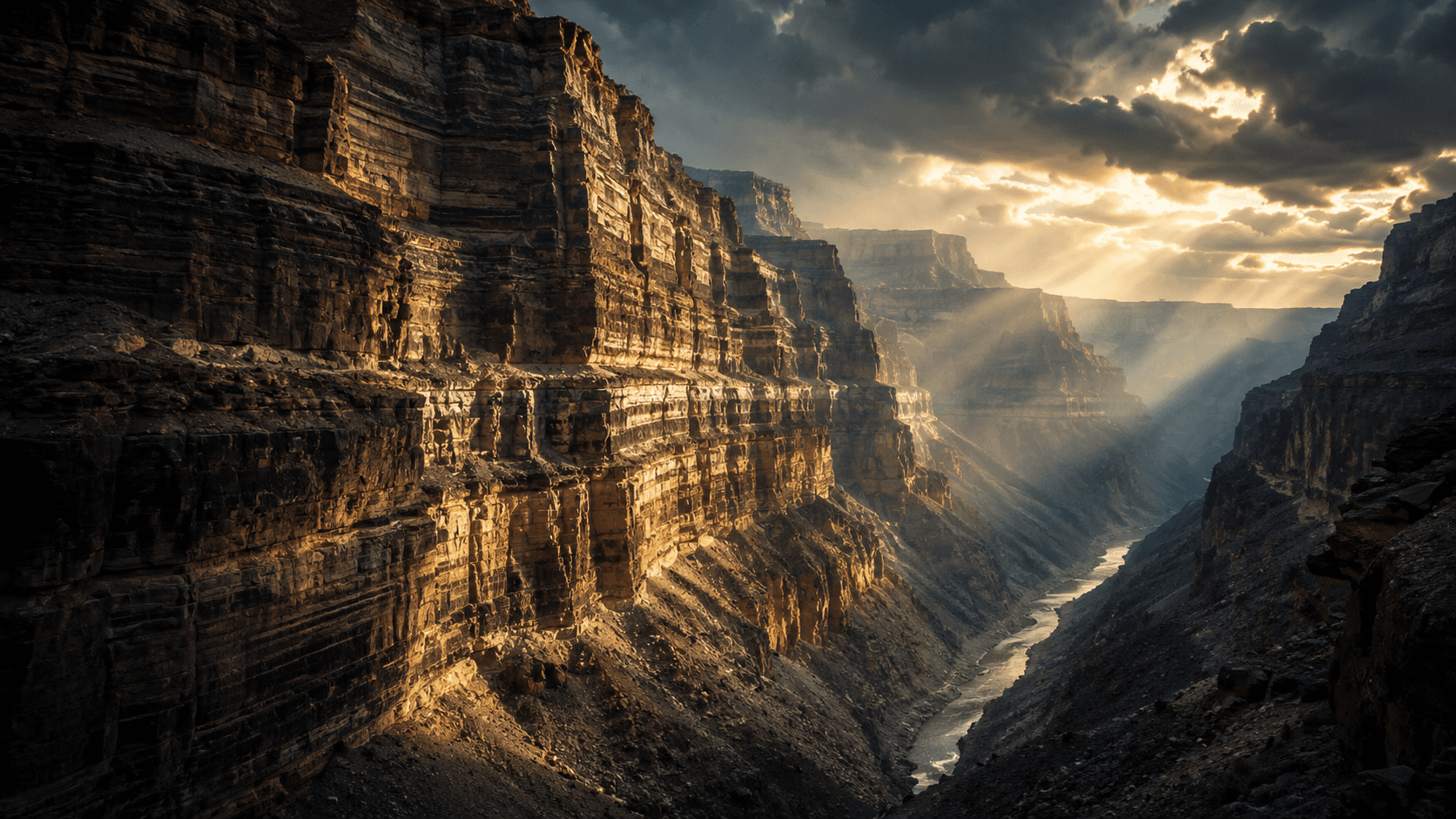
The fossil record is presented as the most decisive evidence for evolution. On closer reading, it is one of the strongest pieces of evidence against it. The rocks do not show a slow, branching ascent from simple to complex; they show creatures appearing abruptly and fully formed, persisting unchanged, and dying in vast catastrophic graveyards. That is not the signature of gradual transformation. It is the signature of created kinds, a global flood, and a world running down — the very history the Bible records.
A word first about the spirit of this. It is no insult to the patient, careful work of paleontology to ask whether the grand story built on top of it actually follows from the bones. The fossils are real and fascinating; it is the interpretation — the assumption that they document one kind of creature turning into another over deep time — that this study tests. Scripture remains its own final authority — “to the law and to the testimony” (Isaiah 8:20). This piece is the companion to Genesis vs. Deep Time, which weighs the long ages the fossil story depends on.
The claim, reversed
If life arose by gradual descent with modification, the rocks are where we should see it happen. Darwin knew this and staked his theory on it, conceding that the “innumerable transitional links” his idea required were not to be found, and pinning his hope on future discovery and the imperfection of the record. More than a century and a half of intense collecting has followed. The museums are full. And the pattern that has emerged is not the one gradualism predicted — it is, point for point, closer to what a Bible-believing reader would expect. Let us take the predictions one at a time and lay the data beside them.
What gradualism predicts
Slow evolution makes clear, testable predictions about the buried world. The lowest, oldest layers should hold only the simplest life, with complexity creeping upward layer by layer. Between every major group there should be long chains of intermediates — innumerable transitional forms grading one body plan into the next. Lineages under environmental pressure should show steady, directional change over their millions of years. And new, fundamentally different body plans should arrive gradually, by accumulation, never all at once. Hold those four predictions in mind. The record contradicts each of them.
The Cambrian explosion
At the base of the fossil-bearing rocks, in the layers called the Cambrian, nearly every major animal body plan appears abruptly and at roughly the same time— arthropods, molluscs, echinoderms, even chordates — complex, complete, and without ancestors in the rocks beneath. Trilobites arrive with compound eyes already among the most sophisticated optical systems in nature. The event is so contrary to gradual expectation that even committed evolutionists reach for explosive language: the paleontologist Jeffrey Levinton called it biology's own “Big Bang.” A theory that predicts a slow build from the bottom up instead finds the most important chapter — the sudden arrival of the basic animal designs — written at the very start, fully formed. That is creation's pattern, not evolution's.
The continuing absence of transitional forms
The gaps the Cambrian opens are never really closed higher up. The handful of much-paraded “transitions” are disputed even among specialists, while the great divisions between groups remain abrupt. Stephen Jay Gould, no friend of creationism, admitted that the “extreme rarity of transitional forms in the fossil record persists as the trade secret of paleontology,” and that the evolutionary trees in the textbooks have “data only at the tips and nodes of their branches; the rest is inference, however reasonable, not the evidence of fossils.” His proposed remedy — “punctuated equilibrium,” in which change happens so fast, in such small populations, that it leaves no fossils — is candid about the problem but solves it by explaining why the predicted evidence is missing. A prediction rescued by the permanent absence of its own evidence is in serious trouble.
Living fossils
Run the prediction the other way. If lineages change steadily under selection over hundreds of millions of years, very ancient creatures should look nothing like anything alive. Yet the coelacanth, declared extinct for some seventy million years and known only from fossils, was hauled up alive off South Africa in 1938 — essentially unchanged. Horseshoe crabs, certain sharks, the nautilus, the ginkgo, dragonflies, crocodiles: a long roster of organisms sits in ancient rock looking just like its living counterpart. The standard reply is “stabilizing selection” — that they stopped changing because they were well-suited. But that turns the theory unfalsifiable: rapid change confirms evolution, and no change confirms evolution too. A mechanism that predicts both an outcome and its opposite has stopped predicting anything.
Polystrate trees and rapid burial
How the fossils were buried matters as much as which fossils they are. A creature lying on a riverbed or seafloor does not normally fossilize — it rots, is scavenged, and scatters. Fossilization requires rapid burial, sealing the organism from decay and oxygen. The record is full of it: fish fossilized in the very act of swallowing other fish, creatures preserved giving birth, vast bone beds of animals heaped together by moving water. The clearest sign is the polystrate fossil — a tree trunk standing upright through many layers of rock at once, layers that are each supposed to represent long ages. The tree cannot have stood, un-decayed, for the thousands or millions of years those layers are said to record; the layers must have piled around it quickly, while it was still whole. Multiply that across the globe and the picture is not slow, calm deposition but a watery catastrophe burying living things at speed.
Soft tissue in dinosaur bone
In 2005 the paleontologist Mary Schweitzer reported something that should not exist: inside a Tyrannosaurus rex bone said to be sixty-eight million years old, she found soft, stretchy tissue — flexible blood-vessel structures, and what tested as fragments of the protein collagen. Proteins and soft tissue are fragile; under any measured decay rate they should be utterly gone in a small fraction of that time — tens of thousands of years at the outside, not tens of millions. The find was so unexpected it was met first with disbelief, then with a search for some preservation mechanism that could hold tissue intact a thousand times longer than anything observed. The simpler reading, and the one the decay rates actually support, is that the bone is not nearly as old as assumed — that it was buried, like so much else, in the recent catastrophic past.
The dinosaur-to-bird claim
The showcase transition of our day is dinosaurs into birds. It has serious problems its promoters tend to skip. The bird lung is a unique flow-through system, structurally unlike the bellows lung of the reptiles birds supposedly descend from, and the physiologist John Ruben argued the step-by-step transition would leave an animal unable to breathe. The ornithologist Alan Feduccia pressed a developmental mismatch: bird wing digits form in the embryo from different finger positions than the dinosaur hand they are said to have evolved from. And when sensational “feathered dinosaur” specimens have been announced, some have collapsed under scrutiny — the “Archaeoraptor” that National Geographic trumpeted in 1999 proved to be a glued- together composite, prompting the paleontologist Storrs Olson to denounce the whole episode publicly. None of this proves a negative for all time, but it shows the flagship case is contested at the level of anatomy, embryology, and even authenticity.
Variety within the kinds
Where the record does show change, it is the kind of change no one disputes — variation within a created type, not the crossing from one type to another. Genesis says God made living things to reproduce “after his kind” (Genesis 1:24), and built into each kind a rich capacity to vary. From the wolf has come every breed of dog, from the chihuahua to the mastiff — astonishing diversity, and still a dog, still interfertile, never on its way to becoming something else. The finches, the cichlids, the famous peppered moths: all real, all observed, all within the kind. This is exactly what the Bible predicts and exactly what breeders and naturalists see. What no one has ever observed — in the field, the lab, or the rocks — is one kind giving rise to a genuinely new one. The barrier the text describes is the barrier the evidence keeps.
Bigger before: devolution, not evolution
Look at the recent past and the arrow points the wrong way for progress. The mammals of the Ice Age were, again and again, larger and more robust than their living kin: mammoths and mastodons, the giant ground sloth, the cave bear, the Irish elk with its enormous antlers, beavers the size of bears. The trend from then to now is not upward into novelty but downward into diminishment — smaller, fewer, more specialized, going extinct. That is what a good creation looks like after a catastrophe and millennia of a degrading environment and accumulating genetic load: not climbing, but running down. Scripture calls it a creation that “waxes old as doth a garment” and groans, awaiting deliverance (Psalm 102:26; Romans 8:22).
The hominid story and Christ's testimony
The human-origins parade deserves special caution, because it has the longest record of overreach. Piltdown Man, hailed for forty years as a crucial ape-man, was a forgery — a human skull joined to an orangutan jaw. Nebraska Man, reconstructed in full with a whole primitive family, was built from a single tooth that turned out to belong to a pig. Sober assessment sorts the actual fossils into two groups: the australopithecines, which are apes with ape-sized brains, and the specimens classed as Homo, which are fully human, within the ordinary range of human variation. The supposed bridge between them is a matter of artists' impressions and confident captions more than of bone. Against the whole edifice stands one plain sentence from the One Who was there:
But from the beginning of the creation God made them male and female.
Not ape-men slowly straightening over millions of years, but man and woman, from the beginning — made in the image of God, fully human from the first breath God breathed into Adam.
The sure word
The point of all of this is not to win an argument but to clear an obstacle — to take away the false impression that the rocks have buried the Bible. They have not. The most important chapter of life appears suddenly; the transitions are confessedly missing; ancient creatures live on unchanged; trees stand through the ages that were supposed to bury them; dinosaur bone still holds soft tissue; the kinds vary but never cross; and the human story is man and woman from the beginning. Every line of it sits more easily with creation, catastrophe, and a world grown old than with a slow climb upward.
And the One Whose word made the kinds, and Who placed man and woman at the beginning, is the same One Who entered His own creation to redeem it. “All things were made by him; and without him was not any thing made that was made” (John 1:3) — and that Maker became flesh and dwelt among us. The fossils do not finally point to a tree of chance. They point, like everything else, back to a Creator Who is worthy of trust — with the beginning of the world, and with you.
Sources & further reading
Scripture is quoted from the King James Version. The paleontological claims and quotations are matters of public record; readers are encouraged to verify them and to weigh the honest qualifications noted in the text. The case is cumulative — no single fossil is asked to bear the whole weight.
The biblical framework (KJV)
- Genesis 1:20-25 — living things made to reproduce 'after his kind'
- Mark 10:6; Matthew 19:4 — 'from the beginning of the creation God made them male and female'
- Psalm 102:26; Romans 8:22; John 1:3 — creation waxing old; the whole creation groaning; all things made by Him
The paleontological claims
- S. J. Gould, 'Evolution's Erratic Pace' (1977) — the 'trade secret of paleontology'; data only at the tips and nodes
- The Cambrian explosion — major animal body plans appearing abruptly (J. Levinton, 'The Big Bang of Animal Evolution', 1992)
- M. Schweitzer et al., soft tissue and collagen in Tyrannosaurus rex bone (Science, 2005)
- The coelacanth — declared extinct ~70 Ma, found alive in 1938, essentially unchanged
- The 'Archaeoraptor' hoax (National Geographic, 1999) and Piltdown Man / Nebraska Man — cautionary failures of method