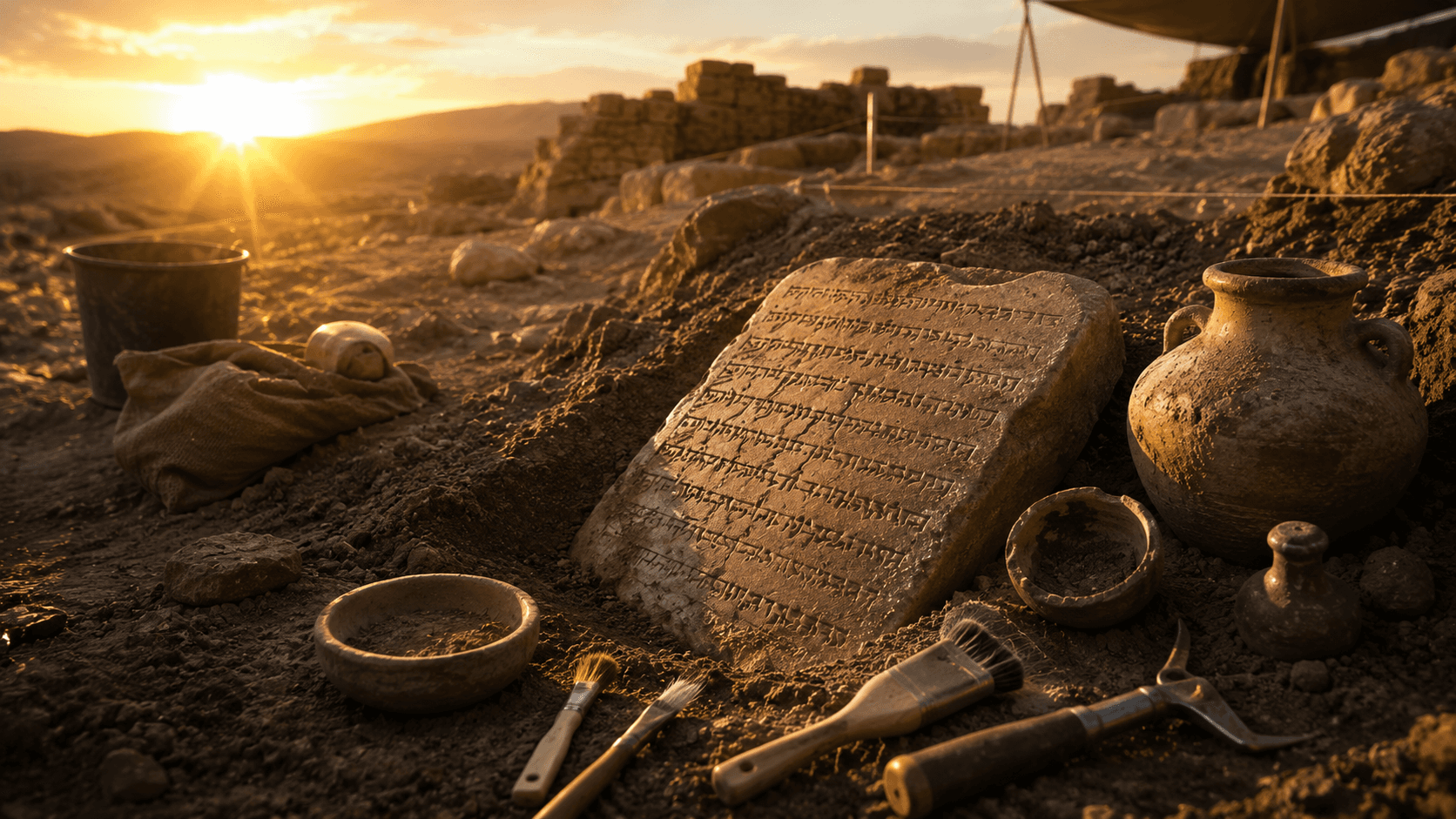
It is often assumed that religion begins where evidence ends — that the Bible asks to be believed precisely because nothing can be shown. Scripture itself says the opposite. It rests its credibility on things that can be tested: prophecies written down and dated centuries before their fulfilment, and a historical record the spade keeps confirming. God throws down a challenge to every rival — “shew the things that are to come hereafter, that we may know that ye are gods” (Isaiah 41:23) — and then meets His own test, telling the end from the beginning so that, when it comes to pass, “ye might believe” (John 14:29). This study weighs the case in two parts. First the prophetic evidence: three proud cities — Tyre, Petra, and Babylon — whose dooms were written while they stood in their pride, and fulfilled to the letter. Then the archaeological evidence: a buried Semitic nation in the land of Goshen, the Tel Dan stone and the house of David, an Assyrian king's own account of Hezekiah, the Dead Sea Scrolls that carried the Hebrew text a thousand years closer to its source, and the spade's confirmations of the world of Christ Himself. The honest limits of all of it are named along the way.
A word at the outset. The aim here is not to prove God in the way one proves a theorem; faith is not the conclusion of a syllogism, and this study will say plainly what evidence can and cannot do. The aim is narrower and fairer: to show that the Bible is not the blind leap its critics imagine, but a book that has staked itself on the public record and been vindicated there again and again — so that trust in it is reasonable, grounded, and worthy of a thinking person. The evidence is offered as a support, never as a club, and never as a measure of anyone's standing in Christ. And Scripture remains, as always, its own final authority: the stones confirm the Word; they do not sit in judgment over it. “To the law and to the testimony” (Isaiah 8:20). This study has a close companion in Daniel & Revelation, where the long prophetic outline of history is traced in full.
Why ask for evidence?
There is a popular picture of faith as a virtue that grows stronger the less reason it has — believing because it is absurd. That is not the Bible's idea of faith. Biblical faith is trust placed in a person who has proven trustworthy; it is the confidence a child has in a parent whose word has always held. And God invites the test. He does not say believe Me without reason; He says, in effect, watch what I foretell, and judge Me by whether it comes true.
This is the very thing that sets the God of Scripture apart from the idols in the great courtroom scene of Isaiah 41-46. Anyone can claim divinity; only One can demonstrate it by declaring the future: “I am God, and there is none like me, declaring the end from the beginning, and from ancient times the things that are not yet done” (Isaiah 46:9-10). Prediction is the signature He offers as proof of identity. And the test cuts both ways: a prophecy that fails convicts the prophet (Deuteronomy 18:22), so the standard is exacting. The question this study asks is simply whether the Bible passes its own test. We will find that it does — not in vague horoscope-language that could mean anything, but in named cities and dated reigns whose fate was written down, in some cases centuries in advance. We begin with three of those cities, whose ruins still answer, stone for stone, to the words spoken against them while they stood.
The stones that speak
Some of the most testable predictions in all of Scripture were aimed not at individuals but at cities — the great capitals of the ancient world, proud, powerful, seemingly eternal — and pronounced their doom in specific terms, often when those cities were at their height and such a fate looked absurd. Three of these stand out because their fulfilment is so exact and so checkable that, as one writer put it, the very ruins have become witnesses. Tyre, the merchant-queen of the sea; Edom's fortress-city of Petra, carved into rose-red rock; and Babylon, the glory of kingdoms. Each was told its end; each met it; and the manner of each fulfilment was written down in advance. We take them in turn, naming honestly both what the prophecy said and what history shows.
Tyre — scraped to the bare rock
Tyre was the greatest seaport of the ancient Mediterranean, a Phoenician power of fabulous wealth. Around 586 BC, Ezekiel pronounced against it one of the most detailed doom-prophecies in Scripture — and the details are peculiar enough to be falsifiable. Read them closely:
Behold, I am against thee, O Tyrus, and will cause many nations to come up against thee… They shall destroy the walls of Tyrus, and break down her towers: I will also scrape her dust from her, and make her like the top of a rock. It shall be a place for the spreading of nets… And they shall lay thy stones and thy timber and thy dust in the midst of the water… thou shalt be built no more.
Several distinct predictions are stacked here: many nations (not one) would come; the city would be scraped to bare rock; its very stones, timber, and dust would be cast into the sea; and the site would become a place for fishermen to spread their nets. History obliged in two acts. First, Nebuchadnezzar of Babylon besieged the mainland city for thirteen years (c. 586-573 BC) and destroyed it — but the inhabitants withdrew to an island fortress half a mile offshore, which he could not take. The prophecy of total ruin seemed only half kept, the island still proud. Then, in 332 BC, came the second act, and the strangest detail came true. Alexander the Great, needing to reach the island, did something no besieger had done: he had his army scrape up the rubble of the ruined mainland city — its stones, its timbers, the very dust — and throw it into the sea to build a causeway out to the island. The debris of old Tyre was literally laid in the midst of the water. The “many nations” — Babylonians, then Greeks, and others after — had come; the mainland site was scraped to the rock.
Honesty requires the qualification, and it does not weaken the case. There is a city called Tyre (Sur) in Lebanon today, on the peninsula that Alexander's causeway created. But the prophecy was against the proud old city, and that specific site — the mainland rock — has remained a bare place where, to this day, fishermen dry their nets, exactly as Ezekiel said. The merchant-queen of the ancient world, scraped and drowned and never restored to her former glory, is precisely the picture the prophet drew while she still ruled the waves.
Petra and the curse on Edom
South-east of the Dead Sea lay Edom, the kingdom of Esau's descendants — a proud people who made their fortress homes in the clefts of unscalable red sandstone, and who later gave the world the rose-coloured rock-city the Nabataeans carved there: Petra, the Sela (“rock”) of the Old Testament. Edom grew rich controlling the caravan routes, and felt untouchable in its cliffs. The prophets said otherwise, and they said it with unusual finality. Obadiah, devoting his whole short book to Edom, declared: “The pride of thine heart hath deceived thee, thou that dwellest in the clefts of the rock… Though thou exalt thyself as the eagle… thence will I bring thee down” (Obadiah 3-4), and “thou shalt be cut off for ever” (Obadiah 10). Jeremiah echoed it (Jeremiah 49:16-18), and Isaiah pronounced a desolation as absolute as language allows:
It shall not be quenched night nor day… none shall pass through it for ever and ever… thorns shall come up in her palaces… and it shall be an habitation of dragons.
Two things were foretold: the people of Edom would be cut off for ever, and their proud rock-dwelling would become a perpetual desolation. Both came to pass. The Edomites, having lost their land to the Nabataeans and then to history, ceased to exist as a people; by New Testament times only the name “Idumaea” lingered, and then even that vanished — there is no Edomite nation on the earth, and has not been for two thousand years. And their fortress-capital, for all its carved splendour, was abandoned. After Rome annexed the region and the trade routes shifted, and a series of earthquakes broke its aqueducts, Petra emptied. For roughly a thousand years the West did not even know where it was; it survived only as a rumour until a Swiss traveller, Johann Ludwig Burckhardt, slipped in disguise through the gorge in 1812 and found the silent, magnificent ruin standing empty in the rock — exactly the perpetual desolation the prophets described. Honesty notes that tourists and a few Bedouin pass through Petra today; but the people against whom the word was spoken are gone without trace, and their city is a museum of emptiness, not a living capital. The proud who nested as the eagle were brought down, precisely as written.
Babylon — never to be inhabited
The hardest test of all is Babylon, because Babylon was not a city one would ever bet against. When Isaiah pronounced its doom — perhaps a century before Nebuchadnezzar made it the wonder of the world — it was still rising, and the prophecy must have sounded like madness. Isaiah did not merely say Babylon would fall; cities fall and rise again. He said it would fall and stay fallen, for ever:
And Babylon, the glory of kingdoms, the beauty of the Chaldees' excellency, shall be as when God overthrew Sodom and Gomorrah. It shall never be inhabited, neither shall it be dwelt in from generation to generation: neither shall the Arabian pitch tent there; neither shall the shepherds make their fold there. But wild beasts of the desert shall lie there.
Jeremiah added the same verdict and a strange specific: “they shall not take of thee a stone for a corner, nor a stone for foundations; but thou shalt be desolate for ever” (Jeremiah 51:26); the city would become “a land wherein no man dwelleth” (Jeremiah 51:43). Now weigh this against history. Babylon was not destroyed when it fell — Cyrus took it intact in 539 BC, and it remained a great city for generations. The prophecy seemed simply wrong for centuries. But it did not need a single catastrophe; it needed only the slow, complete, permanent emptying it specified. Alexander the Great intended to rebuild Babylon as the capital of his empire — and died there, in 323 BC, the plan dying with him. His successors built Seleucia nearby and drained Babylon of its people. Century by century the glory of kingdoms subsided into deserted mounds of brick beside the Euphrates, and so it has remained: uninhabited, a haunt of jackals, exactly the picture the prophets drew.
Two honest qualifications only sharpen the case. Over the centuries local builders did cart away Babylon's loose bricks for nearby towns — but no one ever took her stones to lay the corner and the foundations of a rebuilt Babylon, which is what Jeremiah's words specify; the city itself was never raised again on its old footings. And the modern attempts prove the rule rather than break it: when a twentieth-century ruler set out to rebuild a palace on the site, stamping the bricks with his own name, the result was a tourist replica standing over dead ground, not a living metropolis — and it too was soon abandoned. Set Babylon beside the other great capitals of antiquity: Jerusalem was destroyed and rebuilt and is inhabited still; Damascus, Athens, even Rome live on. Babylon alone, of all the ancient world-cities, was told it would lie empty for ever — and it is the one that does.
Archaeology of the Exodus
Turn now from prophecy to the spade — from the Bible foretelling history to history confirming the Bible. And begin at the beginning of Israel as a nation, with the event sceptics most often call pure legend: the Exodus from Egypt. The usual claim is that there is no archaeological trace of it. The likelier truth is that the mainstream has been digging in the wrong century. For the date of the Exodus is not, in the first place, an archaeological question; the Bible fixes it. “In the four hundred and eightieth year after the children of Israel were come out of the land of Egypt… he began to build the house of the Lord” (1 Kings 6:1). Solomon's fourth year is securely dated to about 966 BC; count back 480 years and the Exodus falls around 1446 BC— in the fifteenth century, not the thirteenth. The common late date (c. 1250 BC, under Rameses II) rests largely on the place-name “Raamses” in Exodus 1:11 — but that is as likely an editorial update of an older town's name (as “Salem” becomes “Jerusalem”) as a clue to the date. Look in the right century, and the evidence is there.
An Egyptian lament, and a buried city in Goshen
The Ipuwer Papyrus, an Egyptian text lamenting a national catastrophe, reads at points like the plagues seen from the Egyptian side: “the river is blood… men shrink from tasting” (compare Exodus 7:20-21), fire running along the ground, the death of the sons, slaves departing with the gold of Egypt. Critics rightly note it belongs to a known genre of lament; the answer is that no other text gathers all these specific notes — blood, fire, dead firstborn, fleeing wealth-laden slaves — into a single composition that tracks Exodus so closely. And in the eastern Nile delta — the land of Goshen, where Genesis settles Jacob's family — the Austrian excavation of Avaris (Tell el-Dab'a), under Manfred Bietak, has uncovered the largest Semitic city in second-millennium Egypt: Canaanite pottery and house-plans, Levantine burials, West-Semitic names — a foreign, Asiatic population living exactly where Scripture places Israel. Two features arrest the eye: shallow mass graves of bodies thrown in without ceremony at a single horizon, the signature of a sudden mortality; and an abrupt abandonment — houses left intact, possessions left behind, the population simply gone, as a captive people leaving in haste would leave it.
Within the same city stood the smashed statue of a non-royal Asiatic official, over life-size, in an Egyptian governor's regalia, wearing a multi-coloured striped coat— buried in a pyramid-style tomb later violently defaced and emptied of its bones. Some, notably David Rohl, identify it as the tomb of Joseph — the coat of many colours (Genesis 37:3), the ruler over Egypt (Genesis 41), the bones carried out at the Exodus (Exodus 13:19). That identification is frankly speculative, and the statue bears no name. But the minimum an honest observer must grant is striking: in the very region and era Scripture assigns to Joseph, an extraordinary Asiatic governor's tomb was raised, marked as the Bible marks him, and then destroyed and emptied — as one might expect under a later king “which knew not Joseph” (Exodus 1:8).
A Hebrew name, the divine name, and walls that fell outward
The witnesses accumulate. An Egyptian household register, the Brooklyn Papyrus, lists scores of servants of the right period, about a third of them bearing North-West-Semitic names — among them Shiphrah, the name of one of the two Hebrew midwives of Exodus 1:15. The Soleb inscription in Nubia, carved under Amenhotep III around 1400 BC, lists among conquered peoples “the land of the Shasu of Yhwh” — the earliest known writing of the divine name outside the Bible, attached to a nomadic people east of Egypt, exactly when and where Scripture has Israel wandering with the name newly revealed at the bush (Exodus 3:14-15). And at Jericho, whatever the disputes over its date, four features of the destruction layer read like a transcript of Joshua 6: the mud-brick walls fell outward, down and flat, forming a ramp the attackers could climb (Joshua 6:20) — the opposite of how a battered wall normally collapses; the city was burned end to end in a single conflagration (Joshua 6:24); the grain jars were found full and burned in place, unplundered, just as the command forbade taking spoil (Joshua 6:17-19); and that full grain shows a short siege at harvest-time, matching the seven-day account, not a long investment that would have eaten the stores.
Honesty requires the qualifications, and this study makes them gladly. Each line can be contested in isolation — the Thutmoside identification of the pharaohs leans on a particular Egyptian chronology; Ipuwer is a known genre; the Avaris Semites need not be specifically Israelite; Jericho's redating is fought over to this day. The location of Mount Sinai is likewise unsettled: Paul places it “in Arabia” (Galatians 4:25), which fits a mountain east of the Gulf of Aqaba better than the traditional peak in the Egyptian Sinai — but much of the popular material for the Arabian site traces to the amateur Ron Wyatt, whose wider claims are not credible, and the matter awaits real excavation. None of it is offered as proof. What is offered is the cumulative pattern: corrected to the right century, the record yields a Semitic nation in Goshen, an Egyptian lament of plagues, a Hebrew midwife's name in an Egyptian ledger, the divine name on a desert people, and a city whose walls fell outward over unburnt grain — a convergence harder to dismiss than the bare verdict “no evidence” admits.
The house of David
From the founding of the nation we move to its golden age — and to a king a whole generation of scholars tried to erase. Through the late twentieth century, a school of minimalist scholars argued that King David was a legend — a theological invention of much later writers, with no more historical reality than King Arthur — and that the “united monarchy” of David and Solomon never existed. There was, they pointed out, no mention of David anywhere outside the Bible. Then the ground answered.
The Tel Dan Stele
On 21 July 1993, at Tel Dan in northern Israel, a surveyor on Avraham Biran's team turned up a broken slab of basalt inscribed in Old Aramaic — a victory monument set up by an Aramean king (most likely Hazael of Damascus) in the late ninth century BC, roughly a century and a half after David. Boasting of his triumphs over the southern kingdom, the king named the dynasty he had defeated: “the king of Israel” and “the king of the House of David” — in the Aramaic, bytdwd. There it was, carved by an enemy of Israel, in stone older than the doubters had said the legend could be: the dynasty of David, named exactly as contemporary inscriptions named the House of Omri. The first extra-biblical mention of David was a hostile witness — the most credible kind. The slab is now one of the most famous objects in the Israel Museum.
The Mesha Stele, and four more witnesses
A second, independent witness had in fact surfaced over a century earlier and only later been read aright. The Mesha Stele (the Moabite Stone), found at Dibon in 1868 and inscribed around 840 BC by King Mesha of Moab — the very Mesha who rebelled against Israel in 2 Kings 3 — names “Omri king of Israel” and the “House of Omri,” and, on a reading first proposed by André Lemaire in 1994 and strengthened in 2022, the “House of David” as well. And these two inscriptions are only the beginning of the cumulative case. Eilat Mazar's excavation in the City of David uncovered a monumental tenth-century stone structure of finely dressed Phoenician masonry — a palace on the summit of Zion, answering 2 Samuel 5:11, where Hiram of Tyre sends cedar and masons to build David a house — and in it, clay seal impressions of two officials, Jehucal and Gedaliah, named in Jeremiah 37-38. At Khirbet Qeiyafa, radiocarbon-dated to David's own lifetime, archaeologists found a fortified Judahite city with two gates (its Hebrew name, Sha'arayim, means “two gates”; cf. 1 Samuel 17:52), no pig bones, and no idols — a real, organized state where the minimalists insisted there was only a backwater village. The six-chambered city gates at Hazor, Megiddo, and Gezer, built to a single royal template, match 1 Kings 9:15's record of Solomon's building works at those exact three cities. And on the temple wall at Karnak in Egypt, Pharaoh Shoshenq I — the Shishak of 1 Kings 14:25 — carved a list of more than a hundred and fifty conquered towns of the land, memorializing the very invasion the Bible dates to Rehoboam's fifth year.
The honest weight of it is cumulative. No single find “proves the Bible”; the Tel Dan reading was disputed at first, and scholars argue the dating of the gates. But the minimalist hypothesis could survive the loss of one of these witnesses, not the loss of all six together. The king the academy had pronounced a myth in the 1980s was, within a single decade, named in his enemies' monuments and walking through his own capital's ruins. David is not legendary. The archaeology has been arriving since 1868, and it keeps arriving.
Sennacherib & Hezekiah
If the house of David shows the Bible vindicated against those who called it myth, the Assyrian invasion of 701 BC shows something rarer still: a single biblical episode confirmed from so many independent directions that it may be the best-attested event in the entire Old Testament. The story is told three times in Scripture — 2 Kings 18-19, Isaiah 36-37, and 2 Chronicles 32 — and it can now be checked against the invader's own words, his palace art, the city's waterworks and walls, the king's personal seal, and the records of two empires.
The invader's own account
Sennacherib of Assyria left a hexagonal clay prism — the Taylor Prism, recovered from Nineveh in 1830 and now in the British Museum — recording in cuneiform his campaign against Judah. He boasts of taking “forty-six of his strong walled cities,” and of shutting up King Hezekiah in Jerusalem “like a caged bird.” And then comes the most eloquent silence in ancient literature. Assyrian kings catalogued their conquests in lavish, gloating detail — every captured city, every deportation, every heap of plunder. Sennacherib records that he caged Hezekiah, took his tribute, and ravaged his land. He never once claims to have taken Jerusalem. A king who broke forty-six cities and then could not record the capital among them is a king explaining a failure he will not name. The Bible names it: “the angel of the Lord went out, and smote in the camp of the Assyrians an hundred fourscore and five thousand: and when they arose early in the morning, behold, they were all dead corpses” (2 Kings 19:35). Sennacherib withdrew to Nineveh and never came again.
The city that was there, exactly as described
The supporting evidence is dense. The Lachish reliefs, carved on the walls of Sennacherib's own palace at Nineveh, depict in enormous detail his siege of the Judahite city of Lachish — confirming the Bible's passing note that Sennacherib fought there (2 Kings 18:14, 17), and showing exactly what Assyria did to a city it did capture. Hezekiah's Tunnel still runs 533 metres through solid rock beneath the City of David, carrying the Gihon spring into the city — the very waterwork credited to Hezekiah in 2 Kings 20:20 and 2 Chronicles 32:30 — and the Siloam Inscription found in it (1880) records the two teams of diggers meeting in the middle, “pick against pick.” The Broad Wall, uncovered in Jerusalem's Jewish Quarter in 1970, is a fortification seven metres thick, run straight over demolished houses — matching Isaiah's description of houses broken down to fortify the wall under threat (Isaiah 22:9-11). And from the Ophel excavations came the bulla of King Hezekiah — a clay seal impression reading “Belonging to Hezekiah, son of Ahaz, king of Judah”, the first seal of a Judean king ever recovered in a controlled dig; close beside it lay another bulla bearing the name Yesha'yahu — Isaiah — with a partial word that may read “the prophet.”
Even the epilogue checks out. The Bible says Sennacherib was murdered by his own sons as he worshipped in the house of his god (2 Kings 19:37); the Babylonian Chronicle and Assyrian records confirm he was assassinated by a son in 681 BC, and even preserve the conspirators' names — one of which, Adrammelech in the Hebrew, answers the Assyrian Arda-Mulissu. The honest summary is the fair one: of the whole densely-corroborated episode, exactly one element — the overnight death of the army — rests on the biblical text alone. The reasonable question is how to weigh that single uncorroborated detail against the entire confirmed frame around it, reported by the same source that has been proven right at every other point.
The Dead Sea Scrolls
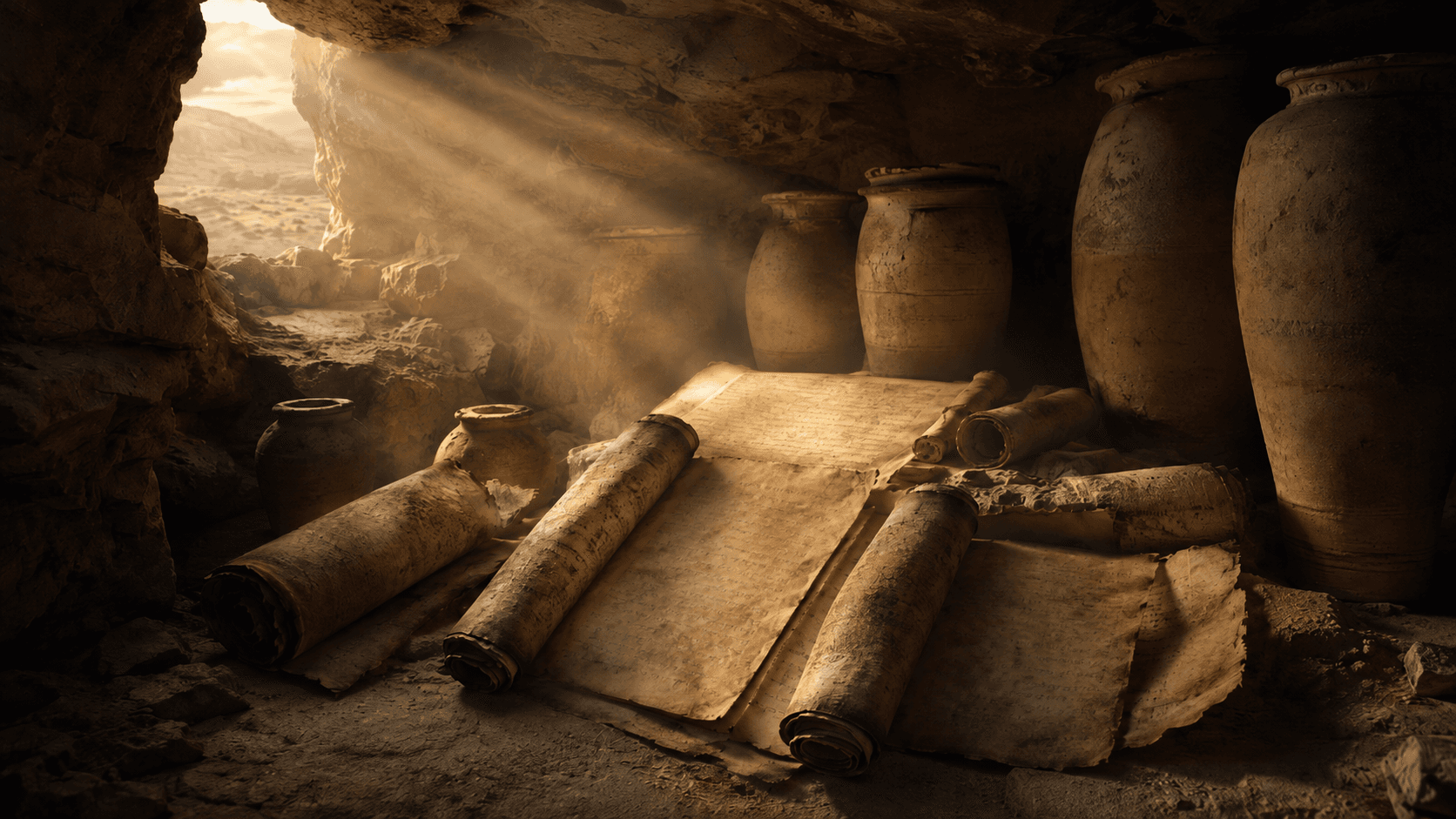
One sceptical question outranked all the others, because if it stood, it undid everything: how do we know the Bible we hold has not been rewritten over the centuries of hand-copying? Perhaps, the argument ran, the messianic prophecies were sharpened, or the text quietly altered, long after the events. For two centuries there was no way to test it, because the oldest complete Hebrew manuscripts dated only to about AD 1000. Then, in 1947, a young Bedouin shepherd chasing a stray goat among the cliffs above the Dead Sea threw a stone into a cave and heard pottery shatter. Inside were clay jars, and in the jars, scrolls.
Eleven caves at Qumran eventually yielded some 981 manuscripts, reconstructed from more than twenty-five thousand fragments — the buried library of a Jewish community destroyed by Rome in AD 68, sealed in the rock for nineteen centuries. Among the very first scrolls drawn from Cave 1 was the find that answered the great question: a complete copy of the book of Isaiah.
A thousand-year test
The Great Isaiah Scroll is carbon-dated to about 125 BC — eight hundred to a thousand years older than the oldest Hebrew Isaiah that scholars had possessed before. Here at last was a controlled experiment: set a copy of Isaiah from before Christ beside the medieval text the church had used, and measure the drift of a thousand years of copying. The verdict was decisive. The two are, in the judgment of one scholar, “word for word identical… in more than 95 percent of the text” — and the remaining differences are almost entirely matters of spelling, obvious slips of the pen, and small modernizations of archaic words. Not a single variant alters a doctrine, a prophecy, or a number of any significance. A text carried by hand across a millennium and preserved that faithfully has not been corrupted in any meaningful sense. The Bible we read is, demonstrably, the Bible they read before Christ was born.
That settles two further questions at a stroke. The scrolls contain a copy of every book of the Old Testament but one (Esther) — twenty-one copies of Deuteronomy, thirty-six of the Psalms, twenty-two of Isaiah — proving that the Hebrew canon was not a late, post-Christian construction but was already gathered and venerated as Scripture before Christ. And it puts the messianic prophecies beyond the reach of the back-dating objection: the suffering servant of Isaiah 53, the pierced hands of Psalm 22, all of it demonstrably in writing more than a century before Calvary. More than that, the community's own writings reveal a Judaism already expecting the very things Jesus claimed to fulfil. One scroll (4Q521) describes the works of the coming Messiah — He will heal the wounded, raise the dead, and preach good news to the poor — which is almost word for word the answer Jesus sent to John the Baptist (Matthew 11:4-5). The expectation Jesus met was not invented by His followers afterward; it lay sealed in clay jars at Qumran before the New Testament was written. As Isaiah himself said, in the scroll that proved his own words had endured: “The grass withereth, the flower fadeth: but the word of our God shall stand for ever” (Isaiah 40:8).
Christ-era discoveries
The same test can be run on the New Testament, and here the ground is even richer, for the first century is the most thoroughly excavated stretch in the whole Bible. The old sceptical theory held that the Gospels and Acts were late, distant compositions — written by people far from the events, inventing a theological Jesus with little grip on real geography or officialdom. The spade has steadily reversed that verdict. Where the New Testament can be checked against stone and soil, it checks out, often in the small details a distant forger would get wrong.
The men who tried Jesus, and the city He walked
For centuries Pontius Pilate was known only from the Gospels and a few literary references, and some doubted he existed. Then in 1961, at Caesarea, archaeologists turned up the Pilate Stone — a Latin dedication naming “Pontius Pilatus, prefect of Judaea” — the only contemporary inscription of the man, and it even confirms his correct title (prefect) and his coastal seat of government. In 1990 a richly carved ossuary came to light bearing the twice-written Aramaic name “Yehosef bar Qayafa” — Joseph, son of Caiaphas — the Caiaphas ossuary, in all likelihood the bone-box of the very high priest who handed Jesus to Pilate (Matthew 26:3; John 18:13). The city itself answers the text. The Pool of Bethesda, which John describes with the odd detail of “five porches” (John 5:2) — long dismissed as symbolic invention — was excavated and found to be a twin pool with porticoes on its four sides and a fifth across the dividing partition: five porches, exactly. And the Pool of Siloam, where Jesus sent the blind man to wash (John 9:7), was uncovered in 2004 — a monumental stepped pool of the Second-Temple period, just where the Gospel places it.
A crucified man, and the officials Luke named
Two finds touch the heart of the matter. In 1968, in a Jerusalem tomb, were found the bones of a man named Yehohanan with a Roman iron nail still driven through his heel — bent on a knot in the wood so that it could not be drawn out, and so buried with him. It is the only physical remains of a crucifixion victim ever recovered, mute confirmation that Rome did to men exactly what the Gospels say was done to Christ. And the historian Luke, whom critics long charged with ignorance, keeps being vindicated on the technical titles of the officials he names. He calls the magistrates of Thessalonica “politarchs” (Acts 17:6) — a term found in no other ancient literature, which sceptics took as proof he invented it, until more than thirty inscriptions bearing the exact word were dug up across Macedonia. At Corinth, a first-century pavement still reads “Erastus… laid this at his own expense”, an aedile of the city — and Paul, writing from Corinth, sends greetings from “Erastus the chamberlain of the city” (Romans 16:23). Luke gets the rare titles right everywhere — proconsul in Achaia, asiarchs at Ephesus, the chief man of Malta — the mark not of a distant myth-maker but of a careful witness who knew the world he wrote about.
The qualifications, again, are made honestly and they cost nothing. A small sealing ring also bearing “Pilatus” may belong to the governor or only to an official of his; the famous first-century fishing boat raised from the Sea of Galilee is of the right type and time but cannot be tied to any Gospel scene; and some contested objects (such as the much-disputed “James ossuary”) are best left out of the case entirely. None of that touches the pattern. Across ruler and pool and synagogue and seal and civic title, the New Testament keeps proving to have been written by people who knew the first-century world from the inside. And the documents that describe a man rising from the dead are the same documents that, on every detail the spade can reach, are confirmed at a density few ancient writings can match.
The sure word
Stand back from the whole and a single shape emerges. The Bible pronounced the doom of Tyre, Petra, and Babylon while they stood in their pride, and the centuries carried out the sentences to the letter — the bare rock where fishermen dry their nets, the empty rose-red city, the mounds by the Euphrates where no man dwells. And where the record can be dug, the spade keeps confirming it: a Semitic nation in Goshen and a city whose walls fell outward; the house of David named in his enemies' stone; Sennacherib's own prism unable to claim the city God spared; a thousand-year-old scroll of Isaiah word-for-word with our own; Pilate's name in Latin and a Roman nail still in a crucified heel. No one link carries the weight; the cable of them together does.
That is exactly the use Scripture says to make of it. Peter, who had seen the risen Christ with his own eyes, still pointed his readers past his testimony to something he called firmer: “We have also a more sure word of prophecy; whereunto ye do well that ye take heed, as unto a light that shineth in a dark place” (2 Peter 1:19). The evidence is the lamp; it is not the destination. It is given so that a thinking person may set aside the charge of credulity and come, with mind intact, to the One the whole book was written to reveal. And John tells us plainly why any of it was written down at all:
But these are written, that ye might believe that Jesus is the Christ, the Son of God; and that believing ye might have life through his name.
Prove all things; hold fast that which is good (1 Thessalonians 5:21). Fly to the waterfront at Tyre and watch the nets dry on the rock; read Sennacherib's prism in the British Museum; stand in the Shrine of the Book before the Isaiah scroll — the stones are there to be visited, and they will not contradict the Word. But do not stop at the evidence. It was only ever the lamp in the dark place, lit to bring you to the One Who keeps His word in the small things so that you may trust Him with the great one: that He so loved the world He gave His Son, and that whosoever believeth in Him should not perish, but have everlasting life.
Sources & further reading
Scripture is quoted from the King James Version. The archaeological and historical claims are matters of public record, held in named museums and published excavation reports; readers are encouraged to verify them, and to weigh the honest qualifications noted in the text. The case is cumulative — no single artifact is asked to bear the whole weight.
The prophetic evidence — the stones that speak (KJV)
- Isaiah 46:9-10; 41:23; Deuteronomy 18:22 — God 'declaring the end from the beginning'; the test of a true prophet
- Ezekiel 26:3-5, 12, 14 — Tyre: many nations, scraped to the rock, stones cast in the sea, a place to spread nets, built no more
- Obadiah 1:3-4, 10; Jeremiah 49:16-18; Isaiah 34:10-13 — Edom and Petra: brought down from the eagle's height, cut off for ever, perpetual desolation
- Isaiah 13:19-22; Jeremiah 51:26, 43 — Babylon: never inhabited, no Arab to pitch tent, no stone for a corner or foundation
The archaeological evidence — the Exodus (KJV)
- 1 Kings 6:1; Exodus 12:40-41 — the 480 years that date the Exodus to c. 1446 BC
- Exodus 1:8, 11, 15; 3:14-15; 7:20-21; 13:19 — the king who knew not Joseph; Shiphrah; the divine name; Joseph's bones (Avaris, Brooklyn Papyrus, Soleb, Ipuwer)
- Joshua 6:17-24; Galatians 4:25 — Jericho's walls fell outward, the burned grain; Sinai 'in Arabia'
The archaeological evidence — the house of David & Hezekiah (KJV)
- 2 Samuel 5:11; 1 Kings 9:15; 14:25-26; 1 Samuel 17:52 — David's palace; Solomon's gates at Hazor, Megiddo, Gezer; Shishak; Sha'arayim (Tel Dan & Mesha steles, Khirbet Qeiyafa)
- 2 Kings 18-19; Isaiah 36-37; 2 Chronicles 32 — Sennacherib's 701 BC campaign; the 185,000; the withdrawal and assassination
- 2 Kings 20:20; 2 Chronicles 32:30; Isaiah 22:9-11 — Hezekiah's tunnel and the broad wall (Siloam Inscription, the Broad Wall, the Hezekiah bulla)
The archaeological evidence — the text, and the Christ-era (KJV)
- Isaiah 40:8; Matthew 5:18; Psalm 12:6-7 — the word that stands for ever (the Dead Sea Scrolls and the preserved text)
- Matthew 11:4-5 — the works of the Messiah the Qumran scroll 4Q521 already expected
- Luke 3:1; Matthew 26:3; John 5:2; 9:7 — Pilate; Caiaphas; the five porches of Bethesda; the Pool of Siloam
- Acts 17:6; 18:12; 19:31; 28:7; Romans 16:23 — the politarchs, the proconsul, the asiarchs, the chief man, Erastus the city treasurer (Luke's accuracy)
What the evidence is for, and the hope (KJV)
- 2 Peter 1:16-19 — 'a more sure word of prophecy… a light that shineth in a dark place'
- John 20:31; 14:29; 3:16 — 'these are written, that ye might believe'; 'that ye might believe'; 'whosoever believeth in him'
- Isaiah 8:20 — 'To the law and to the testimony…' (the reading principle of this article)
Companion studies
- The Foretold Messiah — the prophecies of Jesus: His lineage, birthplace, death, and the seventy weeks that date His coming
- Daniel & Revelation — the long prophetic outline of history, and the seventy weeks that date the Messiah
- Biblical Cosmology — the heavens the prophets actually describe
- The State of the Dead — what Scripture says of death and the resurrection