Two books of the Bible are dismissed more often than they are read. Daniel and Revelation — full of beasts and metals and horns, of seals and trumpets and plagues — are widely treated as obscure, even unintelligible, a tangle of symbols best left to specialists and fanatics. Yet the two were written to be understood, and they were written to fit together: Daniel draws the outline of history in advance, and Revelation unseals it and carries it to the end. Read by the plain, historicist key the Reformers and the Advent pioneers held — letting the Bible define its own symbols, and reading its long time-prophecies on the principle of a day for a year — the two prophets lay out the whole course of the world from Babylon to the kingdom of God, identify the great apostate power of the centuries, fix the hour in which we now live, and turn the entire drama on a single question: whom will you worship? This is a long study, because it is the spine that the rest of the prophecy hangs upon. It ends where both books end — with the Lamb on the throne and a new earth without tears.
A word at the outset, as with everything in this part of the site. What follows is held with conviction, and the historicist reading carries sober conclusions about a religious power named in history. But it is offered as a safeguard and an appeal, never as a test of fellowship, never as an attack on people. The prophecy indicts a system, not the millions of sincere, Christ-loving souls within and around it — and, as will be seen, the harshest words here are quoted from that system's own official mouth, not invented against it. The plea is only the one Isaiah makes: to bring the whole question “to the law and to the testimony” (Isaiah 8:20), and to let Scripture, not tradition or sensation, settle it. This study leans on three companions — on biblical cosmology, the state of the dead, and the closing crisis — and the reader who has not met those arguments is encouraged to weigh them alongside this one.
A word we can trust
Begin with the claim the prophets make for themselves, because everything depends on it. The God of the Bible stakes His very identity on His ability to tell the future: “I am God, and there is none like me, declaring the end from the beginning, and from ancient times the things that are not yet done” (Isaiah 46:9-10). That is not a small claim, and it does not allow a middle position. Either a Mind outside of time has written history before it happened, or it has not. “The Lord God will do nothing,” says Amos, “but he revealeth his secret unto his servants the prophets” (Amos 3:7). And Peter calls prophecy “a more sure word” — a light “that shineth in a dark place” (2 Peter 1:19). The purpose is never to satisfy curiosity or feed sensation; it is to anchor faith, so that when the things foretold come to pass, “ye might believe” (John 14:29).
There is a striking outside witness to how seriously the enemies of this book once took it. The prophecy of Daniel 9 fixes the time of the Messiah so precisely that the rabbis, long after Christ, pronounced a curse upon any who would even count it: “May the bones of the hands and the bones of the fingers decay and decompose of him who turns the pages of the Book of Daniel to find out the time of Daniel 9:24-27, and may his memory rot from off the face of the earth for ever.” Men do not curse a prophecy that fails. They curse one that lands. We will count it ourselves, further on, and see why.
The key in our hand
Prophecy is written in symbols, and a symbol can be made to mean anything if the reader is free to invent its meaning. So the first rule is the one that keeps us honest: let the Bible define its own symbols. We do not guess that a beast is a computer in Brussels or a sports team called the Lions; we ask Scripture, and Scripture answers plainly. Assemble its own definitions and a small dictionary falls into place:
- A beast is a kingdom or political power — “the fourth beast shall be the fourth kingdom upon earth” (Daniel 7:23; cf. 7:17).
- A horn is a king or kingdom that rises out of a beast — “the ten horns… are ten kings” (Daniel 7:24).
- Waters are peoples — “the waters which thou sawest… are peoples, and multitudes, and nations, and tongues” (Revelation 17:15).
- A woman is a church — the bride of Christ when pure (Ephesians 5:23-32; Jeremiah 6:2), a harlot when unfaithful.
- Wind is strife and war (Jeremiah 49:36-37); wine is doctrine that intoxicates; fornication is the church's idolatrous union with the kings of the earth; white linen is the righteousness of saints (Revelation 19:8).
- A mountain is a kingdom (Jeremiah 51:25); the Rock is Christ (1 Corinthians 10:4).
The second rule governs the long time-prophecies. When a prophet measures a future stretch of history in days, Scripture supplies the scale: a prophetic day stands for a literal year. “I have appointed thee each day for a year” (Ezekiel 4:6); “after the number of the days… each day for a year” (Numbers 14:34). On that principle the great periods unfold — the 1,260 days of the persecuting power, the 2,300 days to the cleansing of the sanctuary, the seventy weeks cut off for the Messiah — each one a span of years, laid like a ruler across real history. With these two rules in hand, the prophecies stop being a riddle and become a map.
Daniel 2 — the great image
The map opens with a dream. In the second year of his reign, Nebuchadnezzar of Babylon — the man who had built the greatest city of the ancient world and could not conceive of its end — was troubled by a dream he could not recall. He summoned the wise men, the magicians, the astrologers, the very classes of insiders that kings still keep, and demanded they tell him both the dream and its meaning. They could not. “There is not a man upon the earth,” they protested, that could do such a thing (Daniel 2:10). And that was the point. God had emptied the king's memory precisely so that no human wisdom could supply the answer, and so that when it came, every eye would know its source: “there is a God in heaven that revealeth secrets” (Daniel 2:28). Daniel, given the dream in a night vision, refused the credit and pointed it upward — and unfolded it.
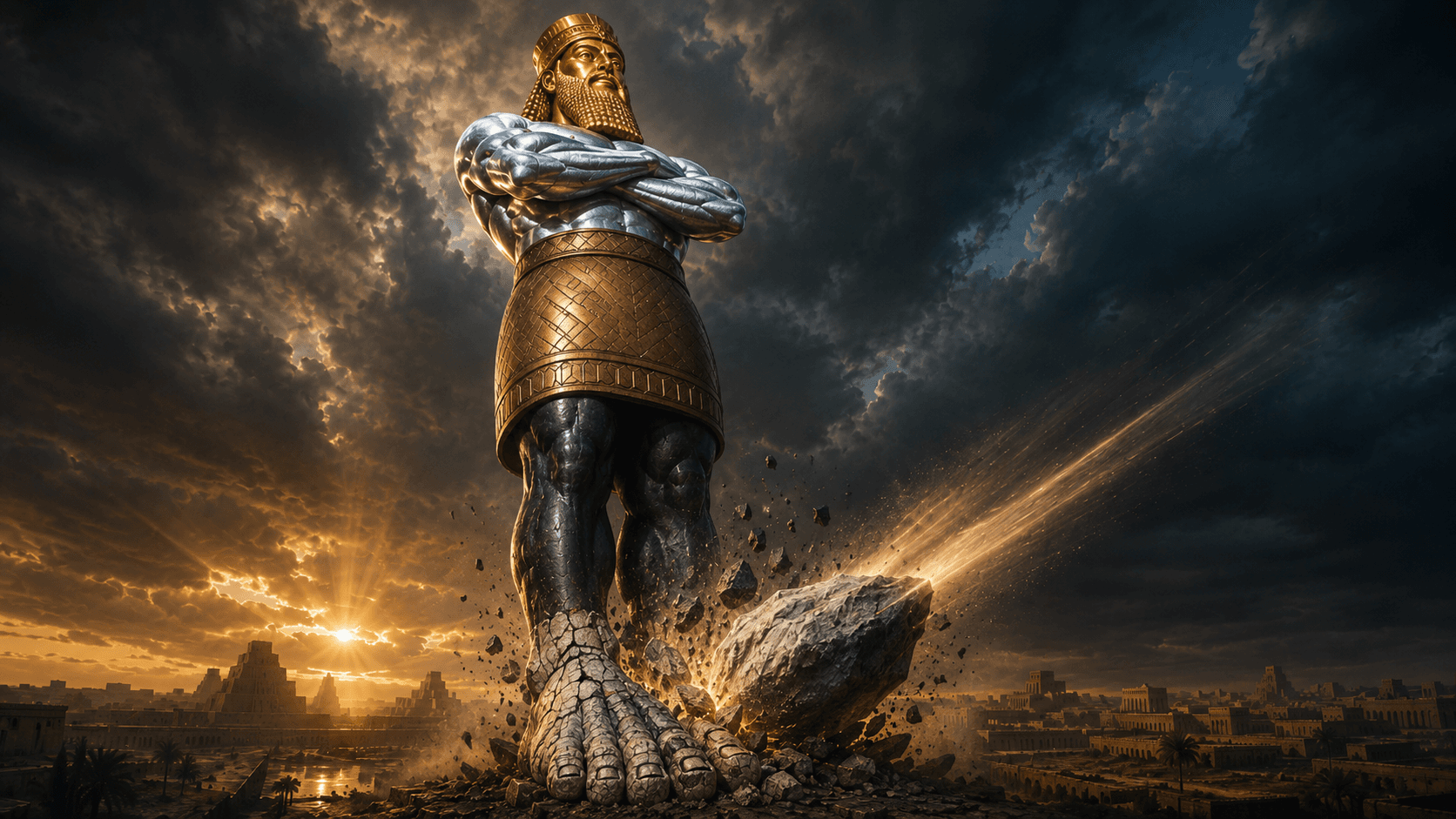
The king had seen a colossal statue, awesome and bright:
This image's head was of fine gold, his breast and his arms of silver, his belly and his thighs of brass, his legs of iron, his feet part of iron and part of clay. Thou sawest till that a stone was cut out without hands, which smote the image upon his feet… and brake them to pieces… and the stone that smote the image became a great mountain, and filled the whole earth.
The metals descend in value — gold, silver, brass, iron — but ascend in hardness, for each kingdom would be more brutal and less refined than the last. And the Bible does not leave us to guess what the metals mean. It interprets itself in the same chapter, naming the first kingdom outright and laying down the sequence for all the rest.
The four kingdoms
The head of gold is Babylon. Daniel says it to the king's face: “Thou art this head of gold” (Daniel 2:38). Babylon ruled the world from 605 to 539 BC, the proud golden empire of the Chaldeans, and Nebuchadnezzar wanted it to last for ever. “After thee,” said Daniel, “shall arise another kingdom inferior to thee” (Daniel 2:39) — and history obeyed the prophecy on schedule.
The breast and arms of silver are Medo-Persia. Two arms, two peoples joined — the Medes and the Persians — who took Babylon in 539 BC and ruled to 331. The transfer was even announced in advance: on the night Babylon fell, the writing on the wall declared, “thy kingdom is divided, and given to the Medes and Persians” (Daniel 5:28). The belly and thighs of brass are Greece (331-168 BC) — and here the symbol carries a quiet confirmation in the metal itself, for the Greek soldier's armour was bronze. Alexander flattened the million-man Persian army with forty-five thousand men, and the brazen kingdom spread its philosophy across the world.
The legs of iron are Rome. “The fourth kingdom shall be strong as iron: forasmuch as iron breaketh in pieces and subdueth all things… shall it break in pieces and bruise” (Daniel 2:40). And again the metal speaks: the Roman legionary's armour was iron, where the Greek's had been bronze. Rome was crueller and harder than any before it — it crucified those who dissented — and it crushed the kingdoms of gold, silver, and brass beneath the iron monarchy, ruling from 168 BC to AD 476. Even the historian Gibbon, with no prophetic interest at all, wrote that “the images of gold, of silver, or of brass… were successively broken by the iron monarchy of Rome.” Four world-empires, named in order, six centuries before the last of them arose. No other book on earth had done such a thing.
The feet of iron and clay
Here the prophecy does something it had not done before. After Rome there is no fifth metal, no single successor. Instead the legs of iron divide into feet and ten toes, part of iron and part of clay— for Rome was not conquered from without; it was broken apart from within. Beginning around AD 351 and complete by 476, the Western Empire was carved up by barbarian tribes into the kingdoms that became the nations of Europe — the Alemanni (Germans), the Franks (French), the Burgundians (Swiss), the Lombards (Italians), the Anglo-Saxons (English), the Suevi (Portuguese), the Visigoths (Spanish), and three others now extinct. The iron of Rome remained, scattered through them all; its law, its language, its administration still run in Europe's veins to this day. The toes are ten because the kingdoms were ten.
And the prophecy makes one more prediction, the boldest of all — that these fragments would never again be welded into a single empire:
And whereas thou sawest iron mixed with miry clay, they shall mingle themselves with the seed of men: but they shall not cleave one to another, even as iron is not mixed with clay.
They would try. “Mingle themselves with the seed of men” is the language of dynastic marriage, and the great houses of Europe intermarried for centuries in the attempt to reunite the continent. Read the roll of those who set out to rebuild the empire of the Caesars and failed: Charlemagne, crowned by the pope as the crown fell apart in his hands; Charles V of Spain; Louis XIV of France; Napoleon, who said he wanted “one people throughout Europe” and met his Waterloo; Kaiser Wilhelm; and Hitler, whose thousand-year Reich lasted twelve. Every one of them was mighty; every one of them was checked. The iron would not cleave to the clay. A line written down in Babylon has held against the strongest ambitions of two and a half thousand years, and it holds today: the European project unites in trade and currency and law, and cannot become one kingdom, because prophecy said it could not.
The stone cut without hands
Then comes the climax — and it is decisive in a way most readers miss. A stone is “cut out without hands” (Daniel 2:34). Note the phrase: this is not a human work, not the rise of another empire, not a political solution engineered by men. It is a direct, divine intervention from outside history altogether — the Rock, Who is Christ, the second coming of the Lord in glory. And note where it strikes. The stone falls upon the feet — the divided kingdoms of our own age — not upon the hips of brass, where a whole stream of popular prophecy mistakenly locates the antichrist in ancient Greece. It strikes the last stage, the one we are living in now.
And when it strikes the feet, the entire image shatters at once — “the iron, the clay, the brass, the silver, and the gold, broken to pieces together” (Daniel 2:35). Why would kingdoms long since fallen crumble in the same instant? Because the anti-God philosophy of each was absorbed into the next and disseminated through the iron to the whole world; at the end, when that one accumulated structure is destroyed, every contribution to it falls together. The wind — the symbol of war — sweeps the fragments away without a trace, and the stone “became a great mountain, and filled the whole earth” (Daniel 2:35). A mountain is a kingdom; this one is the everlasting kingdom of God, and it leaves no rival standing:
And in the days of these kings shall the God of heaven set up a kingdom, which shall never be destroyed… it shall break in pieces and consume all these kingdoms, and it shall stand for ever.
That is the whole of history on a single page: four empires, a divided world that cannot reunite, and then the intervention of God, Who ends the kingdoms of men and reigns for ever. If you have pinned your hope to any human system — any nation, any movement, any coming order of peace — the image is a warning. “The dream is certain, and the interpretation thereof sure” (Daniel 2:45). Seek first, instead, the kingdom that the stone becomes.
Daniel 7 — the same history, coloured in
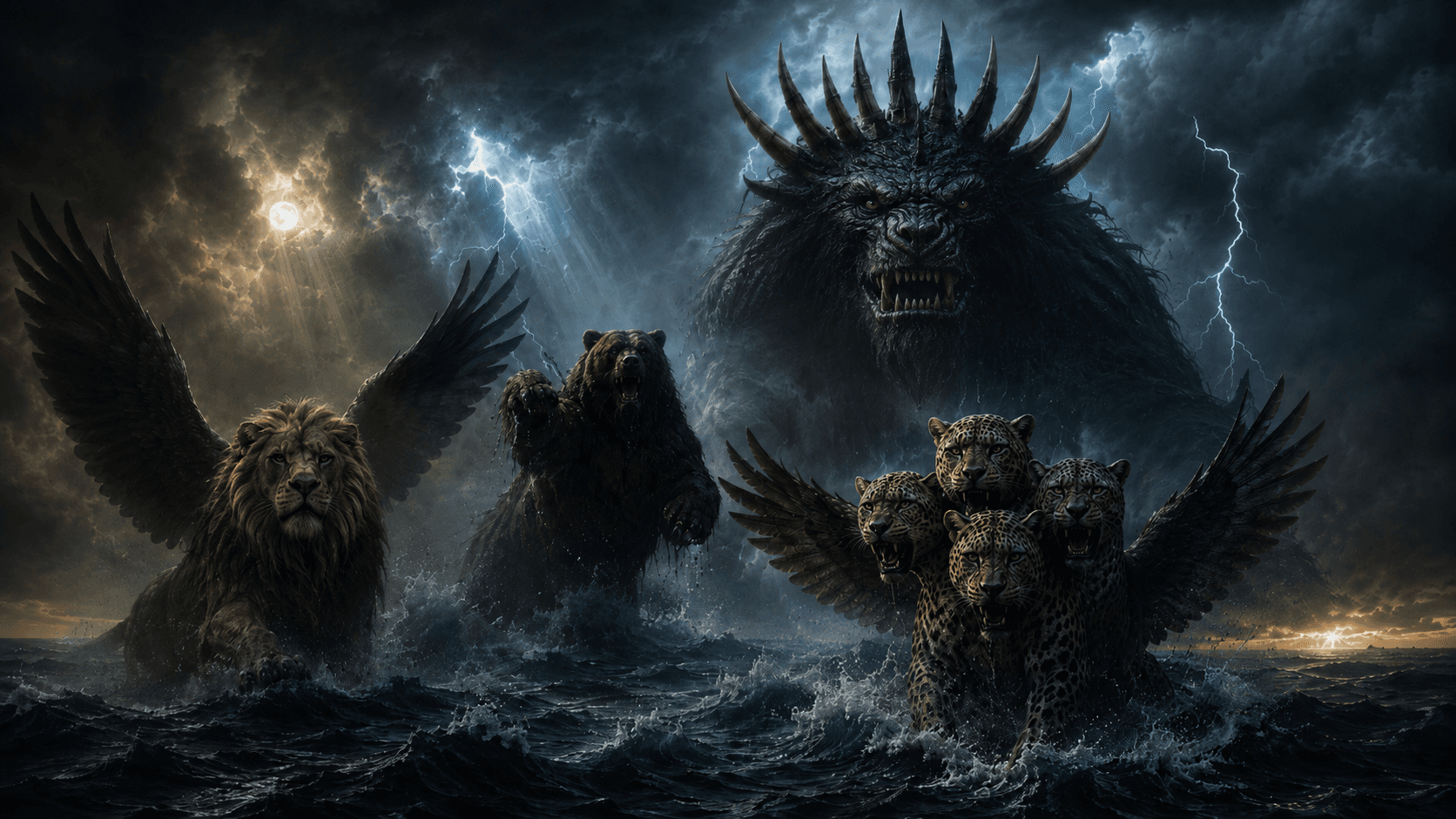
Daniel 2 was the outline drawn for a heathen king; Daniel 7, given to the prophet himself decades later, is the same history coloured in — and it adds the detail that turns a survey into a warning. This time the kingdoms rise not as a glittering statue but as four wild beasts coming up out of a stormy sea (Daniel 7:2-3) — the sea being peoples, the winds being war, the same world but seen now as God sees it.
A lion with eagle's wings is Babylon — the very emblem carved on Babylon's gates, and the symbol the prophets gave her (Jeremiah 4:7; 50:17). Its wings are plucked and it is made to stand up “as a man, and a man's heart was given to it” (Daniel 7:4) — the exact arc of Nebuchadnezzar, who was abased to a beast's mind and then, humbled, restored to a man's (Daniel 4). A bear, raised up on one side, with three ribs in its mouth is Medo-Persia (Daniel 7:5) — lopsided because the Persians overtook the Medes, the three ribs its three great conquests of Lydia, Babylon, and Egypt. A leopard with four wings and four heads is Greece (Daniel 7:6) — swift beyond nature, and four-headed because at Alexander's sudden death his empire split among four generals: Cassander, Lysimachus, Ptolemy, and Seleucus.
And a fourth beast, dreadful and terrible, with great iron teeth and ten horns is Rome (Daniel 7:7) — so monstrous that no animal in nature would picture it. Count the heads of all four beasts and you reach seven (one, one, four, one), the same seven heads that will reappear on the beasts of Revelation, gathering all the kingdoms of all the ages into one final structure. But Daniel's gaze fixes on the fourth beast and on something growing among its horns — and here the prophecy stops surveying empires and begins to expose a single power that would outlast them all.
The little horn
“I considered the horns,” says Daniel, “and, behold, there came up among them another little horn, before whom there were three of the first horns plucked up by the roots: and, behold, in this horn were eyes like the eyes of a man, and a mouth speaking great things” (Daniel 7:8). Out of the dividing of Rome — among the ten kingdoms of Europe, after AD 476, and only there — a new power rises. It is small at first, then grows “more stout than his fellows” (Daniel 7:20). It has the eyes of a man: it is led by a man, a single human figurehead. And it speaks great things against the most High.
The angel gives Daniel a checklist so precise that only one power in all of history can wear it. Gather the marks from Daniel 7:8, 20-25:
- It arises out of the fourth beast — out of Rome, not Greece, not the Middle East.
- It comes up among the ten horns — a power of Western Europe.
- It rises after the ten — after AD 476, when Rome was fully divided.
- It uproots three of the ten kingdoms before it.
- It is diverse from the others — different in kind.
- It has a man at its head, with “eyes like the eyes of a man.”
- It speaks blasphemy — “great words against the most High.”
- It wears out the saints — a persecuting power.
- It thinks to change times and laws — God's times and God's law.
- It reigns for “a time, and times, and the dividing of time” — 1,260 years.
- It continues until the Ancient of days comes — to the very end of time.
- It is finally judged in heaven's court, its dominion taken away and destroyed.
The three horns plucked up are not a mystery. As the new power rose, three of the ten Arian tribes that stood in its way were removed by force: the Heruli in 493, the Vandals in 534, and the Ostrogoths in 538. With the last of them gone, the power rose “like a mushroom” to supremacy. Every one of these marks is historical, public, and checkable — and we will name the power they describe in a moment. But first, the New Testament adds a piece Daniel does not: when this power could appear, and what was holding it back.
The power that held it back
Paul, writing to the Thessalonians, warns them not to expect the day of Christ before a great apostasy and the unveiling of a figure he calls “that man of sin… the son of perdition; who opposeth and exalteth himself above all that is called God… so that he as God sitteth in the temple of God, shewing himself that he is God” (2 Thessalonians 2:3-4). It is the same portrait as Daniel's little horn — a power that exalts a man into the place of God. And Paul says something arresting: this power was already at work in his own day, but something was restraining it: “he who now letteth will let, until he be taken out of the way. And then shall that Wicked be revealed” (2 Thessalonians 2:7-8). One thing was holding the man of sin back. When it was removed, he would rise.
Paul would not name the restrainer in writing — the early church was under Roman persecution, and to predict in ink the fall of Rome was dangerous — but he had told the Thessalonians plainly by mouth, and the early church remembered. Their testimony is unanimous, and it is striking. Tertullian, around AD 200, wrote: “What obstacle is there but the Roman state, the falling away of which, by being scattered into ten kingdoms, shall introduce Antichrist?” Chrysostom, bishop of Constantinople, said the same: when “the Roman empire is taken out of the way, then he” — the antichrist — “shall come.” So did the line of fathers from Irenaeus, the disciple of John, down to Jerome. The restrainer was pagan, imperial Rome. While the Caesars held the throne, the man of sin could not arise; on the fall of the Caesars and the dividing of the empire into ten, he would. Daniel and Paul agree exactly: the little horn rises out of fallen Rome, among the ten kingdoms, after 476. Now we can name it — and we will let it name itself.
Naming the power
Lay the marks of Daniel 7 over history and they fit one institution and no other: the papal power that rose out of fallen Rome, in the city of Rome, among the kingdoms of Europe, in the sixth century. This is not a modern Protestant slur; it was the settled conviction of the Reformation. Wycliffe, Luther, Calvin, Knox, Wesley, Tyndale, Cranmer, Latimer, Ridley, the Waldenses, the Hussites — the whole body of the Reformers identified the office of the papacy with the man of sin. Luther: “I know that the pope is Antichrist, and that his seat is that of Satan himself.” It was to blunt this unanimous testimony that two Jesuit scholars, after the Reformation, invented the two readings that dominate popular prophecy to this day — futurism (Francisco Ribera: the antichrist is a single man still to come) and preterism (Luis de Alcázar: he was a man in the past, Nero or Antiochus) — both designed to point the world's eyes away from Rome, and both contradicting Daniel 7, which sets the power between the fall of imperial Rome and the second coming of Christ.
But the surest witnesses are not the Reformers; they are Rome's own documents. Take the marks one at a time and let the system answer for itself. Does it claim what Scripture calls blasphemy? The Bible gives blasphemy two definitions — a man making himself God (John 10:33), and a man claiming to forgive sins (Mark 2:7). The Archbishop of Venice, soon to be Pope Pius X, wrote: “The Pope is not only the representative of Jesus Christ, but he is Jesus Christ himself, hidden under the veil of human flesh.” An official collection of papal letters states, “We hold upon this earth the place of God Almighty.” And of the priest's confessional it is written that he pronounces over the penitent the words Christ speaks, ego te absolvo— “I absolve thee.” Both biblical definitions, claimed in print.
Did it “wear out the saints”? The centuries of the Inquisition, and the long martyrdom of those who held the Bible against Rome, answer plainly; the medieval church itself called heresy a crime to be punished, and it shed the blood of millions over the possession of Scripture. Did it “think to change times and laws”? Here is the most exact fulfilment of all, and again it is admitted freely. Rome claims the authority to alter the law of God, and points to one change as the badge of that authority — the moving of the day of worship from the seventh day, the Sabbath of the fourth commandment, to the first, Sunday:
Sunday is our mark of authority… The Church is above the Bible, and this transference of Sabbath observance is proof of that fact.
Cardinal Gibbons, in The Faith of Our Fathers, conceded the other half of the point: “You may read the Bible from Genesis to Revelation, and you will not find a single line authorizing the sanctification of Sunday. The Scriptures enforce the religious observance of Saturday.” The little horn that “thinks to change times and laws” is no abstraction; the change is on the record, and the institution that made it has never hidden the claim. (We will return to the Sabbath and the day of worship when we reach the seal of God and the mark of the beast.)
The 1,260 years — from a throne to a wound
The last mark fixes the power in time. “They shall be given into his hand until a time and times and the dividing of time” (Daniel 7:25) — three and a half prophetic years, which is forty-two months of thirty days, or 1,260 prophetic days, which by the year-day principle is 1,260 literal years. The same period recurs seven times across Daniel and Revelation, in three phrasings (a time, times, and half a time; forty-two months; 1,260 days), so that no honest reader can miss it. When did it begin and end? In AD 538, with the last of the three opposing tribes removed and the decree of the emperor Justinian recognizing the bishop of Rome as the corrector of heretics and the head of all the churches, the papal power assumed its supremacy. Count 1,260 years forward and you arrive at 1798 — the year the French general Berthier, under Napoleon, marched into Rome, took the pope captive, and proclaimed the political papacy at an end. The beast received, in the language of Revelation, its “deadly wound” (Revelation 13:3) — 538 to 1798, a measured prophetic span fulfilled to the year. We will watch that wound begin to heal when we reach Revelation 13.
The judgment set
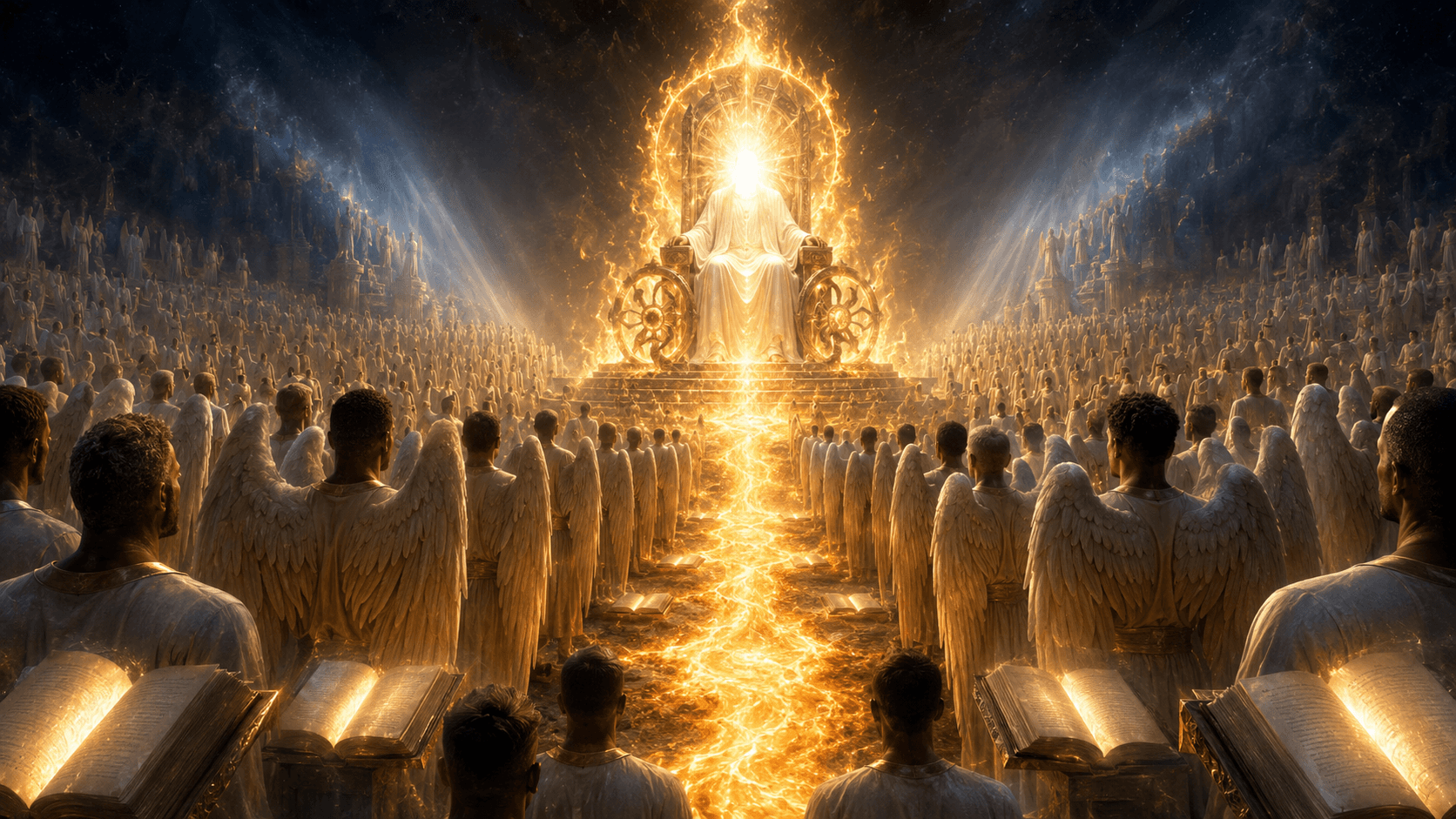
Daniel does not leave the little horn triumphant. While the prophet watches the power blaspheme and persecute on the earth, the scene shifts upward to a courtroom in heaven:
I beheld till the thrones were cast down, and the Ancient of days did sit… thousand thousands ministered unto him, and ten thousand times ten thousand stood before him: the judgment was set, and the books were opened.
The judgment is set; the books are opened. Then “one like the Son of man” comes “with the clouds of heaven” to the Ancient of days, and receives “dominion, and glory, and a kingdom” (Daniel 7:13-14). This is not yet the second coming to the earth; it is a coming to the Father, a session of heaven's court, after which the verdict is given: “judgment was given to the saints of the most High; and the time came that the saints possessed the kingdom” (Daniel 7:22). The persecuting power has its day; but a court sits, the records are read, and the kingdom is awarded — not to the horn, but to the people of God. Hold that heavenly courtroom in mind, for in Daniel's next visions it is given a date, a doctrine, and a sanctuary. That is the second movement of the prophecy, and it carries us to the most contested year in the whole Advent message: 1844.
The 2,300 days
In a later vision (Daniel 8), the prophet sees a ram and a goat — and the angel Gabriel names them outright, removing all guesswork: “The ram which thou sawest… are the kings of Media and Persia. And the rough goat is the king of Grecia” (Daniel 8:20-21). The same march of empires, confirmed a third time. Out of the divisions of Greece comes again a little horn that magnifies itself, casts down the truth, and tramples the sanctuary — Rome in both its pagan and its papal phases. And then Daniel overhears a question and its answer that governs everything after:
How long shall be the vision… to give both the sanctuary and the host to be trodden under foot? And he said unto me, Unto two thousand and three hundred days; then shall the sanctuary be cleansed.
Two thousand three hundred days — by the year-day principle, 2,300 years — reaching to a future cleansing of the sanctuary. Gabriel is commanded, “make this man to understand the vision” (Daniel 8:16), and he explains the ram and the goat and the horn; but the prophet faints before the time-period itself is explained, and the chapter ends with Daniel “astonished at the vision, but none understood it” (Daniel 8:27). The one piece left unexplained is the 2,300 days. So the angel must return — and he does, in the very next chapter, to finish the one thing he left undone: to anchor the great period to a date in history.
The seventy weeks
Gabriel comes back to Daniel while he is praying, and says, “I am now come forth to give thee skill and understanding… therefore understand the matter, and consider the vision” (Daniel 9:22-23) — the same vision, the unexplained one. And he begins with a period cut off from it:
Seventy weeks are determined upon thy people… Know therefore and understand, that from the going forth of the commandment to restore and to build Jerusalem unto the Messiah the Prince shall be seven weeks, and threescore and two weeks.
The word translated “determined” means literally cut off. Seventy weeks — 490 years — are cut off, allotted to Daniel's people, the Jews. Cut off from what? From the 2,300 days of the previous chapter, the only period on the table. The seventy weeks and the 2,300 days share a single starting point. Find the start of the seventy weeks and you have found the start of the 2,300 years. And Gabriel gives the start: “the going forth of the commandment to restore and to build Jerusalem.” That decree went out in 457 BC, in the seventh year of Artaxerxes (Ezra 7). From there, said the angel, sixty-nine weeks — 483 years — would reach “unto the Messiah the Prince.”
Count it. 457 BC plus 483 years (remembering there is no year zero) lands on AD 27 — the very year Jesus of Nazareth was baptized and anointed with the Holy Spirit, and began to preach, “The time is fulfilled” (Mark 1:15). Messiah means Anointed; He was anointed on schedule, to the year. Then Gabriel says the Messiah would “be cut off, but not for himself” and would “cause the sacrifice and the oblation to cease” in the “midst” of the seventieth week (Daniel 9:26-27). Three and a half years after AD 27 is AD 31 — the spring He was crucified, when the veil of the temple tore and the entire sacrificial system met its substance and ceased to have meaning. And the full seventy weeks run out three and a half years later, in AD 34, when the stoning of Stephen and the scattering of the church turned the gospel from the Jewish nation to the Gentiles. Every milestone — the decree, the anointing, the cross, the gospel to the world — falls exactly where the prophecy placed it, centuries in advance. Now we know why the rabbis pronounced their curse.
From 457 BC to 1844
The arithmetic of the larger period now finishes itself. The seventy weeks — 490 years — were the first portion cut off from the 2,300; both begin at the decree of 457 BC. So subtract: 2,300 minus 490 leaves 1,810 years still to run after the seventy weeks closed in AD 34. Add 1,810 to AD 34 and you arrive at 1844. Or, more simply, lay the whole 2,300 years from its starting point: 457 BC plus 2,300 reaches AD 1844.
This is the spine that holds the two halves of Daniel together. The seventy-week prophecy is one of the most precisely fulfilled in all of Scripture — so exact that it identifies the Messiah by the calendar — and it is cut off from the 2,300 days, sharing its origin. If the first 490 years landed on the Messiah to the very year, the remaining 1,810 land on 1844 with the same certainty, for it is one unbroken ruler. And in 1844, said Gabriel, “then shall the sanctuary be cleansed.” The question is only: which sanctuary, and what is its cleansing?
The cleansing of the sanctuary
By 1844 there was no temple in Jerusalem to cleanse; it had lain in ruins for seventeen centuries. The sanctuary Gabriel meant is the one the earthly temple was only ever a copy of — the true sanctuary in heaven, where Christ ministers as our High Priest:
We have such an high priest, who is set on the right hand of the throne of the Majesty in the heavens; a minister of the sanctuary, and of the true tabernacle, which the Lord pitched, and not man.
The earthly tabernacle was built “after the pattern” shown to Moses on the mount (Exodus 25:40; Hebrews 8:5), so its furniture and its services teach us the ministry above. It had two apartments — the Holy Place, with the lampstand, the bread, and the altar of incense, where the daily ministry of forgiveness went on all year; and the Most Holy Place, behind the second veil, with the ark and the law, which the high priest entered only once a year, on the Day of Atonement— the day of judgment and cleansing, when the sanctuary was purged and Israel's case was finally settled (Leviticus 16). The Day of Atonement was the great antitype Daniel 8:14 points to: a work of judgment and cleansing in the heavenly sanctuary, beginning in 1844.
That Christ began His heavenly ministry in the first apartment, and only later passed to the second, the Scripture itself requires. At His ascension He entered the sanctuary “by his own blood… having obtained eternal redemption for us” (Hebrews 9:12). The word there is hágion — the holy place, the sanctuary in general — not hágia hagíōn, the Most Holy. And the logic is airtight: in the earthly type the priest served first in the Holy Place before ever entering the Most Holy; Christ could only minister with His own blood, which He did not have until after Calvary. So He could not have entered the Most Holy at the ascension — He entered the Holy Place, to begin the long work of mediation; and the move to the Most Holy, the antitypical Day of Atonement, awaited its appointed time. Daniel gave the time: 1844. This is why some modern translations have quietly altered Hebrews 9:12 to read “most holy place” — for if Christ went straight to the Most Holy at His ascension, 1844 has no meaning, and the Advent message loses its anchor. The Greek will not allow the change.
So 1844 marks the opening of the final phase of Christ's priestly work — the pre-advent, investigative judgment, the heavenly court Daniel saw in chapter 7, where “the judgment was set, and the books were opened.” This is not God informing Himself; He knows all. It is the public opening of the records before the watching universe — the vindication of God's mercy and justice in every case, before the verdict of the second coming is executed. It is the work of which the first angel of Revelation 14 cries, “the hour of his judgment is come” (Revelation 14:7) — a present-tense judgment-hour message, born in 1844, which is exactly the message the Advent movement was raised up to carry. And because it sets Christ at the centre as the only High Priest, the only mediator, the only Saviour, the doctrine of the heavenly sanctuary is one of the most heavily attacked truths in the modern church.
It is no small thing that the year stands so alone in history. As the judgment-hour message began to sound, a cluster of counter-movements rose at the same moment, each setting Christ aside: Karl Marx began the Communist Manifesto, with its declaration that there is no God; Darwin enlarged his sketch of The Origin of Species in 1844; the Bahá'í faith, today a great voice for the merging of all religions, was founded in 1844 by the Báb — the word means gate; and Codex Sinaiticus, the manuscript behind the modern translations that soften the deity of Christ, came to light in the same era. A message of separation and a counterfeit of unity rose together. The pioneers did not invent the date to fit a theory; the date stood at the convergence of the great spiritual battle of the modern age. With it fixed, we can turn to the book that takes Daniel's sealed outline and unrolls it to the end.
Daniel sealed, Revelation opened
Daniel was told to “shut up the words, and seal the book, even to the time of the end” (Daniel 12:4). Revelation is the answer to that seal — John is told the opposite: “Seal not the sayings of the prophecy of this book: for the time is at hand” (Revelation 22:10). The two books were made for each other; Revelation borrows its symbols from Daniel and the Old Testament prophets, extends Daniel's outline, and fills in the great controversy from the cross to the new earth. And it is not, despite its reputation, a closed book. Its very name is the Revelation of Jesus Christ (Revelation 1:1) — an unveiling, not a riddle — and it opens with a blessing on the one who reads it: “Blessed is he that readeth, and they that hear the words of this prophecy, and keep those things which are written therein” (Revelation 1:3). God does not pronounce a blessing on reading a book He means to keep us from understanding.
Two keys make the book navigable. First, its sanctuary language: where Christ is shown ministering — among the lampstands of the Holy Place, or before the ark of the Most Holy — locates us in the stream of time, exactly as in Daniel's sanctuary. When John sees the ark of God's testament opened in heaven (Revelation 11:19), we have moved into the era of the Most Holy, the judgment — 1844 and after. Second, its structure of sevens: seven churches, seven seals, seven trumpets, seven plagues, each series sweeping through history in parallel, the churches showing the spiritual condition of God's people, the seals the fortunes of the gospel, the trumpets the judgments on the nations. Read in order, the prophecy is not chaos; it is a fugue.
The seven churches
The letters to the seven churches of Asia (Revelation 2-3) are addressed to real congregations on a real postal road — but their names, their order, and their characters trace seven successive ages of the Christian church from the apostles to the end. Ephesus (“desirable”) is the apostolic church, pure and discerning, yet warned for leaving its first love. Smyrna (“myrrh,” the fragrance of sacrifice) is the church under the ten years of Diocletian's persecution — “ye shall have tribulation ten days” — and receives, like Philadelphia, no rebuke at all; the fire only purified it. Pergamos (“elevation”) is the age of compromise under Constantine, dwelling “where Satan's seat is,” holding the doctrine of Balaam, marrying the church to the state.
Thyatira is the long night of the Middle Ages — the age of Jezebel and “the depths of Satan,” arrayed in the very purple and scarlet that Revelation 17 will give the woman on the beast — the 538-to-1798 supremacy seen from inside the church. Sardis (“renewal”) is the Reformation, which had “a name that thou livest, and art dead,” whose works were “not perfect before God” — for the Reformation broke off before it had recovered all the truth, and it stalled, famously, at the Council of Trent on the very question of Scripture alone versus Scripture-and-tradition. Philadelphia (“brotherly love”) is the great missionary awakening, 1798 to 1844, with its “open door” and, again, no rebuke. And Laodicea (“a people judged”) is the last church, ours — lukewarm, “rich, and increased with goods, and… knowest not that thou art wretched, and miserable, and poor, and blind, and naked” (Revelation 3:17) — the only one of the seven that receives no commendation at all, and the one to whom Christ stands outside and knocks. The seven letters are a mirror held up to the whole age of the church, and the last face in it is our own.
The seals and the trumpets
The seven seals (Revelation 6-8) and seven trumpets (Revelation 8-11) run parallel courses through the same Christian centuries — the seals tracing the fortunes of the gospel and its people, the trumpets tracing the judgments that fell on the powers that warred against the truth, from the barbarian invasions that broke pagan Rome to the apostasies and convulsions of later ages. These belong to the historic arm of the book — the era before the close of probation, while Christ still ministers in the sanctuary — and the discipline of the structure is to keep them there, not to fling them forward into the final days where they do not belong. The detail of the seals and trumpets is a study of its own; for our purpose the point is the architecture. The book sweeps through history again and again, each series climbing to the same climax — the great controversy between Christ and the powers of darkness, gathering toward the end. And at that climax stand the central figures of the whole prophecy: the beasts of Revelation 13, and the woman of Revelation 17.
The two beasts of Revelation 13
John sees a beast rise up out of the sea, having seven heads and ten horns, “and upon his heads the name of blasphemy” (Revelation 13:1). It is a composite of all four of Daniel's beasts at once — the body of a leopard (Greece), the feet of a bear (Medo-Persia), the mouth of a lion (Babylon), the ten horns of the dreadful fourth beast (Rome) — gathering every empire of the past into one final power (Revelation 13:2). The dragon gives it “his power, and his seat, and great authority”; it “opened his mouth in blasphemy against God”; it makes war with the saints and continues “forty and two months” — the same 1,260 years (Revelation 13:5-7). This is the sea-beast: the very power Daniel 7 described, seen now from the western shore. And John adds the detail Daniel left for him:
And I saw one of his heads as it were wounded to death; and his deadly wound was healed: and all the world wondered after the beast.
The deadly wound is 1798 — the captivity of the pope, the apparent end of the power, exactly 1,260 years after 538. But the wound is healed. In 1929 the Lateran Treaty restored the Vatican as a sovereign state, and the prophecy of a recovered, world-wondered-after power began to come true before our eyes. Then John sees a second beast, coming up out of the earth, with “two horns like a lamb” that nonetheless “spake as a dragon” (Revelation 13:11). Where the first beast rose from the sea — the crowded Old World — this one rises from the earth, a thinly peopled new land; it appears as the first power is falling, around 1798; it is lamb-like, young and gentle, with two horns that bear no crowns — two principles, civil and religious liberty, a republic without a king and a Protestantism without a pope. One nation answers every line: the United States of America. And the prophecy says this lamb-like power will one day speak as a dragon — that it will make “an image to the beast” (Revelation 13:14), a likeness of the church-state union it was founded to escape, and will use its power to enforce false worship on pain of not being able to “buy or sell” (Revelation 13:17).
That brings us to the heart of the matter — the mark of the beast against the seal of God. A seal and a mark are signs of ownership and authority; the whole final crisis turns on whose authority a person acknowledges in worship. God's seal is found in the heart of His law, in the one commandment that carries His name, His title, and His territory — the fourth: “the seventh day is the sabbath of the Lord thy God… for in six days the Lord made heaven and earth” (Exodus 20:8-11). It names the Lawgiver (the Lord), His office (Maker), and His domain (heaven and earth) — the three marks of a royal seal — and it is the sign He Himself appointed: “a sign between me and you… that ye may know that I am the Lord” (Ezekiel 20:20). The beast's mark is the rival sign of a rival authority — the day of worship the papacy openly calls its mark, set in the Sabbath's place. The mark is received “in their right hand, or in their foreheads” (Revelation 13:16): in the forehead, the mind that is convinced; in the hand, the act that complies. And the number of the beast, “the number of a man” (Revelation 13:18), is 666 — a number some have read in a Latin title of the papal office, though the mark itself is the point, not the arithmetic. None of this falls on anyone today who keeps Sunday in good conscience; the issue becomes the mark only when it is enforced, and a man must choose, with full light, whom he will obey. (The gathering of that crisis is the subject of the closing-crisis study.)
The woman who rides the beast
Revelation 17 gathers the whole portrait into one unforgettable image, and it is offered as a judgment scene: “Come hither; I will shew unto thee the judgment of the great whore that sitteth upon many waters” (Revelation 17:1). A woman is a church; this woman is a harlot — a church unfaithful to her Lord — “with whom the kings of the earth have committed fornication” (her illicit union with the state), making the inhabitants of the earth “drunk with the wine of her fornication” (her intoxicating false doctrines). She sits upon a scarlet beast “full of names of blasphemy, having seven heads and ten horns” (Revelation 17:3) — the same beast of Daniel 7 and Revelation 13, here ridden and directed by an ecclesiastical power.
And the woman was arrayed in purple and scarlet colour, and decked with gold and precious stones and pearls, having a golden cup in her hand full of abominations… And upon her forehead was a name written, MYSTERY, BABYLON THE GREAT, THE MOTHER OF HARLOTS AND ABOMINATIONS OF THE EARTH.
The colours are the colours of cardinals and bishops; the wealth is the wealth of the richest religious institution on earth; the golden cup of abominations is the body of false doctrine she offers the nations. Her name is Mystery — a system that works behind the scenes — and Babylon, the city of confusion, the mother of an apostate family of daughter churches who have received her unbiblical teachings. She is “drunken with the blood of the saints, and with the blood of the martyrs of Jesus” (Revelation 17:6) — the persecuting power of Daniel 7, named again. The angel even decodes the heads: “the seven heads are seven mountains, on which the woman sitteth” (Revelation 17:9) — and the city famed across the world as the city on seven hills is Rome. The beast that “was, and is not, and yet is” (Revelation 17:8) is the wounded power that seemed to die in 1798 and lives again.
And the prophecy ends her reign with a grim justice. The ten horns — the political powers that had given her their strength — at last turn on her: “these shall hate the whore, and shall make her desolate and naked, and shall eat her flesh, and burn her with fire. For God hath put in their hearts to fulfil his will” (Revelation 17:16-17). The nations that the great church rode and used will one day discover they were duped, and turn upon her. But before that ruin, heaven sounds a call of mercy from within her walls — a call this whole study has been moving toward, and which belongs to the three angels.
The three angels' messages
Revelation 14 sets the final message of God to the world in the mouths of three angels — the marching orders of the remnant church, the last warning before the harvest of the earth. The first angel carries “the everlasting gospel… to every nation, and kindred, and tongue, and people”, and cries:
Fear God, and give glory to him; for the hour of his judgment is come: and worship him that made heaven, and earth, and the sea, and the fountains of waters.
The hour of his judgment is come — the present-tense judgment-hour message born in 1844. And the call to worship him that made heaven and earth is a call back to the Creator and to the sign of His creatorship, the Sabbath — the seal against the mark. The whole crisis is, at bottom, a crisis of worship. The second angel announces, “Babylon is fallen, is fallen” (Revelation 14:8) — the verdict on the great harlot — and is answered later by the merciful summons of Revelation 18:4, “Come out of her, my people, that ye be not partakers of her sins.” There are honest, Christ-loving people in every fallen communion, and heaven's last word to them is not condemnation but an outstretched hand: come out. The third angel warns, in the most solemn language in Scripture, against receiving the mark of the beast and worshipping his image (Revelation 14:9-11). And the three messages close by describing exactly the people they create:
Here is the patience of the saints: here are they that keep the commandments of God, and the faith of Jesus.
That is the whole of it — the commandments of God (loyalty to His law, including His Sabbath) and the faith of Jesus (a living trust in the Saviour). Not law without grace, and not grace without law, but both, held in one heart. These are the messages the Advent movement was raised up to carry; and when the world has heard them and made its choice, the harvest of the earth is ripe, and the things to come unfold quickly.
The plagues and Armageddon
When probation closes — when every heart has finally chosen, and Christ lays down His priestly work with the words “It is done” (Revelation 16:17) — the seven last plagues fall (Revelation 15-16). These are not part of the historic sweep of the trumpets; they come after the judgment, and they fall only on those who have received the mark of the beast (Revelation 16:2). They echo the plagues of Egypt, and so does God's protection in them: as Israel dwelt safe in Goshen while Egypt was struck, so the promise stands over His people, “A thousand shall fall at thy side, and ten thousand at thy right hand; but it shall not come nigh thee” (Psalm 91:7). They may be hunted, hungry, and imprisoned; they are never forsaken.
The sixth plague gathers the powers of the earth to “the battle of that great day of God Almighty”, to a place called Armageddon (Revelation 16:14-16). It is not, as popular prophecy imagines, a regional war in the Middle East. It is the final, global climax of the great controversy itself — the dragon, the beast, and the false prophet sending forth “three unclean spirits… the spirits of devils, working miracles” (Revelation 16:13-14) to unite the whole world against the Lamb and His commandment-keeping people. The issue is loyalty to God, not territory; and the outcome is settled before it begins — “the Lamb shall overcome them: for he is Lord of lords, and King of kings” (Revelation 17:14). The deception that gathers that battle — its UFOs and apparitions, its false christ and counterfeit fire — is the subject of the closing-crisis study; here it is enough to know how the battle ends.
The second coming
Then the stone strikes the image. The hope of both prophets, and of the whole Bible, is the literal, visible, glorious return of Jesus Christ — not a secret rapture, not a spiritual figure, but the King of kings descending in the sight of all the earth:
Behold, he cometh with clouds; and every eye shall see him, and they also which pierced him: and all kindreds of the earth shall wail because of him.
Every eye shall see Him; His coming is as visible as lightning “from the east… unto the west” (Matthew 24:27). Paul fills in the scene: “the Lord himself shall descend from heaven with a shout, with the voice of the archangel, and with the trump of God: and the dead in Christ shall rise first: then we which are alive and remain shall be caught up together with them in the clouds, to meet the Lord in the air: and so shall we ever be with the Lord” (1 Thessalonians 4:16-17). For those who have waited, it is the deliverance and the resurrection — the morning the sleeping saints wake to His face. For those who refused Him, it is terror; they cry to the rocks to hide them “from the face of him that sitteth on the throne” (Revelation 6:16). One event, two harvests; and the long ruler of prophecy ends at the feet of the image, exactly where Daniel said it would. (On why the dead rise at that trumpet, and do not wander conscious before it, see the state of the dead.)
The millennium and the judgment
Revelation 20 unfolds the thousand years that follow. At the second coming the righteous dead are raised and the living righteous are caught up; the wicked are slain by the brightness of His coming; and the earth is left desolate and depopulated. Satan is “bound” and cast into the “bottomless pit” (Revelation 20:1-3) — bound not by a literal chain but by circumstance, shut up on a ruined, empty world with no living soul left to deceive. Meanwhile the redeemed reign with Christ in heaven, and they share in a work of judgment: “the saints shall judge the world… we shall judge angels” (1 Corinthians 6:2-3). This is not the saved overruling God; it is God opening His books to them, answering every question, laying bare every hidden motive, so that the universe sees with its own eyes that He was merciful, patient, truthful, and just in every case — that no one is lost whom love could have saved.
At the end of the thousand years the wicked dead are raised, Satan is loosed to deceive them one last time, and the lost armies of all the ages surround the holy city (Revelation 20:7-9). Then comes the end: “fire came down from God out of heaven, and devoured them” (Revelation 20:9) — the second death, from which there is no resurrection. This is not a torture God delights in; He has “no pleasure in the death of the wicked” (Ezekiel 33:11). It is the final, clean end of sin, sinners, Satan, and death itself — sin is not quarantined to fester for ever in some corner of the cosmos, but ended. The lost are not destroyed because God refused to save them, but because they refused the life He freely offered in His Son. (The nature of that fire is weighed more fully in the state of the dead.)
The new heaven and the new earth
And then the very thing the stone became — a kingdom filling the whole earth — is realised for ever. The fire that ends sin also purifies the planet, and out of it God brings the home He always intended:
And I saw a new heaven and a new earth… And God shall wipe away all tears from their eyes; and there shall be no more death, neither sorrow, nor crying, neither shall there be any more pain: for the former things are passed away.
Everything sin broke is healed; everything the enemy stole is restored. The earth is not abandoned to evil for ever but made new — the eternal home of the redeemed, where “the tabernacle of God is with men” (Revelation 21:3). The prophecy that opened with a king dreaming of falling empires closes with the one kingdom that never falls. And so the books end as they began — not in fear, but in an invitation.
The Lamb wins
Stand back from the whole and the design is breathtaking in its unity. A golden image and four beasts lay down the march of empires; a little horn rises out of fallen Rome and reigns its 1,260 years; a heavenly court sits, and a sanctuary is cleansed at the appointed 1844; the seven churches mirror the ages; two beasts and a woman gather the powers of earth for a final crisis of worship; three angels sound the last warning; the plagues fall, the Lamb prevails at Armageddon, and Christ returns in glory; a thousand years vindicate the justice of God; sin is ended; and a new earth without tears stands for ever. From Babylon to the kingdom of God it is one seamless prophecy, and it has come true, century by century, exactly as written.
But the prophecy was never given to make us experts in the future; it was given to make us faithful in the present. It will not let us pretend the world is drifting quietly toward peace — deception will deepen, false worship will be pressed, the commandments of God will be put to the test — and it calls for the patient endurance of those who keep the faith of Jesus. The deepest comfort in it is not the chart but the Person at the centre of it: the One Who died for sinners, Who pleads for His people in the sanctuary above, Who warns the world in mercy, Who seals His own, and Who is coming to wipe away every tear. The real question these books put to us is not whether Daniel and Revelation can be trusted — history has answered that — but whether we will trust the Christ revealed in them. And their last word is an open door:
And the Spirit and the bride say, Come. And let him that heareth say, Come. And let him that is athirst come. And whosoever will, let him take the water of life freely.
Prove all things; hold fast that which is good (1 Thessalonians 5:21). Search these prophecies for yourself, trace the kingdoms through history, count the years, and weigh it all by the Word and not by tradition or the headlines. And whatever you make of the details, do not miss the One the whole vision was written to reveal — for the prophecy ends not with a date but with a hand held out, and the Lamb Who was slain upon the throne for ever.
Sources & further reading
Scripture is quoted from the King James Version. Read the prophecies in full and weigh the whole testimony of the two books — the historicist reading stands or falls on whether its outline matches real history, century by century. Quotations attributed to Roman Catholic sources are given to let the system speak for itself; readers are encouraged to verify them.
The prophetic word, and the rules of reading (KJV)
- Isaiah 46:9-10 — 'declaring the end from the beginning'
- Amos 3:7; 2 Peter 1:19; John 14:29 — God reveals His secret; 'a more sure word'; 'that ye might believe'
- Numbers 14:34; Ezekiel 4:6 — 'each day for a year' (the year-day principle)
- Daniel 7:17, 23-24; Revelation 17:15; Jeremiah 49:36; Revelation 19:8 — the Bible defining its own symbols (beast, horn, waters, wind, white linen)
- Isaiah 8:20 — 'To the law and to the testimony…' (the reading principle of this article)
Daniel's outline — the image and the beasts (KJV)
- Daniel 2:31-45 — the great image; the four kingdoms; the feet of iron and clay; the stone cut without hands
- Daniel 5:28 — 'thy kingdom is divided, and given to the Medes and Persians'
- Daniel 7:1-14 — the four beasts; the little horn; the judgment set and the books opened
- Daniel 7:20-27 — the marks of the little horn; 'a time and times and the dividing of time'; the saints possess the kingdom
- 2 Thessalonians 2:3-8 — the man of sin, the son of perdition, and the power that restrains him
The sanctuary and 1844 — the 2,300 days and the seventy weeks (KJV)
- Daniel 8:13-14, 16, 20-21, 27 — 'unto two thousand and three hundred days; then shall the sanctuary be cleansed'; the ram and goat named
- Daniel 9:22-27 — the seventy weeks 'determined' (cut off); 'unto the Messiah the Prince'; the decree, the cross 'in the midst of the week'
- Ezra 7 — the decree of Artaxerxes to restore and build Jerusalem (457 BC), the starting point
- Hebrews 8:1-5; 9:11-12, 24 — Christ the high priest of the true sanctuary, entering 'by his own blood'
- Leviticus 16; Exodus 25:40 — the Day of Atonement (cleansing/judgment); the earthly built 'after the pattern'
Revelation unveiled — churches, beasts, the woman, the angels (KJV)
- Daniel 12:4; Revelation 1:1-3; 22:10 — Daniel sealed, Revelation opened; 'blessed is he that readeth'
- Revelation 2-3 — the seven churches (Ephesus to Laodicea), seven ages of the church
- Revelation 13 — the sea-beast (the deadly wound and its healing); the land-beast with two lamb-like horns; the image, the mark, and 666
- Exodus 20:8-11; Ezekiel 20:12, 20 — the Sabbath, the seal in the heart of the law; 'a sign… that ye may know that I am the Lord'
- Revelation 17 — the woman who rides the beast; MYSTERY, BABYLON THE GREAT; the seven mountains; the ten horns turn on her
- Revelation 14:6-12; 18:4 — the three angels' messages; the hour of judgment; 'come out of her, my people'; the patience of the saints
The things to come, and the hope (KJV)
- Revelation 15-16 — the seven last plagues; Armageddon; the three unclean spirits
- Revelation 1:7; Matthew 24:27, 36; 1 Thessalonians 4:16-17 — the visible, glorious second coming
- Revelation 20; 1 Corinthians 6:2-3; Ezekiel 33:11 — the millennium and the judgment; the saints judge; 'no pleasure in the death of the wicked'
- Revelation 21:1-4; 22:17 — the new heaven and new earth; 'no more death'; 'whosoever will, let him take the water of life freely'
Companion studies
- The State of the Dead — why the dead sleep until the resurrection, and the nature of the fire
- UFOs, the Spirits of Devils & the Closing Crisis — the deception that gathers the world to Armageddon
- Biblical Cosmology — the heavens the prophets actually describe
- The Godhead — one God the Father, His begotten Son, and the Spirit of both