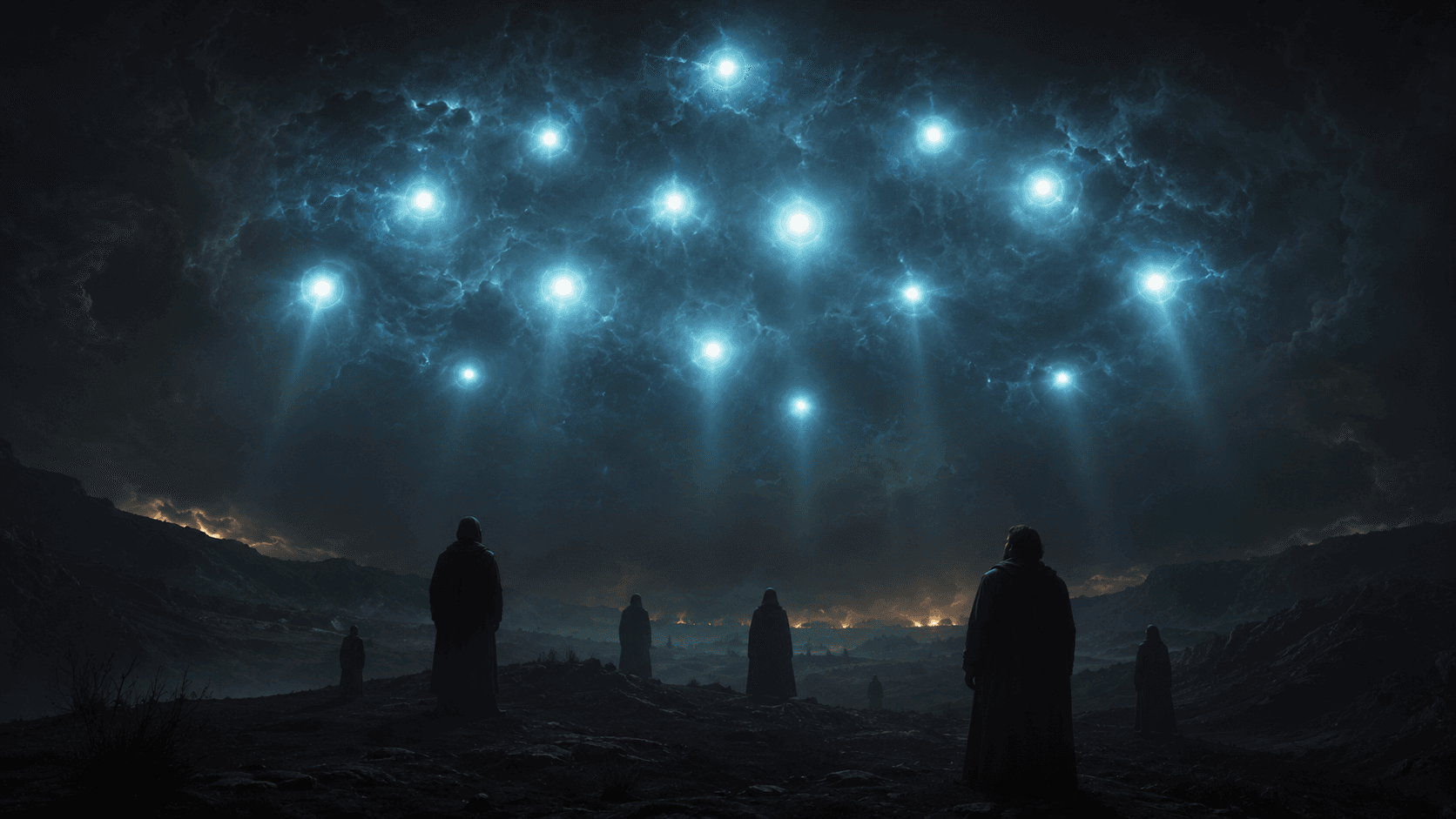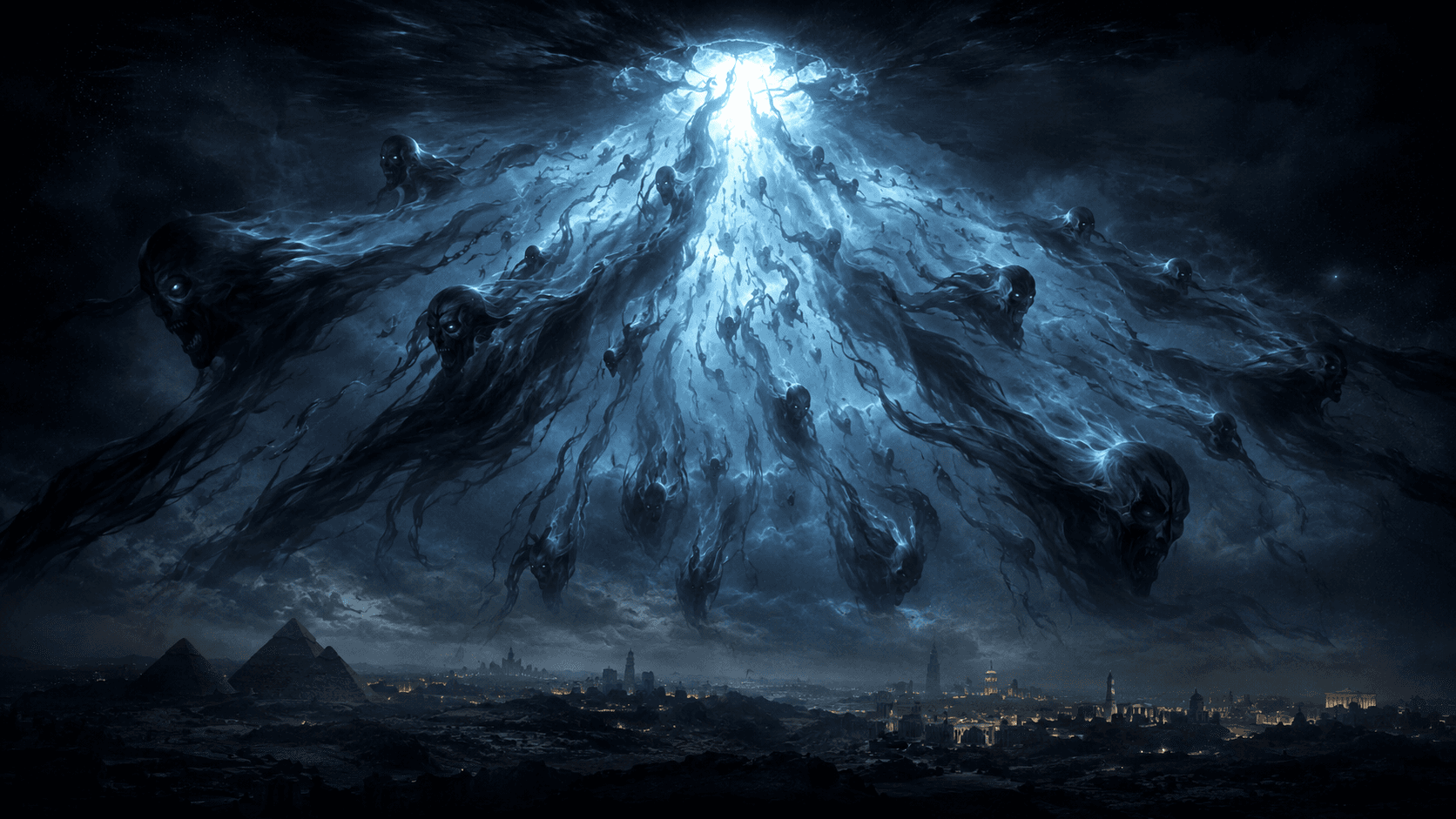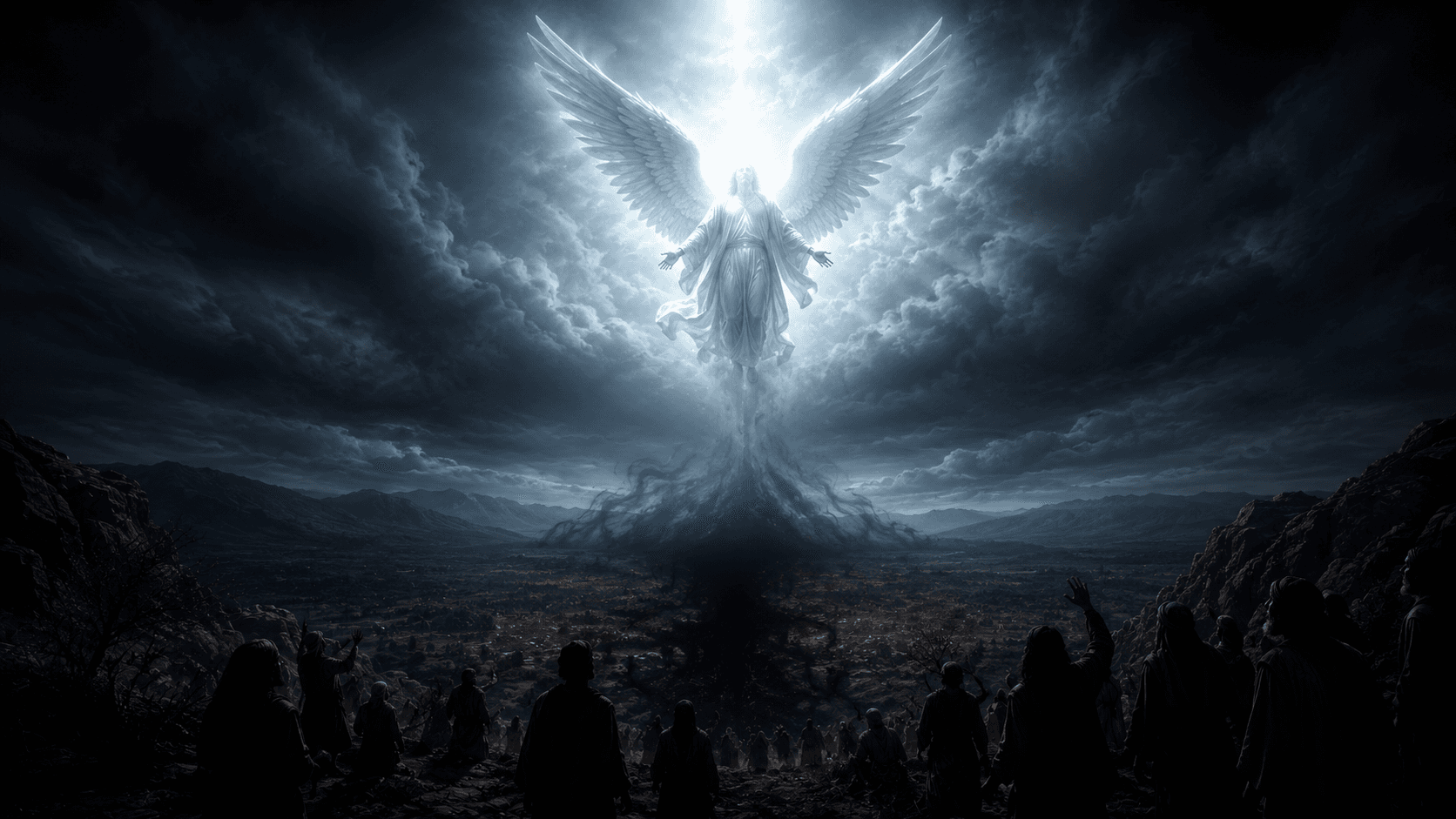
Are we alone? The question is wrong before it is answered. It arrives wrapped in a picture of the heavens — vast empty distances, numberless inhabitable worlds, evolved races perhaps crossing the void in craft — that is about four hundred years old and that Scripture nowhere draws. Re-ask it inside the cosmos the Bible actually describes, and the beings now appearing in our skies are not interstellar visitors at all. They are an order of intelligence Scripture named long ago: the fallen angels of Revelation 12, working under the one disguise this generation is primed to welcome — visitors from the stars. This study comes in two parts. Part One is the identification: who they are, and the test by which the claim is settled. Part Two follows the prophecy of Revelation 16 — the three unclean spirits and the closing crisis they are gathering the world toward.
A word first, as always. This is held with conviction, but it is not a test of fellowship and not a measure of anyone's standing in Christ. It is also not an attack on the millions of honest, curious people — many of them Christians — who have studied this phenomenon for seventy years without ever being shown what Scripture has to say about it. They were handed a menu with only two options — interstellar visitors or secret human technology — and the biblical option was not on it. This article exists to put it back on the menu, and to bring the whole question, as Isaiah says, “to the law and to the testimony” (Isaiah 8:20). It rests on two companion studies — on biblical cosmology (what the heavens actually are) and on the state of the dead (why the dead cannot be the ones speaking) — and the reader who has not met those arguments is encouraged to weigh them alongside this one.
Part One — UFOs and the spirits of devils
For most of the post-war era the official posture of the United States government toward unidentified flying objects was managed denial. That posture has shifted, and the shift is the reason the question is live again. In June 2021 the Office of the Director of National Intelligence delivered to Congress a preliminary assessment that called the phenomenon real, refused to ascribe it to any earthly programme, and declined to rule out a non-earthly origin. In December 2023 Congress passed a UAP Disclosure Act. In late 2024 a House subcommittee heard witnesses testify under oath that the government has concealed recovered craft of non-human origin and biological material for decades; that same winter, unexplained drones appeared night after night over New Jersey and New York, vanishing from one place and reappearing in another, and were never officially accounted for. The institutional silence is closing — and into that closing silence three explanations have organised themselves: secret terrestrial technology, intelligent visitors from elsewhere, and the explanation Scripture wrote down before either of the others existed. This study sets out the third.
The question is wrong before it is answered
The question now occupying senators, journalists, and the public — are we alone in the universe? — does not arrive neutral. It arrives inside a picture: vast distances, stars understood as far-off systems each potentially hosting its own evolved life, travel times measured in light-years that a sufficiently advanced civilisation might have learned to bridge. That picture is recent, and it is not the picture Scripture draws. If the heavens of Genesis 1, Job 26, Psalm 104, and Isaiah 40 are the heavens that actually exist — an established earth, a stretched firmament, lights set in that firmament, waters above — then “are we alone?” has no purchase, because the modern sense of the question presupposes a structure of the heavens Scripture nowhere teaches and at many points directly contradicts. (That case is made in full in the companion study on biblical cosmology.)
This is not a cosmetic disagreement; it is the foundational one. Every later question — what is flying over New Jersey, who is in the recovered craft, what do they want, why now — forms correctly or forms mal-formed depending on which picture of the heavens the questioner has already accepted. Most modern questioners accepted the wrong picture without ever knowing they were given a choice.
What the heavens actually hold
Watch where Scripture puts the lights. They are not distant inhabited systems hanging in deep void; they are set into the structure of the heavens, for a stated purpose:
And God said, Let there be lights in the firmament of the heaven… and let them be for signs, and for seasons, and for days, and years… And God set them in the firmament of the heaven to give light upon the earth.
The Hebrew Scriptures never once describe these lights as other earths or as the homes of other races. They are lights, given function rather than autonomous existence, ordered for the benefit of this earth's inhabitants. The earth has foundations (“Who laid the foundations of the earth, that it should not be removed for ever,” Psalm 104:5; cf. Job 38:4-7); the heavens are stretched out as a curtain (Isaiah 40:22). The picture modern people carry — galactic distances, inhabited planetary candidates, a spinning earth among them — is written over the top of Genesis 1, not drawn out of it.
The worlds Scripture does affirm
One thing must be set in place clearly, because it is easy to misread in haste. Scripture does not teach that this earth is the only world. It teaches the opposite — and the institute affirms it without apology. God “made the worlds” by His Son (Hebrews 1:2); “through faith we understand that the worlds were framed by the word of God” (Hebrews 11:3). The plural is deliberate: the Son is the maker of the worlds, and this earth is one work in a larger creation.
The Book of Job lifts the curtain on those worlds in council: “there was a day when the sons of God came to present themselves before the Lord, and Satan came also among them” (Job 1:6; 2:1). These sons of God are not Adam's fallen, scattered line; they are the representatives of other unfallen worlds — intelligences made in God's image who never fell and never needed a Redeemer. Satan's presence among them is conspicuous precisely because he is the rebel, the representative of this one fallen world among the many. The same loyal creation was present and rejoicing when this earth was made: “when the morning stars sang together, and all the sons of God shouted for joy” (Job 38:7). Paul says the unfallen creation watches still: “we are made a spectacle unto the world, and to angels, and to men” (1 Corinthians 4:9).
So the institute holds, plainly, that there are other worlds, that they are inhabited, and that their inhabitants are intelligent. What it denies is the modern picture now reframed and sold to the public: evolved races that arose by natural selection on far-off planets across astronomical voids and may be crossing them in ships. The biblical other worlds are not the modern other planets. They are the unfallen creations of God, ordered under one Father, holding worship that has never been broken. And here is the point that settles the whole question: those unfallen worlds do not send craft to seize people from their beds, contradict their Creator, deliver an anti-Christ gospel, and recoil from the name of Jesus. A being who descends from a craft claiming to be a visitor from another world is, by the very act of arrival and by every word he speaks, identifying himself outside the biblical category of the loyal creation — and inside a category Scripture has already named.
Two orders of beings not of this earth
The Bible does not deny that intelligent beings not of this earth interact with it — it affirms the fact at length. What it does is identify them, and it knows exactly two orders. There have never been more than two.
The first order is the holy angels, faithful servants of the Father who come on errands of mercy and judgment at His express commission. An angel met Hagar in the wilderness (Genesis 16); two came to deliver Lot from Sodom (Genesis 19); Gabriel brought Daniel the prophecy of the seventy weeks (Daniel 9) and announced the births of John and of Christ (Luke 1); the angels filled the night over Bethlehem (Luke 2); one rolled the stone from the tomb (Matthew 28); one opened Peter's prison and walked him into the street (Acts 12). The second order is the fallen angels — the third part of the host who followed Lucifer and were cast down:
And there was war in heaven… And the great dragon was cast out, that old serpent, called the Devil, and Satan, which deceiveth the whole world: he was cast out into the earth, and his angels were cast out with him.
These are not metaphors. “We wrestle not against flesh and blood, but against principalities, against powers, against the rulers of the darkness of this world, against spiritual wickedness in high places” (Ephesians 6:12). The fallen angels are real intelligences — conscious, willed, capable of speech, of locomotion, of physical manifestation, and of working signs and wonders within the limits God permits — organised under one rebel who directs their work, and “Satan himself is transformed into an angel of light” (2 Corinthians 11:14). That is the whole company of intelligences Scripture knows operating on this earth from beyond it: the loyal and the fallen. There is no third file marked “extraterrestrials.”
Christ's authority over both orders
Both orders answer to the Son. The holy angels are “all ministering spirits, sent forth to minister for them who shall be heirs of salvation” (Hebrews 1:14), and they ascribe unbroken worship to the Lamb (Revelation 5:11-12). The fallen angels obeyed Christ's mere word: “with authority commandeth he even the unclean spirits, and they do obey him” (Mark 1:27). And He handed that authority to His followers: “even the devils are subject unto us through thy name… I give unto you power… over all the power of the enemy: and nothing shall by any means hurt you” (Luke 10:17-19). He never rescinded it. In the closing controversy that is among the most important things that can be put back before a generation taught to fear the phenomenon and never told that the authority belongs to every soul who has received the Son.
The test that settles the question
Here the matter leaves theory and meets evidence. For roughly thirty years a field researcher in Florida — working inside the mainstream UFO research community, the network of investigators who take abduction reports and follow up cases — documented what he came to call the stopped abduction. Persons who described being seized by non-human entities in night encounters reported that the encounter abruptly stopped when, in extremity, they called on the name of Jesus Christ.
He checked one case, then another, then a third. He took the question to the senior figures in the field and found, off the record, that they had met the same pattern and quietly set it aside — not because they had tested it and found it wanting, but because publishing it would compromise their standing in a field whose presuppositions ruled the answer out before the question could be asked. Across the next twenty-five years he compiled more than six hundred documented cases, and the pattern held with a consistency that is itself the finding:
- The experience can be initiated from outside the experiencer's will.
- It can be stopped from inside the will — by the invocation of one name.
- It cannot be stopped by any other name. Not Krishna. Not Allah. Not the spirits of the dead. Not the alleged aliens themselves.
- Calls in the name and authority of Jesus Christ stop it — and the closure persists; experiencers who continued with Christ report, decades on, that the encounters never returned.
That record is decisive. A visitor from a distant inhabited world would have no reason to be subject to the name of a first-century Galilean carpenter; the alien mythology supplies no mechanism by which such a being should know that name or obey it. But the biblical account supplies exactly such a mechanism. The fallen angels of Revelation 12 know the Son intimately — they were cast down by Him and are bound under His judgment — and they cannot remain when His name is invoked over them by one of His own. Two witnesses converge: the testimony of the experiencers identifies the entities as subject to the name of Jesus, and Scripture identifies fallen angels — and only fallen angels among the orders it knows — as required to be so subject. Where experience and Scripture meet on one identification, the identification is settled. These are not visitors from somewhere else. They are the angels of the rebellion, under a new disguise.
The first lie, reworked for the modern age
Every deception trades on a premise the audience already holds. The premise this one trades on is the oldest lie ever spoken on earth. God had said of the forbidden tree, “in the day that thou eatest thereof thou shalt surely die” (Genesis 2:17). The serpent answered in five words: “Ye shall not surely die” (Genesis 3:4). The lie was that death is not really death — that woven into man at the level of nature is an immortal something that survives the body and continues in conscious existence beyond the grave. Every later doctrine of the disembodied spirit, the ghost, the familiar spirit, the consultable dead, descends from that one sentence.
Scripture contradicts it flatly: “the dead know not any thing” (Ecclesiastes 9:5); “his breath goeth forth… in that very day his thoughts perish” (Psalm 146:4); “our friend Lazarus sleepeth” (John 11:11). The departed are asleep until the resurrection — not in heaven watching, not in an intermediate school still learning, not available to be consulted. (The full case is in the companion study on the state of the dead.) This matters here because it is the hinge of the whole deception. Grant the serpent's premise — that the dead live on and can appear — and the impostor walks straight through the door. Reject it, and the impostor is exposed the moment he arrives.
From the séance table to the craft
The older form of the deception is necromancy — the supposed consultation of the dead. It is older than Israel: the Egyptians, the Canaanites, the Greeks and Romans practised it; medieval folk-magic practised it under Christianised names; the modern spiritualist movement that arose in upstate New York in 1848 practised it openly. Mediums, séances, automatic writing, channelling, Ouija boards — all rest on one foundation, that the consciousness of the dead is somewhere available to be summoned. God forbade it in the strongest language Scripture gives to any moral category:
There shall not be found among you any one that… useth divination, or an observer of times, or an enchanter, or a witch, or a charmer, or a consulter with familiar spirits, or a wizard, or a necromancer. For all that do these things are an abomination unto the Lord.
And He gave the test: “should not a people seek unto their God? for the living to the dead? To the law and to the testimony: if they speak not according to this word, it is because there is no light in them” (Isaiah 8:19-20). When the supposed voice of the dead contradicts the word God has already spoken, the voice is not what it claims to be — it is a familiar spirit, a fallen angel.
The modern form is the alien encounter. The substance is identical; only the packaging is updated for an age taught the modern cosmology and taught to be embarrassed by the old spiritualist language. The medium has been retired and the extraterrestrial introduced; the séance board replaced by the channelling session; the shimmering apparition of the dear departed replaced by the glowing being stepping down from the craft. And the continuity is unmistakable in the evidence itself: experiencers frequently report being greeted aboard the vessel by a deceased relative — the mother met by a father buried six years before, the grandson who saw his grandfather on the ship. The recognition of the “dead loved one” is precisely the device by which the deception is closed around the heart. The same overwhelming, weeping-without-cause “love” reported in the presence of the entities is the same overwhelm reported by nineteenth-century mediums at the moment of contact, and under the hallucinogens, and in the deep states of eastern meditation. The door is the same door; the visitor that walks through it has not changed in three millennia.
The alien gospel — one settled enemy
What does the visitor say? Here the matter becomes unmistakable, because the messages channelled and reported across the entire modern UFO and spiritualist literature carry one content, delivered with extraordinary consistency across cultures, substances, decades, and otherwise independent witnesses. And the content is consistently against one thing. Not Hinduism. Not Buddhism. Not the channeller's own tradition. Not atheism. Not any other religious system on earth. It is against the Christ of Scripture, and against the Father Whom that Christ declared.
The recurring components are these. There is no Creator Who made the heavens and earth — only long evolution, accelerated in the elaborate versions by genetic seeding from the messengers themselves. There is no fall, only unactualised potential. There is no judgment, no need of atonement, no Redeemer. There is no uniquely-begotten Son of the Father — only an ascended master in a long line of ascended masters, of whom Jesus was one and of whom others have since arisen. There is no second coming as Scripture defines it — only humanity rising into a higher consciousness, assisted by more evolved beings arriving now to help the transition. There is no sin to confess and no name to fear; there is only love — love offered on terms that require the recipient to surrender the most load-bearing claims of the Christian Scripture.
A non-human intelligence neutral toward the religions of earth would have no reason to bear this one-direction signature. An intelligence with a single settled enemy has every reason. The messages identify their source as surely as a watermark identifies a forger: the source has one enemy, and the enemy is the Christ of Scripture.
The frame the deception needs
This is why the order of the argument has been deliberate — cosmology first, identification second. The cosmology is the door through which the identification lands or fails to land. Sanitise the words of the UFO debate while leaving the modern picture of the heavens in place, and you have a half-rescue: as long as the listener still imagines vast distances and remote inhabited worlds, the being who claims to come from one of them keeps a foothold of plausibility, and the next manifestation — more impressive than the last — will exploit it. Correct the frame, and the entity that descends claiming to have evolved on a distant world is making a claim Scripture rules out at the level of the world it claims to come from, not merely the being it claims to be. The door closes.
Read in this light, the disclosure pressure now underway — the hearings, the Disclosure Act, the carefully-prepared whistleblowers, the official softening from “no comment” to “real, but origin unknown” — is not a neutral correction of the record. It is preparation. A public primed across seventy years of films, fiction, and curated leaks is being walked, step by step, toward a point at which a visible manifestation of non-human beings will be received not as a deception to be tested but as a long-awaited disclosure to be welcomed. The framing of the moment is being managed — and it serves a purpose. The fallen angels are not gathering to introduce themselves. They are gathering the kings of the earth, by miracles wrought in the sight of men, to a final confrontation Revelation describes with more precision than any other source. That is the subject of Part Two.
Part Two — The spirits of devils and the closing crisis
The identification is settled by the record; the frame is set by Scripture. The remaining question is purpose. Granting that the beings are what Scripture says — the fallen angels of Revelation 12 under a new disguise — what are they here to do, and why now? Revelation does not leave the question hanging. In its sixteenth chapter the apostle John is shown the precise political and religious work for which the unclean spirits go forth in the closing hour of the present age. Part Two walks that prophecy. It belongs to the historic Protestant and pioneer-Adventist line of interpretation, and it is offered, like everything here, as conviction to be weighed by Scripture — not as a date-setting chart and never as a club.
Three unclean spirits, three mouths
And I saw three unclean spirits like frogs come out of the mouth of the dragon, and out of the mouth of the beast, and out of the mouth of the false prophet. For they are the spirits of devils, working miracles, which go forth unto the kings of the earth and of the whole world, to gather them to the battle of that great day of God Almighty.
Three things are named at once: who the spirits are (the spirits of devils — the same fallen angels Part One identified), what they do (work miracles), and where they issue from (three mouths — the dragon, the beast, and the false prophet). The frog-like spirits are not three new powers; they are the demonic agency speaking through three earthly powers, drawing the rulers of the whole world into one final confederacy against God. So the prophecy must first identify the three mouths. The pioneers identified them from the symbols Revelation itself had already defined.
The dragon — paganism and spiritualism
Revelation has already labelled the dragon: “the great dragon… that old serpent, called the Devil, and Satan” (Revelation 12:9). In its political dimension the dragon worked through pagan Rome — the power that sought the life of the man-child at His birth (Revelation 12:4-5; cf. Herod). But the dragon-spirit did not die with paganism; it persists in the modern revival of the occult and of spiritualism — the very deception Part One traced. The first mouth, then, is the spiritualist principle itself: the ancient lie that man does not die, now wearing the face of channelled masters and visitors from the stars. The unclean spirit that comes out of the dragon's mouth is the spirit of the séance and the craft, gone global.
The beast — and a charge from Rome's own record
The beast of Revelation 13 is described with marks the pioneers, standing in the long Protestant interpretive tradition, read as a religio-political power that grew out of fallen Rome, wielded both spiritual and civil authority, persecuted the saints, claimed to change the law of God, and ran its allotted prophetic period. The institute holds, with that tradition, that the symbol answers historically to the Papal power. This is said carefully and without malice toward Catholic people — many of whom love Christ sincerely and have never examined the system's claims — and it is a charge best made not from Protestant polemic but from Rome's own record.
On the change of the law, Rome has spoken plainly about itself. Its catechisms have long taught that the Church transferred the solemnity of the seventh-day Sabbath to Sunday on its own authority, and have offered that very act as proof of the Church's power over Scripture — that Protestants who keep Sunday while professing “the Bible only” are, by their own practice, honouring the Church's tradition over the written commandment. That is not a Protestant accusation read into Rome; it is Rome's own boast, repeated in its catechetical literature. The point of citing it is not to wound, but to show that the prophetic identification rests on the testimony of the accused. “He… shall think to change times and laws” (Daniel 7:25) is not a slur; it is a description the power has, in its own words, owned.
The false prophet — apostate Protestant America
The third mouth is the false prophet — which Revelation 13 also pictures as a second beast, rising not out of the crowded “sea” of the old world's peoples but out of the earth, a sparsely-settled place, with “two horns like a lamb” that speaks “as a dragon” (Revelation 13:11). The pioneers read this lamb-like, late-rising power as the United States — a nation founded on the two gentle principles of civil and religious liberty (the two lamb-like horns: republicanism and Protestantism), which the prophecy says will at last speak as a dragon: that is, turn its civil power to enforce religious observance, the very thing its founding renounced.
What Revelation foresaw as future, the pioneers could only describe in principle; a modern reader watches the principle take on flesh. The rise of an explicitly Christian-nationalist political theology — the “Seven Mountains” ambition to seize the commanding heights of the culture and government for a particular religious vision, the open call to write sectarian religious observance into national law — is precisely the apparatus by which a lamb-professing nation learns to speak as a dragon. The point is not that any one figure is the antichrist; it is that the machinery the prophecy described — a Protestant nation persuaded to wield the state in matters of worship — is being assembled in plain sight. And the false prophet's task, Revelation says, is to make the world “worship the first beast” and to build an image to it (Revelation 13:12, 14).
Fire from heaven — the signature miracle
How will the false prophet move a sceptical, scientific age to such an end? By miracle. Revelation is specific:
And he doeth great wonders, so that he maketh fire come down from heaven on the earth in the sight of men, and deceiveth them that dwell on the earth by the means of those miracles which he had power to do.
The chosen sign is fire from heaven— and the choice is not arbitrary. In Scripture, fire from heaven was the divine credential. It fell on Elijah's altar at Mount Carmel and settled the contest against the prophets of Baal: “The Lord, he is the God” (1 Kings 18:38-39). It fell at the dedication of Solomon's temple as the seal of God's acceptance (2 Chronicles 7:1). Fire from heaven was, in the people's memory, the unanswerable proof of the true God. So when the closing deception reaches for a credential, it counterfeits the Carmel sign — the very wonder that once vindicated the true God is staged to vindicate the false system, and a watching world, primed by the “spirits of devils, working miracles,” takes the spectacle for heaven's endorsement. This is why the warning of Part One matters so much: a generation that has learned to receive wonders as proof, and that cannot tell a divine sign from a demonic one, is a generation ready to be gathered.
The image of the beast
An image is a likeness — a copy. The image of the beast is formed when the lamb-like nation reproduces, on its own soil, the thing the first beast was: a union of church and state in which the civil power is used to enforce religious worship. Revelation foresees the false prophet saying “to them that dwell on the earth, that they should make an image to the beast” (Revelation 13:14), and then giving that image life and the power to compel — that “as many as would not worship the image of the beast should be killed” and that none might “buy or sell” without its mark (Revelation 13:15-17). The mechanism is the marriage of professed religion to coercive law — exactly what Christian-nationalist and Seven-Mountains theology, taken to its logical end, would build: a state that legislates worship. When a nation founded on liberty of conscience crosses that line, the image stands.
The mark — a question of worship
The whole closing crisis, the pioneers saw, is at bottom a crisis of worship— and the deciding question is which authority a person will obey: the Creator's, or the power that claims the right to change the Creator's law. Revelation sets the mark of the beast over against the seal of God, and the three angels' messages frame it as worship of “him that made heaven, and earth, and the sea” versus worship of the beast and his image (Revelation 14:7, 9-12). Because the one institution that memorialises God as Creator is the seventh-day Sabbath — “the seventh day is the sabbath of the Lord thy God” (Exodus 20:8-11) — and because the very mark of the beast's authority, by Rome's own account, is the substituted day, the pioneers read the final test as falling along that line: a legislated Sunday observance, enforced by the image, set against the Sabbath of the fourth commandment. The mark is not a microchip or a barcode; it is allegiance — a sign in the hand (action) or in the forehead (assent) of submission to a usurped authority in the place of God's. God's people are described, against it, simply: “here are they that keep the commandments of God, and the faith of Jesus” (Revelation 14:12).
Satan's masterpiece — the false christ
The deception climbs to one final height. Having moved the world by spiritualist wonders, having gathered the nations through the three mouths, the adversary attempts his masterpiece: a personal impersonation of Christ Himself. Scripture warns of it directly — “there shall arise false Christs, and false prophets, and shall shew great signs and wonders; insomuch that, if it were possible, they shall deceive the very elect” (Matthew 24:24); and “Satan himself is transformed into an angel of light” (2 Corinthians 11:14). The adversary will appear as a being of dazzling glory, will heal and work wonders, will speak words of grace, and will claim to be the returned Christ — ratifying every previous deception at once: the immortal soul, the spirits of the dead, the change of the law, the new universal religion. It is the convergence of the alien gospel, the spiritualist apparition, and the counterfeit miracle in a single overwhelming manifestation.
The test by which God's people will not be deceived
And yet God has not left His people defenceless before it; He has given a test that the prophecies themselves supply, and it is decisive. The counterfeit cannot reproduce the manner of the true second coming. Scripture describes the real return of Christ in terms no earth-bound manifestation can imitate: He comes visibly and to all at once — “every eye shall see him” (Revelation 1:7); He comes in the clouds of heaven, not walking the earth — “as the lightning cometh out of the east, and shineth even unto the west; so shall also the coming of the Son of man be” (Matthew 24:27); the living righteous are “caught up… to meet the Lord in the air” and the dead in Christ are raised at that moment (1 Thessalonians 4:16-17). A christ who appears on the earth, in one place, healing and lecturing and accepting worship from a crowd, has by that very fact identified himself as the counterfeit — for the true Christ does not touch the ground at His coming, and Jesus warned in advance, “if they shall say unto you, Behold, he is in the desert; go not forth: behold, he is in the secret chambers; believe it not” (Matthew 24:26). The believer who knows the prophecy is unshakeable precisely because the test is settled before the deception arrives: measure every wonder, every visitant, every glorious appearing against the law and the testimony — and where it does not answer to the word, however bright it shines, it is not of God.
The hope at the centre
It would be easy to read a study like this and come away frightened. That is the opposite of its purpose. The whole point of identifying the deception in advance is that the one who sees it coming need not fear it. The beings in the skies are real, but they are a defeated, judgment-bound order, subject to a name; the closing confederacy is real, but its outcome is already written; the false christ is real, but he cannot counterfeit the one thing that matters — the manner of the true coming. Over all of it stands the Son, Who holds “the keys of hell and of death” (Revelation 1:18), to Whom every order of spirits must bow, and Whose name, spoken by the weakest of His own, still stops the encounter cold.
Greater is he that is in you, than he that is in the world.
So the safeguard is not vigilance against the dark but possession of the Light. Prove all things; hold fast that which is good (1 Thessalonians 5:21). Anchor in the Christ of Scripture — the begotten Son, the only Mediator, the coming King — and the whole apparatus of deception, however bright and however global, loses its hold; for the one who has the Son has the only thing the spirits of devils most want him to surrender, and it cannot be taken from him. “Behold, I come quickly… Even so, come, Lord Jesus” (Revelation 22:20).
Sources & further reading
Scripture is quoted from the King James Version. Weigh the whole — the identification in Part One and the prophecy in Part Two stand or fall on the consistency of the Scriptures cited, read in their own context.
Part One — the heavens, the orders of beings, the test (KJV)
- Genesis 1:6-8, 14-17 — the firmament, and the lights set in it for signs and seasons
- Psalm 104:5; Isaiah 40:22; Job 38:4-7 — the founded earth, the stretched heavens, the sons of God at creation
- Hebrews 1:2; 11:3; Job 1:6; 2:1; 1 Corinthians 4:9 — the worlds the Son made; the unfallen sons of God; a spectacle to the universe
- Revelation 12:7-9; Ephesians 6:12; 2 Corinthians 11:14 — the fallen angels cast down; spiritual wickedness; Satan as an angel of light
- Hebrews 1:14; Mark 1:25-27; Luke 10:17-20 — Christ's authority over both orders, given to His followers
- Genesis 2:17; 3:4; Ecclesiastes 9:5; Psalm 146:4; John 11:11-14 — the first lie, and the sleep of the dead that exposes it
- Deuteronomy 18:10-12; Isaiah 8:19-20 — necromancy forbidden; the test of the law and the testimony
Part Two — the closing-crisis prophecy (KJV)
- Revelation 16:13-14 — three unclean spirits from the dragon, the beast, and the false prophet
- Revelation 12:9; 13:1-18 — the dragon; the beast; the lamb-horned second beast that speaks as a dragon
- Daniel 7:25 — the power that 'shall think to change times and laws'
- Revelation 13:13-17 — fire from heaven; the image of the beast; the mark; buy and sell
- 1 Kings 18:38-39; 2 Chronicles 7:1 — fire from heaven as the divine credential (Carmel; Solomon's temple)
- Revelation 14:6-12 — the three angels' messages: worship the Creator; the mark; 'the commandments of God, and the faith of Jesus'
- Exodus 20:8-11 — the seventh-day Sabbath, the seal of the Creator
- Matthew 24:23-27; 2 Corinthians 11:14; Revelation 1:7; 1 Thessalonians 4:16-17 — the false christ, and the test of the true second coming
- Revelation 1:18; 18:1-4; 1 John 4:4; Revelation 22:20 — the keys of death; the call to come out; 'greater is he that is in you'; 'come, Lord Jesus'
- Isaiah 8:20 — 'To the law and to the testimony…' (the reading principle of this article)