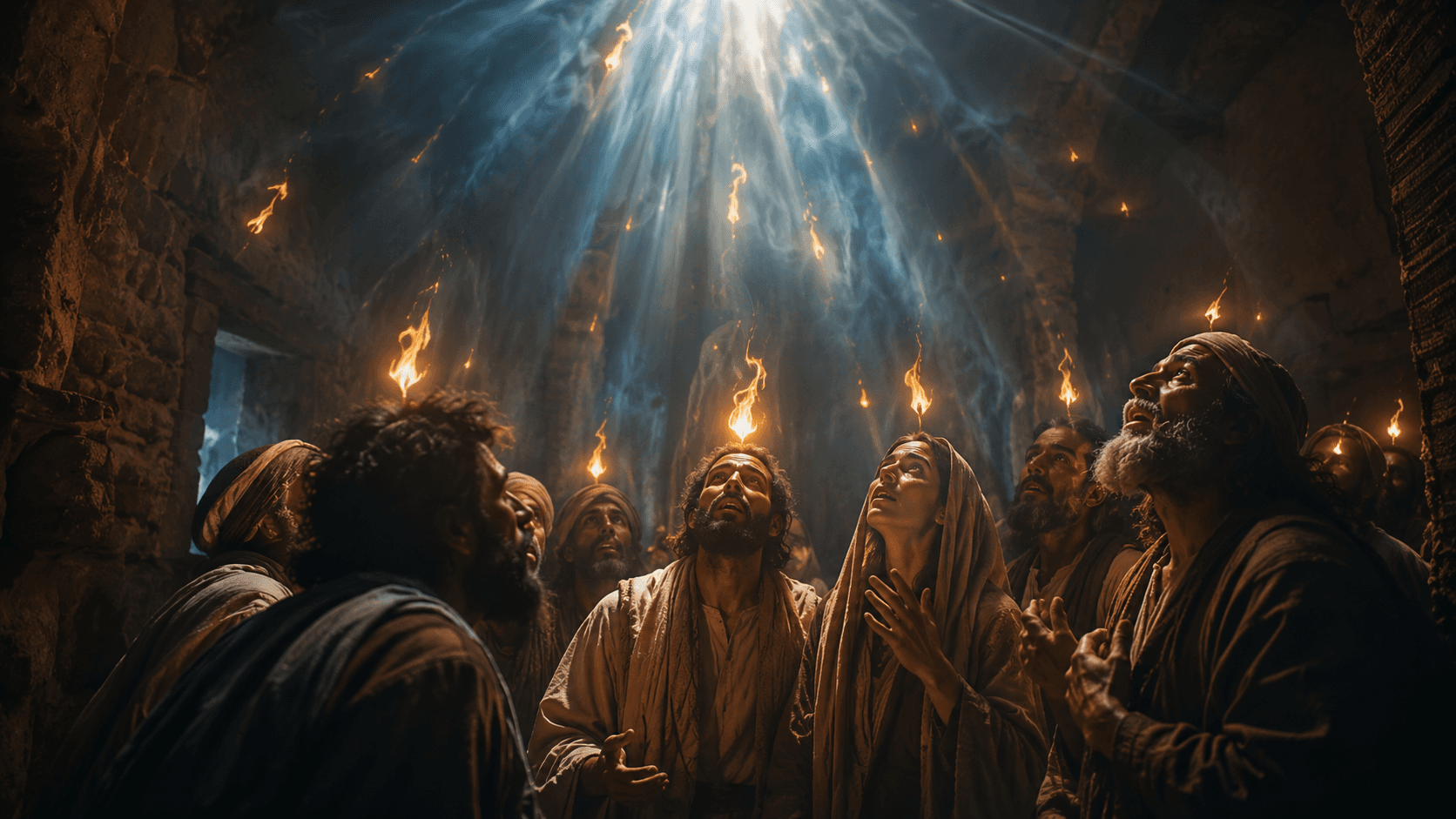
On the night before the cross, Christ promised His disciples “another Comforter.” Modern readers hear those words and picture a third divine person, distinct from the Father and the Son — the third member of a trinity. But read the promise in its own setting, and a very different and far warmer truth comes into view: the Comforter Christ promised is His own presence, returning to His people by His Spirit. He said so in the plainest possible terms a few sentences later — “I will not leave you comfortless: I will come to you” (John 14:18). This article makes the scriptural case that the Holy Spirit is the Spirit of Christ Himself: the indwelling life of the Son, not a separate being. And it rests on a fact most readers have never been shown — that, by Christ's own statement, the whole of this discourse was spoken in parables.
It belongs with the other pieces in this part of the site — on the Godhead, on the Spirit of truth and John 16:13, and on how the trinity entered Christianity. Together they recover the apostolic confession: one God the Father, His begotten Son, and the Spirit Who is the personal presence of both.
The promise that gets misread
The Comforter promise spans John 14 through 16 — all of it spoken inside one continuous farewell discourse on the last night, after the supper, before the arrest. Only John records this discourse at any length; the other three Gospels move almost straight from the upper room to Gethsemane. And the word Comforter appears nowhere else in any Gospel — not in Matthew, Mark, or Luke, and nowhere else in John. It occurs only here, in this one farewell speech, and only four times. The assumption that “the Comforter” must be a separate third person is read into these four verses rather than out of them — and, as we will see, it is read in against Christ's own explicit instruction for how to take the passage.
A parable, by Christ's own word
Begin where it is most useful to begin: at the end. After He has finished the whole discourse, Christ tells the disciples exactly what kind of speech they have just heard:
These things have I spoken unto you in proverbs: but the time cometh, when I shall no more speak unto you in proverbs, but I shall shew you plainly of the Father.
The margin of many Bibles gives the alternate word for proverbs: parables. By His own description, then, the discourse that contained the Comforter promise was spoken in parables — figurative, illustrative, not-to-be-taken-flatly language — and a plainer word was still to come. This single fact governs the entire passage, and missing it is what produces the misreading. We are used to Christ announcing a parable before He tells it — “Hear ye the parable of the sower.” Here He does the reverse: He speaks at length, and only at the close says, these things I have spoken in parables. Because the speech runs across several chapters, the closing key is forgotten by the time most readers reach it, and the figurative words get treated as flat, literal speech. They were never meant to be.
This is not special pleading invented to rescue a doctrine; it is simply reading the passage the way its Author said to. The same discourse contains other parables that everyone already recognises as figurative — the vine and the branches (John 15), the woman in travail whose sorrow turns to joy (John 16:21), and the figure of the shepherd and the door (carried over from John 10). The parable of the Comforter sits among them. And there is a sobering precedent for what happens when a parable is read as flat fact: the story of the rich man and Lazarus (Luke 16) is a parable, yet it is pressed into service to teach that the dead are conscious — against the whole testimony of Scripture that the dead sleep. The Comforter passage is misread in exactly the same way, and with exactly as much warrant.
What the discourse is really about
A parable has a subject, and the subject here is not the metaphysics of a third divine person. It is the Father — how the disciples may know Him, and how He will continue to dwell with them. Watch how the discourse is launched. Christ says, “I am the way, the truth, and the life: no man cometh unto the Father, but by me” (John 14:6), and presses on it: “if ye had known me, ye should have known my Father also” (14:7). Then Philip, voicing what the others were surely feeling, interrupts: “Lord, shew us the Father, and it sufficeth us” (14:8). You can feel the gentle disappointment in the reply: “Have I been so long time with you, and yet hast thou not known me, Philip? he that hath seen me hath seen the Father” (14:9).
That exchange is the launching point for everything that follows. The disciples have missed the deepest thing Christ has been showing them — that the Father dwells in Him, that to see the Son is to see the Father — so He turns to illustrations, to parables, to press the truth home. “Believe me that I am in the Father, and the Father in me… the Father that dwelleth in me, he doeth the works” (14:10-11). Keep that firmly in view, because it is the key to the whole passage: the Father dwells in Christ, and the only way anyone comes to the Father is through Christ. So when Christ promises a Comforter by Whom the Father will continue to abide with His people, the Comforter cannot be a fourth party standing outside that relationship. It must be the very means by which the Father and the Son draw near — which the discourse will identify as Christ's own returning presence.
First mention: “I will come to you”
The first of the four occurrences is the one the whole misreading leans on: “I will pray the Father, and he shall give you another Comforter, that he may abide with you for ever; even the Spirit of truth” (John 14:16-17). Read flatly, “another Comforter” sounds like a different individual. But Christ immediately interprets His own figure, two sentences later, and the interpretation is unmistakable:
I will not leave you comfortless: I will come to you.
He has just promised the Comforter; now He says the disciples will not be left comfortless — literally, without a comforter, as orphans — because “I will come to you.” The arrival of the Comforter and the return of Christ to His people are the same event, named in the same breath. A few verses on He is more explicit still about who does the indwelling: “If a man love me, he will keep my words: and my Father will love him, and we will come unto him, and make our abode with him” (John 14:23). The ones Who come to make their home in the believer are the Father and the Son — not a third party sent in their place.
“Another” — of the same kind
Much is made of the word another, as if it demanded a different individual. But the Greek is allos — another of the same kind — not heteros, another of a different kind. The word points to a Comforter of the same nature as the first: a continuation of Christ's own comforting presence, not the introduction of someone unlike Him. The disciples had a Comforter walking beside them; they were promised the same Comforter, now within them. And notice the disciples' own reaction, a few verses later: Judas (not Iscariot) asks, “Lord, how is it that thou wilt manifest thyself unto us, and not unto the world?” (John 14:22). The question is not who is coming — they understood it was Christ Himself — but how: how He would now manifest Himself to them inwardly rather than walk among them in the flesh. They had the identity right. It is later tradition that lost it.
Second mention: a change of manner, not of speaker
The second occurrence comes a few verses later: “These things have I spoken unto you, being yet present with you. But the Comforter, which is the Holy Ghost, whom the Father will send in my name, he shall teach you all things” (John 14:25-26). Christ contrasts speaking “being yet present with you” against the teaching that will come after. The implication is not a change of teachers but a change of manner: the same Teacher, no longer present in the flesh, but teaching inwardly by the Spirit. Make it two teachers and the gospel unravels, for Christ has just said He alone is “the way, the truth, and the life,” the only one Who can reveal the Father. There cannot be a second teacher equally qualified to bring men to the Father without overturning that very claim.
And the “he shall teach” phrasing — third person — is no obstacle, because Christ habitually spoke of Himself in the third person inside His parables. He spoke of “the Son of man” coming with His angels and sending them to gather His elect (Matthew 24:31; 25:31-32) — and that Son of man is Christ Himself. He spoke of “the good shepherd” who leads the sheep, opens the door, and lays down his life — third person throughout — and then said plainly, “I am the good shepherd” (John 10:11). No one reads the Good Shepherd as a separate being from Christ; to be consistent, no one should read the Comforter so either. The same Speaker is describing His own future ministry in the figurative third person of a parable.
Third mention: how the Spirit testifies of Christ
The third occurrence is the one pressed hardest, because it seems to distinguish the Comforter from Christ by what He does: “But when the Comforter is come, whom I will send unto you from the Father, even the Spirit of truth, which proceedeth from the Father, he shall testify of me” (John 15:26). Three details answer the objection. The Comforter is sent by Christ; He is called the Spirit of truth — and Christ said “I am… the truth”; and He proceeds from the Father — the Father in Whom Christ said He dwells and Who dwells in Him. A Spirit proceeding from the Father, sent by the Son, named for the truth that the Son is, cannot well be a stranger to either.
But “he shall testify of me”— how does Christ's own Spirit testify of Christ? By confirmation. When the Father sends the Spirit of His Son into the heart, it makes real, confirms, and witnesses to the truth of all that Christ promised. That is what a testimony is: a making-real of what was said. Christ named the day it would happen: “At that day ye shall know that I am in my Father, and ye in me, and I in you” (John 14:20) — the day of Pentecost, when the promise was fulfilled and the disciples knew inwardly what they had been told. The Spirit testifies of Christ the way the dawn testifies of the sun: not as a separate witness pointing at a distant object, but as the very arrival of the thing promised.
Fourth mention: why He had to go away first
The fourth and final occurrence carries a detail that only makes sense on this reading: “It is expedient for you that I go away: for if I go not away, the Comforter will not come unto you; but if I depart, I will send him unto you” (John 16:7). Why should the coming of a wholly separate third person depend on Christ's departure? A distinct divine being would be under no such constraint; Christ could simply have sent Him and stayed. But the coming of the Comforter is tied to Christ's own glorification — He had to be glorified before the Spirit could be given (compare John 7:39). The Comforter is intrinsically linked to His person, because the Comforter is His person, no longer limited to one body in one place but poured out to indwell every believer everywhere. He had to leave them in the flesh in order to come to them in the Spirit — to all of them at once, for ever.
And let one thing be clear, because it is often the real worry beneath the question: none of this makes the Spirit impersonal. The Comforter is fully personal — He can be grieved, can be lied to, leads and teaches and convicts — precisely because He is the personal presence of a Person, the Lord Jesus Himself. To show that the Spirit is personal is not to show that the Spirit is a different person from Christ. A man's own spirit is fully personal and is not someone other than the man. The Spirit of Christ is Christ, present in spirit; nothing in His personhood requires Him to be a separate divine individual.
“He shall glorify me”
One more line is raised against this reading: “He shall glorify me: for he shall receive of mine, and shall shew it unto you” (John 16:14) — surely, it is said, only someone other than Christ could glorify Christ. But look at how this very discourse is bracketed by plain speech on exactly that point. Just before it, speaking plainly, Christ says “God shall glorify him in himself, and shall straightway glorify him” (John 13:32) — the Father glorifies the Son. Just after it, in the prayer of John 17, again plainly: “Father… glorify thou me with thine own self” (17:5) — the Son asks glory of the Father. Plain speech before, plain speech after: it is the Father who glorifies the Son.
So the figurative line in between — “he shall glorify me”— names the same reality in parable form: the Father glorifies the Son by fulfilling Christ's promise, sending the Spirit of His Son, and making the words of Christ a living reality in the believer's heart. The Spirit glorifies Christ not as a rival voice praising Him from outside, but by carrying His own presence into us and proving His promises true. The source of the Son's glory, from first to last, is the Father — never a third party beside Him.
The Spirit is the Spirit of Christ
Step outside the farewell discourse and the rest of the New Testament names the indwelling presence directly — and it uses Spirit of God, Spirit of Christ, and Christ in you as the same thing, in a single passage:
But ye are not in the flesh, but in the Spirit, if so be that the Spirit of God dwell in you. Now if any man have not the Spirit of Christ, he is none of his. And if Christ be in you, the body is dead because of sin…
In three consecutive lines, “the Spirit of God,” “the Spirit of Christ,” and “Christ… in you” are interchanged as one and the same indwelling. Paul does the same elsewhere: “God hath sent forth the Spirit of his Son into your hearts” (Galatians 4:6); “Now the Lord is that Spirit” (2 Corinthians 3:17). And the whole hope of the gospel is summed up as an indwelling Person Who turns out to be Christ Himself: “Christ in you, the hope of glory” (Colossians 1:27).
The Galatians passage is worth pausing on, because it reaches all the way down into your own standing before God. The Spirit sent into the heart is “the Spirit of his Son… crying, Abba, Father” — the Spirit of adoption, by which we become sons and daughters of God. But notice the mechanism: we are adopted into the family of God by receiving the Spirit of the Son. The Father has one only-begotten Son; He brings us into His family by giving us the Spirit of that Son, so that the Son's Father becomes our Father. Make the indwelling Spirit someone other than the Son, and the chain breaks — you have not received the Spirit of the Son, and your sonship to God is left a kind of role-play rather than a real adoption. The identity of the Comforter is not a remote technicality. It is the very thing by which you are made a child of God.
John's own verdict
John, who recorded the parable of the Comforter that night and then lived a long lifetime as a Christian, tells us plainly, as an old man writing to the church, who he understood the Comforter to be. And he uses the very same Greek word — paraklētos, “Comforter” — that he had used in the Gospel, here translated “advocate”:
My little children, these things write I unto you, that ye sin not. And if any man sin, we have an advocate with the Father, Jesus Christ the righteous.
This is the fifth and final time the word appears in the whole New Testament — the same paraklētos — and John spends it naming the Comforter outright: Jesus Christ the righteous. There is no parable here; this is plain speech, an apostle's settled witness after decades of reflection. The Comforter has a name, and the name is Jesus. The man who was in the room that night understood the parable. We are not at liberty to understand it differently.
Baptized in His name
There is also the witness of how the apostles actually obeyed Christ. He told them to baptize “in the name of the Father, and of the Son, and of the Holy Ghost” (Matthew 28:19) — and then, without exception, the book of Acts records them baptizing in the name of Jesus Christ: at Pentecost (Acts 2:38), in Samaria (Acts 8:16), at the house of Cornelius (Acts 10:48), at Ephesus (Acts 19:5). The men who heard the commission firsthand did not understand it as invoking three separate divine persons; they understood the name of the Father, the Son, and the Spirit to be gathered up and revealed in the one name of Jesus — in Whom dwells all the fulness of the Godhead. Their practice is a window into how the earliest church read the Spirit: as the presence of the Lord Jesus, not a third deity beside Him.
What is at stake
This is not a quarrel over arithmetic. It changes the texture of the Christian life. Make the Spirit a third person sent in Christ's place, and you quietly interpose a distance between the believer and the Lord — Christ is far away at the Father's right hand, and someone else attends to you here. But the New Testament's promise is nearer and sweeter than that: Christ Himself lives in you. “I will come to you.” “Christ in you, the hope of glory.” The Spirit is how the ascended Son keeps that promise — His own life and presence, imparted to His people. To recover the Comforter's true identity is to recover the intimacy the promise was always meant to give.
It also keeps the rest of the doctrine of God in its biblical shape. If the Father alone is “the only true God” (John 17:3), and the Son is His begotten and divine Lord, then the Spirit is not a third object of a tri-personal Godhead but the personal presence by which the Father and the Son dwell in their people — the Spirit of God, which is the Spirit of Christ. The three are not three separate deities; they are the Father, His Son, and the one Spirit that is their own life reaching into ours.
When Christ said “I will not leave you comfortless: I will come to you,” He meant it as plainly as it sounds. The Comforter is not a stranger sent in His absence. It is the Lord Jesus Himself, come to make His home in everyone who loves Him — the same Christ Who walked with the first disciples, now living within all of His own. The question John leaves us with is not only whether we know who the Comforter is, but whether we have Him. To know the Spirit rightly is to know that you are never, for a moment, left alone.
Sources & further reading
Scripture is quoted from the King James Version. The four occurrences of “Comforter” in John 14–16, and the fifth (“advocate,” paraklētos) in 1 John 2:1, can be read in full below — weigh the whole discourse in its own context.
The parable of the Comforter (KJV)
- John 14:6-11 — 'I am the way'; Philip's question 'shew us the Father'; 'the Father that dwelleth in me'
- John 14:16-18, 22-23 — 'another Comforter'; 'I will not leave you comfortless: I will come to you'; 'we will come… and make our abode'
- John 14:25-26 — 'the Comforter… whom the Father will send in my name, he shall teach you all things'
- John 15:26 — 'whom I will send unto you from the Father… he shall testify of me'
- John 16:7, 13-15, 25, 28 — 'if I depart, I will send him'; 'he shall glorify me'; 'I have spoken in proverbs'; 'I came forth from the Father'
The Spirit named as the Spirit of Christ (KJV)
- Romans 8:9-10 — 'the Spirit of God'… 'the Spirit of Christ'… 'Christ in you' (interchanged)
- Galatians 4:6 — 'God hath sent forth the Spirit of his Son into your hearts, crying, Abba, Father'
- 2 Corinthians 3:17 — 'Now the Lord is that Spirit'
- Colossians 1:27 — 'Christ in you, the hope of glory'
- 1 John 2:1 — 'we have an advocate [paraklētos] with the Father, Jesus Christ the righteous'
Parallels & the apostles' practice (KJV)
- John 10:2-11 — the Good Shepherd: third-person figure, then 'I am the good shepherd'
- Matthew 24:31; 25:31-32 — 'the Son of man' in the third person, sending His angels (Christ of Himself)
- John 13:31-32; 17:5 — the Father glorifies the Son (plain speech bracketing John 16:14)
- Acts 2:38; 8:16; 10:48; 19:5 — the apostles baptizing in the name of Jesus Christ
- Isaiah 8:20 — 'To the law and to the testimony…' (the reading principle of this article)