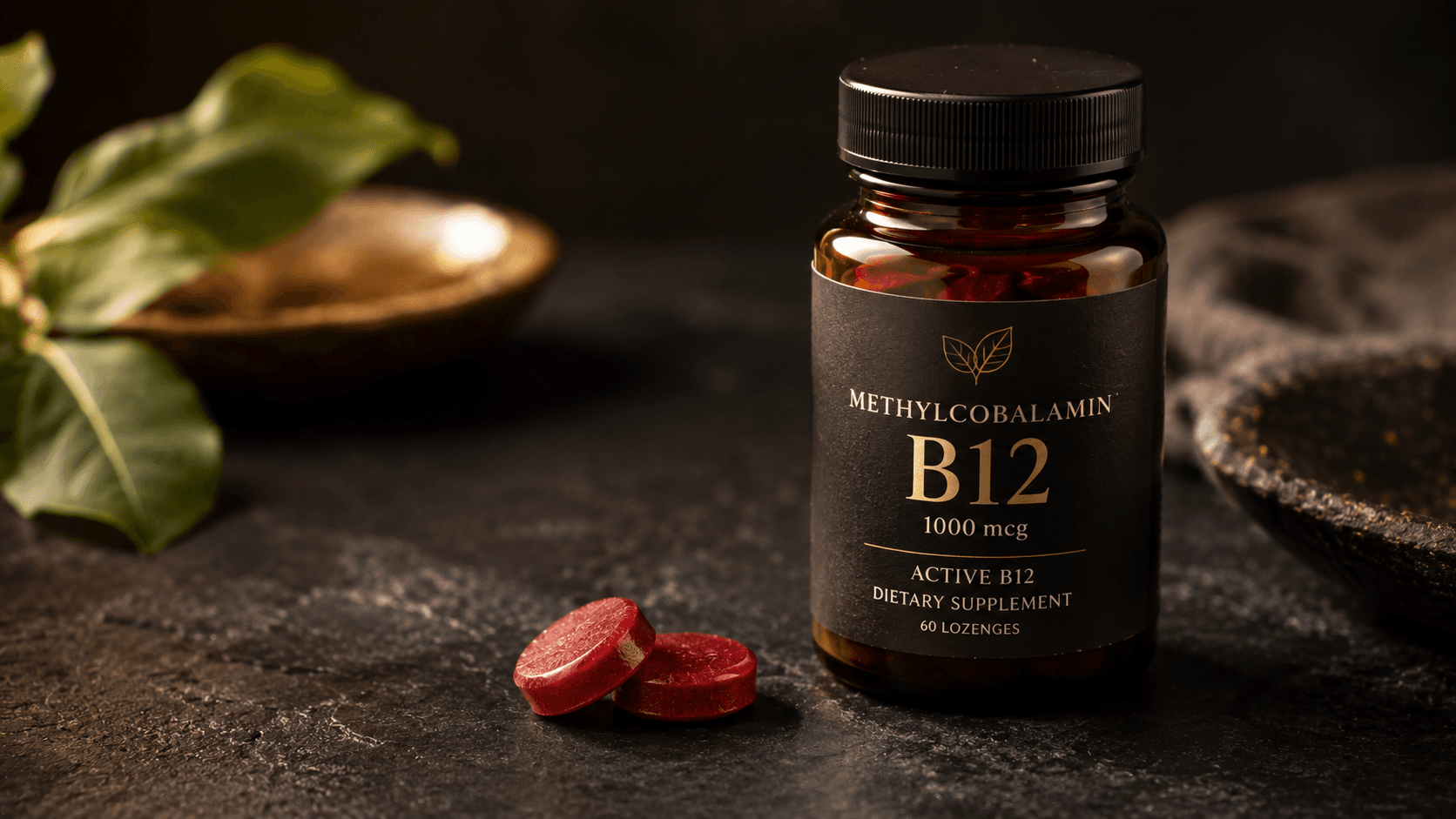
B12 is the most under-diagnosed nutrient deficiency in modern Western medicine. It is also one of the most consequential. Severe B12 deficiency causes neurological damage that can become irreversible if left untreated for long enough — peripheral neuropathy, cognitive decline that mimics dementia, mood disturbance, anemia. It causes people to lose function their doctors attribute to aging when in fact the cause is a missing vitamin. The standard serum B12 lab test that most American doctors order has a reference range that, by the assessment of the functional-medicine literature, is calibrated dramatically too low — Japan considers B12 deficient below 500 pg/mL; the United States considers it deficient below 200 pg/mL. The gap is enormous, and 20–30% of the people sitting in that gap have functional B12 deficiency that goes unrecognized for years.
This is the companion deep-dive to the B vitamins overview. That article introduced B12 alongside the rest of the complex; this one covers what makes it the most complex single vitamin in the human diet: the four chemical forms, the eight-step absorption pathway that gives the body more places to fail at B12 than at any other micronutrient, the reference range problem, the dementia and neurological case, and the question of when food is enough versus when supplementation becomes necessary.
What B12 actually is
Vitamin B12 — chemical name cobalamin — is the most complex of the eight B vitamins, and the most complex vitamin in the human diet by a significant margin. Three things make it unique:
- It contains a metal. B12 is built around a central cobalt atom — hence "cobalamin." This is the only vitamin in nature with a metal at its core. The corrin ring structure surrounding the cobalt is one of the most complex biological molecules outside of proteins themselves.
- It comes almost exclusively from animal sources. No plant produces B12 in usable form. The pseudo-B12 in algae, spirulina, and most fermented foods is biologically inactive and may actually interfere with real B12 absorption (see the spirulina article for the full breakdown of why this is one of the most persistent and consequential pieces of misinformation in the vegan-nutrition space).
- It has the most complex absorption pathway of any vitamin. The body uses an eight-step biological process to extract B12 from food and deliver it to tissues — covered in detail in the next section. The complexity is the reason deficiency is so common: there are far more places it can go wrong than with other vitamins.
The four forms — and why it matters which one you take
B12 exists in four different forms, distinguished by the chemical group attached to the central cobalt atom. They are not interchangeable in supplements, and the form question is one of the most under-discussed parts of any B12 conversation.
1. Cyanocobalamin — the cheapest, most common, and the wrong default
Cyanocobalamin is what is in almost every cheap multivitamin, B-complex pill, and fortified food in the United States. It is a synthetic form of B12 with a cyanide molecule attached to the cobalt. When your body processes cyanocobalamin, the cyanide group is released — a tiny amount, well below toxicity for healthy people, but unnecessary nonetheless. The body must then convert cyanocobalamin to one of the active forms before it can be used.
Cyanocobalamin is widely used because it is the most chemically stable form (the cyanide molecule binds tightest to the cobalamin ring) and the cheapest to manufacture. It is, however, not the form your body actually uses — it requires conversion that some people do less efficiently, and the cyanide release, while small, is worth avoiding when better options exist.
The functional-medicine consensus: avoid cyanocobalamin when better forms are available.
2. Methylcobalamin — one of the two active forms
Methylcobalamin is the active form of B12 your body uses for methylation reactions — including the conversion of homocysteine into methionine, the synthesis of neurotransmitters, and the regulation of gene expression. The methyl group attached to the cobalt is ready to be transferred directly to other molecules without requiring any conversion step.
For most oral and sublingual supplementation, methylcobalamin is the form to look for. Better retention than cyanocobalamin, ready-to-use methylation activity, no cyanide release, and particularly important for people with MTHFR gene variants (covered in the B vitamins article) who already have impaired methylation capacity.
3. Adenosylcobalamin — the mitochondrial active form
Adenosylcobalamin (sometimes written as dibencozide or coenzyme B12) is the other biologically active form. It works inside the mitochondria — specifically, in the breakdown of certain amino acids and fatty acids for energy production. While methylcobalamin handles the methylation side of B12's job, adenosylcobalamin handles the cellular energy side.
A few high-end B12 supplements provide both methylcobalamin and adenosylcobalamin together — the most complete form of supplementation available. For most people, methylcobalamin alone is enough; the body can convert between the two as needed.
4. Hydroxocobalamin — the injection workhorse
Hydroxocobalamin has a hydroxyl group attached to the cobalt, which gives it a longer half-life and higher plasma protein affinity than the other forms. This makes it the standard form used in B12 injections — a single shot of hydroxocobalamin lasts significantly longer in the body than the same dose of cyanocobalamin would.
Hydroxocobalamin is also useful in clinical situations like cyanide poisoning (it binds and neutralizes cyanide directly — the same chemistry that makes cyanocobalamin stable becomes therapeutic in this context). For people with MTHFR variants or methylation issues who don't tolerate methylcobalamin well, hydroxocobalamin is often the preferred supplemental form because the body converts it to whichever active form is needed.
The short version: methylcobalamin for daily sublingual or oral supplementation. Hydroxocobalamin for injections or for people who don't tolerate methyl forms. Avoid cyanocobalamin when possible.
The absorption story — why B12 deficiency is so common
B12 has the most complicated absorption pathway of any vitamin in the human diet. The body uses an eight-step biological process to extract B12 from food and get it into circulation, and each step is a potential failure point. Understanding the pathway is the key to understanding why B12 deficiency is so common in modern populations.
The full sequence:
- B12 in food is bound to dietary proteins. In the mouth, saliva contains haptocorrin (R-protein) that begins binding to B12.
- In the stomach, hydrochloric acid and pepsin released by parietal cells digest the food proteins and free the B12. Without adequate stomach acid, this step fails.
- The freed B12 binds tightly to haptocorrin (R-protein) in the stomach — a temporary carrier that protects it through the acidic environment.
- In the duodenum (upper small intestine), pancreatic enzymes degrade haptocorrin, releasing the B12 again.
- The B12 then binds to intrinsic factor (IF) — a glycoprotein produced specifically by parietal cells in the stomach. Without adequate intrinsic factor, this step fails entirely. This is the critical step that goes wrong in pernicious anemia.
- The B12-IF complex travels through the small intestine to the terminal ileum — the very last section of the small intestine. Damage to this segment (from Crohn's disease, celiac disease, or surgical resection) prevents absorption.
- In the terminal ileum, the B12-IF complex binds to cubilin-amnionless receptors on the intestinal wall and is absorbed via receptor-mediated endocytosis.
- Inside the bloodstream, B12 is transferred to transcobalamin II, which transports it to tissues and cells throughout the body.
Eight steps. Multiple specific proteins, enzymes, and tissue locations that all have to work correctly. The contrast with most other vitamins is stark — vitamin C, for example, is absorbed by simple passive diffusion across the small intestine wall, requiring no carriers, enzymes, or specific tissue locations. The complexity of B12 absorption is why so many things can go wrong with it.
Who tends to be deficient — and why
The eight-step pathway creates a long list of populations at high risk of B12 deficiency:
Older adults — the largest deficient population
Roughly 30% of adults over 60 have some degree of atrophic gastritis — chronic inflammation of the stomach lining that reduces hydrochloric acid and intrinsic factor production. Both Step 2 and Step 5 of the absorption pathway become impaired. Even adequate dietary B12 intake fails to translate into usable circulating B12. This is the single largest cause of B12 deficiency in the developed world, and almost all of it is misdiagnosed as aging, fatigue, "mild cognitive decline," or worse.
PPI and acid-blocker users
Proton pump inhibitors — Prilosec (omeprazole), Nexium (esomeprazole), Prevacid (lansoprazole), and similar drugs — work by suppressing hydrochloric acid production. They do exactly what they advertise. They also destroy B12 absorption by failing the stomach acid step. PPIs are among the most widely prescribed drugs in the world, often taken for years or decades. Long-term use is one of the most common iatrogenic causes of B12 deficiency in modern medicine.
Metformin users
Metformin — the most-prescribed diabetes drug in the world — depletes B12 through a mechanism that is still not fully understood but is clinically well-documented. Estimates put B12 deficiency rates in long-term metformin users at 10–30%. Most are not told to test or supplement. The American Diabetes Association recommends periodic B12 screening for metformin users; in practice, this is rarely done.
Vegans and strict vegetarians
Animal foods are the only reliable dietary source of usable B12. Plant foods do not produce it. People who have eliminated all animal foods from their diet must supplement — there is no honest food-based alternative. The spirulina and algae claims are substantially incorrect, as covered in the spirulina article. Fortified foods (cereals, nutritional yeast, plant milks) can fill the gap if intake is consistent and adequate.
Pernicious anemia
An autoimmune condition in which the body produces antibodies that attack either the parietal cells or intrinsic factor itself. Intrinsic factor production fails, B12 absorption stops, and severe deficiency develops over time. Pernicious anemia requires injectable B12 (hydroxocobalamin typically) because the absorption pathway itself is broken.
GI surgery and conditions affecting the ileum
- Gastric bypass and other bariatric surgeries remove or bypass the parietal cells. Lifetime B12 supplementation is essentially mandatory afterward.
- Crohn's disease, particularly when it affects the terminal ileum, destroys the absorption site. Many Crohn's patients require lifelong B12 injections.
- Celiac disease can damage the small intestine, including the terminal ileum, and reduce B12 absorption even when gluten is removed.
- H. pylori infection is associated with atrophic gastritis and reduced acid production.
Other depleters
- Heavy alcohol use — affects stomach acid production, liver storage of B12, and overall absorption.
- Nitrous oxide exposure — both medical (anesthesia) and recreational (whippets, hippy crack). Nitrous oxide inactivates B12 by oxidizing its central cobalt atom. Frequent or heavy users develop functional B12 deficiency rapidly.
- Long-term broad-spectrum antibiotics can disrupt the gut bacteria that contribute to B12 balance.
- H2 blockers (Pepcid, Zantac, etc.) — same acid-suppression mechanism as PPIs, milder but still a concern with long-term use.
The reference range problem — why "normal" lab values miss deficiency
This is the single most consequential teaching point in the entire article, and the one that explains why so many B12-deficient people get misdiagnosed for years.
The standard serum B12 reference range in the United States is roughly 200 to 900 pg/mL. Anything above 200 is considered "normal" — meaning a patient with a serum B12 of 210 gets told their B12 is fine. The problem: this cutoff is dramatically too low.
Compare the international picture:
- Japan and most of Europe: Deficiency threshold at 500 pg/mL. Japan actually raised its reference range in the 1980s after recognizing that the previous lower cutoff was missing functional deficiencies.
- The United States: Still at 200 pg/mL. Functional-medicine practitioners describe this as "one of the most poorly calibrated laboratory cutoffs in clinical medicine."
The clinical implication is documented in the research: 20–30% of people with serum B12 between 200 and 500 pg/mL have elevated methylmalonic acid (MMA), which confirms functional B12 deficiency despite a "normal" serum reading. Neurological symptoms of B12 deficiency are documented at serum levels up to 350 to 400 pg/mL in multiple clinical series.
If your serum B12 is between 200 and 500 pg/mL and you have symptoms of deficiency — fatigue, brain fog, tingling, mood changes, memory issues — there is a one-in-four to one-in-three chance you are functionally deficient despite the "normal" lab result. Ask for an MMA test before you accept the dismissal.
The number to ask your practitioner for is at least 500 pg/mL serum B12 as the functional floor, with optimal at 700+ pg/mL. Below 500, MMA testing is warranted regardless of how "normal" the serum reading looks.
MMA — the better functional marker
Methylmalonic acid (MMA) is the most accurate functional marker for B12 status. The biochemistry is clean: when B12 is functionally low, a specific reaction (the conversion of methylmalonyl-CoA to succinyl-CoA, catalyzed by adenosylcobalamin) slows down. Methylmalonyl-CoA accumulates, and its breakdown product — methylmalonic acid — rises in blood and urine.
This means: elevated MMA = functional B12 deficiency, even when serum B12 reads normal. MMA testing closes the gap between what the simple serum B12 test shows and what is actually happening at the cellular level.
The tests to ask for if you suspect a B12 problem:
- Serum B12 — baseline, but interpret with the international reference range (functional floor at 500 pg/mL), not the US 200 cutoff.
- Methylmalonic acid (MMA) — the functional gold standard. Elevated MMA = real deficiency.
- Homocysteine — also elevated in B12 deficiency (though it's elevated in folate deficiency too, so less specific). Useful as a cardiovascular risk marker independently.
- Holotranscobalamin (Active B12) — a newer test that measures only the bioactive fraction of B12. More accurate than total serum B12 but not widely available in standard labs yet.
- Complete blood count (CBC) with MCV — elevated mean corpuscular volume (large red blood cells, megaloblastic pattern) is a classic B12 deficiency sign.
- Folate — should be tested alongside, because folate deficiency can mask B12 deficiency on the CBC while the neurological damage progresses anyway.
The deficiency symptoms
B12 deficiency presents on multiple fronts because the vitamin is required for so many distinct processes. The symptom picture, in rough order of severity:
Neurological — the most concerning
- Peripheral neuropathy — numbness, tingling, "pins and needles" sensations, especially in feet and hands. Often the first noticeable symptom.
- Loss of vibratory sense and proprioception — your sense of where your limbs are in space deteriorates.
- Gait problems and balance issues — stumbling, difficulty walking heel-to-toe, difficulty with stairs.
- Subacute combined degeneration of the spinal cord — the late-stage neurological manifestation. Severe, can be permanent if untreated long enough.
The neurological damage is what makes B12 deficiency urgent. Long-standing B12 deficiency causes demyelination of nerves — destruction of the fatty insulating sheath around nerve fibers — and that damage can become permanent if the deficiency is not corrected in time. Catching B12 deficiency early is the difference between full recovery and permanent neurological deficit.
Cognitive and psychiatric
- Brain fog — that fundamental "I can't think clearly" feeling that's so common in modern adults.
- Memory problems — particularly short-term recall. B12-deficiency memory issues mimic early dementia closely enough that "reversible dementia" in older adults is, in a meaningful percentage of cases, just an unrecognized B12 deficiency.
- Cognitive slowing — processing speed decreases.
- Depression and anxiety — through the methylation pathway and neurotransmitter synthesis disruption.
- Irritability, mood swings, personality changes — in severe cases.
- Psychosis — in extreme, prolonged deficiency.
Hematological
- Megaloblastic anemia — the classic "B12 anemia." Red blood cells become large, irregular, and inefficient at carrying oxygen.
- Fatigue — chronic, profound, doesn't improve with sleep.
- Pallor — pale skin and inside of lower eyelids.
- Shortness of breath and heart palpitations — secondary to the anemia.
Other
- Glossitis — smooth, beefy-red tongue. A classic clinical sign.
- Mouth ulcers and a sore tongue.
- Loss of appetite, weight loss in advanced cases.
The dementia connection
One of the most tragic patterns in geriatric medicine is the misdiagnosis of B12 deficiency as dementia. An older adult presents with memory problems, confusion, brain fog, balance issues, and possibly mood changes. The family worries about Alzheimer's. The doctor orders standard cognitive testing, possibly imaging, possibly a neurology referral. What often does not happen is a thorough B12 workup with MMA, even though the symptoms are textbook B12 deficiency presentation.
B12 deficiency in older adults can present as a complete dementia syndrome — and in many cases, restoring B12 completely reverses the cognitive symptoms. The neurology literature describes this as "reversible dementia," and B12 deficiency is one of the most common identifiable causes when the workup is actually done.
If you have an older adult in your life developing memory or cognitive symptoms, before you accept a dementia diagnosis, insist on serum B12 (with the 500 pg/mL functional floor) and MMA testing. The cost of these tests is trivial. The cost of missing a treatable cause is enormous.
The top food sources of B12
For people whose absorption pathway works correctly, food can provide more than adequate B12. The top sources, in rough order of B12 density:
- Clams — the single highest source. A 3-oz serving delivers roughly 80 mcg, over 3,000% of daily requirement.
- Beef liver — about 70 mcg per 3 oz. One of the most nutrient-dense foods in existence. A single serving of liver once a month essentially covers B12 by itself.
- Oysters and mussels — extraordinarily high, comparable to clams.
- Mackerel and sardines — ~9 mcg per 3 oz.
- Salmon — ~4–5 mcg per 3.5 oz. Single serving covers daily requirement.
- Beef (grass-fed especially) — ~2–3 mcg per 3 oz. Reliable everyday source.
- Cod and other lean fish — ~1 mcg per 3 oz. Moderate but real contribution.
- Eggs — ~0.6 mcg per egg, most of it in the yolk. Daily contribution adds up.
- Dairy — milk, yogurt, cheese all contribute modest amounts.
- Nutritional yeast (fortified) — one of the few non-animal options that delivers true B12, usually as methylcobalamin in quality brands.
The official daily requirement is 2.4 mcg for adults — though this number is widely considered too low. Functional-medicine targets for daily intake are typically 5–10 mcg or more, particularly for older adults and anyone with absorption concerns. Real food sources easily clear that bar.
When to supplement
Food first, supplement when food alone isn't enough. Clear-cut situations where B12 supplementation is warranted regardless of diet:
- Vegans and strict vegetarians. Non-negotiable. Take methylcobalamin sublingually or use fortified foods consistently.
- Adults over 50 — even with adequate dietary intake, declining stomach acid and intrinsic factor production reduce absorption efficiency. Supplementation becomes increasingly important.
- Anyone on PPIs, H2 blockers, or metformin — your medication is interfering with B12 absorption. Supplement and re-test periodically.
- History of gastric or intestinal surgery — gastric bypass, ileal resection, etc. Usually requires lifelong supplementation, often by injection.
- Pernicious anemia — requires injectable B12 because the absorption pathway is broken.
- Crohn's, celiac, or other GI conditions affecting the terminal ileum.
- Confirmed deficiency on labs — serum B12 below 500 pg/mL with symptoms, or elevated MMA regardless of serum level.
- Pregnancy — increased demand, particularly important for fetal neurological development. Methylcobalamin preferred.
Supplementation routes and dosages
Sublingual methylcobalamin — the default oral option
For most people who need supplementation, the simplest and most effective approach is sublingual methylcobalamin — tablets or drops dissolved under the tongue. The sublingual mucosa absorbs B12 directly into the bloodstream, bypassing the intrinsic-factor-dependent pathway in the gut that tends to fail in older adults. For most people, this works as well as injections without the needle.
Typical doses:
- 1,000 mcg daily for general supplementation in adults over 50 or vegans.
- 2,500–5,000 mcg daily for short-term correction of confirmed deficiency.
- 5,000+ mcg several times a week for people with severe absorption issues.
B12 is non-toxic at high doses — excess is simply excreted in urine. There is no meaningful overdose concern with oral or sublingual B12.
Injections — for severe deficiency
Injectable B12 (usually hydroxocobalamin, sometimes methylcobalamin) is the gold standard for severe deficiency, pernicious anemia, or any condition where the gut absorption pathway is broken. Typical protocols are weekly injections during a loading phase, then monthly maintenance. These are typically prescribed and administered by a doctor.
Quality brand references
For oral sublingual methylcobalamin (not products I am specifically affiliated with — these are quality reference points):
- Pure Encapsulations B12 Liquid or sublingual tablets — clean formulation, reliable methylcobalamin.
- Jarrow Methyl B-12 — widely available sublingual lozenge.
- Solgar Methylcobalamin — well- regarded sublingual.
- Quicksilver Scientific Liposomal Methyl B12 — premium liposomal delivery for higher bioavailability.
- Seeking Health offers both methyl and hydroxo forms — useful if you don't tolerate methylcobalamin well.
My approach
Almost entirely food-based, by intention. My current B12 intake comes from the same animal foods that cover the rest of the B vitamins:
- Eggs daily. Modest B12 per egg, but consistent daily intake adds up.
- Grass-fed beef several times a week. Reliable B12 contribution at every meal it's part of.
- Salmon and cod when they're on the menu. A single serving of salmon covers daily B12 by itself; cod adds a moderate contribution.
- Tangy Tangerine — the Wallach Youngevity drink (covered in the boron article) contains added B12 alongside the trace minerals. Background contribution rather than primary source.
With this combination, I have not historically needed separate B12 supplementation, and labs have supported that. The honest caveat is that this only works because of the specific situation I'm in — under 50, no medications that deplete B12, no identified absorption issues, varied animal-foods diet. The picture would change in any of the following conditions:
- Crossing 50 (declining absorption capacity)
- Going on any of the medications that deplete B12 (PPI, metformin, etc.)
- Eating less animal food (whether by choice or circumstance)
- Developing any GI condition affecting absorption
- Lab work suggesting borderline or low B12 status — particularly elevated MMA
In any of those situations, I would add a daily sublingual methylcobalamin (1,000 mcg) without hesitation. The food protocol is the floor; the sublingual is the easy upgrade when life conditions change.
How to start
- Eat animal foods regularly if you can. Eggs, beef, salmon, sardines, occasional liver. This is the foundation. With this in place, most non-vegan, non-elderly, non-medicated people don't need a separate B12 supplement.
- If you have symptoms, get tested. Ask for serum B12 and MMA. If your serum B12 is below 500 pg/mL with symptoms, insist on the MMA test before accepting a "normal" dismissal.
- If you're vegan or vegetarian, take sublingual methylcobalamin daily. This is non- negotiable; the algae claims do not provide real B12.
- If you're over 50 or on PPIs/metformin, add a daily sublingual methylcobalamin (1,000 mcg) as insurance. Re-test in 3–6 months.
- Avoid cyanocobalamin where possible. Read labels. Choose methylcobalamin or hydroxocobalamin.
- If a loved one is showing signs of cognitive decline, insist on a complete B12 workup (serum B12 + MMA + homocysteine + folate + CBC) before accepting a dementia diagnosis. The cost is trivial. The stakes are enormous.
Closing
B12 is the deficiency mainstream medicine misses more often than any other. The combination of a complex absorption pathway with many failure points, a reference range calibrated below where functional deficiency actually starts, and a symptom picture that overlaps with aging, depression, anxiety, and dementia means that an enormous number of people are running on functionally low B12 without anyone recognizing it.
The case for caring about B12 specifically — and not just "B vitamins generally" — is that the neurological damage from prolonged deficiency can become permanent. You don't get unlimited time to catch it. The cognitive decline, the peripheral neuropathy, the gait problems — these reverse if caught early and don't reverse if caught late.
The protocol, in summary:
- Eat animal foods regularly — eggs, beef, salmon, the occasional liver. This is the food-first foundation.
- Test serum B12 with the 500 pg/mL functional floor, not the US 200 cutoff. Add MMA if you have symptoms.
- Use methylcobalamin or hydroxocobalamin if you supplement. Avoid cyanocobalamin.
- Supplement if you're vegan, over 50, on PPIs/metformin, or have any of the absorption-related conditions covered above.
- For anyone in your life with cognitive symptoms, insist on B12 testing before accepting a dementia diagnosis.
The vitamin is named after the metal at its center. The deficiency is named for the people it quietly cripples. The fix — for almost everyone in the developed world — is shockingly accessible.
Sources & further reading
- Dr. Berg — Methylcobalamin vs Cyanocobalamin: Which Is Better
- Vitamin B12 Deficiency — StatPearls / NCBI Bookshelf (comprehensive medical reference)
- Pernicious Anemia — StatPearls / NCBI
- Watanabe et al., 'Biologically active or just pseudo-vitamin B12 as predominant form in algae-based nutritional supplements'
- Chris Kresser — Why B12 Deficiency Is Significantly Underdiagnosed (the canonical critique of the US reference range)
- Vitamin B12 — Optimal Levels, Reference Ranges & Interpretation — Lamkin Clinic
- Methylmalonic Acid (MMA) as key marker of vitamin B12 status and metabolism — Biocrates
- Association of vitamin B12, MMA, and functional parameters — Netherlands Journal of Medicine