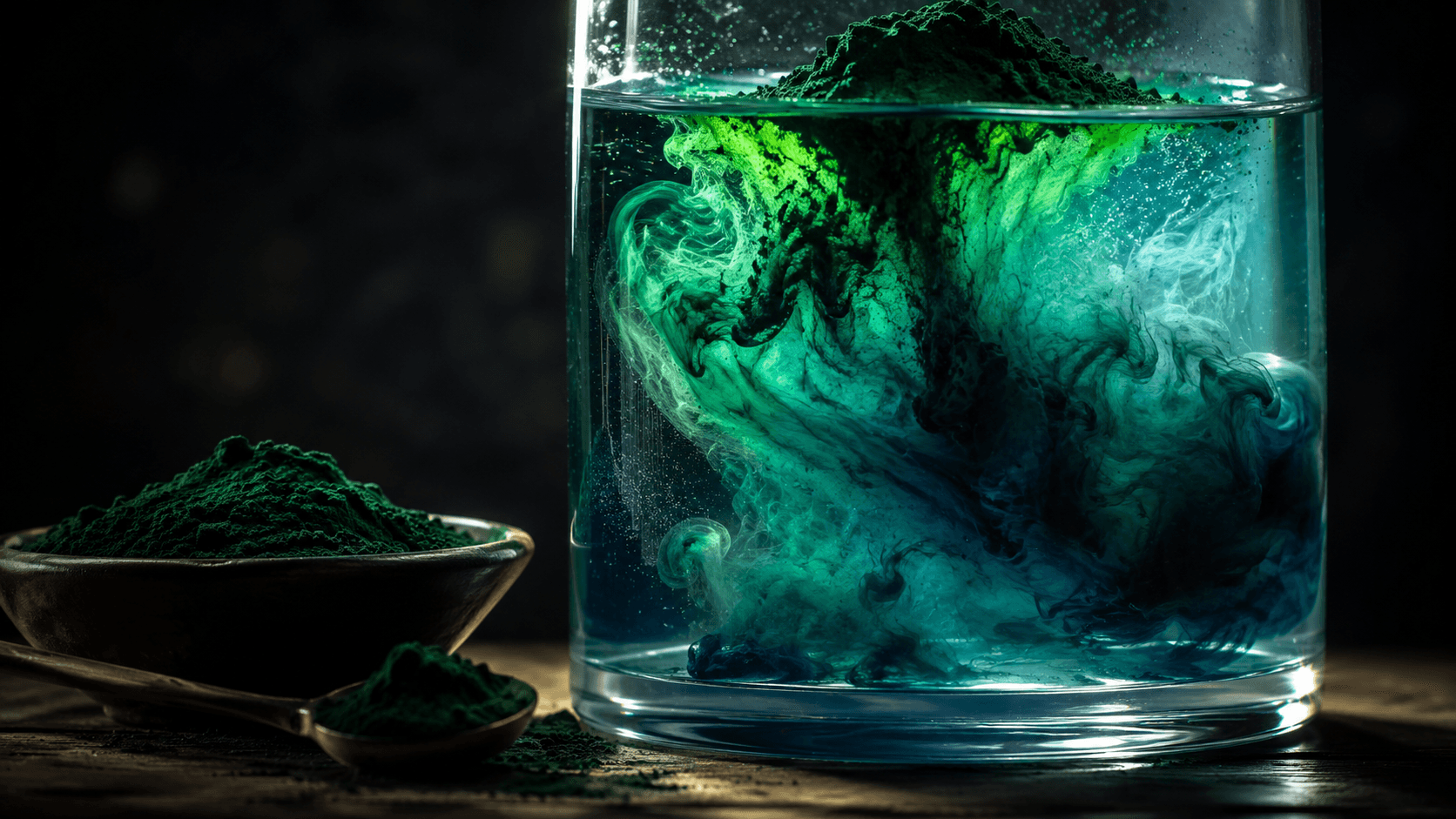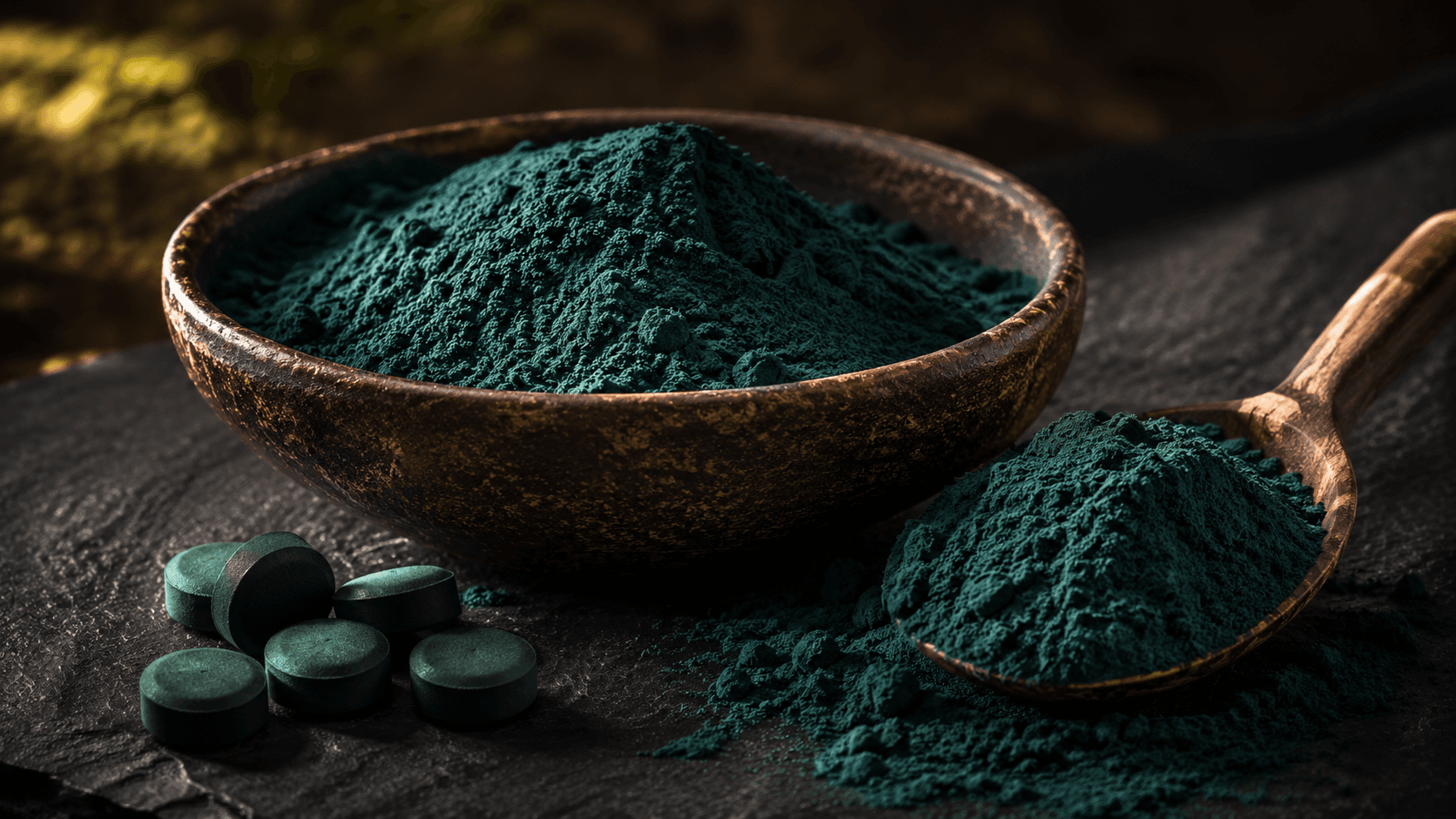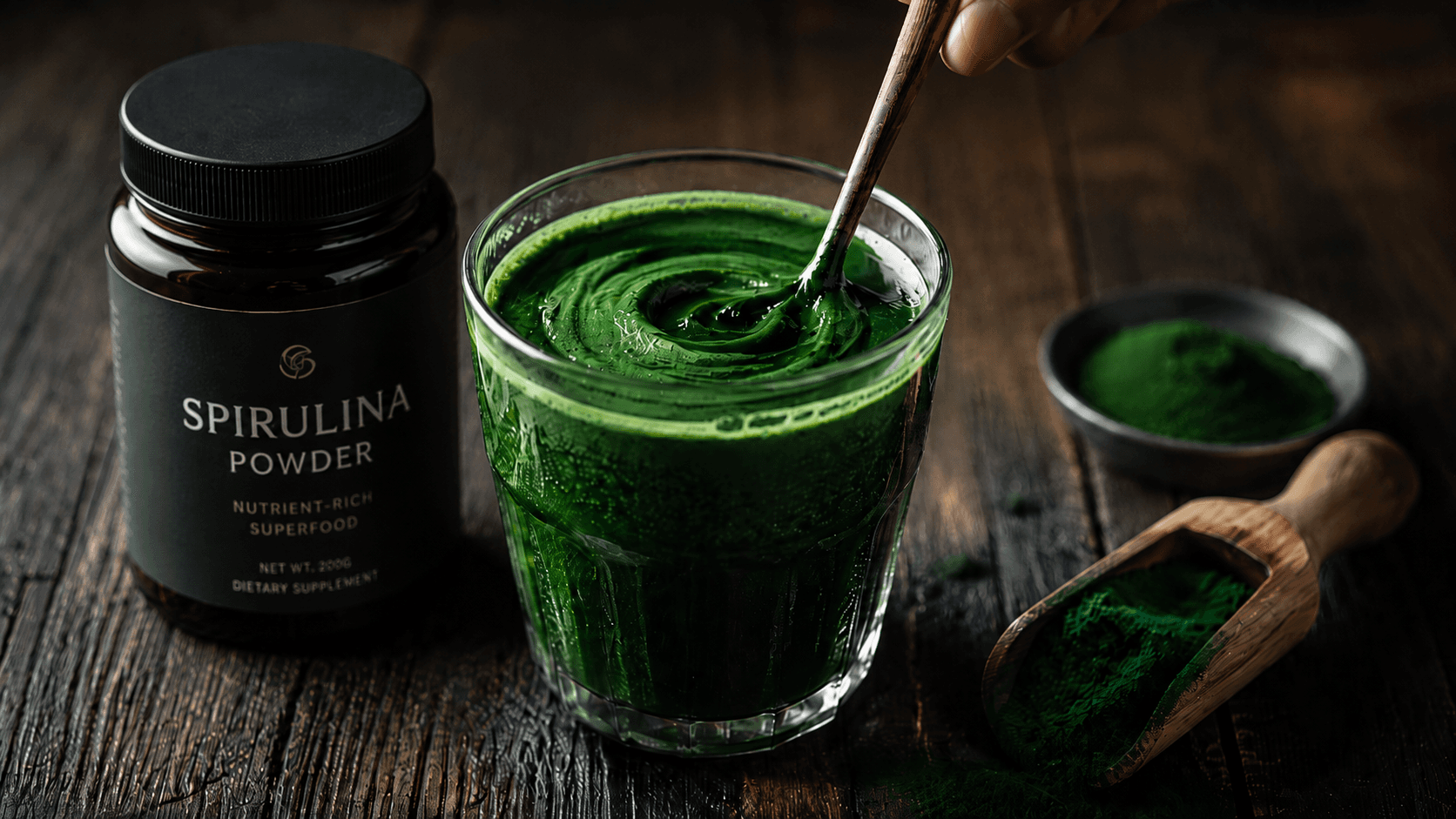
Spirulina is, by most reasonable measures, one of the most nutrient-dense single foods on earth. It is roughly 60–70% complete protein by weight — more than steak, more than eggs, more than soy. It contains an antioxidant pigment called phycocyanin that is unique to spirulina and a handful of related cyanobacteria — a compound that, in clinical research, has shown measurable effects on cholesterol, blood pressure, oxidative stress, and inflammation. NASA has studied it as a candidate food for long-duration space missions. The Aztecs harvested it from Lake Texcoco as a staple food. The Kanembu people of Lake Chad in central Africa have been doing the same with their local strain — called dihé — for centuries.
And yet — and this is the part that gets less attention in the marketing — spirulina also has a handful of real caveats. The most consequential is that the famous "high B12 content" claim, which is what got spirulina classified as a vegan superfood in the first place, is mostly incorrect: the B12 in spirulina is largely a biologically inactive analogue that your body can't use, and in some studies it may actually compete with and reduce absorption of real B12. There is also a heavy-metal contamination concern with low-quality sources, an immune-stimulation concern for people with autoimmune conditions, and a quality variance across brands that is wider than almost any other supplement on the shelf.
This article covers both sides honestly — the real research-supported benefits, the practical use case, and the caveats that most spirulina coverage glosses over. Spirulina is a powerful nutritional tool when used correctly. It is not magic, and not a substitute for the things it's often marketed as a substitute for.
What spirulina actually is
Spirulina is the common name for two species of cyanobacteria (blue-green algae): Arthrospira platensis and Arthrospira maxima. Cyanobacteria are among the oldest forms of life on earth — fossil evidence places their ancestors at over 3.5 billion years old. They are the original photosynthesizers; the oxygen in earth's atmosphere is largely there because cyanobacteria spent two billion years putting it there.
Spirulina has been eaten as food by multiple human cultures for at least a thousand years. The clearest historical records come from:
- The Aztecs — who harvested spirulina from Lake Texcoco (the lake that Mexico City was later built on top of), dried it into cakes called tecuitlatl, and ate it as a regular protein source.
- The Kanembu people of Chad — who still harvest spirulina from Lake Chad today, drying it into cakes called dihé and using it as a daily food.
Modern commercial spirulina is cultivated in controlled ponds (mostly in Hawaii, California, India, and China), harvested by filtration, and spray-dried into the green powder you see on supplement shelves. The growing conditions matter enormously — more on that in the quality section below.
Nutritional density
Per gram, spirulina is one of the densest concentrations of nutrients in any food source. A single tablespoon (about 7 grams) of dried spirulina powder contains:
- ~4 grams of complete protein with all nine essential amino acids in roughly the right proportions. Spirulina is one of the few non-animal sources of complete protein.
- Iron, calcium, magnesium, potassium, zinc in meaningful amounts.
- Beta-carotene (precursor to vitamin A), vitamin K, and a range of B vitamins.
- Gamma-linolenic acid (GLA) — a rare omega-6 fatty acid with anti-inflammatory properties (the same one that makes evening primrose oil valuable).
- Chlorophyll — the same green pigment that gives wheatgrass most of its medicinal value.
- Phycocyanin — the unique blue pigment, covered in detail below.
- Less than 1 gram of carbohydrates per tablespoon, making it essentially keto-compatible.
For a single ingredient that you can shake into a smoothie, this is a remarkable nutritional payload. The density is the reason traditional cultures that incorporated it survived on less calorically-dense food overall — spirulina filled in the protein, mineral, and micronutrient gaps that their other foods couldn't cover.
Phycocyanin — the unique compound
The single most interesting thing about spirulina is its phycocyanin content. Phycocyanin is the blue pigment that gives spirulina (when combined with chlorophyll's green) its characteristic deep blue-green color. It is found almost exclusively in spirulina and a handful of related cyanobacteria — there is no other common food on the standard human diet that contains it.
The active mechanisms documented in published research:
- Powerful antioxidant action. Phycocyanin neutralizes free radicals at rates comparable to or exceeding vitamin C and vitamin E.
- Anti-inflammatory action. Phycocyanin selectively inhibits COX-2 — the same enzyme that pharmaceutical NSAIDs (ibuprofen, aspirin, celecoxib) target. The mechanism is part of why spirulina shows measurable anti-inflammatory effects in controlled studies.
- Endothelial nitric oxide stimulation. Phycocyanin increases the expression of endothelial nitric oxide synthase (eNOS) in blood vessel walls, which improves vasodilation, supports healthy blood pressure, and protects the vascular endothelium. This is the same nitric oxide pathway covered in the beets article.
- Hepatoprotective (liver-supportive) effects. Phycocyanin has been shown to reduce liver injury markers in animal models of toxic liver damage and to improve outcomes in non-alcoholic fatty liver disease studies in humans.
- Emerging anti-cancer research. Mostly in vitro and animal models so far, but with consistent findings of selective cytotoxicity against certain cancer cell lines while sparing healthy cells.
Pure phycocyanin is sold as a standalone supplement — extracted and concentrated — at significant cost. Spirulina powder is the affordable way to get a real dose of it daily, plus everything else that comes along with it.
What the clinical research actually shows
Spirulina has been the subject of an unusual amount of clinical research for a single food — including systematic reviews and meta-analyses of randomized controlled trials, which is the gold standard of evidence. The consistent findings:
Cholesterol and lipid profile
A meta-analysis of RCTs on spirulina supplementation found significant improvements across the lipid panel:
- Triglycerides reduced by ~15 mg/dL on average.
- Total cholesterol reduced by ~12 mg/dL.
- LDL cholesterol reductions of up to 10% in some trials.
- HDL cholesterol modestly increased.
These are real, clinically meaningful improvements from a food supplement — the kind of effect size that some prescription medications struggle to consistently produce.
Blood pressure
A 2021 systematic review and meta-analysis confirmed "a significant, clinically relevant reduction in systolic blood pressure" with spirulina supplementation, with the effect most pronounced in subjects with elevated baseline pressure. The mechanism ties back to phycocyanin and the endothelial nitric oxide pathway.
Other clinical findings
- Body fat reduction. Spirulina supplementation, particularly when combined with exercise, produces modest reductions in body fat percentage and waist circumference.
- Allergic rhinitis. Multiple RCTs have shown spirulina meaningfully reduces symptoms of seasonal allergic rhinitis (hay fever) — runny nose, sneezing, congestion. The mechanism is part anti-inflammatory, part immune modulation.
- Liver function. Particularly relevant for non-alcoholic fatty liver disease, where spirulina supplementation has reduced liver enzyme markers in controlled studies.
- Blood sugar. Modest improvements in fasting glucose and insulin sensitivity in pre-diabetic and type 2 diabetic populations.
- Exercise recovery. Some research (though less robust than the cardiovascular evidence) suggesting spirulina may reduce exercise-induced oxidative stress and improve recovery time. This partially supports its use as a sports-nutrition add-on, which is the protein-shake context most people encounter it in.
The B12 myth — the honest caveat most coverage skips
Here is the part that most spirulina marketing carefully avoids. Spirulina is widely promoted as a vegan source of vitamin B12. This claim is substantially incorrect, and the science is unambiguous.
When you test spirulina with a standard microbiological B12 assay — the kind originally developed to measure B12 activity in bacteria — you get a high reading. This is how spirulina got its B12 reputation in the first place. The problem is that those early assays cannot distinguish between true vitamin B12 and its biologically inactive analogues (pseudo-cobalamins). When researchers developed better tests that could tell the difference, what they found was striking: between 73% and 98% of the "B12" in commercial spirulina is actually pseudo-cobalamin, not the real vitamin.
Pseudo-cobalamin is structurally similar to true B12 but biologically inactive in humans. Worse, there's research showing that the pseudo form may actively compete with real B12 at intrinsic factor — the gut protein that absorbs B12 — with one in-vitro study finding the binding affinity of pseudo-B12 to intrinsic factor to be 500 times lower than true B12. The practical implication is that pseudo-B12 may reduce absorption of any real B12 you're getting from food.
A 1991 study published in the American Journal of Clinical Nutrition looked at vegan toddlers with B12-deficiency anemia who were supplemented with spirulina and nori (another algae) as their B12 sources. Their anemia got worse, not better. Four to six months of "spirulina B12" did not correct the deficiency; the children's hematological markers deteriorated.
If you are vegan or vegetarian and you have been relying on spirulina for B12, you are not getting B12. You need to supplement actual methylcobalamin or cyanocobalamin separately, or eat actual animal-source foods that contain real B12.
This is the kind of correction the alt-health space tends to be slow to make because the "spirulina is a complete vegan superfood" story is so compelling. The honest version: spirulina is excellent at many things; B12 delivery for humans is not one of them. If you eat meat, eggs, or dairy, you don't need spirulina for B12 — and if you don't, you need to get B12 from a real source (animal foods, fortified foods, or properly formulated supplements with methylcobalamin or cyanocobalamin). Spirulina is not it.
Other honest caveats
Heavy metal contamination
Spirulina, like any aquatic organism, absorbs minerals and metals from the water it grows in. This is part of how it concentrates beneficial minerals like iron and magnesium — but the same mechanism means it can also concentrate lead, mercury, cadmium, and arsenic if the water is contaminated. Spirulina grown in poorly regulated facilities, in regions with environmental contamination, or wild-harvested from polluted lakes can carry heavy metal loads at levels that make the supplement worse for you than not taking it at all.
The practical implication: brand and source matter enormously with spirulina. Reputable producers test every batch for heavy metals and microcystin (a liver toxin that can contaminate poorly-controlled algae production). Discount-bin spirulina from unknown sources is genuinely a quality risk. This is one of the few supplements where the price gap between cheap and quality reflects a real safety difference.
Autoimmune conditions
Spirulina is immune-stimulating. It increases the activity of multiple immune-cell populations — which is part of why it shows benefit for allergies, immune function, and general resistance to infection. The same property makes it potentially problematic for people with active autoimmune conditions, where the immune system is already attacking the body's own tissues. Conditions where caution is particularly warranted:
- Hashimoto's thyroiditis and Graves' disease
- Lupus (systemic lupus erythematosus)
- Multiple sclerosis
- Rheumatoid arthritis
- Crohn's disease and ulcerative colitis
- Psoriasis (in some cases)
The case-by-case picture is complex — some autoimmune patients do fine on spirulina; others see flares. If you have an autoimmune condition, talk to a practitioner familiar with both the condition and the immune- stimulating effects of medicinal foods before adding daily spirulina.
PKU (phenylketonuria)
Spirulina is very high in the amino acid phenylalanine, which people with phenylketonuria (PKU) cannot metabolize. This is a specific genetic condition usually identified in infancy, but anyone with diagnosed PKU should avoid spirulina entirely. This caveat applies to a small population but is worth noting.
My approach
Simple and unfussy. Spirulina is one of the easier supplements to integrate into an existing daily routine because the form is just powder that mixes into almost anything.
- The recommended dose of spirulina powder (whatever the bottle specifies — typically 3 to 5 grams), once a day, blended into a protein shake. Same shake also includes creatine. The combination gives me a daily nutrient-density boost without requiring extra effort — the shake was already part of the routine; the spirulina is just an additive.
- I'm not taking it for any specific therapeutic reason. I don't have hypertension, high cholesterol, allergic rhinitis, or any of the conditions the clinical literature specifically supports it for. I'm taking it as a general nutrient-density and antioxidant insurance policy — the kind of small daily input that, kept up over years, contributes to the slow accumulated foundation the rest of this section is built around.
The protein-shake integration is honestly the cleanest way to take spirulina. The taste is intense — vegetal, slightly fishy, definitely not for everyone in straight form — and a protein shake with banana, cocoa, berries, or any flavored protein powder masks it completely. Some people tolerate it in water; most don't. The shake is the simple answer.
How to buy quality spirulina
This matters more for spirulina than for most supplements. Look for:
- Third-party heavy metal testing with results published or available on request. Any reputable spirulina producer will gladly share their testing data.
- Controlled tank or pond cultivation rather than wild-harvested. The major producers (in Hawaii, California, India) grow in dedicated facilities where water quality is monitored constantly.
- USDA Organic or equivalent certification — particularly meaningful for a product where the growing environment determines the safety of the final product.
- Spray-dried at low temperature to preserve the heat-sensitive phycocyanin. Some cheap producers use high-heat drying that degrades the active compounds.
- Powder over tablets for cost-per-gram. Tablets are convenient but you pay 2–3× more per dose for the convenience. The powder form lets you use it in a shake (which is the easiest application anyway).
Reputable brands worth knowing about (not products I'm specifically affiliated with — these are reference points rather than personal endorsements):
- Nutrex Hawaii (Hawaiian Pacifica Spirulina) — grown by Cyanotech in dedicated ponds on the Kona coast, deep-ocean water source, considered the gold-standard producer. More expensive but consistently clean and high in phycocyanin.
- Earthrise — California-grown, also high-quality, decades of operation.
- Now Foods — generally reliable mid-market option with third-party testing.
- Micro Ingredients — competitively priced, organic, third-party tested. (The same brand covered in the beets article for their beet root juice powder; they also make spirulina.)
How to start
- Start with half the recommended dose for the first week. Some people have mild GI reactions (nausea, loose stool) when first introducing spirulina at full dose. Ramp up gradually.
- Take it with food — not on an empty stomach. The protein-shake integration is ideal because the shake provides the food matrix.
- Take it in the morning or with a meal, not at night. Some people find it mildly energizing (probably the B-vitamin content) and don't sleep well if they take it close to bedtime.
- Mask the flavor with stronger ingredients. Berry-flavored protein powder, cocoa, banana, peanut butter, or a date all cover the spirulina taste effectively. Plain water won't work for most people.
- Don't expect a dramatic effect. Spirulina is a slow, accumulated benefit, not a same-day energy hit. The cardiovascular, anti- inflammatory, and antioxidant effects show up across weeks and months, not hours.
- Reconsider if you have an autoimmune condition. See the caveats section above.
Closing
Spirulina is one of the few "superfood" products where the scientific case is genuinely strong — meta-analyses of randomized controlled trials, a unique active compound (phycocyanin) with documented mechanisms, thousands of years of traditional use, and consistent results across cholesterol, blood pressure, inflammation, and immune markers. It earns its place in a serious nutrient protocol.
What it doesn't earn is the "complete superfood" myth that some of the marketing leans on. The B12 claim is substantially wrong. The heavy-metal contamination concern is real if you buy cheap brands. The autoimmune-stimulating effect is a real consideration for a meaningful slice of the population. Honesty about these things is what separates this article from the dozens of breathless "spirulina cures everything" articles that fill the search results.
Used the way I use it — a daily spoonful in a protein shake, from a quality source, alongside the rest of a real-food protocol — spirulina is one of the more efficient nutrient-density additions a person can make. It accumulates. The phycocyanin antioxidant effect, the complete protein contribution, the modest but consistent cardiovascular benefits, and the trace mineral content all add up over months and years.
One scoop, blended in. That's the whole thing.
Sources & further reading
- Dr. Berg — Spirulina Benefits: The Green Superfood Explained
- Machowiec et al., 'Effect of Spirulina Supplementation on Systolic and Diastolic Blood Pressure: Systematic Review and Meta-Analysis of RCTs' — Nutrients, 2021
- Serban et al., 'A systematic review and meta-analysis of the impact of Spirulina supplementation on plasma lipid concentrations' — Clinical Nutrition
- Watanabe et al., 'Biologically active or just pseudo-vitamin B12 as predominant form in algae-based nutritional supplements' — ScienceDirect (the canonical paper on the B12 issue)
- Dagnelie et al., 'Vitamin B12 from algae appears not to be bioavailable' — American Journal of Clinical Nutrition, 1991
- Spirulina supplementation and human health: An umbrella review of meta-analysis on randomized controlled trials
- Effects of spirulina supplementation alone or with exercise on cardiometabolic health — Frontiers in Nutrition, 2025