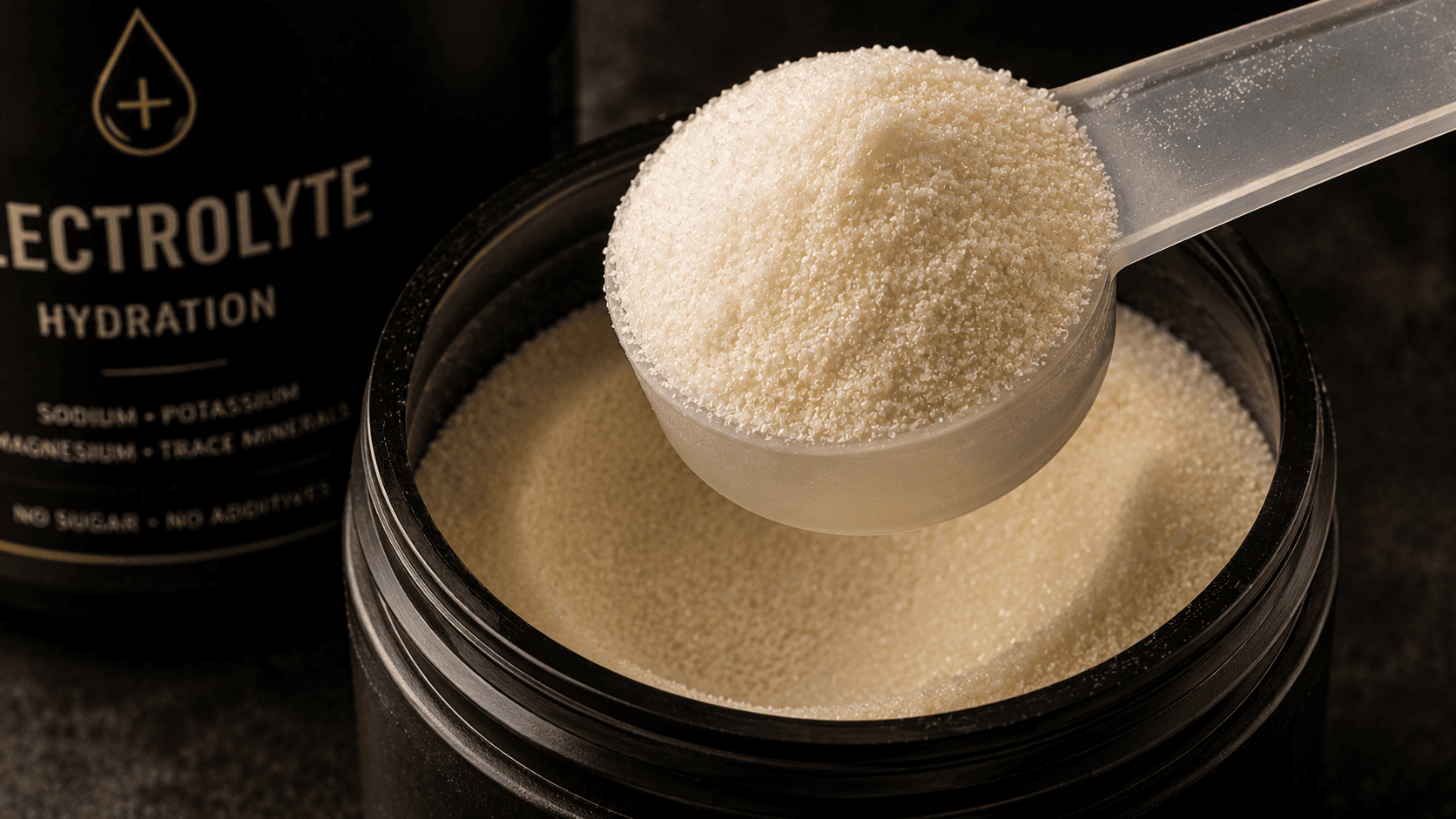
Dr. Berg's Electrolyte Powder is the cleanest and most therapeutically-dosed electrolyte product I've found on the modern supplement market, and the one I default to and keep in stock. The single feature that distinguishes it from competing products is the potassium dose: roughly 1000mg of potassium per serving, which is an order of magnitude higher than what standalone potassium supplements are legally allowed to deliver, and several times higher than what most competing electrolyte products include. Combined with meaningful doses of sodium, magnesium, calcium, and trace minerals — and no sugar, maltodextrin, artificial sweeteners, or synthetic dyes — it covers the full electrolyte profile that fasting, keto, exercise, and general modern life consistently deplete.
This article covers who Dr. Eric Berg actually is and why his framework matters, the modern electrolyte deficiency picture and why most people are running below where they should be, the four electrolytes that actually matter and what each one does, the strange regulatory situation around potassium (the 99mg standalone supplement cap that most people don't know about), what's actually in Dr. Berg's powder compared to LMNT and Redmond Re-Lyte and Ultima, the use cases where it earns its place (fasting, keto, exercise, hot weather, daily hydration), the taste and dosing realities, the direct-vs-Amazon question, and the way I actually use it.
Who is Dr. Eric Berg
Dr. Eric Berg, DC is one of the most- followed alternative-health educators in the world. He runs the YouTube channel "Dr. Eric Berg DC", which has tens of millions of subscribers, and has built one of the largest single audiences in the modern health-content space. His background is in chiropractic (DC), not allopathic medicine — a credentialing question his critics raise — but his work has covered the functional-medicine framework, keto and intermittent fasting, insulin resistance, mineral and vitamin deficiencies, and the broader real-food approach for the better part of two decades. He's referenced across this site more than any other single educator alongside Dr. Mark Sircus.
The Berg framework, in short:
- Insulin resistance is the upstream driver of most modern chronic disease — type 2 diabetes, fatty liver, cardiovascular disease, PCOS, obesity, metabolic syndrome
- Keto and intermittent fasting address insulin resistance at its root, where pharmaceuticals only manage the symptoms
- Mineral deficiencies — particularly potassium — are far more common and consequential than mainstream medicine recognizes
- Real food from clean sources is the foundation; supplements address the gaps the modern food supply leaves
- The body heals itself when given the right inputs and protected from the wrong ones — a thesis he shares with Dr. Sircus and other voices referenced across this site
Dr. Berg started selling supplements years ago, and the product line — including the Electrolyte Powder, his keto-related products, his vitamin D and minerals formulations, and the broader range — has become one of the larger alt-health supplement businesses on the market. The standard question that comes with any health educator who sells supplements is whether the framework was built to sell the products or the products exist to address what the framework identified. The Berg case is clearly the latter — the framework predates the supplement business by roughly a decade, and the products are formulated to address specific deficiencies the framework had already identified. The Electrolyte Powder is one of the cleaner cases of a product directly addressing what its creator had been teaching about for years.
Why electrolytes actually matter
"Electrolyte" is one of those terms that has been so heavily used in sports drink marketing that most people have stopped paying attention to what it actually means. The biological reality is that electrolytes are the dissolved minerals that carry electrical charge across cell membranes, and almost every major function of the human body depends on the right concentrations being maintained within tight ranges.
What electrolytes are doing in your body at any given moment:
- Generating every nerve impulse — every thought, every reflex, every signal from brain to muscle depends on the sodium-potassium gradient across cell membranes
- Triggering every muscle contraction — including the heart's contraction, which fires roughly 100,000 times a day, every one of which depends on the right electrolyte concentrations
- Regulating fluid balance — the distribution of water between blood, cells, and the extracellular space
- Maintaining blood pH within the narrow range the body requires
- Powering cellular ATP production — magnesium is required as a cofactor for almost every enzyme that produces or uses ATP
- Supporting hormone signaling across virtually every endocrine system
When electrolytes are inadequate — even by relatively modest amounts — the symptoms cascade across many systems simultaneously: fatigue, muscle cramps, heart palpitations, headaches, brain fog, anxiety, sleep disruption, low blood pressure, dizziness on standing, cold extremities, irritability. Many of these symptoms get attributed to other causes — stress, dehydration, "getting older" — when the underlying issue is a depleted electrolyte profile that the modern diet and modern lifestyle have made the new normal.
The four electrolytes that actually matter
Sodium
The most-vilified and most-misunderstood electrolyte. The mainstream medical narrative has spent decades telling people that sodium is the cardiovascular villain and that "low sodium" is virtuous. The actual data has never supported this neatly — multiple large studies have shown a J-shaped or U-shaped curve where both low and high sodium intake increase cardiovascular risk, with the lowest risk in the middle range of intake. People consuming less sodium than the population mean often have worse outcomes than average sodium consumers.
Functions: nerve signaling, fluid balance, blood pressure regulation, glucose absorption in the small intestine, and the renal sodium-potassium pump that keeps cellular membrane potentials in the right place. The body has a tight target range and will retain or excrete sodium aggressively to maintain it. Inadequate sodium produces fatigue, dizziness, headaches, mental fog, and reduced exercise tolerance.
The Berg powder uses real, clean sodium — not the iodized white table-salt kind — at meaningful doses (around 1000mg per serving).
Potassium
The electrolyte the modern diet is most consistently deficient in. As covered in the dedicated potassium article, the recommended daily intake is roughly 4700mg, while average American intake is closer to 2500–2900mg. The gap — somewhere around 2000mg of potassium per day on average — represents one of the largest single mineral deficiencies in the modern population.
Functions: nerve signaling (paired with sodium across the cell membrane), muscle contraction and relaxation, heart rhythm regulation, blood pressure (potassium counters the blood-pressure-elevating effect of sodium), cellular fluid balance, glucose metabolism (potassium is required for insulin signaling), and cellular pH regulation.
Inadequate potassium produces fatigue, muscle weakness and cramps, heart palpitations and arrhythmias, elevated blood pressure, increased fluid retention, and (over time) increased risk of cardiovascular disease, stroke, and kidney stones. The standard medical response to people with mild potassium-deficiency symptoms — irritable heart, occasional palpitations, muscle cramps — is to prescribe a beta-blocker or calcium channel blocker rather than to fix the actual potassium deficit. Berg has been particularly vocal about this gap.
Magnesium
Covered in detail in the magnesium article. The cofactor for over 300 enzymatic reactions in the body, including virtually every reaction that produces or uses ATP (cellular energy). The single most depleted mineral in the modern population — estimates suggest 50–80% of Americans are below the RDA, with measurable consequences across sleep, cardiovascular function, glucose metabolism, anxiety, and muscle function.
Berg's powder includes magnesium in a meaningful dose, but the dose is appropriately moderate — not the full therapeutic 400mg+ that would put it into "this is your magnesium supplement" territory. For someone running the dedicated magnesium glycinate / Magtein protocol from the magnesium article, the powder provides a useful supplemental dose rather than replacing the standalone supplement.
Calcium
Often overlooked in the electrolyte conversation because it's mostly thought of as a "bone mineral," calcium also plays a critical role in muscle contraction (the heart specifically), nerve signaling, blood clotting, and cellular signaling more broadly. Inadequate calcium contributes to muscle cramps, irregular heart rhythm, and the slow long-term picture of bone density loss covered in the weight lifting article. The Berg powder includes a meaningful dose alongside the other three.
The 99mg potassium cap — the strange regulatory situation
One of the more interesting and underdiscussed facts about supplement regulation in the United States is the 99mg cap on standalone potassium supplements. The FDA has effectively limited single-ingredient potassium pills and capsules to 99mg of elemental potassium per serving — approximately 2% of the daily requirement.
The regulatory rationale: very high doses of single-ingredient potassium can theoretically cause esophageal damage or sudden cardiac issues in vulnerable populations (people with kidney disease, on potassium-sparing medications, etc.). The cap was instituted decades ago and has never been revisited despite the modern population running substantially below recommended intake.
The practical consequence: standalone potassium supplements are essentially useless for actual potassium repletion. If you're 2000mg per day below the RDA, taking 99mg pills closes 5% of the gap. To close the full gap from standalone supplements would require 20+ pills per day, which is impractical and which the FDA specifically intended to prevent.
The workarounds:
- Food sources — the cleanest path. Avocados, leafy greens, potatoes, tomatoes, beets, wild salmon, real coconut water. Covered in the potassium article.
- Multi-ingredient electrolyte products — these are not subject to the 99mg cap because the regulation applies to standalone potassium supplements specifically. Products that combine potassium with other electrolytes can include substantially higher doses. This is the regulatory loophole that electrolyte powders use to deliver therapeutic potassium doses.
- Lite Salt (potassium chloride salt substitute) and the dedicated NOW Foods Potassium Gluconate powder — both effective workarounds
Dr. Berg's Electrolyte Powder delivers approximately 1000mg of potassium per serving — roughly 10 times what standalone supplements are allowed to provide, and one of the highest single-serving potassium doses in any consumer electrolyte product on the market. This is the single feature that puts the powder in a category of its own for serious potassium repletion. LMNT delivers about 200mg per packet; Redmond Re-Lyte about 350mg; most sports drinks about 50mg. The Berg powder dose is the outlier, and the outlier is the point.
The 99mg potassium cap on standalone supplements is why electrolyte powders matter. Berg's formula delivers 10x what regulations allow standalone potassium to provide — and that 10x is exactly what the modern dietary gap actually requires.
What's actually in Dr. Berg's powder
The full ingredient profile per serving (one scoop, mixed with 16–24 oz of water):
- Potassium citrate — ~1000mg of elemental potassium. The citrate form is well-absorbed and easier on the stomach than potassium chloride. The hero ingredient.
- Sodium chloride — ~1000mg of elemental sodium from real salt, not iodized industrial salt
- Magnesium citrate — ~60mg of elemental magnesium. A meaningful supplemental dose that pairs with whatever standalone magnesium protocol you're running.
- Calcium — ~75mg
- Trace minerals — including a small amount of broader trace minerals that round out the electrolyte profile
- Natural flavoring from real fruit extracts (lemon, raspberry, orange, etc., depending on the flavor)
- Stevia for sweetness
What's not in it — equally important:
- No sugar
- No maltodextrin (a common filler in cheaper electrolyte products that spikes blood sugar)
- No artificial sweeteners (no aspartame, sucralose, or acesulfame K)
- No synthetic dyes
- No high-fructose corn syrup
- No artificial preservatives
This is the cleanest ingredient list in the consumer electrolyte category, and the reason Berg's powder is compatible with strict keto, intermittent fasting, and broader real-food protocols where most commercial "electrolyte drinks" violate the underlying dietary principles you're trying to follow.
Versus LMNT, Redmond Re-Lyte, Ultima
Most clean-electrolyte conversations in the keto and fitness communities center on four products: Dr. Berg's Electrolyte Powder, LMNT, Redmond Re-Lyte, and Ultima Replenisher. Each has its niche. The honest comparison:
LMNT (Recharge)
The most-marketed clean electrolyte product in the keto and fitness communities. Founded by Robb Wolf and the keto/paleo crowd. Per packet: about 1000mg sodium, 200mg potassium, 60mg magnesium, no other ingredients of note.
- Strengths: single-serving packets are convenient for travel; sodium dose is generous and suits people who need aggressive sodium replacement (heavy sweaters, athletes, hot-weather work); broad flavor selection; very clean ingredients
- Weaknesses: potassium dose is substantially lower than Berg's (200mg vs 1000mg); expensive per serving relative to bulk powders
- Best for: athletes needing high sodium for sweat replacement; travelers needing single-serve convenience; people whose sodium needs dominate their electrolyte picture
Redmond Re-Lyte
From Redmond Real Salt, using their ancient Utah sea salt as the sodium source. Per serving: ~810mg sodium, ~400mg potassium, ~60mg magnesium, plus trace minerals from the Real Salt.
- Strengths: the Real Salt sourcing is one of the cleanest mineral salts available; trace mineral profile is broader than most competitors; clean ingredient list
- Weaknesses: potassium dose substantially lower than Berg's; price comparable to LMNT
- Best for: people who prioritize the mineral-salt sourcing question and want the broader trace mineral profile alongside the major electrolytes
Ultima Replenisher
Widely available in mainstream stores. Per serving: ~55mg sodium, ~250mg potassium, ~100mg magnesium, plus trace minerals and vitamins.
- Strengths: accessible in regular stores; gentler dose suits people doing light electrolyte support rather than serious repletion
- Weaknesses: sodium dose far too low for fasting, keto, or athletic use; not formulated for the use cases where Berg/LMNT/Redmond shine
- Best for: general daily mild hydration support; not the serious-electrolyte use case
Where Berg's powder wins
The Berg powder occupies a specific niche that the others don't fully fill: the highest potassium dose in the consumer electrolyte category, combined with adequate sodium and meaningful magnesium and calcium, at a price-per-serving that's competitive with or better than the alternatives, with a clean ingredient list that meets all the same standards LMNT and Redmond meet.
If your electrolyte picture is dominated by sodium needs (heavy sweating, athletic performance, hot weather), LMNT is arguably a slightly better tool. If your priority is trace mineral and salt sourcing, Redmond Re-Lyte wins. For fasting, daily potassium repletion, modern insulin-resistance protocols, and the broad chronic potassium-deficiency picture most modern adults are actually running, Berg's powder is the single best product I'm aware of. The 1000mg potassium dose is what makes it unique, and the chronic potassium gap is what makes that dose matter.
The use cases — when to actually reach for it
Fasting
Covered in detail in the fasting article. As insulin drops during a fast, the kidneys excrete sodium and potassium aggressively, and within 24–48 hours most fasters are running well below baseline. The Berg powder is one of the most consequential interventions for sustainable longer fasting — stirred into water once or twice during the fasting day, it resolves most of the "fasting feels hard" symptoms (headaches, fatigue, brain fog, leg cramps, heart palpitations) that come from electrolyte depletion. This is the use case I rely on most.
Keto and low-carb
Same biology as fasting. Low-carb eating drops insulin, which drives sodium and potassium excretion, which produces "keto flu" symptoms that are actually electrolyte symptoms. Berg's powder is one of the cleanest ways to manage the electrolyte side of a low-carb protocol without breaking the dietary framework with sugar-laden sports drinks.
Exercise and athletic recovery
Hard training depletes electrolytes through sweat — primarily sodium, with smaller amounts of potassium and magnesium. For the resistance training sessions covered elsewhere on this site, electrolyte replenishment after the workout supports recovery and prevents the cumulative deficit that produces late-week training fatigue.
Hot weather and outdoor work
Sweat losses in hot weather are substantial — heavy sweating can lose 1–2 grams of sodium and 200–400mg of potassium per hour. For yard work, hiking, long walks in summer heat, manual outdoor labor, a glass of Berg powder before and after the activity prevents the headache, fatigue, and felt-bad pattern that's often misattributed to dehydration when the underlying issue is electrolyte depletion.
Daily background hydration
For people with chronically low electrolyte intake — particularly those eating processed food, drinking mostly water without minerals, or with mild symptoms of fatigue, mild cramps, or sleep disruption that respond to electrolyte intake — a daily glass of Berg powder is a reasonable maintenance dose. One scoop in 16 oz of water, once a day, is the standard daily-use protocol.
Taste and flavors
Berg's powder comes in several flavors — the most common being lemon, raspberry, orange, grape, and watermelon. The taste is genuinely pleasant, sweetened with stevia rather than artificial sweeteners, and dramatically better than the metallic/salty flavor that cheaper electrolyte products produce.
The two practical taste considerations:
- Dilute generously. The powder is designed for 16–24 oz of water. Mixing in 8 oz produces a concentrated salty-sweet drink that's hard to enjoy. Mixing in 24 oz produces a light, fruit-flavored hydration drink that's actually pleasant.
- Stevia tolerance varies. Some people don't like the aftertaste of stevia. Berg has produced both stevia-sweetened and unsweetened variants over the years — check the label if you're stevia-averse and want the plain version.
Dosing and timing
- Standard daily dose: one scoop in 16–24 oz of water, once a day. For most people on a reasonable diet, this is enough.
- Fasting dose: one to two scoops spread across the fasting day, typically one in the morning and one in the late afternoon if doing extended fasts. The morning scoop replaces what was excreted overnight; the afternoon scoop maintains levels through the second half of the day.
- Exercise dose: one scoop within 30–60 minutes after a hard training session, particularly for sessions over 45 minutes or in hot conditions. Pre-workout dose is also reasonable for serious training.
- Hot weather dose: one scoop before significant heat exposure, additional scoops every 60–90 minutes during sustained heat or heavy sweating.
- Don't take it right before bed — the diuretic effect of the additional fluid and sodium loading can disrupt sleep through middle-of- the-night bathroom trips. Morning to early evening is the ideal timing window.
- Separated from thyroid medication by at least 2 hours if you take levothyroxine or similar — the calcium and other minerals can interfere with absorption.
Direct from Berg vs. Amazon — the honest framing
One of the small but real questions with Berg products is where to buy. Two main options:
Direct from shop.drberg.com
- Freshest stock — direct shipment from the manufacturer, not third-party warehouses
- Subscription pricing — automatic recurring delivery typically with a discount
- Authenticity guarantee — no concern about counterfeit or expired product from sketchy resellers
- Often cheaper per serving than Amazon, particularly when third-party resellers mark up listings
- Not an Amazon affiliate link — no commission to me if you buy direct, but the cleaner option for the buyer
Amazon listings
- Convenience — one-click ordering, Prime shipping, the existing Amazon account workflow
- Third-party resellers — most Berg-product Amazon listings are not from Berg directly; they're third-party sellers who've purchased product wholesale and are reselling. Prices can be substantially marked up.
- Freshness uncertain — stock may have been sitting in a third-party warehouse for months
- Affiliate links available — which is why this article does include an Amazon search link below for those who prefer the Amazon convenience
The honest recommendation: buy direct from shop.drberg.com whenever you're paying attention. Use the Amazon link if convenience genuinely matters more than the price and freshness considerations.
My approach
- Daily background dose — one scoop in 16–20 oz of water, usually mid-morning. Not first thing (I prefer water and the ACV-and-salt glass for that), and not late afternoon (to avoid the late-day sodium load disrupting evening). The mid-morning slot fits cleanly after the morning walk.
- Fasting days — two scoops on extended fast days. Morning scoop around 9–10am, second scoop around 3–4pm. Combined with the ACV-and-salt glass and plenty of plain water, this is what keeps longer fasts comfortable.
- Post-workout — one scoop after hard lifting sessions, particularly any session involving heavy compound work that produced meaningful sweat
- Hot weather — pre-emptive scoop before yard work or extended outdoor activity in summer
- I buy direct from shop.drberg.com on subscription — the freshest product at a slight discount, automatic recurring delivery
- I don't take it before bed — the fluid load and the sodium together produce middle-of-the-night bathroom interruptions that disrupt sleep architecture covered in the sleep article
How to start
- Try one scoop in 16 oz of water the first day. Notice how you feel within 30 minutes. Most people experience a subtle but unmistakable improvement in energy, mental clarity, or felt-stability that signals underlying electrolyte deficiency was real.
- Mid-morning timing is the safest starting slot. Avoid first-thing (the empty stomach can find it intense) and avoid evening (sleep disruption).
- Dilute generously — 16–24 oz of water per scoop. Better taste, better absorption, gentler on the stomach.
- Pick a flavor — the lemon is the most-recommended starter flavor; the raspberry is the most popular; the watermelon and grape are love-them-or-hate-them. Try a couple to find yours.
- Run it for two weeks before judging the effect. The chronic potassium-deficit symptoms — fatigue, brain fog, occasional muscle cramps, sleep disturbance — improve gradually as tissue stores rebuild.
- Build it into a use case rather than taking it indefinitely "just because". Daily, fasting days, training days, hot weather days — clear use cases produce a sustainable long-term habit.
Honest cautions
- Kidney disease — high potassium intake can be dangerous for people with impaired renal function. The 1000mg potassium dose in this product is meaningful enough to warrant medical guidance for kidney patients.
- Potassium-sparing diuretics (spironolactone, eplerenone) and ACE inhibitors or ARBs can produce dangerous hyperkalemia in combination with additional potassium intake. Coordinate with your prescribing physician.
- Heart conditions — particularly certain arrhythmia conditions and heart failure warrant medical guidance before adding meaningful potassium to the diet.
- Pregnancy and breastfeeding — consult with a practitioner before significant electrolyte supplementation
- Children — adult-dose electrolyte products are not appropriate for children without pediatric guidance
- Don't replace water with it. Electrolyte powder is an addition to water intake, not a replacement. Drinking only flavored electrolyte water all day produces its own imbalances.
- Don't take it directly before bed for the reasons covered above
- Stevia sensitivity — a small percentage of people don't tolerate stevia well digestively. The unsweetened version exists for those people.
What I actually use
Closing
Dr. Berg's Electrolyte Powder is the cleanest and most therapeutically-dosed electrolyte product on the consumer market, and the one I default to. The single feature that distinguishes it from every alternative is the 1000mg potassium dose — 10 times what standalone potassium supplements can legally deliver, and the exact dose that addresses the chronic 2000mg-per-day potassium deficit most modern adults are running. Combined with adequate sodium, meaningful magnesium and calcium, real trace minerals, and a clean ingredient list with no sugar or artificial sweeteners, it covers the full electrolyte profile that fasting, keto, exercise, and modern life consistently deplete.
It is not a replacement for the targeted single-mineral protocols covered in the potassium, magnesium, and other mineral articles — those still handle the therapeutic doses where single-mineral effects actually fire. The Berg powder is the daily background layer that delivers the four major electrolytes in the ratios the body actually uses them, in a single convenient drink, with a formulation cleaner than virtually anything else in the consumer category.
For anyone doing serious fasting, anyone on keto or low-carb, anyone training hard, anyone living in hot weather, or anyone running the chronic potassium deficit that defines most of the modern population — this is the product I'd recommend before any other. One scoop in 16–24 oz of water, mid-morning or as needed. Buy direct from shop.drberg.com when you can. The rest is detail.
Sources & further reading
- Dr. Eric Berg DC — Official site
- Dr. Berg's Electrolyte Powder — official product page
- Dr. Berg — The Importance of Electrolytes (representative video)
- Dr. Berg — Why Potassium Is So Important (representative article)
- FDA — Code of Federal Regulations on potassium supplement labeling (the 99mg standalone supplement context)
- IOM Dietary Reference Intakes for Sodium and Potassium (2019 revision)
- Mente et al., 'Sodium intake, blood pressure, and cardiovascular events: the J-curve in the PURE study' — The Lancet, 2016 (one of the major studies challenging the low-sodium consensus)
- Aburto et al., 'Effect of increased potassium intake on cardiovascular risk factors and disease: systematic review and meta-analyses' — BMJ, 2013
- LMNT Recharge Electrolyte Drink Mix (comparison product)
- Redmond Re-Lyte Electrolyte Mix (comparison product)
- Dr. Berg's YouTube channel — comprehensive electrolyte and mineral content