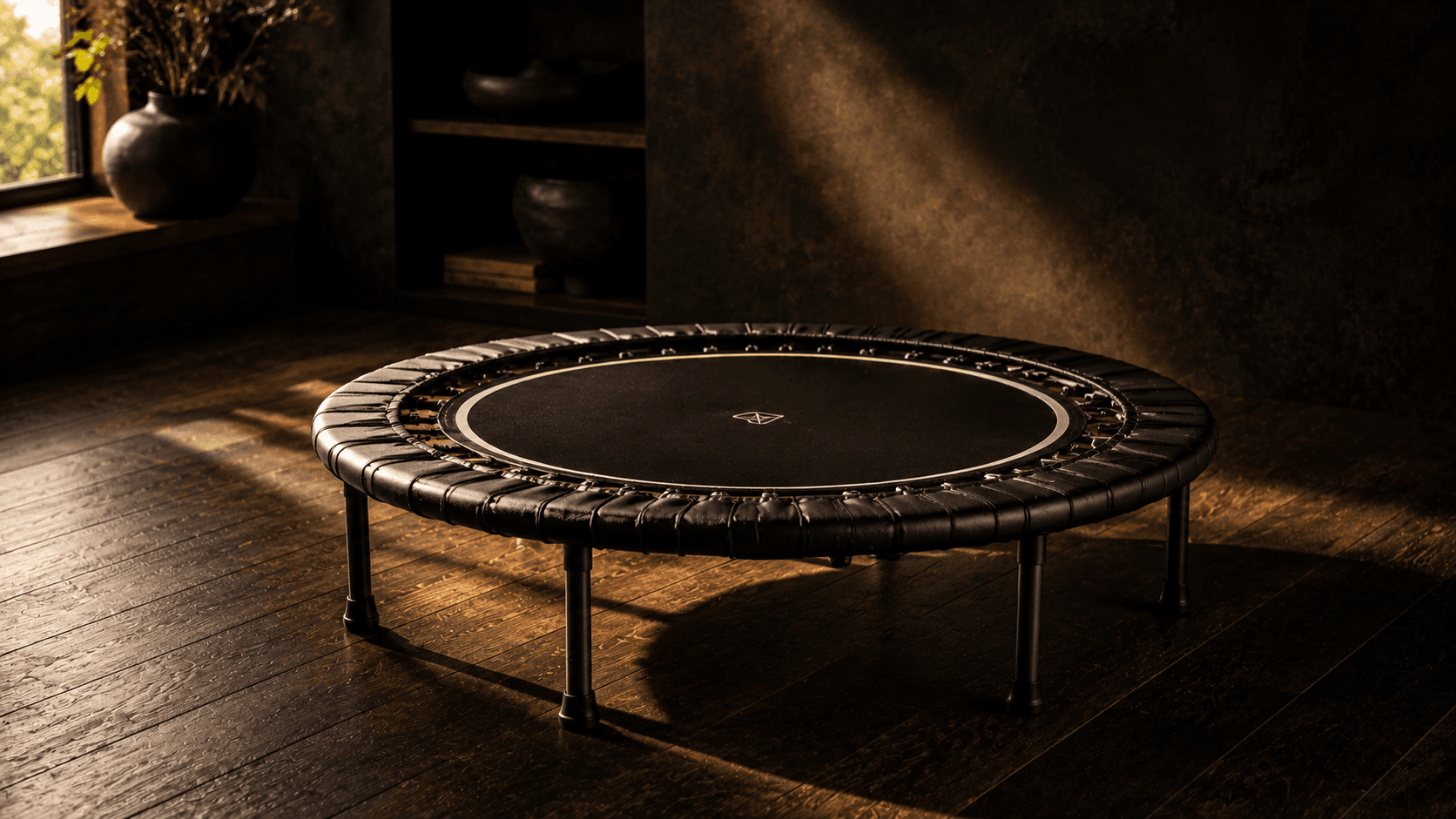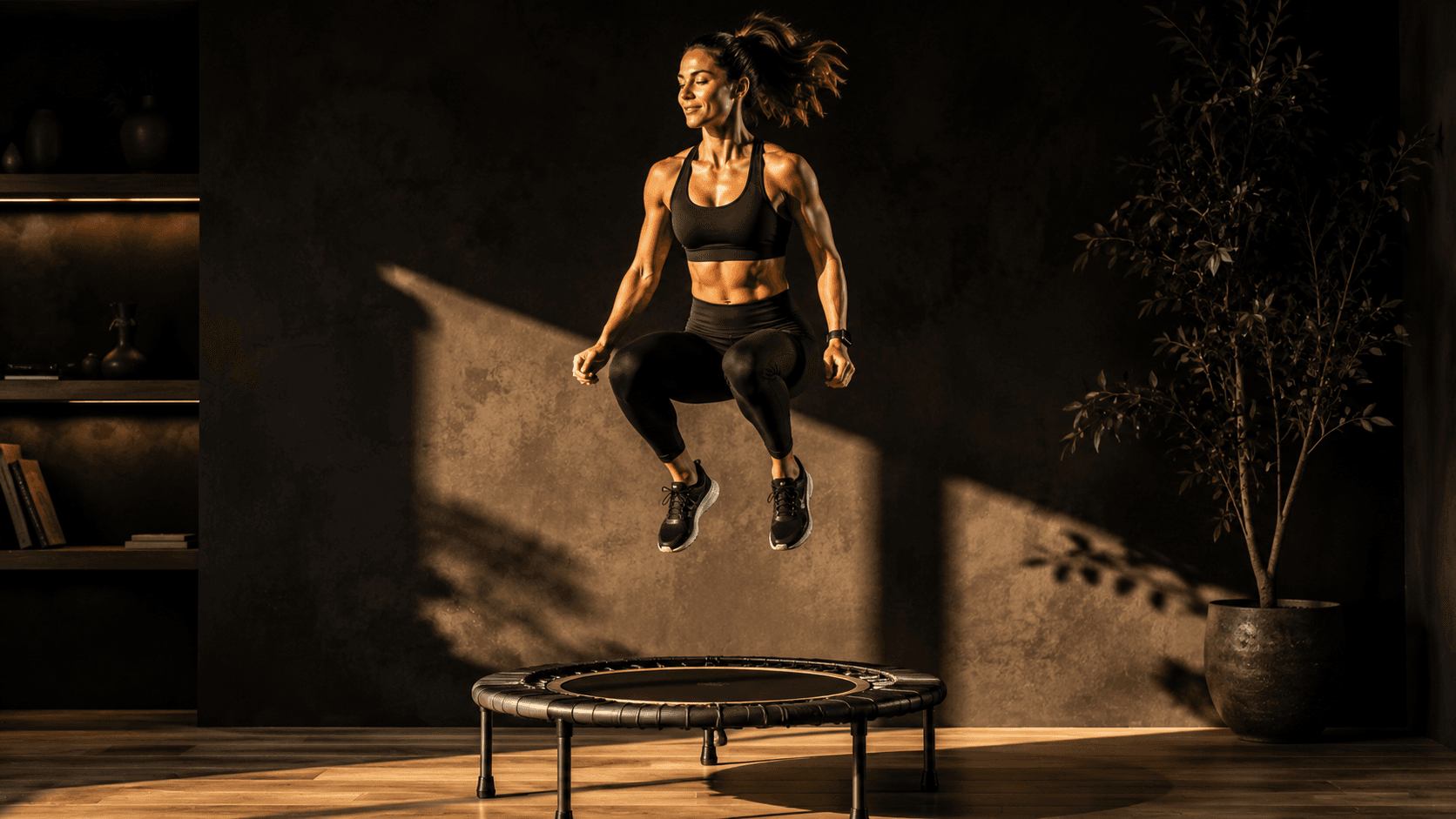
Rebounding — bouncing on a small spring-loaded or bungee-loaded mini-trampoline — is, dollar-for-dollar and minute-for-minute, probably the most effective single piece of exercise equipment ever invented. It moves your lymphatic system in a way that nothing else does. It conditions your cardiovascular system in a fraction of the time of equivalent walking or running. It is almost completely joint-friendly once you've adapted to it. It fits in a closet. And it is one of the only practical answers to the slow, grinding damage that sitting at a desk all day does to a human body.
The case for rebounding rests on one piece of anatomy that almost nobody thinks about: the lymphatic system. Understand what lymph is, what it does, and why it is the most neglected piece of your body's plumbing, and the case for getting on a mini-trampoline for ten minutes a day stops feeling like wellness fluff and starts feeling like a very serious intervention.
The lymphatic system — the forgotten circulation
Your body has two circulatory systems. The first one — the blood circulation, driven by the heart — gets all the attention. Hearts get medications, transplants, stents, and their own medical specialty. The second one — the lymphatic circulation — gets essentially no attention from conventional medicine, despite being just as critical to your survival.
The lymphatic system is your body's drainage and immune highway. It collects the fluid and waste that leaks out of your blood capillaries into your tissues, filters it through lymph nodes, removes pathogens and dead cells, and returns the cleaned fluid back to the bloodstream. It carries immune cells throughout the body. It is the primary route by which cellular waste — including heavy metals, dead pathogens, and the byproducts of normal metabolism — leaves your tissues. Without it, you would die within hours.
Here is the part that almost nobody knows: the lymphatic system has no pump. There is no lymph-heart. The fluid moves entirely passively, propelled by three things and three things only:
- Muscle contraction. When you move, your muscles squeeze the lymph vessels and push fluid forward through one-way valves.
- Deep breathing. The expansion and contraction of the thoracic cavity pulls lymph upward through the largest lymph trunk in the body, the thoracic duct.
- Gravity changes. Vertical movement — standing up, sitting down, bouncing — opens and closes the valves and drives fluid through.
A sedentary life starves all three of these. Sit for eight hours, breathe shallowly, never change vertical position, and your lymph effectively stops moving. The fluid pools. Waste accumulates. Immune cells don't circulate. The result is a slow, quiet decline that shows up as cellulite, puffiness, chronic mild swelling in the legs and ankles, that "tired but can't say why" feeling, repeated colds, and a general sense that your body has stopped processing things efficiently. Almost everyone reading this is in some stage of this. The modern world is precisely designed to produce it.
Rebounding solves all three problems at once.
Why rebounding is unique
When you bounce on a rebounder, your body alternates rapidly between two distinct states. At the top of each bounce, you are momentarily in something close to weightlessness — near-zero G, the same condition that astronauts experience in orbit. At the bottom of each bounce, when your weight loads onto the mat, you are momentarily at 2 to 3 times normal gravity — your body weighs two or three times what it normally does, for a tiny fraction of a second.
That alternating G-force is what makes rebounding categorically different from walking, running, or cycling. The one-way valves in your lymphatic vessels open under the increased G-force at the bottom of the bounce and close at the top — over and over, dozens of times per minute, throughout your entire body simultaneously. The result is a pumping action that no other form of exercise produces.
Walking is good for lymph. Running is good for lymph. Rebounding is in a different category — it is essentially direct mechanical stimulation of every lymphatic valve in the body at the same time. Even a gentle bounce where your feet never leave the mat — what's called a "health bounce" — is enough to move lymph dramatically. You don't need to jump high. You barely need to jump at all. The vertical oscillation alone does the work.
The 1980 NASA study
The most-cited piece of research in the entire rebounding world is a single 1980 paper. The full citation: Bhattacharya, A., McCutcheon, E. P., Shvartz, E., and Greenleaf, J. E. "Body acceleration distribution and O₂ uptake in humans during running and jumping." Journal of Applied Physiology 49(5): 881–887, 1980 — conducted at the Biomechanical Research Division of NASA-Ames Research Center in Moffett Field, California.
A brief aside on this: I don't take much of what NASA says about space at face value — that's a topic for another day. But NASA also does a great deal of legitimate science, including biomechanics and physiology research, and this rebounding study is one of those pieces of work. The data has held up regardless of who funded it. On the rebounder question specifically, the study is real, quotable, and worth knowing about.
The research design was straightforward: eight young male subjects (ages 19–26) walked and ran on a treadmill at four different speeds, and jumped on a mini-trampoline at four different heights. The researchers measured oxygen uptake, heart rate, and the acceleration forces on the body at the ankle, back, and forehead. The key finding, in the paper's own measured wording:
For similar levels of heart rate and oxygen uptake, the magnitude of the biomechanical stimuli is greater with jumping on a trampoline than with running.
The popular alt-health summary — the famous "rebounding is 68% more efficient than running" — comes from this study's biomechanical efficiency calculations. The exact statistic gets some interpretive license in casual retellings, but the underlying finding is solid: at the same cardiovascular cost, you get more total mechanical conditioning on a rebounder than on a treadmill. The researchers were specifically looking for an exercise modality that could counteract the deconditioning astronauts experience in weightlessness — and rebounding came out on top. There is a reason it remains the alternative-medicine community's most- cited piece of exercise research forty-five years later.
Rebounding doesn't replace walking — it pairs with it
One important framing point. The popular sales pitch for rebounders is "you don't need to walk anymore." That is not how I'd describe my own practice, and it is not the right framing. Walking and rebounding are doing different jobs. Walking gives you sustained, low-grade cardiovascular work, natural sunlight (huge for vitamin D), the psychological benefit of being outdoors, varied terrain that engages the stabilizer muscles, and a kind of slow contemplative rhythm that nothing indoors can match. None of that goes away because you also rebound.
What rebounding adds — that walking can't — is the vertical G-force component, the direct lymphatic pump, and the time- efficiency. Ten minutes of rebounding does work on the lymphatic system that you cannot get from an hour of walking, because the mechanism is different. The right protocol is both, not one or the other. The two complement each other. Walking outside; rebounding indoors. Walking for duration; rebounding for intensity. Walking for sun and ground; rebounding for lymph and time efficiency.
The micro-dose protocol — two minutes every half hour
Of all the ways rebounding has been used, the one that I think delivers the highest return on the smallest investment is what I'd call the micro-dose approach: stepping onto the rebounder for two minutes every half hour or hour throughout a working day. Not a workout. Not a session. Just a two-minute bounce break.
The reason this works so well is that sedentary damage is not a function of "did you exercise today." It is a function of how many continuous hours you spent sitting still. The studies on sedentary mortality are clear: an hour of dedicated exercise does not undo eight hours of uninterrupted sitting. But breaking up those eight hours into smaller stretches — with brief, vigorous movement in between — largely does. The micro-bounce break is one of the cleanest ways to do this. It takes two minutes. It doesn't require changing clothes. It dramatically wakes up the lymphatic system, the legs, and your alertness for the next stretch of sitting.
The felt effect is consistent: after a two-minute bounce, the fog of the previous hour of sitting noticeably lifts. Energy comes up. Mental clarity returns. It is, in a real way, the opposite of a coffee break — instead of using a stimulant to paper over the lethargy, you are addressing the actual cause of it.
Everything else rebounding does
The lymph case alone is enough. The supporting list is long:
- Cardiovascular conditioning. Per-minute cardio benefit comparable to or better than running, with a tiny fraction of the joint impact.
- Bone density. The repeated mild G-force loading at the bottom of each bounce stimulates bone mineralization — without the wear-and-tear of running on pavement.
- Balance and proprioception. The slightly unstable surface of the mat continuously engages the stabilizer muscles and the inner-ear balance system. This is disproportionately valuable as you age.
- Cellular health. The same G-force that pumps lymph also subjects every cell in your body to brief, mild compression-and-release cycles, which appear to stimulate cellular waste removal and the activity of mitochondria.
- Mood and energy. Almost everyone who rebounds regularly notices a meaningful upward shift in baseline energy and mood. Some of this is the immediate blood-flow and endorphin response; some is the cumulative lymphatic effect of finally moving waste out of tissues that had been quietly accumulating it for years.
- Weight management. Not because of dramatic caloric burn per session — although the burn is real — but because it raises baseline metabolism, supports thyroid function, and reverses the metabolic damage of sitting. Lymphatic stagnation is itself a metabolic problem, and fixing it has downstream weight effects.
A note on the knees
One honest piece of personal experience, because it's the single most common objection I hear from people considering a rebounder. The knees can be a little tough at first. For the first week or two of regular bouncing, if you've been sedentary, you'll feel it in your knees more than you expect — not pain, but a kind of "these joints are remembering how to work" awareness.
That phase passes, and what comes after it is the opposite of what most people would predict. After a few weeks of consistent rebounding, my knees became measurably stronger. The stabilizer muscles around the knee joint, the ligaments, the proprioceptive control — all of it improved together. The downstream effect was that running became easier, not harder. Walking uphill became easier. Things I used to feel in my knees, I stopped feeling. The rebounder, used consistently, is one of the best knee-strengthening tools I've found — once you've gotten past the initial adjustment period.
If you've got a serious pre-existing knee injury, this is a place to talk to a real physical therapist before you start. If you've just got the ordinary "my knees aren't what they used to be" creakiness of modern adult life, the rebounder is almost certainly going to help, not hurt — with patience through the first couple of weeks.
Choosing a rebounder
Quality matters more than almost anywhere else in the wellness space. A bad rebounder can hurt you. The cheap ones from big- box stores use poor-quality springs that lose their tension quickly, hard plastic frames that flex unsafely, and mat materials that bottom out — meaning at the bottom of your bounce, the mat slams to a hard stop and the impact transfers directly into your spine. This is the opposite of what you want.
A quality rebounder will have:
- Either heavy-duty steel springs or bungee suspension. Bungee is quieter and gentler; quality springs last longer.
- A steel frame, not plastic.
- A weight rating at or above your weight by a comfortable margin.
- A mat that doesn't bottom out under your full weight at the bottom of an aerobic bounce.
- Optional but useful: a stability bar for beginners, older users, or anyone with balance concerns.
Prices range from about $200 for a respectable mid-range spring rebounder up to $1,200+ for the high-end German bungee systems (Bellicon). The cheap ones at $50–$100 are frequently false economy — they break in months and the bouncing experience is poor enough that you stop using them. The premium ones earn their price in quietness, joint comfort, and the consistency of the bounce.
My approach
Two rebounders, alternated, plus walking. Roughly daily.
- 10 to 20 minutes of dedicated rebounding most days, either as one continuous session or split into shorter blocks. Some of it is the gentle health bounce; some of it is more vigorous aerobic bouncing. The variety keeps it interesting and works different muscle groups.
- Two-minute bounce breaks every 30 to 60 minutes during desk-bound stretches. This is the highest-leverage piece of the whole protocol — the sedentary-lifestyle antidote. I'll step onto the rebounder, bounce gently for a couple of minutes, and step off feeling palpably more awake.
- Daily walking continues as normal. The rebounder is added to walking, not in place of it. Walking gives me sun (huge for vitamin D), outdoor air, varied terrain, and the slower contemplative rhythm that indoor bouncing doesn't offer.
- Two rebounders in the house. I use both a Cellercise (high-quality spring rebounder, Dave Hall's brand, well-engineered) and an Urban Rebounder. Honestly, I have both simply because we've purchased both as a family — not because of any strategic advantage. They each have a slightly different feel: the Cellercise has a softer, deeper bounce; the Urban Rebounder is a bit firmer. Both are great. Worth noting that the Cellercise actually has excellent storage options — Dave Hall's company sells versions that fold into two parts and three parts, which makes the unit easy to stash in a closet. Urban Rebounders also fold. Either one works as a primary rebounder.
- Bellicon is the eventual upgrade. The German bungee rebounders are noticeably quieter than spring rebounders — no spring squeak, no metal-on-metal — and apartment dwellers, late-night bouncers, and anyone with family members trying to sleep in the next room will appreciate that. They're expensive but they are also the best-engineered piece of equipment in the category.
How to start
- Start with the health bounce. Feet stay on the mat. You're not jumping, you're letting the rebounder push you up and down through a gentle vertical oscillation. Five minutes a day for the first week. This alone moves lymph dramatically — you don't need to graduate to harder bouncing to get the lymphatic benefit.
- Add deep breathing. The thoracic-duct effect from deep breathing is the second pillar of lymph movement. Breathe in deeply on every two bounces, out on every two — far slower than your natural breath. Combined with bouncing, this dramatically amplifies the lymphatic pump.
- Add jumping height gradually. Week two, start letting your feet leave the mat briefly. Week three, actual aerobic bouncing in short bursts. By a month in, you can comfortably do 15–20 minute mixed sessions.
- Expect knee adjustment. First two weeks, knees may feel "worked." This is normal and almost always resolves with consistency. If it becomes actual pain, back off and consult a real practitioner.
- Hydrate. Mobilized lymph carries waste out through the kidneys and bowel. Bouncing without enough water is the most common reason people feel washed out afterwards.
- Don't rebound right after a heavy meal. Wait an hour. It's not dangerous, it's just unpleasant.
What I actually use
Closing
The lymphatic system is the most under-discussed piece of human anatomy in modern medicine, and rebounding is the most direct intervention available for it. Add to that the time-efficiency, the joint-friendliness once you've adapted, the bone-density benefit, the balance training, the mood lift, and the fact that the whole apparatus fits in a corner of a small apartment, and there is essentially no good reason not to own one.
Pair the rebounder with daily walking, the right mineral stack, adequate sun for vitamin D, and an occasional chlorophyll boost from wheatgrass, and you have a remarkably complete daily protocol for maintaining the body that the modern world tries to keep motionless.
Two minutes every half hour. Ten to twenty minutes once a day. That's the whole thing. The cumulative effect over months and years is the kind of thing that, in retrospect, will feel like one of the smarter decisions you ever made.
Sources & further reading
- Bhattacharya, McCutcheon, Shvartz, Greenleaf — 'Body acceleration distribution and O₂ uptake in humans during running and jumping' — Journal of Applied Physiology 49(5): 881-887, 1980
- NASA Technical Reports Server — Body acceleration distribution and O₂ uptake (the original NASA-Ames report)
- Cellercise — Dave Hall's rebounder education and product line
- Bellicon — German bungee rebounders (the high-end engineering reference)
- Wikipedia — Rebound exercise (general history and research overview)