Few names in Scripture are wrapped in as much controversy as Michael the Archangel. Some hold that Michael is simply a high-ranking created angel; others, that Michael is none other than the divine Son of God Himself, under another name. This study takes the second view — and argues it not to win a debate, but because the answer turns out to carry the gospel inside it. For the name Michael means “who is like God,” and the question of who in the universe is genuinely like God — and how anyone comes to be like Him — runs straight to the heart of how we are saved. It is a companion to the Godhead and especially to the divinity of Christ, whose argument from the begetting it carries into the Old Testament.
And the usual worry should be answered before a word more is written. To identify Michael as the Son of God is not to demote Christ to the rank of an angel; it is the opposite. As the case unfolds it will become plain that “Archangel” here does not mean a created angel but the commander of all the angels — the One Who made them, Who receives their worship, Who bears the very name of God. This is held with conviction, but it is not a test of fellowship and not a condition of salvation. Sincere believers differ on it and love the Lord; they are brothers and sisters still. The aim is to magnify Christ, not to lower Him, and to let the question land where it really matters — on the gospel.
A question of identity
The whole study turns on identity, so it is worth saying at the outset why identity is the point. The deepest thing about Michael is not what He does but who He is — and, as we will see, those two are not the same. The aim is not merely to label a mysterious figure correctly, but to understand what makes Him who He is, because that same principle will turn out to govern what makes us who we are. Hold that thread; it is the one the whole article is tied to.
What the name actually means
Start with the words, because the words decide a great deal. The single verse in all of Scripture that joins the name and the rank together — “Michael the archangel” — is Jude 9. The phrase occurs nowhere else; you find Michael in some places and the archangel in another, but together only here. So both words deserve weighing.
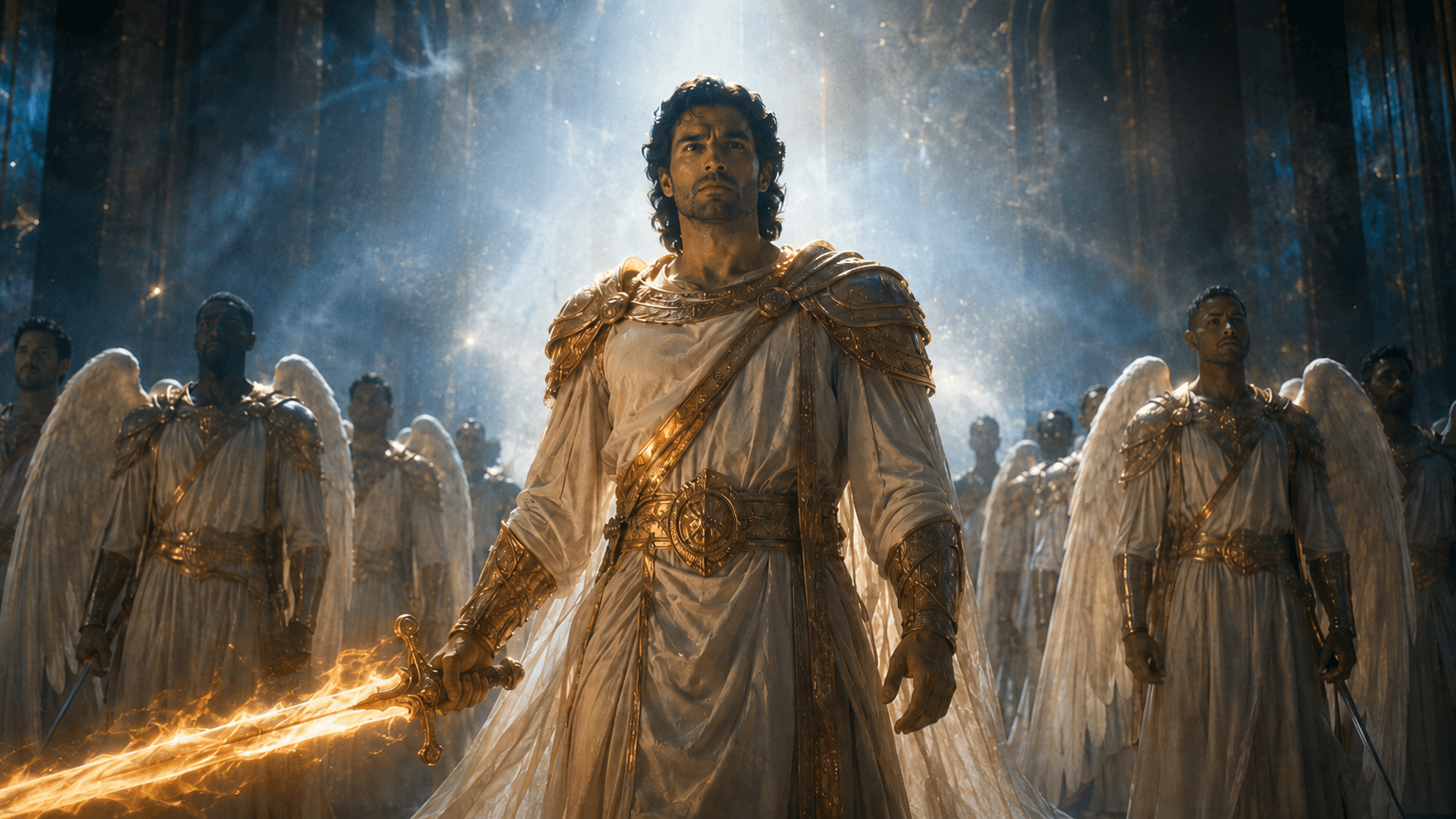
Michael is Hebrew, formed of Micha and El. El is the shortened form of Elohim, God; and the name as a whole means “who is like God” — not a question but a statement: one who is like God. Notice what kind of name that is. It does not describe the bearer in Himself; it describes Him by reference to Another. His whole identity is linked to God and derived from God. The benchmark is God, and Michael is just like Him. Archangel, the Greek, means the chief or commander of the angels. Put the two together and “Michael the Archangel” is the one who is like God, the commander of the angels.
There is an apparent difficulty here that is worth facing squarely. God says in Isaiah, “I am God, and there is none like me” (Isaiah 46:9) — and yet here is a being whose very name means “like God.” The two are reconciled by the context of Isaiah: God is contrasting Himself with the false gods and idols of the nations, none of which is anything like Him. That leaves room for the one Scripture does present as truly like God — not a rival deity, but a Son Who shares His Father's nature. As the rest of this article shows, there is indeed one such Being in the universe, and only one.
The dispute over the body of Moses
Yet Michael the archangel, when contending with the devil he disputed about the body of Moses, durst not bring against him a railing accusation, but said, The Lord rebuke thee.
Look first at what is happening. Michael and the devil are contending over the body of Moses — which means Moses was dead. What is there to dispute about a dead body? Not merely who may claim a corpse, but what was about to be done with it: Michael was about to resurrect Moses and restore him to life, and Satan was resisting it. (That Moses was in fact raised is borne out when he appears alive, with Elijah, on the mount of transfiguration.) Keep the resurrection in view; it returns later as a thread that ties Michael to Christ directly.
This verse is the one most often raised against identifying Michael with the Son of God. The argument runs: Michael does not rebuke Satan in His own authority but says “The Lord rebuke thee,” deferring to Someone higher — therefore He cannot be divine; He must be a created angel referring the matter upward. It sounds reasonable until you find where else that exact rebuke occurs.
Whose words He was speaking
The same words appear in Zechariah's vision of Joshua the high priest — and there they are spoken by the Lord Himself:
And he shewed me Joshua the high priest standing before the angel of the Lord, and Satan standing at his right hand to resist him. And the Lord said unto Satan, The Lord rebuke thee, O Satan… is not this a brand plucked out of the fire?
The scene mirrors Jude almost exactly — a servant of God, Satan standing to resist, and the rebuke “The Lord rebuke thee, O Satan.” But here the speaker is named: it is the Lord, in the setting of the angel of the Lord standing by. In the King James, “the Lord” in small capitals renders the divine name — Jehovah. So the angel of the Lord speaks the very words of Jehovah. Put the two passages together and Jude reads differently: Michael was not deferring to a higher rank when He said “The Lord rebuke thee.” He was speaking the very formula God Himself uses to rebuke Satan. He was not pointing away from His own authority; He was exercising it in the words of God.
The Angel of the Lord — the highest messenger
The phrase that trips readers is “the angel of the Lord.” Angel simply means messenger; it does not by itself mean a created being. “The Angel of the Lord” is the messenger of Jehovah — and Scripture describes Him in terms no creature could bear:
Behold, I send an Angel before thee, to keep thee in the way… Beware of him, and obey his voice, provoke him not; for he will not pardon your transgressions: for my name is in him.
This Messenger can pardon transgressions — He forgives sins, which Scripture everywhere reserves to God alone — and the reason given is decisive: “my name is in him.” This is the One Who led Israel out of Egypt, Who went before them in the pillar of cloud, and Whom Paul identifies plainly: “they drank of that spiritual Rock that followed them: and that Rock was Christ” (1 Corinthians 10:4). The Angel of the Lord is the divine Son — the highest of all messengers, the true representative of the Father, the One Who carries God's own name. To be called “the angel of the Lord” is not a lowering; it names the office of the supreme Messenger. And the One Who is the supreme Messenger, Who bears God's name and forgives sin, is exactly the One the title Archangel — commander of the angels — would fit, and no other.
The Captain Who is worshipped
The same figure meets Joshua outside Jericho, and the encounter draws the line between the divine Son and every created angel:
Nay; but as captain of the host of the Lord am I now come. And Joshua fell on his face to the earth, and did worship… And the captain of the Lord's host said unto Joshua, Loose thy shoe from off thy foot; for the place whereon thou standest is holy.
Two things mark this Captain as divine. First, He receives worship — Joshua falls down before Him and is not rebuked for it. Second, He gives the very command Moses received at the burning bush — loose thy shoe, for the place is holy— which there came from the mouth of the I AM. The “captain of the host of the Lord” is the commander of all the heavenly hosts — and the hosts of heaven are the angels. The commander of the angelic host is, by definition, the Archangel.
Set against this the test case of a true created angel. When John fell to worship the angel who showed him the Revelation, he was sharply stopped:
And when I had heard and seen, I fell down to worship before the feet of the angel which shewed me these things. Then saith he unto me, See thou do it not: for I am thy fellowservant… worship God.
A created angel — likely Gabriel, the messenger of prophecy who also came to Daniel and to Zacharias — refuses worship and redirects it to God: “I am thy fellowservant… worship God.” The Captain of the Lord's host accepts it. That single contrast settles the category. The being Who rightly receives worship, Who forgives sin, Who bears God's name, is not in the rank of Gabriel. He is the divine Son.
“The express image” — just like God
If Michael means “who is like God,” Scripture should somewhere describe such a Being plainly — and it does, of exactly one Person:
Who being the brightness of his glory, and the express image of his person, and upholding all things by the word of his power…
The brightness of His glory; the express image of His person. That is the meaning of Michael rendered into description: just like God. And note — there is no one else in all of Scripture described this way. Only Christ is the brightness of the Father's glory and the exact imprint of His person; the description is unique in the universe because the Person is. The same uniqueness shows in the honour He is owed: “That all men should honour the Son, even as they honour the Father. He that honoureth not the Son honoureth not the Father” (John 5:23). Equal honour with the Father — no reserve, no lower measure. To name Christ “Michael” is therefore not to file Him among the angels; it is to confess Him the only Being who is fully like God.
How Michael came to be like God
A name like “who is like God” raises the obvious question: how did He come to be like God? Scripture's answer is the same one that grounds the whole doctrine of the Son — begetting. “The Word was made flesh… and we beheld his glory, the glory as of the only begotten of the Father” (John 1:14). He is the express image of God because He is the only-begotten of the Father; He inherited the Father's nature and the Father's name — which is why “his name is in him.” And this is not something that began at Bethlehem. He was like God from the beginning. The incarnation is when He became the Son of man; He was already the begotten Son of God, long before — the Michael Who acted all through the Old Testament. (The fuller treatment of this divinity-by-inheritance is in the companion study on the divinity of Christ.)
One verse seals it, and it is the same one the gospel keeps returning to: “For as the Father hath life in himself; so hath he given to the Son to have life in himself” (John 5:26). The Son alone shares the one thing that belongs to God alone — underived, self-existent, immortal life — and He has it because the Father gave it to Him in the begetting. It is His by right of birth. That is what makes Him “like God” from the beginning, and it was put on display at creation, where all things were made by Him and every living thing received its life through the begotten Son.
Being, not doing
Here is the hinge of the whole study, and it must be stated carefully. We are accustomed to proving Christ's divinity by what He does — He forgives sins, stills storms, creates, raises the dead, receives worship — and those works are real witnesses. But they are secondary. Christ is not divine because He does divine things; He does divine things because He is already divine. His actions reveal His identity; they do not create it. His name is not “the one who acts like God” or “the one who behaves like God” — it is the one who is like God. The being comes first; the doing flows from it. Hold this distinction, because in a moment it becomes the very shape of the gospel.
The voice that wakes the dead
Return now to the resurrection thread from Jude. Michael came to raise Moses; and when Scripture describes the great resurrection at the end, the same rank appears:
For the Lord himself shall descend from heaven with a shout, with the voice of the archangel, and with the trump of God: and the dead in Christ shall rise first.
The Lord himself descends — and He descends with the voice of the archangel, and that voice raises the dead. Michael is not named, but the rank is; the Archangel's voice is the voice that calls the dead from their graves. And Christ told us plainly Whose voice that is: “the hour is coming, in the which all that are in the graves shall hear his voice, and shall come forth” (John 5:28-29). The voice of the Son of God is the voice of the Archangel. The One Who disputed with Satan to raise Moses, the One Whose shout will empty the graves at the last day, and the One Who said “I am the resurrection, and the life” — are one and the same.
The great Prince of His people
Daniel names Michael three times, and each adds to the picture. First, as the one Who comes to Gabriel's aid in the unseen conflict: “Michael, one of the chief princes, came to help me” (Daniel 10:13). “One of the chief princes” sounds like merely one among several — until you note the King James margin, which reads “the first of the chief princes.” As a prime minister is not merely one cabinet member among equals but the head over them, so Michael is the first — the foremost, the commander. Then He is named the possessor of the people: “Michael your prince” (Daniel 10:21) — the same One Who led Israel through the wilderness now standing as their Prince in captivity. And finally:
And at that time shall Michael stand up, the great prince which standeth for the children of thy people: and there shall be a time of trouble… and at that time thy people shall be delivered.
Not merely a prince but the great Prince Who stands for His people — their deliverer, their advocate, the One Who secures that they “shall be delivered.” That is the language of a Saviour, not a functionary. The One who is like God came to be God-with-us, to stand for His people and bring them through.
Michael and His angels
The last appearance of the name gathers the rest into the great controversy itself:
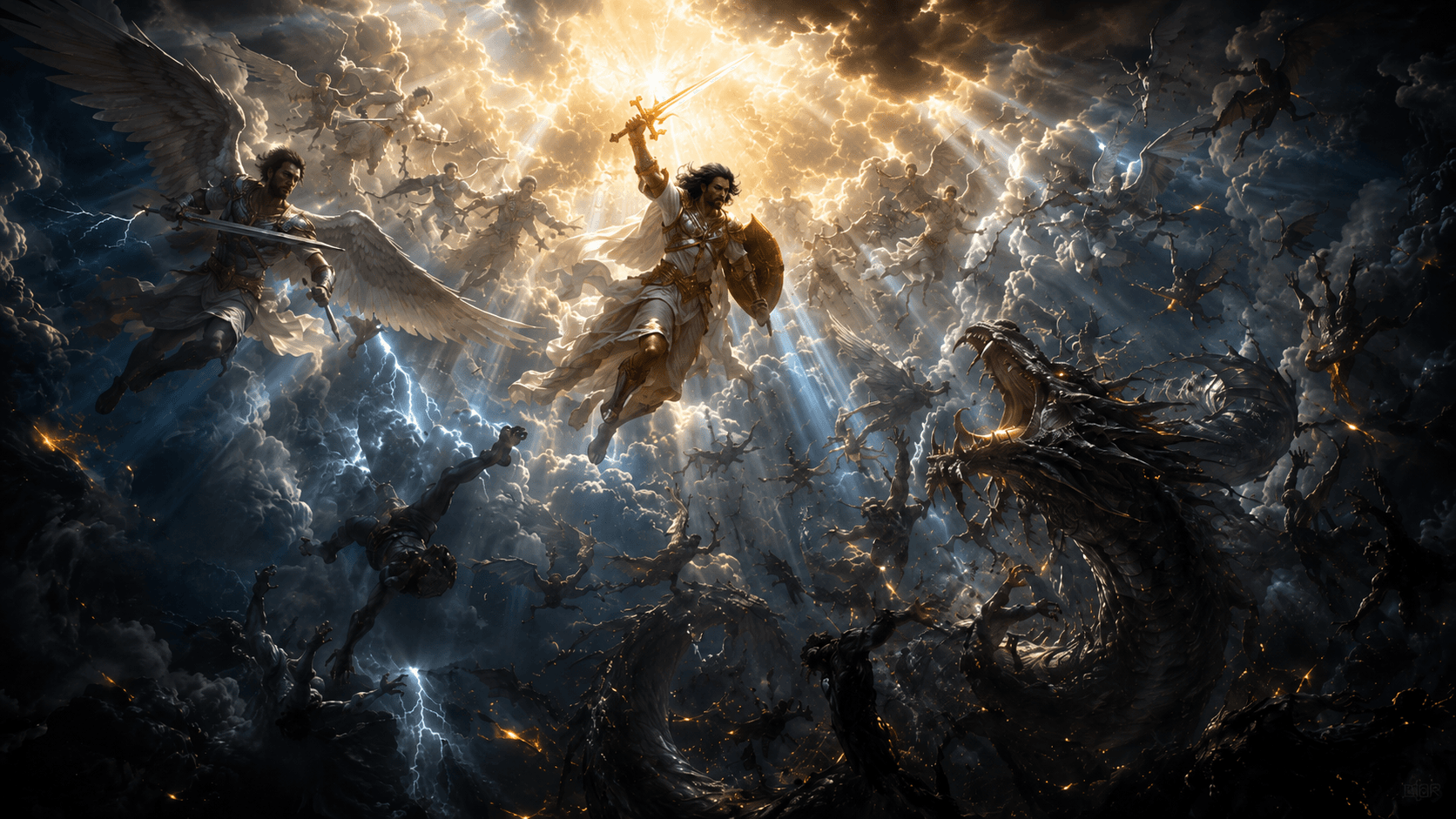
And there was war in heaven: Michael and his angels fought against the dragon; and the dragon fought and his angels… And the great dragon was cast out, that old serpent, called the Devil, and Satan, which deceiveth the whole world.
Notice first the possessive: Michael and HIS angels. The angels are His; He is their commander, not a deputy sent to fight on another's behalf. And notice the timing, which is more surprising than the usual reading allows. We tend to place this war at the very beginning, before the fall of man — but the context places it after the cross. The chapter has just described the man child “caught up unto God, and to his throne” (the incarnation, mission, and ascension of Christ, verses 3–5); and the heavenly voice that follows the war announces, “Now is come salvation, and strength, and the kingdom of our God” — words that make no sense before salvation was accomplished. The dragon is called “the accuser of our brethren… which accused them before our God day and night” — but there were no brethren to accuse before man fell. The casting-out is dated by its own context to after the ascension.
So why is Christ called Michael here, after He has become man and is named Jesus? Because this final war is the culmination of the conflict that began with Michael in the beginning. There was a first war, when Lucifer was cast out; it spread to earth when man fell and Satan seized the place of fallen Adam as humanity's representative; and it was settled when Christ, as a man, met Satan and won that place back — and so Satan was at last dispossessed and cast down, the accuser silenced, and Christ took up His office as our High Priest and Advocate. The name Michael binds the end of the story to its beginning: the same divine Son Whom Lucifer first rose against is the One Who finally casts him down. That is why heaven cries, “Now is come salvation.”
The gospel hidden in the name
Gather the threads. Michael is the commander of the angels, the Angel of the Lord Who bears God's name, the Captain Who receives worship, the great Prince of His people, the Voice that wakes the dead, the One Who is the express image of God — descriptions that fit one Being only, the only-begotten Son. And every one of them rests on the same foundation: He is like God not by what He does but by what He is — by inheritance, because He was begotten of the Father. Now comes the part that makes this more than theology.
How does anyone else become like God? The same way. Not by doing — not by climbing to a high standard of behaviour, the method every false religion prescribes — but by birth, by receiving a life we did not have. “They overcame him by the blood of the Lamb” (Revelation 12:11); and the blood is the life. We are made like God only by being born again — by receiving the life of the Son, which the Father gave Him to give to us. The new birth is not something we do; it is something God does in us when we stop trying to climb and simply receive the gift.
And there is the lie of Eden turned inside out. Satan told Adam and Eve — who were already like God — that they could do something to become like God. That lie has run down all of history: keep this rule, acquire that knowledge, perform this rite, and you will be like God. Michael refutes it by His own existence. He is like God not because He behaves like God but because He is like God, begotten of the Father — and His every act simply reveals what He already is. So with us: we are made like Him not by performance but by the new birth, by having the One who is like God living in us. This is why the reality of Christ's Sonship matters so much: it is the very prototype of the gospel. The whole good news is folded into the meaning of a single name.
He that hath the Son hath life; and he that hath not the Son of God hath not life.
That is the appeal the name finally makes. The only way to be like God is to have the One who is like God — to have Michael, the divine Son, living within. Salvation is in no other, and it comes not by doing but by receiving the life of the Lamb. The identity of Michael is not a curiosity for collectors of doctrine; it is the gospel, written into a name.
So weigh the verses for yourself, and prove all things; hold fast that which is good (1 Thessalonians 5:21). But do not leave the question on the level of a label. The One who is like God came to make us like God — not by handing us a ladder to climb, but by giving us His own life. The only way to be like God is to have the One who is. That is the appeal the name has been making all along.
Sources & further reading
Scripture is quoted from the King James Version. Read the passages in full and weigh the cumulative case for yourself.
The name and the disputed text (KJV)
- Jude 9 — 'Michael the archangel… The Lord rebuke thee' (dispute over the body of Moses)
- Zechariah 3:1-2 — the Lord Himself: 'The Lord rebuke thee, O Satan'
- Isaiah 46:9 — 'I am God, and there is none like me' (contrasted with the idols)
The divine Messenger, Captain, and Prince (KJV)
- Exodus 23:20-21 — the Angel in whom God's name dwells, who pardons transgression
- 1 Corinthians 10:4 — 'that Rock was Christ' (the One who led Israel)
- Joshua 5:13-15 — the Captain of the Lord's host receives worship; the holy ground
- Revelation 22:8-9 — a created angel refuses worship: 'worship God'
- Daniel 10:13, 21; 12:1 — 'the first of the chief princes'; 'Michael your prince'; 'the great prince'
The Son who is like God, and the gospel (KJV)
- Hebrews 1:3 — 'the brightness of his glory, and the express image of his person'
- John 5:23, 26, 28-29 — equal honour with the Father; 'life in himself'; the voice that wakes the dead
- John 1:14 — 'the only begotten of the Father'
- 1 Thessalonians 4:16 — 'the Lord himself… with the voice of the archangel'
- Revelation 12:7-11 — 'Michael and his angels'; 'now is come salvation'; 'overcame him by the blood of the Lamb'
- 1 John 5:11-12 — 'He that hath the Son hath life'
- Isaiah 8:20 — 'To the law and to the testimony…' (the reading principle of this article)