Nearly every Christian confesses that Jesus is divine. The deep disagreement is not over whether He is divine, but over why. This article takes up that single question and follows it to the bottom. It is a companion to the larger study of the Godhead, narrowing the lens to the one point on which the two answers part: the divinity of the Son, and the ground on which Scripture rests it. And let me say plainly at the start what I will say again at the end — this is held with conviction, but it is not a test of fellowship and not a condition of salvation. It is written to exalt Christ, not to diminish Him.
The question that divides
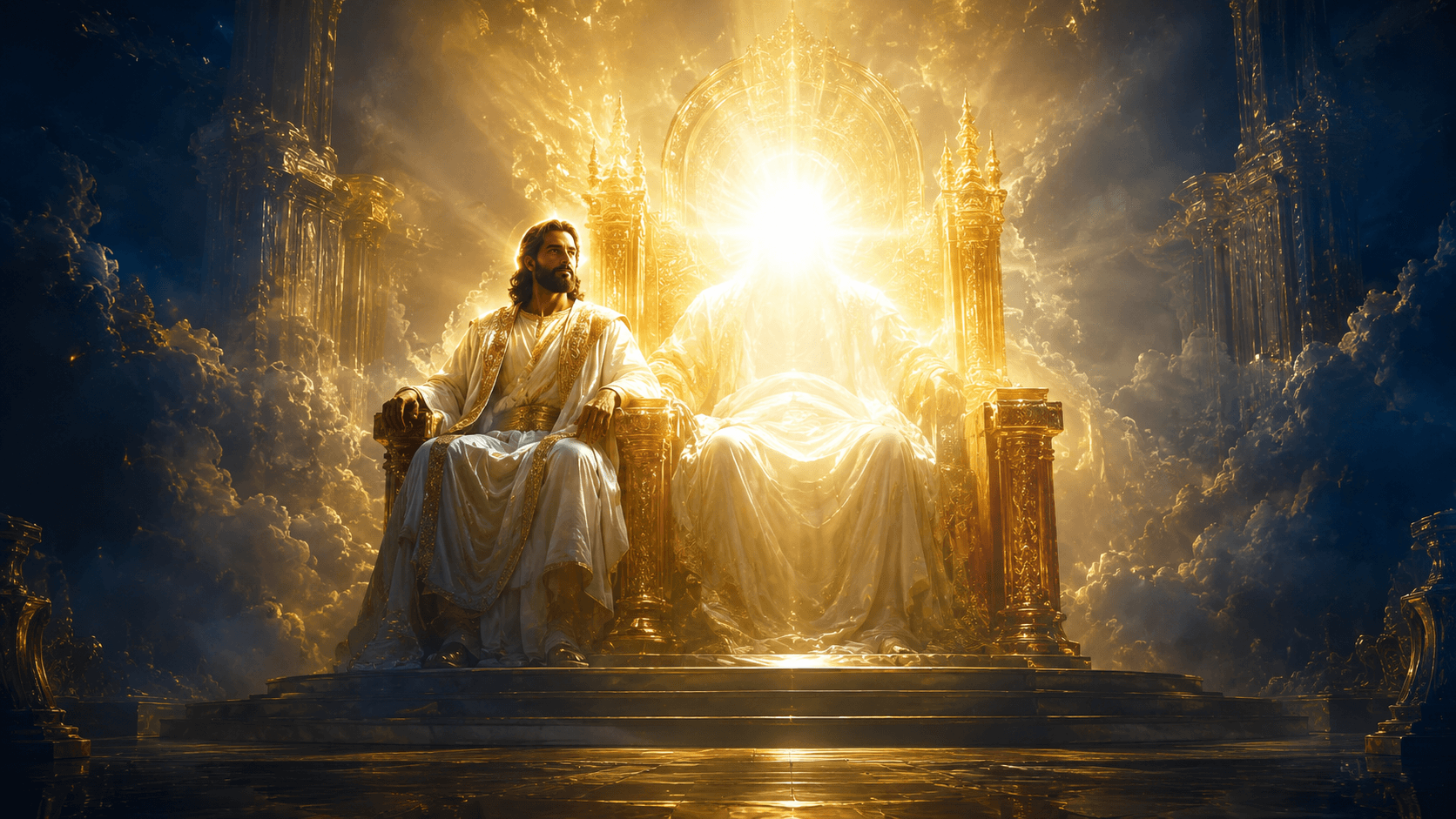
Two answers stand opposed. The first — the trinitarian answer — is that Christ is divine because He is co-eternal with the Father, of one substance, having always existed as the second person of the Godhead; on this view the title “Son” designates an eternal relationship, not a literal begetting, and “begotten” is read as a metaphor. The second — the answer defended here, and the older one — is that Christ is divine because the Father literally brought Him forth before all creation, and in being begotten He inherited the divine nature, name, and life of God.
The two cannot both be true, and the difference is not a quibble. A Son Who has no beginning was not literally brought forth; a Son Who was literally brought forth has a beginning. The question is forced, and Scripture must settle it. The whole of this article is an attempt to let the Bible answer in its own words.
Where the Bible begins, Christ begins
The clearest Old Testament window onto the Son's origin is Proverbs 8, where divine Wisdom — Whom Paul names directly as “Christ the power of God, and the wisdom of God” (1 Corinthians 1:24) — speaks of her own coming forth. Twice the language is that of birth:
When there were no depths, I was brought forth… before the hills was I brought forth.
The Hebrew verb is the ordinary word for the travail of childbirth — the same family of language Eve uses in Genesis 4:1: “I have gotten a man from the Lord.” It describes a real bringing-forth at a real point — “the beginning,” before the depths and the mountains existed. This is not the incarnation in Bethlehem; it is the Son's pre-incarnate origin, a moment so far back in eternity that, as the pioneer E. J. Waggoner put it, “to finite comprehension it is practically without beginning.” Wisdom does not say she was created among the works; she says she was brought forth, and then stood beside the Father as the things were made (Proverbs 8:30).
John echoes the same beginning
John opens his Gospel on the same note Proverbs strikes: “In the beginning was the Word, and the Word was with God, and the Word was God” (John 1:1). The same “beginning” — the same coming-forth — but now the divinity is stated outright: the Word was with God (distinct from the Father) and was God (sharing the Father's nature). John is not describing a creation; he is describing the One Who already possessed the divine nature in the beginning, the One “by whom all things were made” (John 1:3). When that same Word “was made flesh” (John 1:14), His glory was “the glory as of the only begotten of the Father.” The begetting is the premise of the whole prologue, not an afterthought to it.
After his kind
Genesis lays down a law of life on the third day of creation and never repeals it: every living thing brings forth “after his kind” (Genesis 1:11-12). Like begets like. Scripture then applies the very same principle to a son: “Adam… begat a son in his own likeness, after his image; and called his name Seth” (Genesis 5:3). A son carries the nature of the one who begot him. This is the hinge of the whole argument. The Father did not make a Son after some lesser kind; He brought forth a Son after His own kind. Whatever the Father is in His nature, the Son inherited by being brought forth from Him. To be begotten of God is to be God — not a second, separate God, but the divine Son sharing the one divine nature of His Father, as truly as Seth shared the nature of Adam.
Being precedes doing
Many well-meaning defences of Christ's divinity argue from His miracles: He forgave sins, stilled storms, raised the dead, received worship — therefore He must be God. The works are real and they do bear witness. But notice the order Scripture keeps, because getting it backward leads straight into error. Christ does not become divine by doing divine things; He does divine things because He is already divine. Being precedes doing. A man who reasons his way to Christ's deity through the miracles alone has built on the works rather than on the Person — and John's Gospel, which presses the divinity harder than any other, grounds it again and again not in the wonders but in the relationship: He is the Son, sent from the Father, sharing the Father's life.
Life in himself
The deepest statement of that shared life is one short sentence of Christ's own:
For as the Father hath life in himself; so hath he given to the Son to have life in himself.
To have life in himself — underived, self-existent, original life — is the very thing that distinguishes God from every creature. Creatures have life on loan; God has life in Himself. And Christ has it too — “so hath he given to the Son to have life in himself.” Mark both halves. The Son has the same kind of life the Father has: divine, self-existent. And the Son has it as a gift— “hath he given” — received from the Father in the act of begetting, not at the manger. This is exactly what divinity by inheritance means: the Father, Who is the fountain of life, gave that life to the Son when He brought Him forth, so that the Son possesses it truly and as His own.
Eternal life is in the Son
That given life is not a metaphysical curiosity tucked away in the doctrine of God. It is the whole pivot of the gospel. John states it without a seam:
And this is the record, that God hath given to us eternal life, and this life is in his Son. He that hath the Son hath life; and he that hath not the Son of God hath not life.
Follow the single chain that runs from eternity to your own soul: the Father gave life to the Son in the begetting; the Son carried that life through the incarnation, the cross, and the resurrection; and the believer receives that very life by receiving the Son. “He that hath the Son hath life.” This is why the begetting is not an abstraction to be left to scholars. The life that saves you is the Father's own life, lodged in His Son and given to you in Him. Pull the literal Sonship out, and the chain has no first link.
The Father's own testimony — and the disciples' confession
When the Father Himself broke heaven's silence to identify Jesus, He grounded His Son's authority not in credentials, deeds, or office, but in sonship: “This is my beloved Son, in whom I am well pleased” — at the baptism (Matthew 3:17) and again on the mount (Matthew 17:5). And when the disciples reached for the highest confession they could make, it was the same: “Thou art the Christ, the Son of the living God” (Matthew 16:16); “I believe that thou art the Christ, the Son of God” (John 11:27). To confess Jesus as the Son of God is to confess His divinity — because Sonship from the Father is the very basis on which His divinity stands. John tells us this is precisely why he wrote: “that ye might believe that Jesus is the Christ, the Son of God; and that believing ye might have life through his name” (John 20:31).
The cost of the metaphor
The formal doctrine of the trinity, fixed at the Councils of Nicaea (AD 325) and Constantinople (AD 381), requires the Son to be co-eternal with the Father. That requirement forces a re-reading of “begotten” — it can no longer mean literally brought forth, so it must be recast as a timeless, figurative relationship. The cost of that move is rarely counted, but it is steep. One trinitarian study centre states the premise frankly: “The term Son is used metaphorically when applied to the Godhead.” Trace where that leads.
Once the Sonship is a metaphor, the begetting is a metaphor. Once the begetting is a metaphor, the inheritance is a metaphor — for there is no real bringing-forth in which a nature could be passed on. And once the inheritance is a metaphor, the divine nature is not actually handed from Father to Son at all — which means the very ground on which Scripture builds Christ's divinity has been quietly removed. The trinitarian must then re-establish that divinity on a different foundation: philosophical co-equality and shared substance, asserted apart from any begetting. The irony is sharp. The doctrine erected to guard Christ's divinity ends by cutting the biblical root of it, and replacing the gospel's living Father-and-Son with a metaphysical formula the apostles never taught.
Why a begotten Son is not an inferior one
The instinctive objection is that a Son with a beginning must be lesser — that “begotten” threatens His full deity. Scripture's own illustrations answer it. Eve was brought forth from Adam, taken out of him and so in one sense later and derived — yet she was every bit as fully human as he. Seth was begotten of Adam, in Adam's own likeness — and no one imagines Seth was a lesser kind of man for having a father. Temporal order and derivation do not diminish shared nature; they establish it. So with the Son. That He came forth from the Father does not make Him a lesser God; it is the very reason He is fully God — of the Father's own kind, the express image of His person, “God of God,” as the oldest creeds confessed before the councils. The begetting is not the flaw in His divinity. It is its source.
A historical note
This is not a modern invention but the older confession. The founders of the Advent movement — James White, Joseph Bates, and the rest — held to literal sonship, and Ellen G. White wrote of Christ as “a son begotten in the express image of the Father's person, — not a son by creation, as were the angels, nor a son by adoption, as is the forgiven sinner.” Neither created nor adopted, but begotten — fully divine, of the Father's own nature. It is worth knowing, too, that the doctrine of the trinity in its modern form was not officially adopted as a fundamental belief by the Seventh-day Adventist Church until 1980; the position set out here is the historic Adventist teaching, not a departure from it. The fuller history — how the councils built the formula and how Rome enforced it — is traced in the companion piece on how the trinity entered Christianity.
What this means
Gather it into one line. The divinity of Christ is divinity by inheritance: the divine nature, name, and life received from the Father at the begetting of the Son, before any created thing existed. He is not a creature. He was not made. He was brought forth — and what is brought forth of God is God. He stands on the Creator's side of the line, the One through Whom every created thing came to be.
And this is the record, that God hath given to us eternal life, and this life is in his Son. He that hath the Son hath life.
And eternal life is in this Son. To have the Son is to have the life; to receive Him is to receive everything Scripture promises in the gospel. So whatever a brother concludes who has weighed the same verses and still holds the older creed, love him as a brother — the point of all of it was never to win an argument about a word, but to send you to the Son, in Whom the Father has lodged His own life, that believing you might have life through His name.
Sources & further reading
Scripture is quoted from the King James Version. Read the key passages in full and weigh the argument for yourself.
Scripture (KJV)
- Proverbs 8:22-25, 30 — Wisdom 'brought forth' before the depths and the hills
- Genesis 1:11-12; 5:3 — 'after his kind'; Adam 'begat a son in his own likeness, after his image'
- John 1:1-3, 14, 18 — 'the Word was God… all things were made by him… the only begotten of the Father'
- John 5:26 — 'so hath he given to the Son to have life in himself'
- 1 John 5:11-12 — 'this life is in his Son… he that hath the Son hath life'
- Matthew 3:17; 17:5 — the Father's testimony: 'This is my beloved Son'
- Matthew 16:16; John 11:27; 20:31 — the confession that Jesus is the Son of God, 'that believing ye might have life'
- 1 Corinthians 1:24, 30 — 'Christ the power of God, and the wisdom of God'
- Colossians 1:15-17; Hebrews 1:3-5 — 'firstborn of every creature… the express image of his person'
- Isaiah 8:20 — 'To the law and to the testimony…' (the reading principle of this article)
History of the doctrine
- The Councils of Nicaea (325) and Constantinople (381) — the fixing of co-eternal trinitarian doctrine (Encyclopædia Britannica)
- Ellen G. White, Signs of the Times, May 30, 1895 — 'a son begotten… not a son by creation… nor a son by adoption'