Salt is not the problem. The kind of salt almost everyone eats is. Real, unrefined salt — Celtic, Baja Gold, Redmond Real Salt, Himalayan — is one of the most mineral-dense foods you can put on your plate, and one of the few things I'd call genuinely non-negotiable. The refined white powder that sits in nearly every kitchen and every processed food is something else entirely: a stripped, bleached, chemically-stabilized industrial product that happens to share a name with the real thing.
For two generations we've been told salt is dangerous — that it drives blood pressure, that "low sodium" is virtuous, that the less you eat the better. The advice was wrong, the science behind it was thin from the start, and the practical result is a population that's often running low on a mineral the body cannot function without — while still eating the worst possible form of it. This article is about untangling those two things: the salt panic, and the salt swap that actually matters.
The salt panic was wrong
The "salt causes heart disease" story rests on a chain of assumptions that has been quietly falling apart for years. The original logic was simple: salt raises blood pressure in some people, high blood pressure is a cardiovascular risk factor, therefore everyone should cut salt. But when researchers actually measured outcomes — heart attacks, strokes, death — rather than the blood-pressure surrogate, the neat line bent into a curve.
The large PURE study and others found a J-shaped (or U-shaped) relationship: both very high and very low sodium intake raise cardiovascular risk, with the lowest risk sitting in a broad middle range that most people are already in. The people with the worst outcomes in several datasets were the ones eating the least salt. As I covered in the electrolyte article, sodium is not the cardiovascular villain it was made out to be — it's an essential electrolyte the body defends within a tight range and works hard to hold onto.
There's a deeper confound the salt panic ignored entirely: almost all the studied salt was refined table salt and processed-food salt— sodium chloride stripped of every other mineral, with no potassium or magnesium alongside it to balance it. Sodium doesn't act alone in the body. It works in constant tension with potassium across every cell membrane. A diet flooded with bare sodium chloride and starved of potassium is a different thing than a diet with real salt and real food — and lumping them together is part of how the science got muddied.
The salt panic studied the wrong salt and the wrong question. It measured blood pressure instead of death, and it measured stripped industrial sodium chloride instead of mineral-rich real salt.
What refined table salt actually is
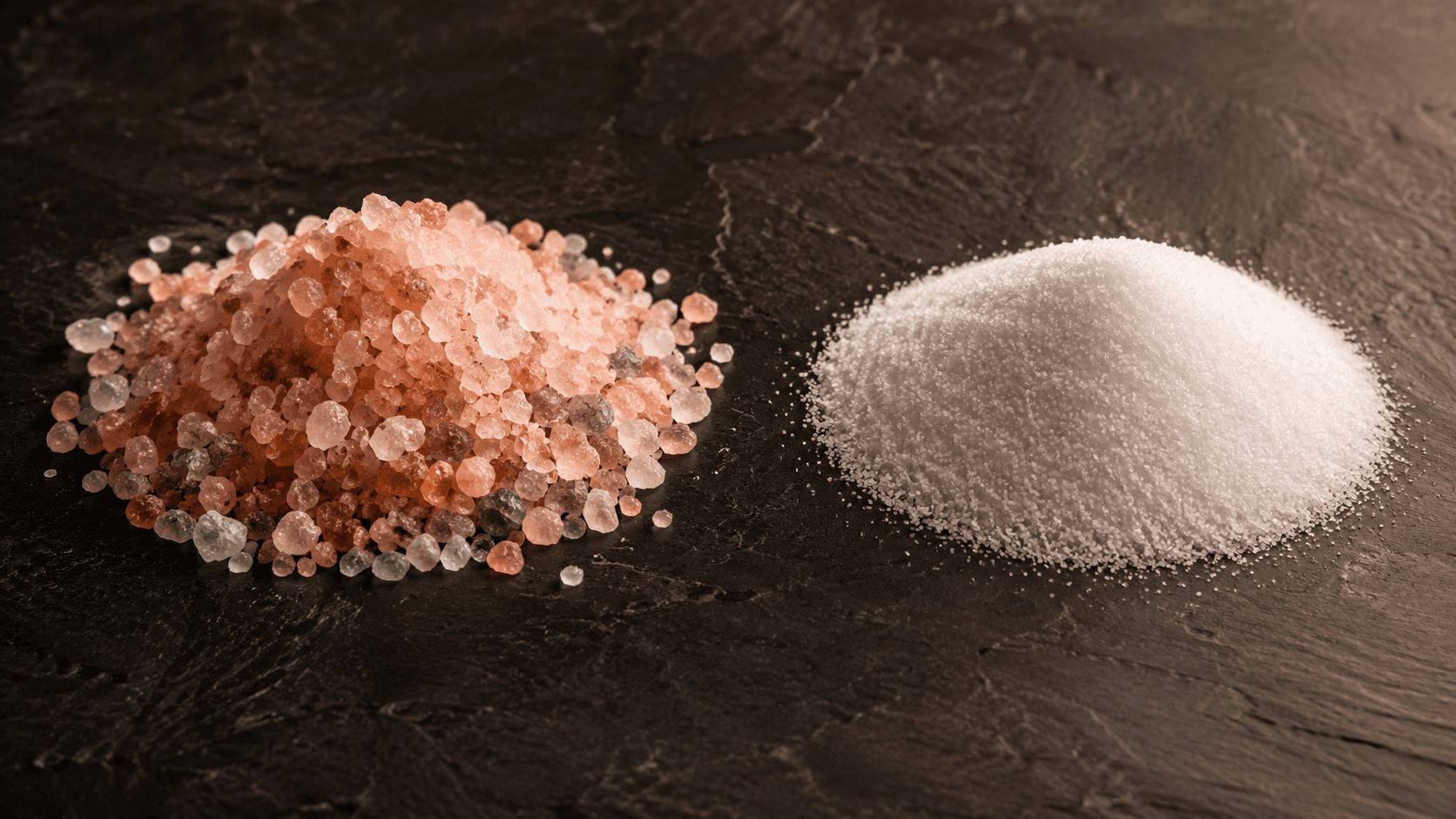
Pick up a standard canister of table salt and you are holding a product that is 97.5% to 99.9% pure sodium chloride. That purity is not a virtue — it's the tell. Natural salt, as it comes from the sea or an ancient seabed, contains sodium chloride plus sixty to eighty-plus trace minerals: magnesium, potassium, calcium, and a long tail of trace elements the body uses. Refined salt is what's left after all of that is removed.
The industrial process, briefly:
- Raw salt is harvested — usually by injecting water underground to dissolve salt deposits, then pumping the brine up.
- It's refined and recrystallized at high temperatures, a process that strips out the magnesium, potassium, calcium, and trace minerals — which are then sold off separately to other industries. The trace minerals aren't waste to the manufacturer; they're a second product line.
- It's often bleached to achieve that uniform, unnatural white.
- Anti-caking agents are added so it pours freely and never clumps.
- Synthetic iodine and a sugar to stabilize it are sprayed on at the end.
What comes out the other end flows freely, looks clean, and is chemically about as far from a whole food as flour is from wheat in a field. This is the "salt" in the salt studies, in virtually every restaurant, and in essentially every packaged product on the shelf.
The additives nobody reads the label for
The free-flowing convenience of table salt is engineered, and the engineering is worth knowing about:
- Anti-caking agents — commonly sodium aluminosilicate or sodium ferrocyanide (yellow prussiate of soda), sometimes calcium silicate. The aluminum-bearing agents are the ones I care about most: a daily, lifelong intake of an aluminum compound on a food you eat every single day, for no nutritional reason whatsoever — only so the powder doesn't clump in a humid kitchen.
- Dextrose (sugar) — yes, there is sugar in your table salt. A small amount of dextrose is added because it stabilizes the added iodine, which otherwise oxidizes and evaporates off the salt over time. It's also what can give iodized salt a faint off-color, so the salt is bleached to compensate.
- Bleaching agents— to reverse the discoloration and deliver the cosmetically perfect white that signals "clean" to a shopper but actually signals "processed" to anyone paying attention.
None of these are in food because they nourish you. They're in food because they make an industrial powder behave like a consumer product. The contrast with real salt — which is one ingredient, full stop — could not be sharper.
The iodized-salt problem — why this is the wrong way to get iodine
Iodized salt is held up as one of public health's great victories: add iodine to salt in 1924, eliminate goiter, problem solved. I take iodine more seriously than almost anyone — I've taken it daily for over a decade — and precisely because of that, I think iodized salt is one of the worst ways to get it. Here's why the two issues — what salt to eat, and how to get iodine — should be completely separated.
- The dose is trivial. Iodized salt was designed to deliver just enough iodine to prevent visible goiter — roughly the 150-microgram RDA range — not anywhere near the 10–12 milligrams that Dr. Sircus and Dr. Brownstein argue is optimal. As I lay out in the iodine article, the gap between "enough to avoid goiter" and "enough to actually be replete" is roughly eighty-fold. Relying on salt for iodine means living inside that gap.
- It's the wrong form. Iodized salt uses potassium iodide — iodide only. The body, and especially breast and glandular tissue, also needs elemental iodine. This is exactly why Lugol's and Iodoral contain both iodine and iodide. A salt that delivers a tiny dose of one half of the pair is not iodine supplementation in any meaningful sense.
- It degrades. The iodine oxidizes and evaporates off the salt over months — which is the entire reason dextrose is added to slow it down. The number on the box is not the number on your food by the time you eat it.
- It chains you to the worst salt. The argument "but I need iodized salt for the iodine" is what keeps people eating the refined, bleached, aluminum-dusted product. Cut that argument and the whole thing falls away.
The clean solution is to separate the two jobs entirely. Get your sodium and your full mineral spectrum from real salt. Get your iodine — properly, at a real dose, in the right form — from Lugol's or Iodoral. As a bonus, real unrefined salt naturally contains a small amount of trace iodine anyway — not enough to be your iodine source, but more honest than a sprayed-on, degrading additive.
Real salt for your minerals. Lugol's for your iodine. Stop asking one industrial powder to do a job it was never able to do.
What real salt actually is
Real, unrefined salt is sea water (or an ancient, dried-up sea) with the water taken out and nothing else done to it. What stays behind is the full mineral matrix the ocean carries — the same broad spread of elements found in human blood and the body's extracellular fluid, which is not a coincidence: the body runs on a salted internal sea that mirrors the very chemistry of the ocean.
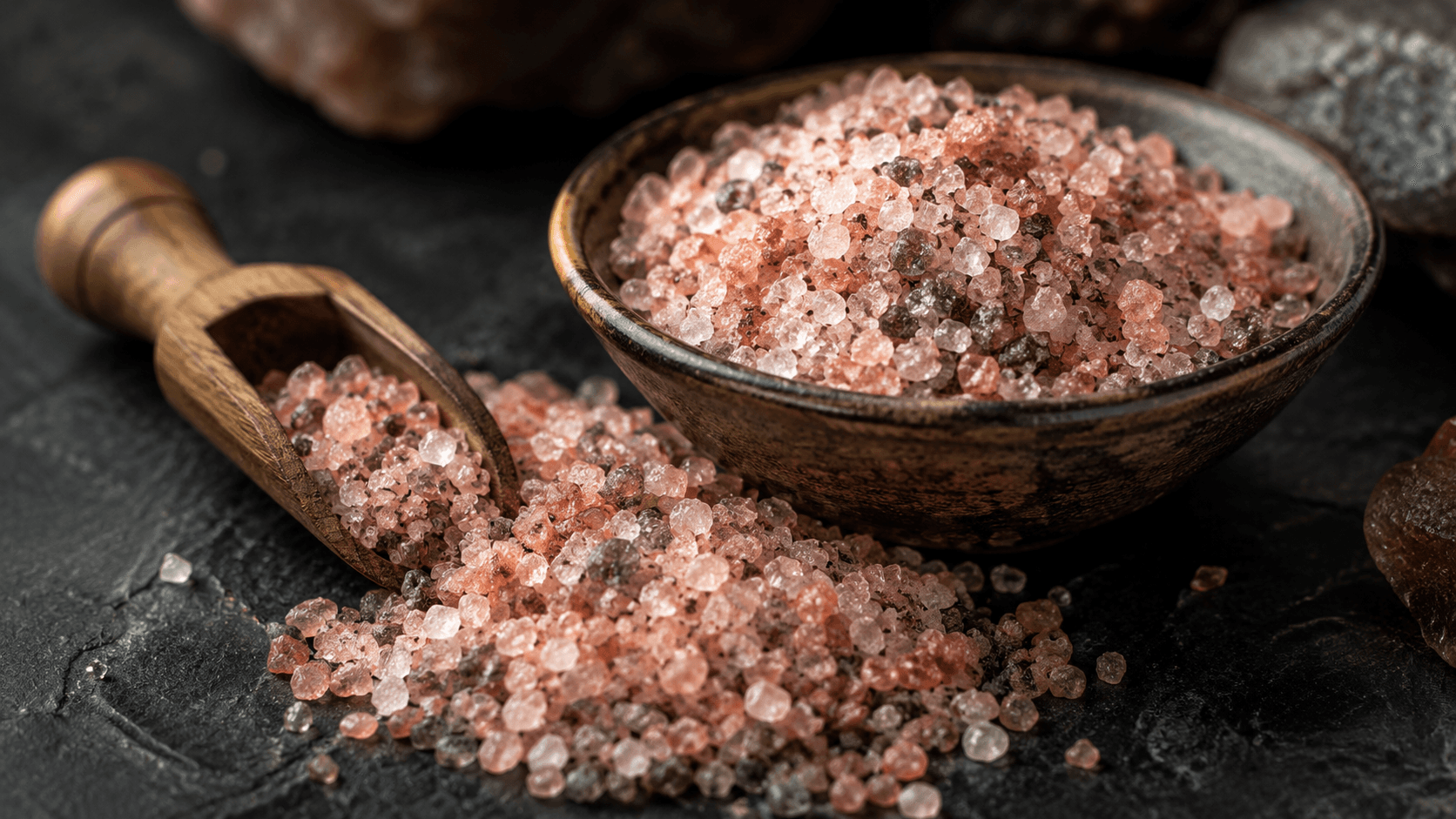
You can usually see the difference. Real salt is rarely pure white — it's grey, pink, rose, gold, or off-white, because the minerals are still in it. Celtic salt is damp and grey. Himalayan is pink. Baja Gold has a faint golden cast. Redmond Real Salt is a pinkish-tan. That color is the trace-mineral content you're actually paying for, and the thing refining removes.
What those minerals do alongside the sodium:
- Magnesium — the single most depleted mineral in the modern population, a cofactor for hundreds of enzymatic reactions (covered in the magnesium article).
- Potassium— sodium's partner across every cell membrane; real salt brings a little of it alongside the sodium instead of bare sodium chloride.
- Calcium, and a long tail of trace elements — zinc, selenium, boron, manganese and dozens more in tiny amounts, the kind of broad mineral coverage modern soil-depleted food increasingly fails to provide.
Celtic, Baja Gold, Redmond Real Salt, Himalayan
The four real salts worth knowing, and how I think about them:
Celtic sea salt
Harvested from coastal salt ponds in Brittany, France, by the traditional hand-raking method, and left moist and grey. The damp, mineral-grey "sel gris" is the most mineral-rich common sea salt you can buy, and the one Dr. Sircus and others point to for its magnesium content. It's the salt I reach for when I want the full living-seawater profile. The moisture is a feature, not a defect — it means the magnesium-bearing brine was never baked out.
Baja Gold sea salt
Harvested from the Sea of Cortez in Baja, Mexico — one of the most mineral-rich and biodiverse bodies of water on earth — by solar evaporation. Baja Gold markets itself on having 90-plus trace minerals and a notably full ionic-mineral profile, and the faint gold color is the minerals themselves. It's a genuinely excellent salt and one of the best-tasting; the broad mineral spread is the reason it has a following among people who take this seriously.
Redmond Real Salt
Mined from an ancient sea salt deposit in Utah— a sea that dried up long before industrial pollution existed, then got sealed under a layer of volcanic ash. That's its quiet advantage: it carries the full trace-mineral profile of an ancient ocean without the modern-ocean contamination question (more on that below). It's American-mined, unrefined, pinkish from its mineral content, and the same Real Salt that anchors the Redmond Re-Lyte electrolyte product I mentioned in the electrolyte article. It's my default everyday cooking salt for exactly that reason.
Himalayan pink salt
Mined from the Khewra deposit in Pakistan — also an ancient sea, also sealed away from modern pollution. The familiar pink crystals are widely available and a perfectly good real salt. It's the most mainstream-accessible of the four, which is both its strength (you can find it anywhere now) and the reason the market is flooded with mediocre and mislabeled versions — buy a reputable brand.
The honest caution: the microplastic question
I'm not going to pretend real salt is flawless. The one legitimate knock on modern sea salt — Celtic, Baja Gold, and any salt harvested from today's oceans — is microplastic and pollutant contamination. The oceans now carry plastic particles and industrial pollutants, and studies have found measurable microplastics in a large share of commercial sea salts worldwide. The amounts are small, but it's a real and growing issue and I'd rather name it than hand-wave it.
This is the strongest single argument for the ancient-deposit salts — Redmond Real Salt and Himalayan pink. Because they come from ancient seas that dried up and were sealed underground long ago, well before plastic or industry existed, they carry the full ancient-ocean mineral profile without the modern-ocean contamination. That's why my own rotation leans on Redmond Real Salt as the daily driver, with a good Celtic or Baja Gold for variety and the high magnesium content. You don't have to pick one forever — but if you want the lowest contamination risk, the ancient-deposit salts win.
What salt actually does in the body
Sodium is not a seasoning the body merely tolerates — it's a mineral it actively defends, because nearly everything depends on it:
- Every nerve impulse and muscle contraction runs on the sodium-potassium gradient across cell membranes — including your heartbeat.
- Fluid balance and hydration— sodium is what actually holds water in the body and lets cells hydrate. Drinking gallons of plain water while low on salt doesn't hydrate you; it dilutes you. Real hydration is water plus minerals.
- Adrenal and cortisol regulation — the adrenals and the hormone aldosterone manage sodium, and chronically low salt makes the body crank up stress hormones to hold onto what little it has. Many people running on chronic low-grade fatigue, dizziness on standing, and salt cravings are simply under-salted.
- Stomach acid and digestion — chloride from salt is a raw material for the hydrochloric acid your stomach uses to break down food and absorb minerals.
- Bromide and toxin excretion — as I cover in the iodine article, unrefined salt in water supports the renal pathway that flushes bromide and other halides out — one reason a little Celtic or Redmond salt is part of an iodine protocol.
The salt craving most people fight is usually information, not weakness. The body asks for salt because it needs it. Give it the real thing and the craving tends to settle where it belongs.
How to actually use it
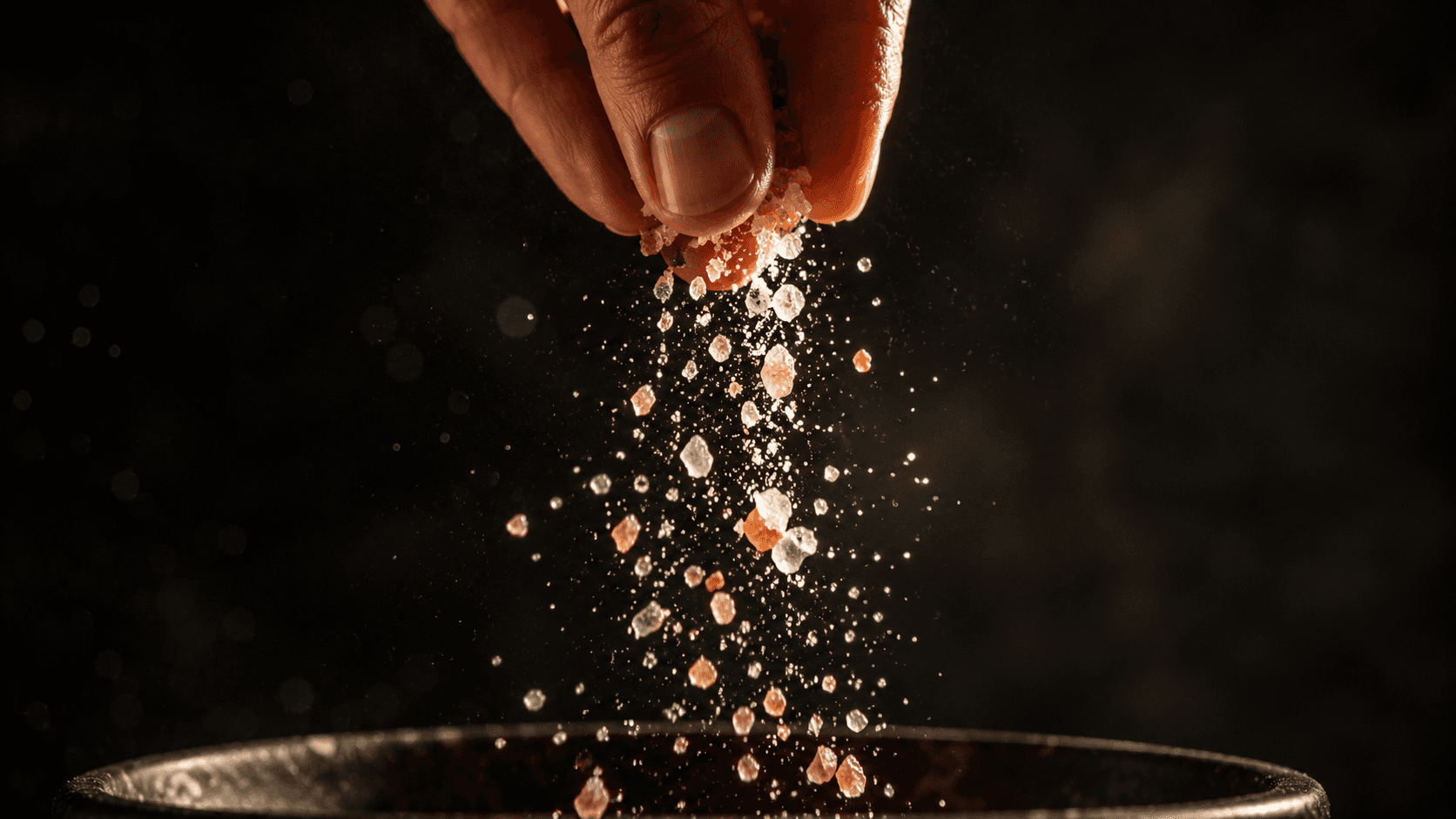
- Replace your cooking salt entirely. The single highest-leverage move: throw out the refined canister and cook and finish everything with real salt. You use salt every day, so this swap compounds faster than almost any other change.
- The morning salt-water glass. A small pinch (1/8 to 1/4 teaspoon) of real salt in a glass of water on waking — often alongside a splash of apple cider vinegar — replaces the sodium lost overnight, supports the adrenals before the day's cortisol rhythm, and hydrates far better than plain water. This is a daily habit for me.
- "Sole" water. Fill a jar a quarter full with real salt, top with water, let it sit a day until the water is fully saturated (some salt stays undissolved at the bottom). A teaspoon of that concentrated brine in a glass of water is the traditional way to take a steady daily mineral dose.
- Salt your water during fasting and exertion. On fasting days, in hot weather, and around hard training, real salt in water (or a clean electrolyte product) prevents the headaches, fatigue, and cramps that are usually electrolyte depletion, not hunger or dehydration.
- Don't fear the amount. Salt to taste with real salt and real food, and let your body's appetite for it guide you. The body regulates sodium well when it's given the real thing alongside adequate potassium.
How I do this
There is no refined salt in my house. Redmond Real Salt is my everyday cooking and finishing salt — American-mined, ancient-deposit, no microplastic question, and it tastes clean and full. I keep a good Celtic grey salt around too, mostly for the higher magnesium content and for the morning glass, and I'll rotate in Baja Gold when I want the broadest trace-mineral spread and the best flavor.
Every morning starts with a pinch of real salt in water, usually with a little apple cider vinegar — the sodium for the adrenals and hydration, before anything else. And I get my iodine entirely separately, from Lugol's and Iodoral, exactly as laid out in the iodine article. Real salt does the mineral job. Lugol's does the iodine job. Neither one pretends to be the other.
Closing
The body heals itself when you give it the right inputs and stop handing it the wrong ones. Salt is one of the clearest examples on the whole site. The mainstream got it doubly wrong: it told you to fear a mineral you actually need, and the "salt" it told you to fear was a bleached, sugar-stabilized, aluminum-dusted industrial powder that barely resembles the real thing.
Swap it out. Cook with Celtic, Baja Gold, Redmond Real Salt, or a good Himalayan. Salt your food and your morning water without guilt. Get your iodine from a real source instead of from a degrading additive sprayed on the worst salt available. It's one of the cheapest, simplest, highest-return changes you can make — and you make it every single time you eat.
Related reading on this site: the iodine article on why salt is the wrong iodine source and what to use instead; the potassium article on sodium's essential partner; and the electrolyte article on putting the full mineral picture together.
What I actually use
All three are in my kitchen. The affiliate tag is a placeholder until I'm enrolled in Amazon Associates.
Sources & further reading
- Dr. Sircus — Sodium Bicarbonate and the broader case for unrefined mineral salts
- Mente et al., 'Associations of urinary sodium excretion with cardiovascular events' — the PURE study, The Lancet, 2016 (the J-curve)
- Graudal et al., 'Compared with usual sodium intake, low- and excessive-sodium diets are associated with increased mortality' — meta-analysis, American Journal of Hypertension
- Kim et al., 'Global Pattern of Microplastics in Commercial Food-Grade Salts' — Environmental Science & Technology, 2018
- FDA — Code of Federal Regulations on salt and iodized salt additives (anti-caking agents, dextrose, potassium iodide)
- Redmond Real Salt — source and mineral analysis
- Baja Gold Sea Salt — mineral profile