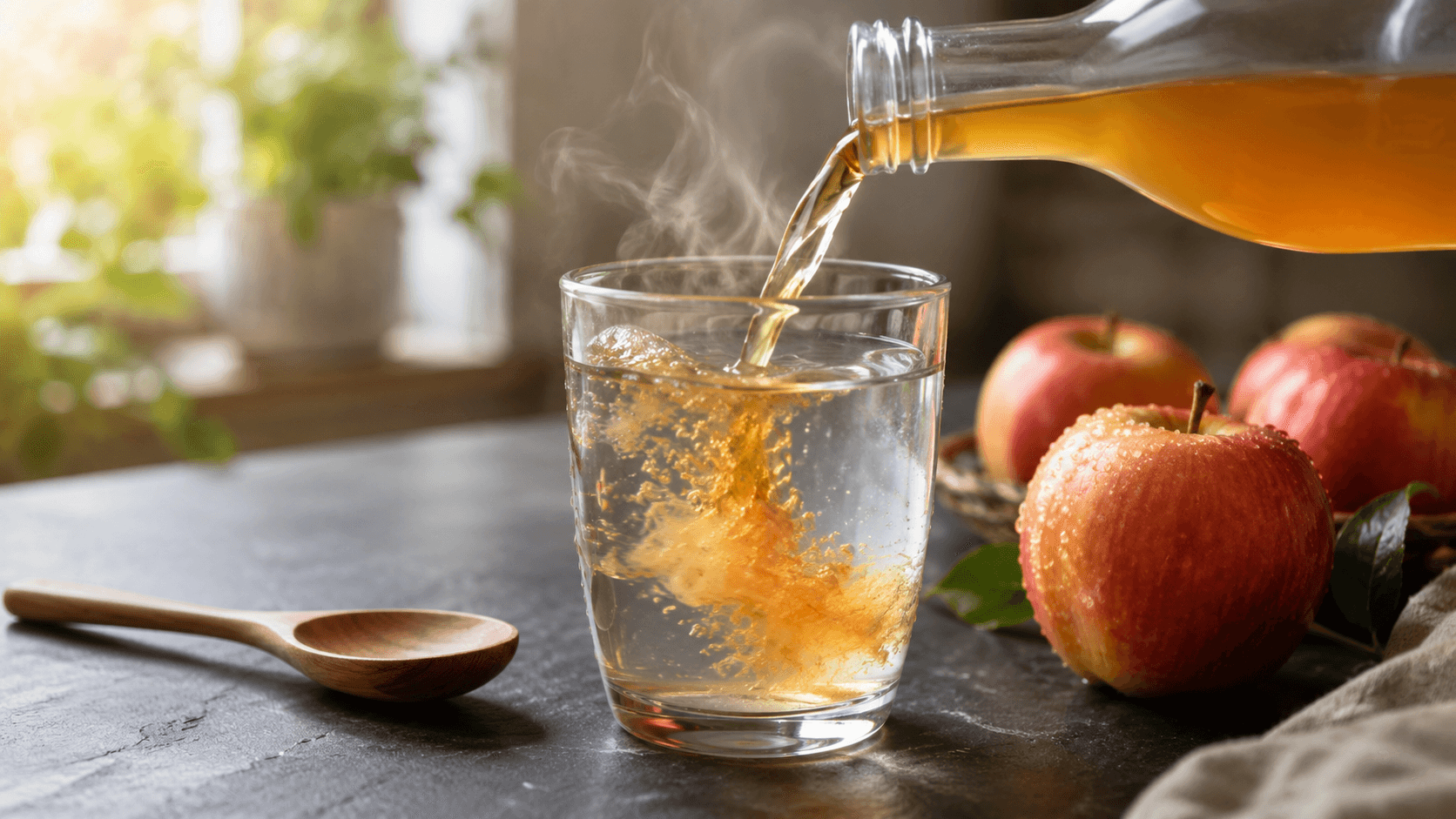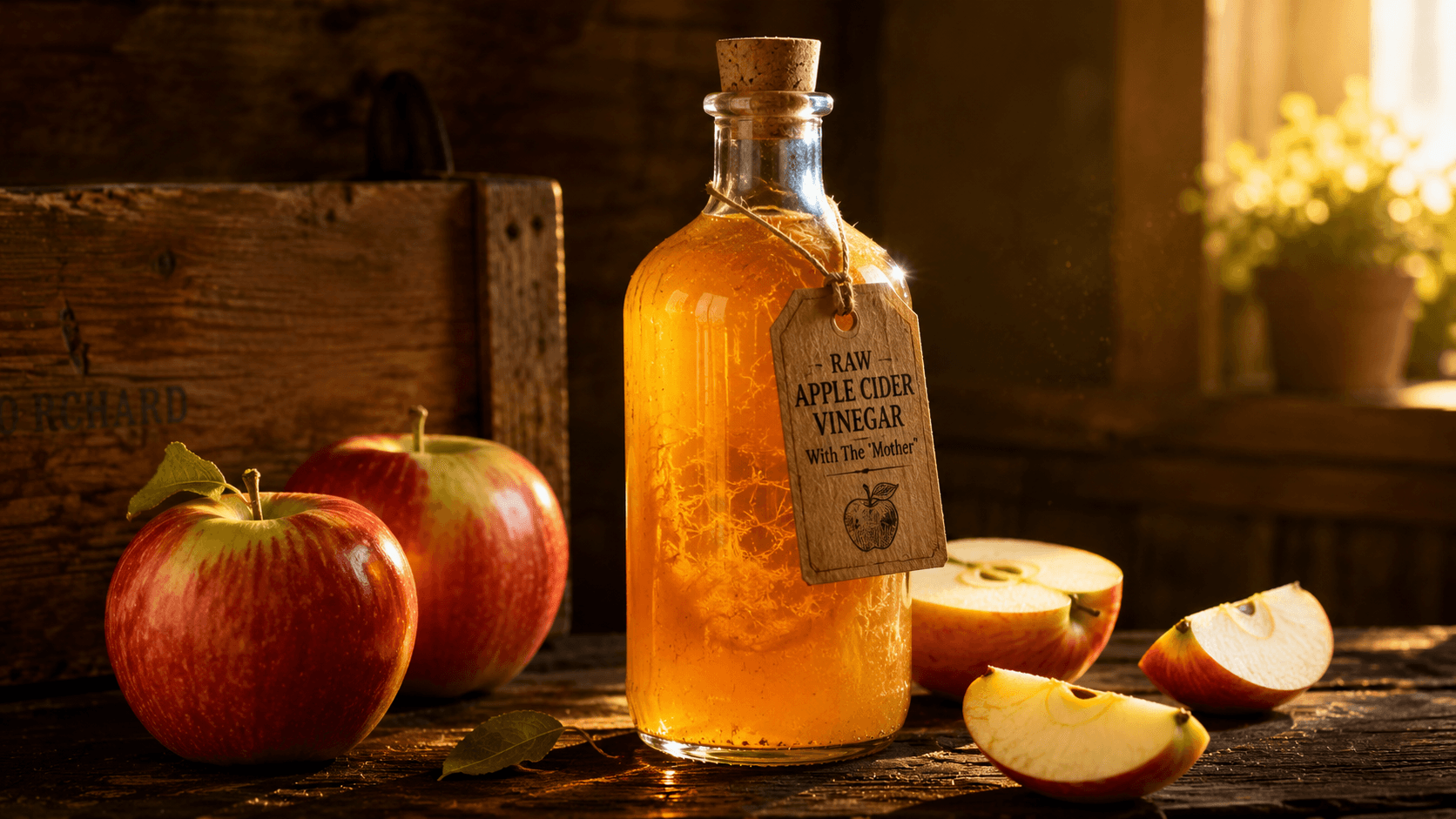
Apple cider vinegar — raw, unfiltered, "with the mother" — is one of the most clinically validated traditional remedies in the entire natural medicine canon. The research base on its effect on postprandial blood glucose is unusually robust: systematic reviews and meta-analyses of clinical trials consistently show vinegar consumption reduces post-meal blood sugar and insulin responses by 20–30% in both healthy subjects and people with glucose disorders. A pre-meal tablespoon of ACV has been shown to improve insulin sensitivity by up to 34% in insulin-resistant subjects. The cost is something like a dollar a week. The taste, with a single accessible fix, is genuinely pleasant.
ACV is one of the cleaner cases in the entire health conversation where a traditional remedy people have used for centuries has held up under modern controlled trials almost perfectly. Hippocrates was prescribing vinegar-and-honey preparations 2,400 years ago. Modern functional medicine has reached essentially the same conclusions. The doses, the timing, the mechanisms — all of it lines up with what people working without microscopes and double-blind protocols figured out empirically thousands of years before the scientific method existed.
This article covers what ACV actually is, why "with the mother" matters, the documented health benefits (blood sugar, weight, digestion, acid reflux paradox, cholesterol, antimicrobial action), the timing question, the brand question (including the Bragg's ownership-change controversy that's worth being honest about), the daily protocol I use, the salt trick that makes the daily glass actually drinkable, the salad dressing recipe that's the single highest-leverage way to add ACV to your diet, and the never-drink-straight rule that genuinely matters for your esophagus.
What apple cider vinegar actually is
Apple cider vinegar is the product of a two-step fermentation. Apples are crushed and pressed to extract juice. The sugars in the juice are fermented by yeast into alcohol (this is hard cider). Then bacteria of the genus Acetobacter ferment the alcohol into acetic acid — the sour, pungent compound that gives all vinegars their character. The result is a liquid that's roughly 5–6% acetic acid by volume, plus a complex mixture of polyphenols, minerals, organic acids, and (in unfiltered ACV) the actual bacterial colonies that did the fermentation.
The two key distinctions when buying ACV:
- Raw vs. pasteurized. Raw ACV has not been heated to high temperatures and retains all the live bacteria, enzymes, and active compounds. Pasteurized ACV has been heated, which destroys most of what makes it medicinal beyond the acetic acid itself. Always raw.
- Filtered vs. unfiltered (with the mother). Filtered ACV is clear and golden. Unfiltered ACV is cloudy and contains visible stringy or cobweb-like material at the bottom of the bottle — that's the "mother." Always unfiltered.
The mother — why it matters
The mother of vinegar is the cloudy, stringy, sometimes sediment-y substance that collects at the bottom of unfiltered ACV bottles. It looks slightly off-putting at first encounter. It is, in reality, the most valuable part of the bottle.
The mother is a colony of:
- Acetobacter bacteria — the microorganisms that did the fermentation. Beneficial for the gut microbiome.
- Cellulose — the structural matrix the bacteria produce, which holds the colony together.
- Enzymes — including ones involved in ongoing fermentation and others with their own biological activity.
- Proteins — small amounts, but present.
- Trace polyphenols — the antioxidant compounds carried over from the apples and amplified by the fermentation.
Research has consistently shown that whole ACV with the mother is more effective than pure acetic acid alone. The mother appears to provide probiotic benefits, additional polyphenol activity, and enzymatic support that the acetic acid by itself can't deliver. This is the practical reason ACV is medicinally distinct from white vinegar or industrial acetic acid solutions — those are just acid in water. Real ACV is a fermented, living product.
The mother is harmless to consume — gently shake the bottle before pouring to redistribute it. If your ACV doesn't have visible mother in the bottle, you bought the wrong product. Take it back and find the cloudy one.
The active compounds
Beyond the mother, ACV contains a meaningful biochemical profile:
- Acetic acid (4–7%) — the primary active compound. Most of ACV's effects on blood sugar, weight, and digestion are mediated through acetic acid mechanisms.
- Pectin — a soluble fiber inherited from the apple, supports gut bacteria.
- Polyphenols — catechin, epicatechin, gallic acid, chlorogenic acid. Same antioxidant families found in green tea and other polyphenol-rich foods.
- Trace minerals — potassium, magnesium, calcium, phosphorus in small but real amounts.
- Organic acids — lactic acid, citric acid, malic acid alongside the acetic acid.
- Live bacteria (in the mother) — probiotic contribution from Acetobacter species.
Blood sugar — the strongest research case
This is where ACV's research record is unusually strong. The mechanism is well-characterized and the clinical data is consistent across multiple systematic reviews and meta-analyses.
The mechanism: acetic acid slows gastric emptying and inhibits the enzyme activity that breaks carbohydrates down into glucose. The practical effect is that the glucose from a meal enters the bloodstream more gradually, blunting the post-meal glucose spike that drives insulin overshoot and metabolic dysregulation.
The specific findings:
- 20–30% reduction in postprandial blood glucose when 1–2 tablespoons of ACV are consumed before a carbohydrate-containing meal. This is across multiple controlled trials and confirmed in systematic review.
- 34% improvement in insulin sensitivity in one frequently cited trial of insulin-resistant subjects who took vinegar before a carbohydrate-rich meal, compared with placebo.
- Reduced fasting blood glucose with consistent daily use over weeks to months in controlled trials of type 2 diabetic patients.
- Improvements in HbA1c (the 3-month average blood sugar marker) with sustained supplementation.
Consuming one to two tablespoons of apple cider vinegar diluted in water approximately 20 minutes before eating can reduce post-meal blood sugar rises by 20 to 30 percent.
For someone with prediabetes, type 2 diabetes, metabolic syndrome, or simply a general interest in flatter glucose curves and better insulin sensitivity, pre-meal ACV is one of the cheapest and best-evidenced interventions available. A dollar's worth of vinegar a week produces effects comparable in direction to some prescription medications, with essentially no side effects at reasonable doses.
Weight management
The weight effects of ACV are real but appropriately modest. The mechanisms:
- Appetite suppression. The acetic acid and the slowed gastric emptying both increase satiety. People who consume ACV before meals consistently report reduced hunger and earlier fullness signals.
- Reduced caloric intake as a downstream consequence of the appetite effect.
- Improved insulin sensitivity over time, which makes fat loss easier (chronically high insulin actively blocks fat mobilization).
- Modest direct effects on fat oxidation shown in some animal models, with weaker but directionally consistent human data.
Multiple controlled trials in overweight and obese adults have shown statistically significant reductions in body weight, body fat percentage, waist circumference, blood sugar, and cholesterol with daily ACV consumption over 8–12 weeks. The effect size is modest — typically a few pounds of weight loss over weeks — but the effects are real and the cost is trivial. Combined with the other dietary changes covered across this section, ACV is a useful contributor to a weight-management protocol rather than a standalone fix.
Digestion and the low-stomach-acid problem
One of ACV's most useful effects in modern adults is supporting digestive function in a population that tends to have too little stomach acid, not too much. The mainstream pharmaceutical narrative has spent decades telling everyone with any digestive discomfort that they have "too much acid" and need a proton pump inhibitor. The reality, particularly in adults over 40, is that low stomach acid (hypochlorhydria) is far more common — and produces symptoms that overlap heavily with the symptoms attributed to "too much."
ACV before meals — by adding direct acid to the digestive tract, plus stimulating endogenous stomach acid production — supports:
- Protein digestion (which requires adequate stomach acid to activate pepsin)
- Mineral absorption — particularly iron, calcium, magnesium, zinc, and B12, all of which require stomach acid for proper absorption
- Sterilization of food — stomach acid is the first line of defense against food-borne pathogens
- Lower esophageal sphincter (LES) closure — counterintuitively, adequate stomach acid is what signals the LES to close properly. Low acid leaves the sphincter weak, which causes reflux even though the symptoms feel like "too much acid."
- Gallbladder and pancreatic enzyme release — both stimulated by the acidic chyme leaving the stomach
The acid reflux paradox
One of the most counterintuitive uses of ACV is for acid reflux and GERD — conditions for which the mainstream treatment is to further reduce stomach acid. For a meaningful fraction of reflux sufferers, the actual problem is inadequate stomach acid producing a weak lower esophageal sphincter, and adding ACV before meals dramatically improves the reflux. This is well-documented in functional-medicine practice and Dr. Berg has written about it directly. The PPI medication ($30-billion-a-year industry) is, for these patients, actively making the underlying problem worse.
The honest caveat: not all reflux is low-acid reflux. If you try ACV before meals and your reflux gets worse, you may be in the smaller subset of patients with genuinely high acid output — stop and see a practitioner. If it gets better (which is the more common outcome), you've found a free fix for a condition that was being mismanaged with pharmaceuticals.
Other documented benefits
- Cholesterol moderation. Multiple controlled trials show modest reductions in total cholesterol, LDL, and triglycerides with daily ACV consumption.
- Blood pressure support. Modest reductions in systolic blood pressure documented in several trials.
- Antimicrobial action. ACV has documented antibacterial and antifungal activity. It has been used as a food preservative and topical disinfectant for centuries.
- Gut microbiome support. The combination of the mother (probiotic bacteria), pectin (prebiotic fiber), and polyphenols supports a healthy gut bacterial population.
- Skin (topical use). Diluted ACV (1:1 with water minimum) has been used topically for mild skin issues, including dandruff (as a hair rinse) and acne (as a toner). The acid restores normal skin pH, which is more acidic than most commercial skincare products allow for.
- Energy and post-meal alertness. Anecdotal but consistent — people who take ACV before meals frequently report avoiding the post-meal energy crash that the glucose-spike-and- crash cycle causes. The mechanism is straightforward: flatter glucose curves mean steadier energy.
The brand question — Bragg's and the management change
The default recommendation for raw unfiltered ACV in the natural-health space for the last several decades has been Bragg's. The Bragg family had owned the company since 1912, and it earned a reputation as the gold-standard organic, unfiltered, mother-rich ACV — the one almost every health-focused household had in the kitchen.
That changed in 2022, when the Bragg family sold the company to Swander Pace Capital, a private equity firm. The acquisition is what it sounds like — a family-owned, mission-driven natural products company passed into the hands of a financial owner whose incentives are not identical to the founding family's. A meaningful slice of the alt-health community has been understandably wary since then. The pattern in food and supplement acquisitions by private equity has historically not been kind to product quality — ingredient sourcing, manufacturing standards, and long-term reputation often suffer as the new ownership optimizes for margin.
The honest current assessment: so far there is no documented evidence of substantial product degradation in Bragg's ACV since the acquisition. The bottle on the shelf today still appears to be the raw, unfiltered, mother-rich product it was before. Whether that holds long-term is the open question. The functional-medicine community is watching, and any meaningful decline in quality would be flagged quickly given how much attention the brand gets.
My honest position: Bragg's is what I use, and I'll continue to recommend it as long as the product quality holds. If that changes, I'll update this article and switch brands. The alternatives worth knowing about include Vermont Village (small-producer, high-quality), Eden Foods, and Aldi's Simply Nature Organic Apple Cider Vinegar (which is what I also use — a budget-friendly raw unfiltered organic ACV at a fraction of the price). For the daily glass habit, the Aldi version is genuinely fine; for the more elaborate uses (salad dressings, topical applications), I gravitate back to Bragg's by force of habit.
My approach
Two times of day, same simple preparation, plus salad dressings.
- 1–2 tablespoons of ACV in a glass of water, with a generous sprinkle of sea salt (or Himalayan, or Celtic) stirred in. The water needs to be enough to actually dilute — at least a full glass (12–16 oz). The salt is the critical part — see the section below on why.
- Before walks. The pre-walk timing provides a small energy and electrolyte boost without sitting heavy. The ACV and salt combination is mildly stimulating and provides minerals for the sweat that's coming.
- About an hour before bed. The evening glass supports overnight blood sugar stability and the digestive winding-down. For people who experience nighttime acid reflux or early-morning blood sugar dips, this is the timing that does the most.
- In salad dressings, regularly. The single most efficient way to integrate ACV into daily life — see the salad dressing recipe below.
That's the whole protocol. Two glasses on a typical day; salad dressing whenever a salad is on the menu. The cost is trivial. The accumulated effect on blood sugar, digestion, and general metabolic health is meaningful.
The salt trick — what makes the daily glass actually drinkable
Here is the single practical fact that determines whether anyone actually keeps up with daily ACV: the plain water-and-ACV mixture, on its own, tastes aggressively sour. The acetic acid is intense. Repeatedly drinking pure vinegar water — even diluted — wears out fast. This is why most people try ACV once or twice, can't stand the taste, and quit.
A generous sprinkle of real mineral salt completely transforms the drink. Add a pinch (or more — adjust to taste) of:
- Real sea salt (the unrefined, grey or pinkish-tinged kind — not the bleached white iodized stuff)
- Himalayan pink salt (which is technically a form of sea salt — ancient sea beds that became mountain salt deposits)
- Celtic salt (gray, moist, mineral- rich — particularly good for this application)
Stir until the salt dissolves. The result is dramatic. The salt cuts the sour edge of the vinegar in a way that's hard to describe until you try it — the drink goes from "ugh, getting through this" to something closer to a savory broth-tea hybrid that's genuinely refreshing. The brain also seems to register the combination differently than the acid alone; the aversion that the brain produces to plain vinegar water mostly disappears.
As a bonus, you're getting a real dose of dietary minerals along with the ACV — the trace minerals in unrefined sea salt are part of the same broader mineral protocol covered in the magnesium and potassium articles. Two interventions in one glass.
The salt is not optional if you want this to be a daily habit. Without it, almost nobody sticks with ACV water past the first week. With it, the daily glass is actually pleasant.
The salad dressing recipe
Beyond the daily glass, the single most efficient way to integrate ACV into your diet is as a salad dressing. A real homemade dressing of just three ingredients beats virtually every bottled dressing on the market — by a wide margin, both for flavor and for nutritional content (most bottled dressings are loaded with industrial seed oils, sugar, and preservatives).
The recipe could not be simpler:
- Real extra-virgin olive oil — quantity to taste, roughly 3 parts oil to 1 part vinegar as a starting ratio.
- Apple cider vinegar (raw, with the mother) — 1 part to every 3 parts oil.
- Real sea salt, Himalayan, or Celtic salt to taste. Never the iodized table-salt kind.
Whisk together, pour over salad, eat. Three ingredients, more health benefits than any bottled dressing on the market, no inflammatory seed oils, no preservatives, no sugar, no synthetic anything. This dressing is referenced in the olive oil article for the same reason — it's the same recipe approached from a different ingredient angle. Add a squeeze of lemon or lime if you want to brighten it further; add a clove of fresh crushed garlic (rested 10 minutes for the allicin) if you want it more savory; add a teaspoon of raw honey if you want it slightly sweet. All optional. The three-ingredient base is the foundation.
Never drink it straight
This rule matters and deserves an honest section. ACV is a strong acid — typically around pH 2.5–3, comparable to stomach acid itself. Drinking it straight from the bottle, in undiluted shots, exposes your esophagus, throat, and mouth to a level of acidity those tissues are not built to handle.
The risks of straight ACV consumption:
- Esophageal burns and irritation — documented cases of esophageal damage from chronic straight ACV consumption.
- Tooth enamel erosion — same concern as with citrus juice, but worse because the pH of ACV is lower than citrus.
- Stomach irritation — for some people, even modest amounts of straight vinegar cause significant gastric discomfort.
- Throat irritation — burning, soreness, voice changes from acid contact with the laryngeal tissues.
Always dilute. The minimum reasonable dilution is 1 tablespoon of ACV in 8 ounces of water; a full glass (12-16 oz) is better. The salt addition (covered above) further softens the acidic impact on tissues. Drinking through a straw can reduce tooth contact for people particularly concerned about enamel. Rinsing your mouth with plain water after — but not brushing immediately, since the acid temporarily softens enamel — is the standard protective protocol.
Other vinegars worth knowing — particularly the dark ones
ACV is the most-studied vinegar and the workhorse for the daily-glass and digestive applications. But it is not the only vinegar worth knowing about, and for some applications the darker, grape-based vinegars are arguably superior — particularly for their polyphenol content. Thomas DeLauer has covered this angle extensively in his content, and the underlying chemistry is straightforward: the darker the vinegar, the higher the polyphenol load tends to be.
The general rule: aged vinegars from darker source ingredients carry meaningfully higher concentrations of polyphenols — the same antioxidant compound family covered in the olive oil, onion, and beets articles. Polyphenols are responsible for a substantial fraction of the cardiovascular, anti-inflammatory, and longevity benefits attributed to a Mediterranean-style diet. Adding polyphenol-rich vinegars to your kitchen rotation alongside ACV is a real upgrade, not a marketing exercise.
The dark vinegars worth knowing about:
- Red wine vinegar. Made from fermented red wine, which carries over substantial concentrations of resveratrol (the famous longevity-research polyphenol) and anthocyanins (the deep red pigments also found in berries, with documented cardiovascular and anti-inflammatory benefits). Sharper and more tannic than ACV, with a deeper savory profile. Excellent in vinaigrettes, marinades, and braised dishes.
- Balsamic vinegar — particularly aged traditional balsamic from Modena, Italy. The polyphenol content of authentic aged balsamic is among the highest of any vinegar. The aging process (12, 18, 25+ years in wooden barrels) concentrates the polyphenols substantially. Important distinction: "traditional balsamic vinegar of Modena" (DOP-certified, expensive, sold in small bottles) is the real medicinal product. The cheap supermarket "balsamic vinegar of Modena" that's everywhere is largely wine vinegar with added caramel coloring and sugar — closer to industrial dressing than real balsamic. For polyphenol density, spend the money on the real thing, even if it's just for finishing.
- Sherry vinegar. Made from sherry wine, typically aged in wooden barrels (similar to balsamic). Complex, nutty, polyphenol-rich. Underused in American kitchens despite being inexpensive relative to traditional balsamic. Particularly good on roasted vegetables and meats.
- Red wine vinegars with the mother — some artisan producers make red wine vinegar in the same raw, unfiltered, mother-containing style as quality ACV. Combines the polyphenol advantage of red wine vinegar with the probiotic and enzymatic benefits of the mother.
The lighter vinegars worth knowing about:
- White wine vinegar and champagne vinegar — milder than red wine vinegar, lower polyphenol content, useful for applications where flavor delicacy matters (light vinaigrettes, fish dishes, hollandaise).
- Rice vinegar — mild and slightly sweet, central to Asian cuisine. Lower polyphenol content than the grape-based vinegars but useful for its flavor.
The vinegars to avoid: distilled white vinegar (essentially just acetic acid in water — useful for cleaning, not for nutrition); the cheap "balsamic vinegar of Modena" that contains added sugar and caramel coloring (industrially adulterated, not the real product); and any flavored or sweetened vinegars sold for "wellness" purposes that have added sugar masking the vinegar flavor — these defeat the purpose.
The practical kitchen approach: keep ACV for the daily-glass health protocol and digestive applications. Keep a quality red wine vinegar, real aged balsamic, or sherry vinegar for cooking and finishing dishes where the polyphenol contribution stacks on top of whatever else you're eating. Different tools for different jobs, and the combined effect of using real vinegars across multiple applications is meaningful for cardiovascular and anti-inflammatory support over time.
How to buy quality apple cider vinegar
- "Raw, unfiltered, with the mother" should be visible on the label. All three terms.
- Organic — meaningful for an agricultural product that's relatively cheap to produce organically. Most quality ACV brands are organic by default.
- Visible cloudiness and sediment in the bottle. If you can see through the vinegar clearly, it's been filtered and is the wrong product. Real raw ACV looks slightly murky with visible mother material.
- Glass bottle over plastic. Glass is standard for quality ACV.
- 5% acidity on the label is the standard. Higher than that (some brands sell 6% specifically for medicinal use) is fine; lower is a warning sign of diluted product.
- Reputable brands — Bragg's (with the ownership caveat above), Vermont Village, Eden Foods, Dynamic Health, and Aldi's Simply Nature organic ACV for the budget option. All deliver raw, unfiltered, mother-containing ACV at competitive prices.
Honest cautions
- Tooth enamel — covered above. The most common real downside of daily ACV consumption. Dilution, salt, drinking through a straw, and rinsing afterward all help.
- Never drink it straight. Esophageal and stomach irritation. Always dilute.
- Drug interactions. ACV can lower blood sugar — for people on insulin or other diabetes medications, this matters and warrants doctor coordination. ACV can also lower potassium (in conjunction with certain medications); people on potassium-sparing diuretics, digoxin, or certain laxatives should discuss with a practitioner.
- Reflux for high-acid sub-population. For the smaller subset of reflux patients with genuine acid overproduction, ACV can worsen symptoms. If your reflux gets worse, stop.
- Gastroparesis. ACV slows gastric emptying — usually a good thing, but for patients with diagnosed gastroparesis (delayed gastric emptying, common in type 1 diabetes), it can worsen the condition.
- Pregnancy and breastfeeding. Culinary amounts are fine; the medicinal daily-glass protocol should be discussed with a practitioner.
- Don't overdo it. 1–2 tablespoons per glass, 1–2 glasses per day is plenty. Higher doses don't produce proportionally more benefit and do produce more of the irritation risks.
How to start
- Buy one bottle of raw, unfiltered, organic ACV with the mother visible. Bragg's, Vermont Village, or Aldi's Simply Nature are all good starting points.
- Start with 1 tablespoon in a full glass of water — at least 12-16 oz of water — with a generous sprinkle of unrefined sea salt. Build to 2 tablespoons over the first week if 1 feels too modest.
- The salt is non-negotiable for taste compliance. Skip the salt and you'll quit within a week.
- Drink it 15–20 minutes before meals for the blood-sugar effect, or any time of day for general use. The pre-meal timing is what produces the documented 20–30% postprandial glucose reduction.
- Make the three-ingredient salad dressing (olive oil + ACV + real salt) instead of buying bottled dressings. The flavor is better and the health profile is dramatically better.
- Use a straw if you're worried about teeth; rinse your mouth with plain water after drinking; don't brush immediately (acid temporarily softens enamel, brushing while softened is what damages it).
- Pay attention to how you feel. People with low stomach acid will often notice improved digestion within days. People with insulin resistance will often notice flatter energy curves within weeks.
What I actually use
For the budget option I genuinely use as well: Aldi's Simply Nature Organic Apple Cider Vinegar with the Mother — raw, unfiltered, organic, with visible mother, at roughly a third of the price of Bragg's. Not an Amazon affiliate link (Aldi is a brick-and-mortar grocery chain). For the daily drinking glass especially, this is a perfectly fine option and one I rotate through.
Closing
Apple cider vinegar is one of the cleaner cases for traditional food-medicine in the entire nutritional literature. The blood-sugar evidence is unusually strong — systematic reviews and meta-analyses across multiple controlled trials, consistent effect sizes, well-characterized mechanisms. The digestive support case fills in a real gap that the pharmaceutical industry has spent decades misframing. The cost is trivial. The protocol is simple. The taste, with the salt trick, is actually pleasant.
Combined with the rest of the food-medicine stack on this site — real olive oil, the right minerals, garlic and onion, adequate walking — ACV rounds out the daily blood-sugar and digestive support that the modern diet specifically struggles to provide.
A bottle in the cupboard. A pinch of real salt. A full glass of water. Before walks. Before bed. In your salad dressing. That's the whole thing.
Related reading on this site: the weight lifting article's diabetes section covers the stacking pattern of resistance training + post-meal walk + pre-meal ACV — three independent mechanisms working together for postprandial glucose control. The sleep article covers why the evening glass of ACV pairs well with before-midnight bedtime for overnight blood sugar stability.
Sources & further reading
- Dr. Berg — 7 Benefits of Apple Cider Vinegar
- Dr. Berg — When Is the Best Time to Drink Apple Cider Vinegar?
- Dr. Berg — How to Use Apple Cider Vinegar for Acid Reflux (the low-stomach-acid paradox)
- Shishehbor et al., 'Vinegar consumption can attenuate postprandial glucose and insulin responses: a systematic review and meta-analysis of clinical trials' — Diabetes Research and Clinical Practice, 2017
- Frontiers in Clinical Diabetes and Healthcare — 'The improvement effect of apple cider vinegar as a functional food on anthropometric indices, blood glucose and lipid profile in diabetic patients: a randomized controlled clinical trial' (2023)
- Johnston et al., 'Vinegar improves insulin sensitivity to a high-carbohydrate meal in subjects with insulin resistance or type 2 diabetes' — Diabetes Care, 2004 (the 34% insulin sensitivity finding)
- Hill et al., 'Apple Cider Vinegar: An Updated Review on Components, Functional Properties, and Health Effects' — 2024