Walking is so unsexy, so accessible, and so undramatic that the wellness industry has spent decades trying to talk people out of it. Run a 5K. Try CrossFit. Do HIIT, do hot yoga, get on a Peloton. Anything but the obvious thing your body was actually designed to do for hours every day — which is walk. And yet the most consistent finding in the entire fat-loss, longevity, and metabolic-health literature, the one that quietly beats almost every other intervention for sustainability and effectiveness, is exactly that boring thing.
The case I'm going to make in this article is that walking is a more reliable tool for weight loss than running, walking is one of the most effective single interventions for preventing and reversing type 2 diabetes, and walking — done consistently — is closer to a complete physical and mental health protocol than almost anything else you can do without a gym, a coach, or a single dollar of equipment. Three voices anchor most of what follows: Dr. Eric Berg on post-meal blood sugar, Dr. Jason Fung on insulin resistance, and Thomas DeLauer on fat metabolism — DeLauer being the person who himself lost over 110 pounds primarily through walking, and who has been one of the clearest voices in the natural-health space arguing that the brisk walk is doing something the run can't.
Why walking beats running for fat loss
This is the part that, if you've been told for years that running is the gold standard for losing weight, is going to feel counterintuitive. The mechanics are clear once you look at them.
Walking burns fat as fuel. Running burns glycogen.
Your body has two primary fuel sources: fat (stored mostly in adipose tissue and intramuscular triglycerides) and glycogen (stored carbohydrate in muscle and liver). Which one you burn during exercise is determined almost entirely by intensity.
At low intensities — walking, brisk walking, easy hiking — your body has plenty of time to mobilize fatty acids from storage, transport them into the mitochondria, and oxidize them for energy. Fat oxidation rates peak in the brisk-walking range, somewhere around 60 to 75 percent of your maximum heart rate. Thomas DeLauer puts the number on it directly: "Zone 2 cardio is able to utilize fat 40 percent more effectively" than higher-intensity training.
Push the intensity higher — into running, especially anything beyond an easy jog — and the body shifts fuel sources. Fat oxidation is too slow to keep up with the energy demand, so the body pivots to glycogen, which can be released and used much faster. The result: running for an hour burns more total calories than walking for an hour, but a much higher percentage of those calories come from carbohydrate. As DeLauer summarizes it: "as a percentage, walking burns more fat, and the longer that you walk at a low intensity, the more fat you are utilizing."
For someone trying to lose fat — not just calories, which can come from anywhere — this distinction matters more than total caloric burn does.
Walking lowers cortisol. Running raises it.
Cortisol is the stress hormone. In short bursts, it's functional — it mobilizes energy, sharpens attention, and helps you respond to threats. Chronically elevated, it does the opposite: it promotes the storage of visceral (belly) fat, breaks down muscle tissue, drives insulin resistance, and disrupts sleep.
Sustained running, especially at intensities above an easy jog, is a moderate-to-significant cortisol stressor. A forty-five minute run is read by the nervous system as the biological equivalent of being chased by something — which is exactly the situation cortisol was made for. Walking, by contrast, is one of the most parasympathetic-activating activities available to a modern person. It quiets the nervous system, lowers cortisol, and produces the opposite hormonal cascade. This is part of why so many dedicated long-distance runners look surprisingly soft around the midsection: chronic cortisol elevation has been quietly telling their bodies to keep storing visceral fat as fast as the running can burn it off.
Walking suppresses appetite. Running tends to stimulate it.
One of the most consistent findings in exercise physiology is that high-intensity exercise tends to raise the hunger hormone ghrelin in the hours after the workout, while low-intensity exercise like walking either has no effect or actively reduces appetite. The practical effect is enormous: people who walk to lose weight rarely compensate by eating extra; people who run hard to lose weight almost always do.
A person who walks for an hour and eats their normal meals is in a small caloric deficit. A person who runs hard for an hour and then "earns" an extra meal — which the ghrelin response makes feel necessary — has often eaten back every calorie they just burned, and then some. This single dynamic explains a great deal of why so many people genuinely commit to running, train for months, and never lose the weight they expected to.
Walking spares muscle. Running breaks it down.
DeLauer makes the point directly: "Walking is very muscle sparing and improves angiogenesis, providing more blood flow into the actual muscle area, making it so that muscle can activate better and preserve better." Long-duration running is mildly catabolic — it gradually breaks down muscle protein, especially when fasted or glycogen-depleted. Walking does not. In fact, walking stimulates angiogenesis (the growth of new capillaries into muscle tissue), which improves long-term oxygen and nutrient delivery without the wear-and-tear cost.
The downstream effect is that walkers preserve and slowly build lean mass while losing fat; aggressive runners often lose both. This is why the "wiry endurance runner" body type is so distinct from the body of someone who walks five miles a day — same caloric expenditure, very different body composition.
The most convincing piece of evidence
DeLauer himself, working from the same mechanistic framework described above, lost over 110 pounds primarily by walking. In his own words: "the large majority of my activity was walking, simply walking." He is not the only one — most sustainable, long-term-maintained large weight losses in the public record are walking-anchored rather than running-anchored — but he is the most articulate and well-cited example in the natural-health space. His own body is the proof of the framework.
Walking after meals — the glucose pathway
Of all the things you can do for blood sugar control, a 10 to 30 minute walk after a meal is one of the most powerful — and one of the cheapest. Dr. Eric Berg cites the research directly: "a 30-min postprandial brisk walking session improves the glycemic response after meals with different carbohydrate content and macronutrient composition." Translation: it works regardless of what you ate.
The mechanism is elegant:
When you walk, your muscles contract. Muscle contraction triggers the translocation of a glucose transporter called GLUT4 to the surface of the muscle cell membrane. This transporter pulls glucose from the bloodstream into the muscle without needing insulin. Read that again. Walking allows your muscles to clear glucose from the blood without raising insulin to do it. This is one of the few situations in the human body where glucose disposal happens insulin-independently, and it is the entire reason post-meal walking has such a dramatic effect on blood sugar.
The practical numbers are striking. In studies, post-meal walking can reduce the post-meal blood-glucose spike (the "area under the curve") by 30 to 50 percent compared to sitting after the same meal. For people with prediabetes or early type 2 diabetes, this is the difference between a glucose excursion their pancreas can comfortably manage and one that contributes to ongoing damage.
Walking and the prevention of type 2 diabetes
Type 2 diabetes is, fundamentally, a disease of insulin resistance. Dr. Jason Fung — the Canadian nephrologist whose books The Obesity Code and The Diabetes Code have done more to change the functional-medicine understanding of T2D than almost anything else in the last decade — frames it sharply: type 2 diabetes is not a chronic progressive disease, as the mainstream insists, but a metabolic derangement that can be halted and reversed. The root cause, in his model, is hyperinsulinemia — too much insulin circulating for too long, until the body's cells stop responding to it.
Fung's primary tools for reversing the condition are fasting and low-carbohydrate eating. But walking, in his framework, does something complementary and essential: it clears glucose from the bloodstream without requiring insulin to do it. Every post-meal walk is a moment where the body manages a glucose load without adding insulin to the chronic burden that caused the problem in the first place. Walking does not replace dietary intervention, but it is one of the very few things that actively pulls in the same direction.
The epidemiology backs this up. The single most consistent finding in the prevention literature is that people who walk regularly — even modest amounts — have dramatically lower rates of type 2 diabetes than people who don't. Not lower than the general population by a few percentage points. Lower by 30 to 60 percent in most studies, depending on volume. There is no medication, no supplement, and no surgical intervention that produces a number like that in a healthy population for the cost of a pair of shoes.
Everything else walking does
The metabolic case alone is sufficient. The supporting list turns it into the most efficient single health intervention available:
- Cardiovascular conditioning. Regular brisk walking lowers resting heart rate, blood pressure, and cardiovascular mortality. The effect is dose-dependent and persists for life.
- Joint health and longevity. Walking preserves joint cartilage by gently loading and unloading the joint surfaces — the opposite of the wear that high-impact running produces.
- Cognitive function. Walking stimulates BDNF (brain-derived neurotrophic factor), the growth factor responsible for new neuron formation. Daily walking is associated with measurable increases in hippocampal volume in older adults — the brain structure most affected by aging and dementia.
- Mood and parasympathetic activation. Walking shifts the nervous system out of the chronic fight-or-flight state most modern people live in and into rest-and-digest. The mood lift is reliable, immediate, and free.
- Sun exposure. A morning walk is one of the most consistent ways to get the daily sunlight your body needs for vitamin D production and circadian regulation.
- Lymphatic flow. Walking is a meaningful lymph pump on its own — not as concentrated as rebounding, but a serious contributor to the lymphatic system's daily work.
- Sleep quality. Daily walkers consistently report deeper, more restorative sleep — both because of the circadian-regulating effect of morning sun and because of the parasympathetic shift walking produces.
- Longevity. Almost every population recognized for unusual longevity — the Blue Zones, the Okinawans, the Sardinian shepherds — is built around walking many miles every day as a baseline. The correlation is not subtle. It is the single most consistent predictor of long life across cultures.
The mental and spiritual case
One of the things that gets lost when walking is discussed purely as exercise is that it is also one of the most reliable spiritual and contemplative practices available to a modern person. Walking is the original meditation. Aristotle's school was called the Peripatetic school — "the walking school" — because philosophy was conducted in motion. Most of the spiritual traditions of the world include walking as a primary contemplative practice.
For me personally, walking is where I get my best thinking done. It is peaceful. It is time alone with my own thoughts. It is time I can use to listen to affirmation tracks I've made for myself, or to simply talk to God. The body is in motion, the mind is freed, and the prayer or thinking that happens during a long walk is fundamentally different from the same prayer or thinking that happens sitting still. There is something about the rhythmic, low-intensity, sustained physical action of walking that puts the mind in a state available almost nowhere else.
If your spiritual life feels stuck — if your prayer life is dry, if your thinking is muddled, if you feel disconnected from yourself — a daily walk is one of the most reliable interventions for any of those, and it has nothing to do with the calorie-burning case made above.
Nature trails versus the neighborhood
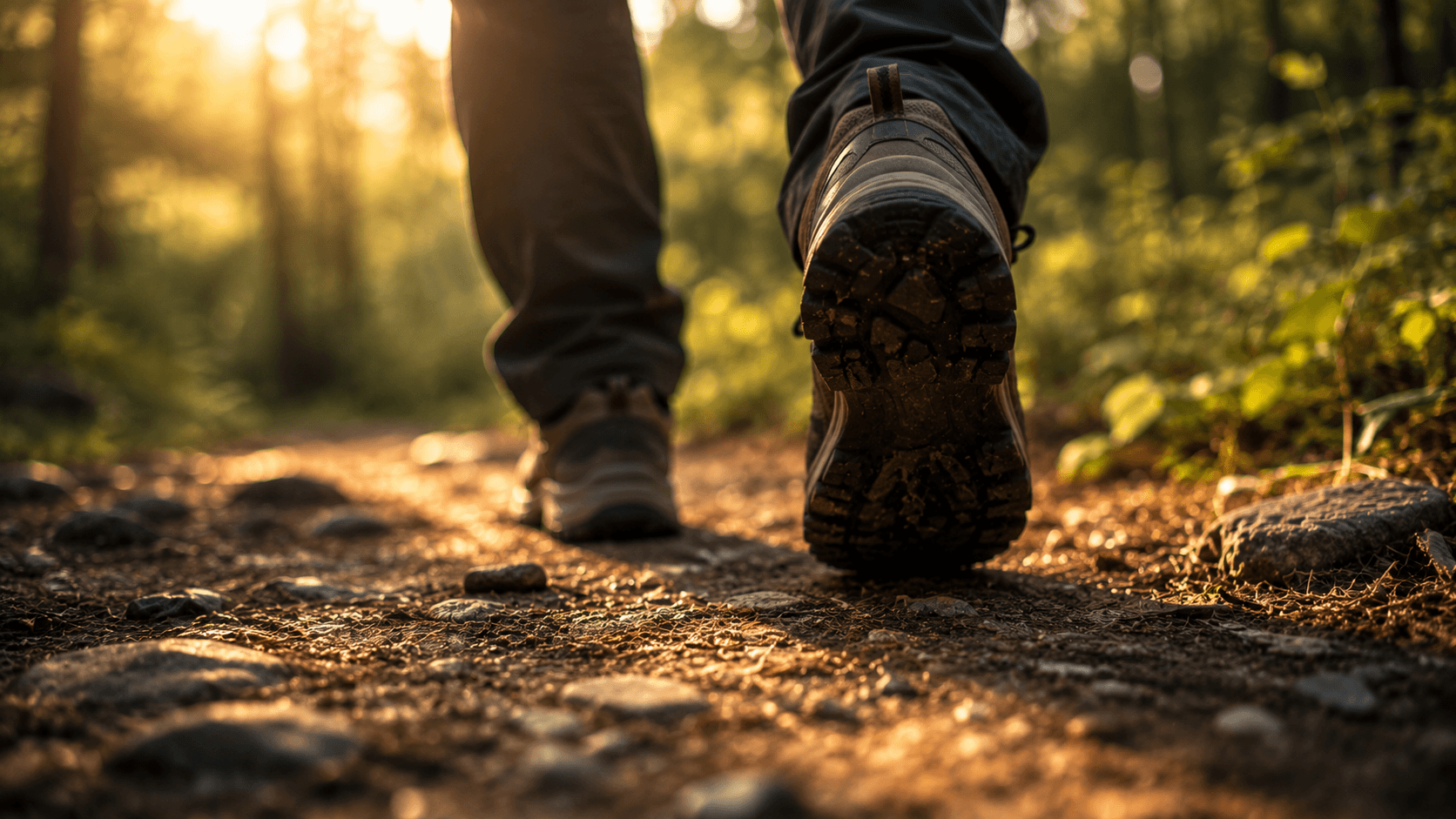
You can walk anywhere. Around your backyard, around your neighborhood, on a treadmill in your basement — all of it works. But if you have access to a nature trail, an outdoor park, or any kind of forested path, that is the upgrade worth taking. There is a real, measurable benefit to walking in nature that walking on pavement doesn't quite match — the Japanese have a whole tradition around it called shinrin-yoku, forest bathing, and the research on the cortisol-lowering and immune-supporting effects of time spent in forests is consistent.
The fresh air is different. The trees release compounds (phytoncides) that have measurable effects on human immune function and stress hormones. The visual environment — green, varied, alive — gives the eyes and the visual cortex something they were made to look at, instead of the flat right-angles of the built environment. Walking through a thick forest on a quiet morning is closer to medicine than to exercise.
That said: the neighborhood walk still works. Walking around your block, around your yard, or down a suburban street gives you 90% of the benefit of the trail walk. Don't let "I don't have access to a perfect nature trail" become the excuse for not walking at all. Walk where you are. Upgrade the location when you can.
"Walking is boring" — addressing the objection
A lot of people who don't walk regularly cite boredom as the reason. This is, frankly, an objection that doesn't survive contact with the modern world. We live in a time when you can carry an unlimited library of music, podcasts, audiobooks, sermons, lectures, courses, and video content in your pocket. Anything you would do sitting on a couch — listen to a podcast, watch a YouTube essay, follow a lecture series, listen to a favorite album — you can do walking. The "walking is boring" argument was reasonable in 1985. It has not been a real objection since the iPod.
The further you go with this, the more powerful it becomes: you can stack walking on top of almost anything else you already do. You're going to listen to that podcast anyway? Walk during it. You're going to watch that video? Walk during it. You're going to make a phone call? Take the call on a walk. The whole "I don't have time to exercise" problem dissolves the moment you accept that exercise and information consumption can be the same hour of the day.
My approach
My daily walking is 45 minutes to an hour and a half on an outdoor trail, almost every day. The pace is what I'd describe as a step below speed-walking — brisk, intentional, not a stroll, but not a power-walk either. This is the pace where most people sit comfortably in Zone 2, where fat oxidation is maximized and the conversation about whether you're "really exercising" stops mattering.
A few details that I think are worth pulling out:
- Mornings, especially in the summer. Walking before noon — ideally well before — avoids the hottest part of the day, gets the sun exposure during the time when UV-B is rising rather than peak, and sets the tone for the rest of the day in a way evening walks don't quite manage.
- Outdoor trails with real forest. The trees, the fresh air, the change of visual environment from the built world — all of it adds something walking in a neighborhood doesn't fully deliver. When the option is available, I take it.
- Affirmation tracks, prayer, and quiet thought. I listen to affirmations I've recorded for myself, I spend time in prayer, and I let the rhythm of walking do the cognitive work it does best. This is the part most people miss when they think of walking as "just exercise."
- 10 to 15 minutes on the rebounder, alongside. Walking is the bulk; rebounding is the supplement. See the rebounding article for the lymphatic case. Even a gentle health bounce or some light jumping jacks on a rebounder for ten or fifteen minutes delivers a meaningful chunk of the same benefits walking gives — for those days when going outside isn't available or appealing.
The minimal protocol — for people who really don't want to go outside
If you genuinely cannot or will not walk outside — bad weather for weeks, a tough neighborhood, a work-from-home life that makes leaving the house feel like a production — there is still a minimum movement protocol that delivers most of the benefit. This is what I'd recommend as the floor, not the ceiling:
- Option A: 10–15 minutes on a treadmill or walking pad, two or three times a day. This breaks up the sedentary stretches that do the real damage, and three short sessions accumulate to the same metabolic benefit as one long one.
- Option B: 15–30 minutes on a treadmill or walking pad once a day, plus 10–15 minutes on a rebounder. This is the combined indoor protocol — the walking pad gives you the sustained low-intensity work, the rebounder gives you the lymphatic and G-force benefits walking alone won't deliver indoors.
- Either option is the minimum daily entry. Not a great protocol — a daily outdoor walk on a trail is still the goal — but a floor that, kept consistently, still does more for your health than 95% of what most people do.
Walking pads have made this dramatically more accessible in the last few years. A walking pad fits under a desk or in a closet, costs a few hundred dollars, and turns the work hour you would otherwise spend sitting into a slow walking hour. Combined with a quality rebounder, it is the entire indoor minimum.
How to start
- Just start walking. Today. Twenty minutes after a meal counts. Walking around the block once counts. The first walk is always the hardest because it has to establish that walking is something you do; every walk after that is easier.
- Aim for a brisk pace. Step a little faster than you would on a leisurely stroll. You should still be able to talk in full sentences, but ideally slightly out of breath after climbing a hill.
- Walk after meals when you can. Even ten minutes after eating produces measurable improvements in blood-sugar response. This is the single highest-leverage walking habit a person can build.
- Walk in the morning when you can. Especially in summer, before the day gets hot. Morning light is also tied to better sleep that night and improved mood through the day.
- Stack content if you need to. Podcasts, audiobooks, music, prayer, your own thoughts — make the walk something you also want to do for some other reason, not just exercise.
- Don't worry about "getting your steps in" as a metric. Step counts are useful as a rough proxy, but the goal is the walking practice, not hitting an arbitrary number. A brisk 45-minute walk does more than a fragmented day of accumulated phone-tracked steps.
Closing
Walking is the most underrated tool in the entire health-and-longevity conversation. It loses to running in marketing copy and wins in the actual evidence. It is the quiet, daily, accessible practice that almost every long-lived population on earth has at the center of its way of life — and it is the practice almost every modern person has somehow allowed to slip out of their day.
Forty-five minutes a day on a trail, or even fifteen minutes three times a day on a walking pad. Brisk pace, comfortable breathing, mind free. Combined with the right mineral stack, daily sun for vitamin D, and a rebounder for the lymphatic finish, this is most of what you need. There is no piece of fitness equipment, no diet program, no supplement, and no medication that produces the same effects for anything close to the same cost.
Take a walk. Today. The rest is detail.
Related reading on this site: the weight lifting article covers resistance training as the structural complement to walking — together they cover both the cardiovascular and the muscular/bone-density bases. The sleep article covers why the morning version of this walk — outdoors, in direct sun, within the first hour after waking — is the most consequential single intervention for circadian rhythm and downstream hormonal health. The natural testosterone article covers the daily walk as part of the cortisol-regulation and sun-exposure stack for male hormonal health.
Sources & further reading
- Thomas DeLauer — Is Walking Actually Better for Fat Loss than Running or HIIT?
- Thomas DeLauer — Zone 2 vs High Intensity Exercise for Fat Loss
- Dr. Jason Fung — Towards Reversing Type 2 Diabetes
- Dr. Jason Fung — The Diabetes Code: Prevent and Reverse Type 2 Diabetes Naturally (book)
- Dr. Eric Berg — Can Diabetes Be Reversed? What You Need to Know
- Dr. Eric Berg — Insulin Resistance Basics
- Reynolds et al., 'Postprandial Walking and Glycemic Response' — Diabetologia / various reviews