Testosterone is collapsing in the modern male population, and the medical system's primary response has been to sell men an increasingly aggressive pharmaceutical fix that permanently shuts down their own production and makes them dependent on weekly injections for the rest of their lives. The TRT (testosterone replacement therapy) clinics that have proliferated across every major city in the last decade have, in many cases, become a frictionless pipeline from "I'm tired and my libido is low" to "you'll be on this forever." Meanwhile, the lifestyle interventions that fix the majority of cases of low T — sleep, training, sun, minerals, real food, and the removal of a handful of endocrine-disrupting modern exposures — sit largely ignored because no one makes money prescribing them.
Average testosterone levels in American men have been falling by roughly 1% per year for at least four decades, independent of age. A 50-year-old man today has substantially lower testosterone than a 50-year-old man in 1980 had, despite no change in his biology. This is not aging. It is environment, lifestyle, and a measurable population-wide hormonal degradation that mainstream medicine has responded to almost exclusively by progressively lowering the "normal" reference range — defining the new lower numbers as healthy rather than acknowledging that something is wrong.
This article covers the generational decline and what's causing it, the difference between mainstream "normal" and actually optimal testosterone levels, the symptoms of low T most men attribute to age but shouldn't, the full natural protocol that fixes most low T — sleep first, training second, sun and minerals and clean food and removal of endocrine disruptors third — the honest critique of TRT and why it should be a last resort, the specific foods that support testosterone production and the specific exposures that crash it, and the protocol I follow personally as a Seventh-day Adventist who eats meat, lifts, and avoids most of the modern saboteurs by default.
The generational decline — testosterone is falling, and it's not aging
The single most important fact about testosterone in 2026 is that the average modern man has substantially lower testosterone than men of the same age had a generation ago. The most-cited study on this is Travison et al. (2007), published in the Journal of Clinical Endocrinology & Metabolism, which examined testosterone levels in American men of the same age across two cohorts roughly two decades apart. A 60-year-old man in 2002 had roughly 17% lower testosterone than a 60-year-old man in 1987. The decline has continued and accelerated since.
This is not the normal age-related decline of testosterone in any individual man across his own lifespan (which is real and well-documented — roughly 1% per year after age 30 in a healthy man on a stable lifestyle). This is a separate, cohort-wide collapse: men at the same age are starting from a lower baseline than the previous generation did. The biology of testosterone production hasn't changed. The environment, the diet, the activity levels, the chemical exposures, the sleep patterns, the light environment — all of those have.
The likely causes, all measurable and most reversible at the individual level:
- Chronic sleep deprivation across the modern population — covered in the sleep article. One week of 5-hour nights drops testosterone by 10–15%. Multiply that effect across decades and the cohort collapse becomes inevitable.
- Sedentary lifestyles and the loss of daily resistance loading — covered in the weight lifting article.
- Endocrine-disrupting chemicals — xenoestrogens from plastics (BPA, phthalates), pesticides (atrazine, glyphosate), personal care products (parabens), and water supplies (atrazine again, plus the estrogen-disrupting pharmaceuticals that pass through municipal water treatment unchanged).
- Diet — particularly the explosion of seed oils, refined carbohydrates, and processed food, and the corresponding decline in cholesterol-rich whole foods (testosterone is built from cholesterol — eat low-fat and you starve the production pathway).
- Vitamin D deficiency — most modern men spend almost no time in direct sun and are clinically deficient or insufficient. Vitamin D is a direct precursor and modulator of testosterone production. See the vitamin D article.
- Mineral deficiencies — zinc, magnesium, and boron in particular. All depleted in modern soil and modern diets. All direct cofactors in testosterone synthesis and free-testosterone availability.
- Chronic stress and elevated cortisol — cortisol and testosterone have an inverse relationship at the molecular level. High chronic cortisol actively suppresses testosterone production.
- Obesity and visceral fat — fat tissue contains the enzyme aromatase, which converts testosterone into estrogen. More body fat means more conversion means lower T means more fat storage (because T is protective against fat gain). A vicious cycle that defines a large fraction of the modern male population.
- Alcohol consumption — one of the most consistently testosterone-suppressing substances in the modern lifestyle. Both acute (a single binge crashes T for days) and chronic (regular drinking maintains suppressed levels).
Every item on this list is modifiable at the individual level. The cohort-wide decline is, in practical terms, a summation of millions of individual men experiencing all of these factors simultaneously. A man who fixes them individually frequently restores his testosterone to ranges that look like he was born in 1960, not 2000.
"Normal" vs. actually optimal levels
One of the more deceptive features of modern testosterone medicine is the way "normal" ranges have been progressively lowered as population averages have dropped. The standard laboratory reference range in the United States is roughly 264–916 ng/dL, with anything inside that range marked as "normal" and anything outside it flagged for review. A man at 320 ng/dL — bottom-quartile of the modern range — is told his testosterone is normal.
The problem is that the "normal" range is a statistical description of what the modern population looks like, not a description of what a biologically healthy adult male should look like. A 25-year-old man with the testosterone of a 75-year-old is technically "in range" — and his doctor will tell him there's nothing wrong. The progressive lowering of the reference range over decades has, in effect, redefined disease as health. Men who feel like their bodies are failing are told their lab work is normal.
Functional and integrative medicine practitioners — and some longevity-focused physicians like Peter Attia — have increasingly distinguished between normal and optimal:
- Below ~300 ng/dL — most labs flag as clinically low. Substantial subset of modern men.
- 300–500 ng/dL — "normal" by the modern range, but functionally low. Most men in this band have measurable symptoms of low T and would feel dramatically better at higher levels.
- 500–700 ng/dL — the lower edge of what functional medicine considers a healthy adult male range.
- 700–900+ ng/dL — the range associated with full energy, libido, drive, muscle building capacity, and the broader picture of "feeling like a healthy man." Increasingly rare in the modern population without intervention.
Free testosterone (the unbound fraction that's biologically active) is in some ways a more important metric than total testosterone. Even men with apparently "normal" total T can have low free T because of elevated sex hormone-binding globulin (SHBG) tying up too much of the total. Optimizing free T involves both producing enough total T and keeping SHBG in a reasonable range — covered in the boron section below.
Symptoms of low testosterone — what most men attribute to age but shouldn't
The symptoms of low testosterone are gradual, additive, and frequently misattributed. Most men who eventually get diagnosed describe years of accumulating problems they assumed were just "getting older." A representative list:
Physical
- Persistent fatigue — not just tired after a hard day, but a chronic low-energy baseline that doesn't improve with sleep
- Loss of muscle mass and strength despite consistent training
- Increased body fat, especially around the midsection — the visceral fat that feeds the aromatase-driven vicious cycle
- Loss of morning erections — one of the most reliable physical indicators; healthy testosterone levels in healthy men produce regular morning wood. Its disappearance is a warning sign that often predates any blood-test diagnosis.
- Reduced libido — both the quantity-of-desire and the spontaneous-thought dimensions
- Erectile dysfunction at younger ages than previous generations experienced it
- Slower recovery from workouts, illness, or injury
- Disrupted sleep — itself both cause and consequence; low T disrupts sleep, and disrupted sleep further lowers T
- Thinning body hair, with paradoxical head-hair loss in some patterns
- Reduced bone density over years
Mental and emotional
- Loss of drive and ambition — the internal motivational fuel that pushes a man toward challenge, risk, and accomplishment
- Depression and low mood — frequently misdiagnosed and treated with SSRIs that don't address the underlying hormonal cause
- Anxiety and emotional volatility
- Brain fog and reduced cognitive sharpness
- Loss of confidence — measurably lower T tracks with reduced self-assurance in social and professional situations
- Reduced competitive drive — both in athletic and professional contexts
- Loss of the felt sense of masculinity — a vaguer but real symptom most men recognize when they hear it described
A meaningful fraction of the depression, anxiety, and "midlife crisis" being treated with SSRIs and therapy in modern men is, underneath, an undiagnosed hormonal collapse. Fix the hormones and you fix what looked like a mental-health problem.
The honest summary: many of these symptoms could be attributed to "just getting older," to depression, to a stressful job, or to relationship problems. In many cases they are downstream of measurable low testosterone, and fixing the testosterone fixes the symptoms in ways that targeting them individually with separate treatments (antidepressants, sleep aids, ED medications, gym memberships) doesn't.
The honest TRT critique — what they don't tell you at the clinic
TRT — exogenous testosterone replacement therapy — has become enormously popular in the last decade. Telehealth TRT clinics have multiplied; the marketing is everywhere; the message is straightforward: low T is a medical condition, we have the cure, you'll feel great in weeks. Some of this is true. Properly administered TRT does produce dramatic and rapid improvements in symptoms for men with genuine clinical hypogonadism. For a defined subset of patients — typically older men with unrecoverable testicular damage, men with pituitary dysfunction, men with genetic conditions affecting androgen production — TRT can be transformative and appropriate.
But the way TRT is being marketed and prescribed to the general male population — particularly to men in their 30s, 40s, and 50s with "low normal" levels who haven't tried any meaningful lifestyle intervention first — is something different. Three things the brochures and telehealth intake forms almost never mention clearly:
It's effectively permanent
When you administer exogenous testosterone, your body's hypothalamic-pituitary-gonadal (HPG) axis — the feedback loop that signals your testes to produce testosterone — receives the message that there's already plenty of testosterone in circulation, and shuts down your endogenous production. Your luteinizing hormone (LH) and follicle-stimulating hormone (FSH) drop to near zero. Your testes, no longer receiving the signal to produce, atrophy — measurably shrinking over months on TRT — and the cells that produce testosterone (Leydig cells) downregulate their function.
The consequence: stopping TRT, particularly after extended use, often produces a long and difficult recovery period — sometimes a year or longer — during which the man's natural production is suppressed below even his pre-TRT baseline. Some men never fully recover. The "post-TRT crash" is well-documented in the men's health community and significantly less well-discussed in the clinical sales pitch. For most men starting TRT in their 30s or 40s, the practical reality is that they have committed to taking testosterone for the rest of their lives.
Fertility consequences
TRT essentially eliminates sperm production in most men on therapy. The same FSH suppression that shuts down endogenous testosterone also shuts down spermatogenesis. Men on TRT who want to father children typically have to come off therapy (with all the recovery problems above) or pursue separate fertility treatments to restore sperm production. For young men starting TRT before completing their family, this is a significant and often insufficiently disclosed consequence.
Side effects, monitoring, and ongoing cost
TRT requires ongoing medical monitoring — regular blood work for testosterone, estradiol (which rises as more testosterone aromatizes to estrogen, often requiring additional medications like anastrozole), hematocrit/hemoglobin (TRT thickens blood, increasing stroke and clot risk), PSA monitoring, and lipids. The ongoing pharmaceutical, lab, and clinic costs add up to thousands of dollars per year indefinitely. The side effects — when they occur — range from mild (acne, increased aggression, sleep apnea worsening) to potentially serious (cardiovascular events, polycythemia, possible accelerated prostate growth).
The honest position on TRT: it is a real medication with real indications, but it is being prescribed far more broadly than the actual indications warrant. Many men who get put on TRT in their 30s and 40s could have restored their levels through aggressive lifestyle intervention — without the permanence, without the fertility cost, without the ongoing monitoring burden, and without the chronic pharmaceutical commitment. The TRT clinics rarely lead with a six-month lifestyle protocol because the lifestyle protocol doesn't generate recurring revenue. The needle does.
The natural protocol — what actually works
The fix for most cases of low testosterone is, biologically speaking, not exotic. The body knows how to produce testosterone. It does so robustly when given the right inputs and protected from the wrong ones. The full natural protocol involves stacking interventions across sleep, training, light, food, minerals, stress, and exposure reduction. None of them is sufficient alone. Together they produce dramatic and durable hormonal restoration in most men who haven't sustained irreversible damage.
Sleep — the single biggest lever
As covered in the sleep article, testosterone is produced primarily during sleep — and specifically, during the early-morning hours that depend on quality deep sleep earlier in the night. The Leproult & Van Cauter 2011 study found that one week of 5-hour nights dropped testosterone in healthy young men by 10–15% — the equivalent of 10–15 years of natural aging in a single week. Most modern men are operating on chronically insufficient sleep and have, in effect, been hormonally aging at an accelerated rate for years.
The corresponding fix: 7.5–8 hours of sleep, with a bedtime before midnight, on a consistent schedule. The before-midnight piece matters specifically because the HGH and testosterone-supporting hormonal cascade is time-locked to circadian rhythm, not to total hours. Going to bed at 10–11pm captures the window. Going to bed at 1am misses most of it regardless of how long you stay asleep.
For most men who haven't fixed their sleep yet, this is where any natural testosterone protocol starts. There is no supplement, no diet change, no training program that will overcome 6 hours of poor-quality sleep per night. Fix the sleep first.
Resistance training — the second biggest lever
Heavy compound resistance training produces acute testosterone elevation during and after the workout, and chronic adaptation of the endocrine system over weeks and months of consistent training. The mechanisms are covered in detail in the weight lifting article. The practical summary:
- Compound lifts produce more T response than isolation work. Squats, deadlifts, presses, rows, and pull-ups recruit large muscle masses and produce larger systemic hormonal responses than curls and lateral raises.
- Moderate-to-heavy loading in the 6–15 rep range, taken close to failure produces the largest acute response. Light weight for high reps without getting near failure does not produce the same effect.
- 3–5 sessions per week is the sustainable sweet spot. More than that risks overtraining and chronic cortisol elevation that lowers testosterone.
- Sufficient calories and protein to support recovery. Chronically under-eating tanks testosterone — the body interprets sustained caloric deficit as a threat and downregulates non-essential functions, of which reproductive hormone production is one.
Training does not produce results on broken sleep — the two interventions stack. With both in place, the remaining lifestyle interventions produce the rest of the restoration.
Sun exposure and vitamin D
Vitamin D is, technically, a steroid hormone — and one of the direct precursors and modulators of testosterone production. Multiple studies have shown a strong relationship between vitamin D status and testosterone levels in men, with deficient men showing markedly lower testosterone and supplementation producing measurable increases in deficient individuals. The Pilz et al. 2011 study showed roughly 20% higher testosterone in vitamin D-supplemented men over a year compared with placebo.
The protocol — covered in detail in the vitamin D article — is direct sunlight exposure for 20–30 minutes per day during the brighter hours, on as much skin as the situation allows, without sunscreen (sunscreen blocks vitamin D synthesis), supplemented with vitamin D3 5000 IU daily in months when sun exposure is insufficient. The sun exposure has additional benefits beyond vitamin D — including circadian rhythm support, mood elevation, and some preliminary evidence that direct sun exposure on the testes themselves may have local effects on testosterone production (a finding from Russian research in the 1930s and one Dr. Berg has covered in modern form).
The mineral stack — zinc, magnesium, boron, iodine
Several minerals are direct cofactors in testosterone synthesis, free-testosterone availability, or thyroid-mediated metabolism that downstream affects testosterone. All of them are depleted in modern soil and modern diets. All of them respond meaningfully to targeted supplementation.
- Zinc — the single most direct mineral cofactor in testosterone synthesis. Prasad et al. (1996) showed that zinc-restricted men had testosterone levels cut nearly in half after 20 weeks of restriction, and that supplementing zinc-deficient men roughly doubled their testosterone. The vast majority of modern men are at least mildly zinc-deficient. The zinc article covers Pure Encapsulations Ultrazin as the standard.
- Magnesium — multiple studies have shown magnesium supplementation raises both total and free testosterone, particularly in men who train. The mechanism involves reducing the binding of testosterone to SHBG, increasing the bioavailable fraction. Magnesium also improves sleep quality, which compounds the testosterone effect.
- Boron — one of the most underappreciated minerals for testosterone. The Naghii et al. (2011) study found that 10mg of boron per day for one week produced a 28% increase in free testosterone and a corresponding 10% decrease in estradiol in healthy men, primarily by lowering SHBG. The study was small but the effect size was striking and has been replicated in other research. The boron article covers the protocol.
- Iodine — not a direct testosterone cofactor, but iodine supports thyroid function, and a sluggish thyroid cascades downstream into low testosterone, low energy, and low metabolic function more broadly. The iodine article covers the Sircus-grade protocol.
- Vitamin D — covered above and in its dedicated article. Technically a hormone, mechanistically a steroid precursor. Functionally one of the four or five most important nutrients for male hormonal health.
The mineral stack should not be considered optional. The modern diet — even a clean one — almost universally fails to deliver adequate levels of these, and the difference between adequate and deficient mineral status maps directly onto the difference between healthy male hormones and the modern collapsed pattern.
Cholesterol and the saturated fat case
Testosterone is built from cholesterol. Every molecule of testosterone in your body started as a cholesterol molecule, processed through a series of enzymatic conversions. This means two things:
- Low-cholesterol and low-fat diets actively suppress testosterone production. Multiple controlled trials have shown that men who switch to low-fat diets see their testosterone drop by 10–30% within weeks. The decades-long mainstream demonization of dietary fat and cholesterol has, among other things, contributed to the population-wide testosterone collapse.
- Adequate dietary fat — and specifically cholesterol-rich animal foods — is foundational to testosterone production. Eggs, grass-fed beef, butter, ghee, and the other clean animal foods covered across this section deliver the raw materials. The diet that produces healthy male hormones is, in significant part, the diet most cultures across history have recognized as men's food: meat, eggs, organ meats, dairy fats, and clean animal proteins, paired with plenty of vegetables, fruits, and other plant foods.
The corresponding negative case applies to industrial seed oils — soybean, corn, canola, cottonseed, safflower, sunflower. These are not just inflammatory and oxidatively unstable (as covered in the olive oil and beef tallow articles); they also actively disrupt testosterone production through their high polyunsaturated fatty acid load, their phytoestrogenic compounds in some cases, and their inflammatory effects on testicular function. The modern man eating industrial restaurant food is consuming massive quantities of seed oils daily — frequently the single largest individual contribution to the modern decline.
The healthy fats stack — butter, coconut oil, tallow, ghee, and the rest
The cholesterol case above is the why. The practical version is the daily kitchen stack — the specific real fats that should be the foundation of cooking, eating, and hormonal-substrate provision for a man trying to support his own testosterone production. The classic "men's hormonal health" food list, almost without exception, centers on these:
- Grass-fed butter — particularly from pasture-raised cows. Real grass-fed butter delivers a combination of nutrients that synthetic substitutes and industrial dairy fats simply do not match: conjugated linoleic acid (CLA) for body composition and anti-inflammatory support; butyrate (a short-chain fatty acid that supports gut health, reduces inflammation, and has emerging evidence for direct hormonal benefits); the full complement of fat-soluble vitamins A, D, E, and K2; and the cholesterol that is the literal molecular precursor to testosterone. Vitamin K2 in particular has direct testosterone- supporting evidence — a 2011 study by Ito et al. showed K2 directly activates the CYP11A enzyme in testicular Leydig cells, the rate-limiting enzyme in testosterone synthesis. Brands worth knowing: Kerrygold (the most accessible and reliably grass-fed option), Vital Farms pasture-raised butter, Organic Valley grass-fed, and Anchor butter. Avoid anything industrial or labeled "spread."
- Coconut oil — covered in detail in its dedicated article. Saturated fat substrate for hormone production, medium-chain triglycerides (MCTs) for quick metabolic energy without insulin spike, lauric acid for antimicrobial gut support (gut health and hormonal health are tightly coupled), and broader thyroid support that downstream supports testosterone. The Aldi or Lidl organic virgin coconut oil is the budget option; higher-quality brands like Nutiva, Garden of Life, and Dr. Bronner's are upgrades.
- Grass-fed beef tallow — covered in detail in its dedicated article. Stearic acid, oleic acid, and palmitic acid in a fatty acid profile remarkably similar to human tissue. Vitamin K2 in grass-fed sources. One of the most stable cooking fats for high-heat applications. Brands like Yecuce and Meadow Bliss are the high-quality grass-fed standards.
- Ghee (clarified butter) — covered in its dedicated article. The pure butterfat with milk solids removed, which concentrates the fat-soluble vitamins and removes the casein and lactose that some people don't tolerate well. Same CLA and K2 benefits as grass-fed butter when sourced from grass-fed cows. Exceptional cooking fat with a high smoke point.
- Real extra-virgin olive oil — high-polyphenol Mediterranean olive oil. Direct evidence for testosterone support from multiple studies, plus the broader cardiovascular and anti-inflammatory profile from the polyphenols. Morocco Gold and Corto Truly are the brands the dedicated article anchors on.
- Egg yolks specifically — the white is protein; the yolk is where the hormonal magic lives. Cholesterol, vitamin D, choline, lutein, zeaxanthin, B vitamins, K2, selenium, and iodine all concentrate in the yolk. Anyone separating yolks for "health" reasons is throwing away the entire reason eggs are testosterone-supportive in the first place. Three or four whole eggs per day is a reasonable baseline for most men. Pasture-raised eggs (yellow yolks deepening to orange) have substantially higher vitamin and omega-3 content than industrial caged eggs.
- Avocados — monounsaturated fat, potassium, magnesium, B6, and the broader cardiovascular and anti-inflammatory profile that supports the hormonal system. One avocado a day is a useful pattern.
- Macadamia nuts — the highest monounsaturated fat content of any common nut. Excellent for the broader fat profile, particularly for people trying to push omega-6 down and monounsaturated up. Watch portion sizes — nuts are calorically dense.
- Raw dairy from grass-fed sources (where legally available and personally tolerated) — controversial but with a long traditional record of supporting male hormonal health. Raw milk preserves the full complement of enzymes, beneficial bacteria, CLA, K2, and bioavailable nutrients that pasteurization destroys. Not for everyone — gut tolerance varies — but for men who tolerate it well, raw whole milk from a trusted local farm is a real food with real hormonal value.
- Bone marrow — traditional men's food across cultures for good reason. Concentrated source of fat, fat-soluble vitamins, collagen-precursor amino acids, and the structural fats that support hormonal production. Roasted bone marrow on sourdough, or marrow added to slow-cooked dishes, connects modern eating back to a traditional pattern that produced strong men.
The unifying logic: real fats from well-raised animals and traditional plant sources are the hormonal substrate. The decades of mainstream advice to avoid saturated fat, swap butter for margarine, use industrial seed oils for cooking, and eat lean meat with the fat trimmed off have actively starved the male hormonal system of its raw materials. Reversing this — making real fats the foundation of the kitchen — is one of the more consequential single changes a man can make for his own testosterone production.
A word on vitamin K2 specifically
Vitamin K2 deserves separate attention. It is one of the most underrated nutrients in modern Western diets, almost entirely absent from industrial food, and recently identified as a direct supporter of testosterone synthesis in addition to its established roles in bone and cardiovascular health (it directs calcium into bones and away from arteries). The major food sources are grass-fed dairy fat (butter, ghee, raw cream), egg yolks from pasture-raised birds, liver and organ meats, fermented foods (sauerkraut, natto if you can stomach it — natto is the single highest K2 food known), and the fat of pasture-raised animals generally. A diet built around the foods on this list delivers K2 naturally. A diet of industrial seed oils, lean grain-fed meat, and processed food does not. K2 supplementation (typically MK-7 form, 90–180 mcg daily) is reasonable for people whose diet doesn't deliver enough through food alone.
Specific foods that support testosterone
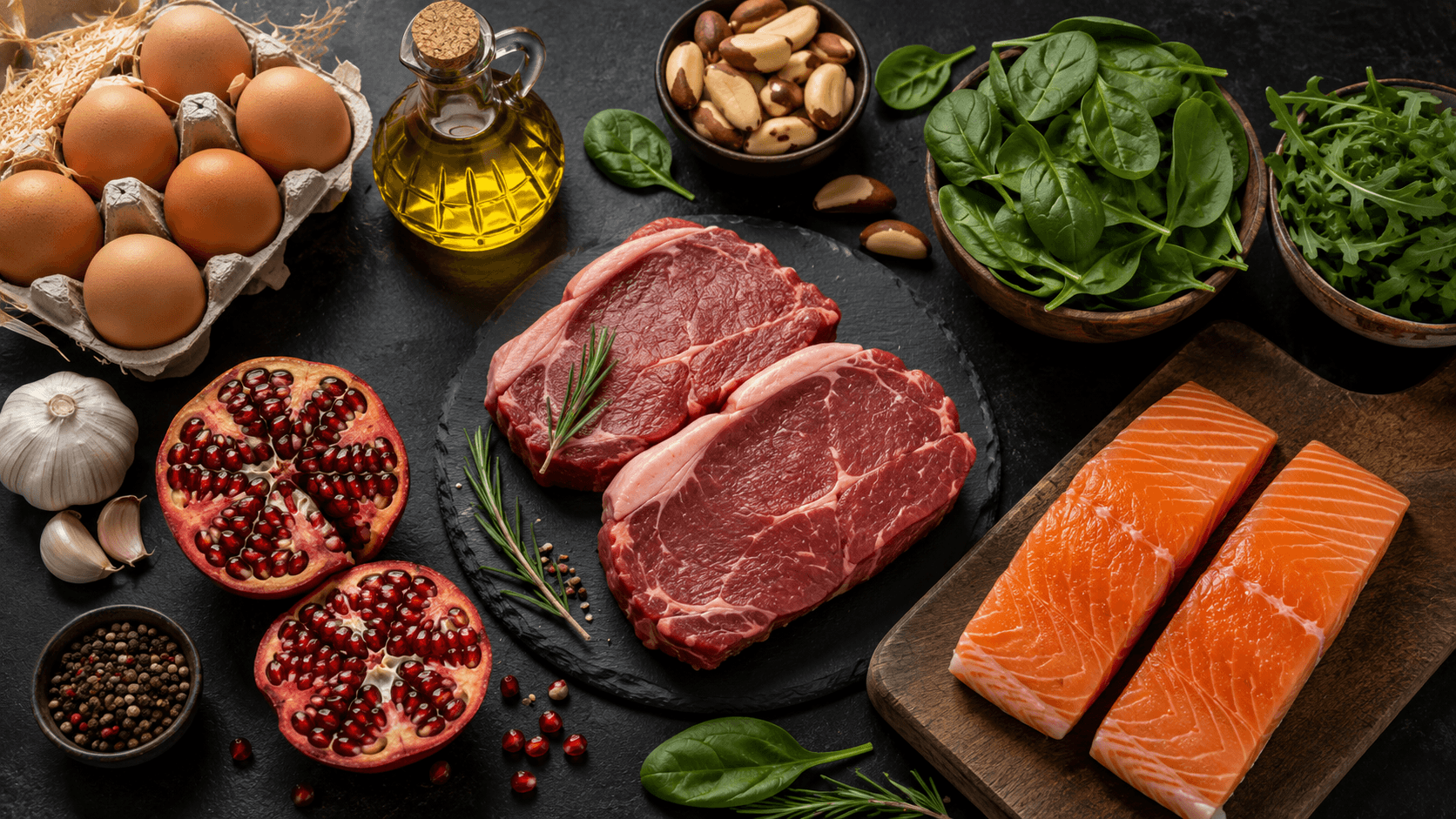
- Eggs — cholesterol, vitamin D, choline, zinc, B vitamins. One of the single most testosterone- supporting whole foods available. Pasture-raised when possible.
- Grass-fed beef — zinc, B12, saturated fat, creatine, complete protein. Cross-referenced in multiple articles for the same reason.
- Salmon — vitamin D, omega-3s, complete protein. Wild-caught when possible.
- Sardines — vitamin D, omega-3s, calcium (from the bones), selenium, B12, complete protein, and almost zero mercury accumulation because they sit so low on the food chain. Cheap, shelf-stable, and one of the most cost-effective hormonal-support foods available. A tin of sardines on sourdough with olive oil and lemon is a complete men's-health meal in under five minutes.
- Liver and organ meats — extraordinarily nutrient-dense, including high levels of zinc, copper, B vitamins, vitamin A, and other cofactors. A few ounces per week of beef liver is one of the best single additions a man can make to his diet.
- Bone broth— slow-simmered beef or chicken bones extract collagen, glycine, proline, minerals, and the gelatinous structural proteins that support gut, joint, and connective tissue health. The glycine specifically supports sleep (which loops back to testosterone) and the broader mineral content supports the whole protocol. Homemade is best; if buying, look for brands like Kettle & Fire that actually simmer real bones.
- Brazil nuts — by far the highest dietary source of selenium, which supports thyroid function and testosterone production. Two or three per day is enough.
- Pumpkin seeds — zinc, magnesium, and healthy fats. One of the best plant-based supports for male hormonal health.
- Real extra-virgin olive oil — high-polyphenol Mediterranean olive oil has been shown in multiple studies to support testosterone production in men, partly through direct enzymatic effects and partly through the broader anti- inflammatory effects of the polyphenols.
- Pomegranate — controlled trials have shown daily pomegranate juice consumption raises salivary testosterone by roughly 24% over two weeks. Real fruit or juice, not the sugar-laden bottled versions.
- Ginger — clinical research has shown a real testosterone- supporting effect from regular ginger consumption, particularly in subfertile men.
- Garlic — has been shown to raise testosterone in some studies, partly through the broader cardiovascular effects and partly through specific compounds in the bulb.
- Raw honey — boron content plus the broader nutritional profile supports the hormonal system. A spoonful at night also helps with sleep, which compounds the effect.
Cold exposure
Cold exposure — cold showers, cold plunges, swimming in cold water — is one of the more talked-about modern interventions for testosterone. The mechanism is real but modest: cold exposure on the body (and particularly on the scrotum, where testicular temperature is a direct determinant of testosterone production) supports testicular function, and the broader stress-adaptation effects of cold exposure (improved cortisol regulation, dopamine release, reduced inflammation) compound the effect.
The practical protocol: end your morning shower with 30–90 seconds of cold water, or take a 2–5 minute cold plunge (50°F or below) a few times per week. Don't make it complicated. The dose-response curve flattens quickly past a couple of minutes; the benefit is in the regular exposure, not the heroic duration. Conversely, avoid chronic heat on the testicles — hot tubs, saunas performed naked for extended sessions, laptops literally on the lap for hours — all of which raise testicular temperature enough to suppress testosterone production.
The avoid list — endocrine disruptors and lifestyle saboteurs
As important as what you add is what you remove. Most modern men are exposed to a continuous stream of testosterone-suppressing inputs, many of which are invisible and embedded in normal life. Removing them is one of the most consequential parts of the protocol.
Alcohol
Alcohol is one of the most directly testosterone- suppressing substances in the modern lifestyle. A single binge can crash testosterone for several days. Chronic regular drinking — even at "moderate" levels — maintains chronically suppressed levels. The mechanisms include direct testicular damage, elevated cortisol, disrupted sleep (alcohol destroys deep sleep and REM, both of which are when testosterone is produced), increased aromatase activity converting T to estrogen, and impaired liver function affecting hormone metabolism. There is no amount of alcohol consumption that improves testosterone. Any meaningful natural testosterone protocol involves substantial reduction or complete elimination. I don't drink at all as a Seventh-day Adventist, and the hormonal advantage of that choice alone is significant.
Marijuana
Marijuana use — acute and chronic — has been associated with reduced testosterone in multiple studies. The relationship is dose-dependent: occasional use produces modest effects, chronic heavy use produces substantial suppression. The cultural normalization of daily cannabis use across the male population is contributing to the generational decline in ways that aren't being discussed honestly. For any serious natural T protocol, marijuana use should be eliminated or at minimum dramatically reduced.
Plastics, parabens, and xenoestrogens
A class of industrial chemicals known as endocrine disruptors mimics estrogen at the receptor level, suppressing testosterone production and shifting male hormonal balance toward estrogen dominance. The major culprits in modern life:
- BPA and BPS — found in plastic bottles, food storage containers, the linings of canned foods, and thermal receipt paper. Bind to estrogen receptors and disrupt male hormonal signaling.
- Phthalates — plasticizers used in soft plastics, vinyl flooring, personal care products (perfumes, lotions, shampoos), and food packaging. Documented effects on testicular function and male reproductive development.
- Parabens — preservatives in cosmetics, shampoos, lotions, and personal care products. Bind to estrogen receptors and have been documented in human testicular tissue.
- Atrazine — one of the most-used agricultural herbicides in the US, found in tap water across most of the country. A documented endocrine disruptor that has been shown to feminize amphibians in controlled exposure.
- Glyphosate — the active ingredient in Roundup, sprayed extensively on conventional crops including wheat, soy, and corn. Implicated in hormonal disruption and gut microbiome damage.
- Pharmaceutical estrogens in water supplies — birth control hormones and HRT compounds pass through municipal water treatment unchanged and accumulate in water supplies, contributing to ambient estrogen exposure.
The practical reduction protocol:
- Glass and stainless steel instead of plastic for food and drink containers.
- Never microwave food in plastic — heat dramatically accelerates the leaching of plasticizers.
- Avoid canned foods when possible — most can linings still contain BPA or BPS.
- Read personal care product labels and avoid those with parabens, phthalates, or "fragrance" (which legally hides phthalates).
- Filter your drinking water — reverse osmosis or a quality activated carbon filter removes atrazine, pharmaceutical residues, and many other disruptors. Add minerals back if using RO.
- Eat organic when feasible — particularly for the foods on the "Dirty Dozen" list with highest pesticide residues.
- Don't handle thermal receipts barehanded — they carry significant BPA loads that absorb through skin.
Soy and phytoestrogens — the honest treatment
Soy is contested in the men's health space. The popular claim is that soy crashes testosterone through its phytoestrogen content. The truth is more nuanced: soy isoflavones do bind to estrogen receptors, but they bind weakly and in some cases competitively (which can reduce overall estrogen signaling rather than increase it). Multiple controlled trials have not found consistent suppression of testosterone in men consuming moderate amounts of whole soy foods (tofu, tempeh, edamame).
That said: industrial soy products — soy protein isolate in protein bars and shakes, texturized vegetable protein, soy oil used as a seed oil in processed food — are a different story. These deliver concentrated, isolated soy compounds in much higher doses than traditional whole soy consumption, and they're typically combined with the other inflammatory features of processed food. Whole, traditional soy foods in moderate amounts probably don't deserve their reputation. Industrial soy embedded throughout the processed-food supply does.
Chronic stress and cortisol
Cortisol and testosterone have an inverse relationship at the molecular level. The same biosynthetic pathway produces both, branching at certain points — and chronic elevation of cortisol shifts the body's resource allocation toward stress hormone production and away from testosterone production. This is part of why chronically stressed men consistently show lower testosterone than peers in similar physical conditions but with better stress regulation.
The interventions: adequate sleep (cortisol normalizes with proper sleep), regular outdoor walking (cortisol drops with sunlight and movement), strength training (which acutely raises cortisol but improves chronic cortisol rhythm), prayer or meditation practice (whatever works for you spiritually), real human relationships (chronic loneliness is itself a cortisol elevator), and the elimination of unnecessary stressors where feasible. Chronic stress is one of the lifestyle variables most men know is a problem and least often address structurally.
The visceral fat vicious cycle
Visceral fat — the abdominal fat that wraps around organs and produces the classic "belly" appearance — contains high levels of the enzyme aromatase, which converts testosterone into estrogen. The more visceral fat a man carries, the more of his testosterone is being converted to estrogen, and the lower his functional testosterone becomes. The lower his testosterone, the harder it becomes to build muscle and lose fat (because testosterone is itself protective against fat gain and supportive of muscle building). The result is a self-reinforcing vicious cycle that defines a large fraction of the modern male population.
Breaking the cycle requires direct fat loss — through some combination of dietary change, training, and (as covered in the sleep article) adequate sleep. The biological reward is rapid: as visceral fat drops, aromatase exposure drops, and functional testosterone climbs, which makes further fat loss easier. The cycle reverses once it's broken. The challenge is the initial momentum to break it, which is where the rest of the protocol — sleep, training, food, minerals — provides the leverage.
My approach
The protocol I actually follow, as a Seventh-day Adventist man who lifts, walks, eats clean, and protects his sleep:
- Sleep — bedtime before midnight, consistent wake time, full protocol from the sleep article. The single biggest hormonal lever.
- Resistance training — 45 minutes to an hour, 3–5 times a week, bodybuilding plus calisthenics plus bands. Full protocol in the weight lifting article.
- Daily walking — 45 minutes to 1.5 hours outdoors, brisk pace, morning when possible. Full protocol in the walking article. Doubles as sunlight exposure and cortisol regulation.
- Sun — 20–30 minutes of direct sun daily during the brighter hours, on as much skin as appropriate, without sunscreen. Pure Encapsulations Vitamin D3 5000 IU in the months when sun isn't sufficient.
- Minerals: Iodine (Iodoral + J. Crow's Lugol's), magnesium (Magtein + Pure Encapsulations Glycinate + Life-Flo flakes for topical oil), potassium (NOW Foods Gluconate + Berg's electrolyte powder), boron (Pure Encapsulations Glycinate), zinc (Pure Encapsulations Ultrazin), and vitamin D. The full mineral stack covered across this section.
- Eggs daily — almost always pasture-raised when available. Three to four per day is normal.
- Grass-fed beef regularly — steaks, ground beef, the occasional roast.
- Wild-caught salmon a few times a week.
- Chicken, turkey, lamb, goat in rotation. No pork. No shellfish. Full protocol in the clean foods article.
- Real fats: extra-virgin olive oil, coconut oil, grass-fed beef tallow, and ghee. Zero seed oils in the home kitchen.
- Garlic, onion, ginger throughout the cooking. Pomegranate when in season.
- No alcohol — SDA choice, but the hormonal benefit alone would justify it.
- No tobacco, no marijuana.
- Cold finishes on showers most mornings — 30–60 seconds at the end.
- Plastic reduction — glass containers, no plastic in the microwave, filtered water, careful with personal care products.
- Prayer and Sabbath rest — the weekly day of complete rest is part of why Adventist populations show lower stress markers across the board, and it shows up in the hormonal data too.
None of this is exotic. Most of it is just consistent execution of the rest of the protocol covered across this section. The natural testosterone case is, in significant part, the same as the natural health case generally — because testosterone is downstream of broader hormonal, metabolic, and lifestyle health. Fix the underlying systems and the testosterone follows.
How to start
- Get blood work first. Total testosterone, free testosterone, SHBG, estradiol, LH, FSH, vitamin D, complete blood count, lipids, fasting glucose, A1c, thyroid panel (TSH, free T3, free T4). Functional medicine practitioners and online lab services (Quest, LabCorp direct-to-consumer, Marek Health, Inside Tracker) make this accessible. You need a baseline to know what you're working with.
- Fix sleep first. Before anything else. Sleep is the foundation, and no other intervention produces full results on broken sleep. The full protocol is in the sleep article.
- Start resistance training. If you don't lift, start. Full protocol in the weight lifting article. Three sessions per week is plenty to start.
- Add the mineral stack. Zinc, magnesium, boron, vitamin D as a baseline. Iodine if you can tolerate it (see iodine article). The minerals stack faster than most men expect — many notice measurable improvements within 2–6 weeks of consistent use.
- Get sun daily. 20–30 minutes outdoors on as much skin as possible. Free. The single most consistently underused intervention.
- Cut alcohol, marijuana, and seed oils. Three of the largest individual saboteurs. Cutting all three for three months produces dramatic measurable change in most men.
- Reduce plastic and chemical exposure. Glass containers, filtered water, clean personal care products, organic produce where feasible.
- Eat real food regularly. Eggs daily, grass-fed beef regularly, wild salmon, leafy greens, real fats, no industrial seed oils. The diet is structural support for everything else.
- Re-test in 3–6 months. The most persuasive evidence that the protocol works is your own blood work moving in the right direction over time. Pay attention to how you feel, but also pay attention to the numbers.
- Be patient. Hormonal systems take months to fully reset. The improvements compound across quarters and years. Most men who follow a serious natural protocol for 6–12 months see substantial improvements in both numbers and quality of life, often substantial enough that the question of TRT quietly disappears.
When TRT might actually be warranted
To be honest and balanced: there are real cases where TRT is genuinely appropriate and where the natural protocol will not fully resolve the underlying problem. The clinical picture for legitimate TRT candidates typically includes:
- Confirmed clinical hypogonadism on repeated blood work, with total testosterone below roughly 250–300 ng/dL on multiple morning draws.
- Pituitary or testicular dysfunction (low LH and FSH suggesting central problems; or normal LH/FSH with low T suggesting testicular damage).
- Persistent symptoms after a serious 6–12 month natural protocol attempt with sleep, training, minerals, sun, diet, and exposure reduction all genuinely addressed.
- Family completion — fertility is largely off the table during TRT, so the decision should ideally come after children are had or never wanted.
- Informed consent on permanence — full understanding that starting TRT is typically a lifetime commitment.
- Quality medical supervision — TRT done well requires ongoing monitoring of testosterone, estradiol, hematocrit, lipids, PSA, and other markers. The discount telehealth model that ships testosterone without serious follow-up is not the standard of care.
For men who meet these criteria, TRT can be genuinely life-changing and appropriate. The argument of this article is not that TRT is bad — it's that it has become the default first-line intervention for a population that hasn't tried the lifestyle protocol first, and that the permanence and downsides are routinely underdisclosed in the sales process. Used appropriately and after the natural options have been exhausted, TRT is a real medical tool. Used as the first option for a tired guy with a normal-but-low number, it's a pharmaceutical solution to a lifestyle problem.
Honest cautions
- Get blood work before assuming you have low T. Many symptoms that look like low T have other causes (thyroid, sleep apnea, depression, chronic infection, anemia, etc.). Blood work confirms or rules out.
- Don't self-diagnose hypogonadism from symptoms alone. Many men have symptoms that look like low T and have testosterone in the normal-to-high range. The hormonal cause is one of several possibilities.
- Don't buy testosterone or related compounds online without medical supervision. Black-market and gray-market testosterone exists and is dangerous. Even legitimate TRT requires medical monitoring.
- The supplement industry contains a lot of testosterone-boosting snake oil. Most "test boosters" sold in supplement stores have minimal or no real effect. The interventions that actually work are the ones in this article — sleep, training, real minerals at real doses, real food, exposure reduction — not branded blends of dried herbs.
- Be cautious with online "men's health" clinics that promise rapid results. Many of them are streamlined TRT pipelines with minimal evaluation. Real comprehensive male hormonal evaluation takes time and rules out other causes.
- Hormonal changes take months. The natural protocol works on a timescale of quarters, not weeks. Don't quit too early.
Closing
The modern male testosterone collapse is real, it is measurable, and it is reversible for most men through interventions that are largely free and almost entirely within their own control. Sleep, training, sun, minerals, clean food, removed exposures, controlled stress, no alcohol, no marijuana — and the body produces the testosterone it was designed to produce. The fact that an entire industry has emerged to sell men a pharmaceutical alternative without seriously trying the natural one is one of the more telling features of modern medicine. The medications can be appropriate. The first-line response to a tired man with declining libido and low normal labs should not be a needle for life.
For me, as a Seventh-day Adventist who doesn't drink, doesn't smoke, eats clean, lifts, walks, takes minerals, gets sun, sleeps before midnight, and stays married — the combination has produced what I can only describe as feeling like a man should feel. Energy, drive, mental clarity, confidence, a body that responds to training, libido in working order. None of this requires drugs. Most of it requires showing up to the basics, every day, for years.
For any man reading this who has been told his testosterone is "low normal" and that TRT is the answer: before you sign up for a permanent pharmaceutical commitment, try the natural protocol for six months. Sleep before midnight. Lift weights. Walk in the sun. Take the minerals. Eat eggs and meat and real fats. Skip the alcohol. Filter your water. Get out of plastic. Then re-test. For most men, the answer to "do you need TRT" turns out to be no — once they finally try the question honestly.
Sources & further reading
- Travison et al., 'A population-level decline in serum testosterone levels in American men' — Journal of Clinical Endocrinology & Metabolism, 2007
- Leproult & Van Cauter, 'Effect of 1 week of sleep restriction on testosterone levels in young healthy men' — JAMA, 2011
- Pilz et al., 'Effect of vitamin D supplementation on testosterone levels in men' — Hormone and Metabolic Research, 2011
- Naghii et al., 'Comparative effects of daily and weekly boron supplementation on plasma steroid hormones and proinflammatory cytokines' — Journal of Trace Elements in Medicine and Biology, 2011
- Prasad et al., 'Zinc status and serum testosterone levels of healthy adults' — Nutrition, 1996
- Cinar et al., 'Effects of magnesium supplementation on testosterone levels of athletes and sedentary subjects at rest and after exhaustion' — Biological Trace Element Research, 2011
- Volek et al., 'Testosterone and cortisol in relationship to dietary nutrients and resistance exercise' — Journal of Applied Physiology, 1997 (dietary fat and testosterone)
- Hämäläinen et al., 'Diet and serum sex hormones in healthy men' — Journal of Steroid Biochemistry, 1984
- Mansour et al., 'Effect of pomegranate juice consumption on steroidal hormone levels in healthy men' — supporting evidence
- Banihani et al., 'Ginger and Testosterone: A review of the literature' — Biomolecules, 2018
- Vingren et al., 'Testosterone physiology in resistance exercise and training' — Sports Medicine, 2010
- Dr. Eric Berg — How to Increase Testosterone Naturally
- Andrew Huberman — The Science of Testosterone, Performance & Recovery (Huberman Lab episode)
- Peter Attia — Testosterone replacement therapy: discussion of its use, indications, risks, and benefits
- Endocrine Disrupting Chemicals — EWG (Environmental Working Group) overview and Dirty Dozen Endocrine Disruptors list
- Rajfer et al., 'Decreased serum total testosterone in men with obesity, type 2 diabetes, and metabolic syndrome' — clinical review on aromatase and male hormonal dysfunction
- Whittaker & Wu, 'Low-fat diets and testosterone in men: Systematic review and meta-analysis of intervention studies' — Journal of Steroid Biochemistry, 2021
- Sarkola & Eriksson, 'Testosterone increases in men after a low dose of alcohol' — Alcoholism: Clinical and Experimental Research, 2003 (alcohol and testosterone)
- Gundersen et al., 'Association between use of marijuana and male reproductive hormones and semen quality' — American Journal of Epidemiology, 2015