The biblical dietary laws in Leviticus 11 and Deuteronomy 14 are routinely dismissed by modern Christians as ceremonial Jewish law, abolished at the cross, and of no practical relevance. The mainstream nutritional establishment, on a parallel track, has spent decades telling us that pork is "the other white meat," that shellfish are heart-healthy, that any well-cooked protein is essentially interchangeable. Both positions become harder to hold the more you actually look at the biology. The animals that scripture marks as unclean turn out, with remarkable consistency, to be the precise animals that modern parasitology, virology, and toxicology have independently identified as the highest-risk protein sources on earth. The list was written about 3,500 years ago. The microscope was invented in the 1600s. The agreement between the two is not a coincidence, and it is not trivial.
I'm writing this as a Seventh-day Adventist, a Christian denomination that has maintained the biblical clean/unclean distinction since its founding in the mid-1800s. Adventists are also one of the most-studied populations in the history of nutritional epidemiology — Loma Linda, California is one of only five recognized Blue Zones, regions where people live measurably longer and healthier than statistical averages predict. That is not the central reason to keep these laws. But it is a fact worth knowing as you read what follows.
A second thing worth saying up front: I'm not personally a vegan Adventist, but I'm not against the position either. Many Adventists are vegan, and it's a defensible and well-respected tradition within the denomination. My honest view is that the soil on most modern US farms has been so depleted of minerals and trace nutrients over decades of industrial agriculture that many of the nutrients we should be getting from plants simply aren't in them anymore. Being a healthy vegan in 2026 requires meticulous supplementation — B12, iron, zinc, omega-3s, choline, vitamin D, K2, complete amino acids — at a level of precision most people don't sustain over years. I find clean, well-sourced animal foods to be the more reliable nutritional foundation for my own body. I eat beef, salmon, chicken, turkey, eggs, sometimes lamb and goat, and have eaten deer only a handful of times in my life. I don't eat pork, shellfish, catfish, or any of the other animals scripture marks as unclean. This article is not an argument against veganism, and it is not an argument that meat is the problem. It is an argument that which meat matters, that the distinction is older than Moses, and that the modern science quietly vindicates what the ancient text claimed.
The laws predate Moses by a long way
The standard objection from Christians who haven't looked at the text closely is that the dietary laws were "Jewish ceremonial law" — given to Israel at Sinai, addressed to Israel only, and dissolved when the new covenant arrived. This account collapses on contact with the first chapters of Genesis.
In Genesis 7:2–3, before the flood, God instructs Noah:
Of every clean beast thou shalt take to thee by sevens, the male and his female: and of beasts that are not clean by two, the male and his female. Of fowls also of the air by sevens, the male and the female; to keep seed alive upon the face of all the earth.
Noah is not Jewish. Moses will not exist for roughly another 800 years. The Sinai covenant is still unimaginably distant. And yet the categories clean and unclean are already in use, with no introduction, no definition, and no sense that they're being invented on the spot. The text treats the distinction as common knowledge — knowledge Noah already possessed and acted on. The clean/unclean line is not a piece of Jewish ceremonial law. It is a piece of pre-Mosaic creation order. Leviticus 11 doesn't invent the categories. It codifies categories that existed from the beginning.
This matters enormously for how you read the rest of scripture. If the distinction predates Israel, it cannot be dissolved by arguments that depend on Israel-specific ceremony. The clean and unclean animals are not a Jewish food code. They are a pre-flood taxonomy of which creatures were designed for human consumption and which were not.
Cross-cultural recognition of the same animals
One of the more striking pieces of evidence that something real is being described — rather than an arbitrary cultural taboo — is that cultures with no historical contact with Israel have independently identified largely the same animals as unfit for human consumption.
- Islam categorically forbids pork (the strongest single prohibition in Islamic dietary law) and most shellfish depending on the school. The Quranic prohibitions overlap heavily with the biblical list, and the Islamic tradition developed its own theology around the same animals.
- Hinduism classifies the pig as one of the most ritually impure animals — pork is forbidden in most traditional Hindu practice — and treats the cow (a chewing-cud, cloven-hoof animal — biblically clean) as sacred and central.
- Ethiopian Orthodox Christianity, an ancient Christian tradition older than most European churches, has maintained the clean/unclean distinction continuously since its founding. Ethiopian Christians do not eat pork.
- Pacific Islander cultures and several traditional Polynesian societies have maintained taboos around specific reef fish, scavenger fish, and shellfish — overlapping substantially with the biblical "fins and scales" criterion and with modern ciguatera-toxicity maps.
- Many African and Middle Eastern traditional societies have independent prohibitions against the same animals — pigs, scavenger birds, certain shellfish — without any documented chain of transmission from biblical sources.
The cross-cultural pattern is what you would expect if the underlying biology really did make these animals higher-risk food sources. Different peoples, observing carefully over generations, kept arriving at the same conclusions through pure empirical observation — long before microbiology could explain why.
The criteria — and why they're not arbitrary
Scripture gives specific, simple criteria for each category of animal. The criteria look strange at first encounter and entirely arbitrary if you don't know any biology. They become very difficult to dismiss as arbitrary once you do.
Land animals
From Leviticus 11:3 and Deuteronomy 14:6: a clean land animal must both chew the cud and have a cloven (split) hoof. Both criteria, not one. The animal must be a ruminant, and it must be a ruminant with a split hoof.
The clean animals under this rule include the ones most major civilizations have built their food systems around: cattle, sheep, goats, deer, elk, bison, antelope, gazelle. The unclean animals include pigs (cloven hoof but not ruminants), camels (ruminants but lacking the proper split hoof), rabbits and hares (described as chewing the cud but lacking the split hoof), and horses, dogs, cats, and every carnivore (neither ruminants nor cloven-hoofed).
The biological logic underneath the rule is striking once you see it. Ruminants are filter systems. Cattle, sheep, goats, and deer have multi-chambered stomachs (typically four compartments — rumen, reticulum, omasum, abomasum) where plant material is fermented by microbial cultures, regurgitated as cud, rechewed, and refermented before final digestion. This elaborate system does something biochemically remarkable: it serves as a detoxification cascade that filters plant toxins, environmental contaminants, and microbial loads before nutrients reach the bloodstream and tissues. A cow's body is, by design, a purifying machine for converting plant matter into clean muscle tissue.
Add the cloven hoof requirement and you've also ruled out predators and most scavengers. Carnivores have paws or claws, not split hooves. The two criteria together — ruminant digestion plus split hoof — describe almost exactly the herbivore-with-clean-tissue profile that modern food science considers safest for humans to eat.
The phytotoxic index — a useful illustration
One demonstration that gets cited in clean-meat discussions involves a simple experiment: take a sample of muscle extract from various animals, apply it to growing plants, and observe whether the plants grow normally or wither. The premise is that the toxic load carried in an animal's tissue will inhibit plant growth proportionally to how loaded with toxins that tissue is. The general finding reported in these demonstrations is that extracts from clean herbivores (cattle, sheep, deer) interfere relatively little with plant growth, while extracts from unclean animals — pigs especially — inhibit plant growth substantially. This kind of phytotoxic assay isn't peer-reviewed gold-standard science, and you should treat it as illustration rather than proof. But it points at a real underlying pattern that more rigorous toxicology has repeatedly confirmed: unclean animals concentrate more toxic and microbial load in their tissues, and that load doesn't disappear just because you cook the meat.
The pig — the case that should end the conversation
The pig is the single animal that scripture talks about most explicitly when describing what not to eat, and it is the animal where modern biology most decisively backs up the prohibition. The case against pork is overwhelming and is not even particularly contested in honest scientific literature — it is simply ignored in the marketing campaigns that have rebranded pork as "the other white meat."
An omnivore with no real filtration system
Pigs are omnivores with a single-chambered stomach and an unusually short digestive tract for their size. They will eat almost anything — vegetation, garbage, feces, carrion, dead rodents, dead members of their own species. In feral and free-ranging conditions they actively scavenge. They have no ruminant filtration cascade, and what they ingest moves through their system rapidly and is incorporated into their tissues with minimal biochemical intervention. What a pig eats, you eat.
Parasites
Pork is the single most common source of food-borne parasitic infection in humans worldwide. The major offenders:
- Trichinella spiralis — the worm responsible for trichinosis. The larvae encyst in muscle tissue and survive standard cooking unless the meat reaches a sustained high internal temperature throughout. Modern commercial pork in the US has reduced trichinella prevalence through farming practices but has not eliminated it; in much of the world it is still a substantial risk.
- Taenia solium — the pork tapeworm. One of the more disturbing pathogens in human food, because its larvae can migrate from the intestine into other tissues, including the brain, causing neurocysticercosis — a leading cause of acquired epilepsy worldwide.
- Toxoplasma gondii — pork is one of the major food-borne sources of toxoplasmosis. Particularly dangerous in pregnancy and immunocompromised patients.
- Yersinia enterocolitica — a bacterial pathogen for which pork is a primary reservoir, and which is also implicated as a possible trigger for certain autoimmune conditions.
Virus reservoir — the pig as a pandemic incubator
Pigs have a biological feature that virologists treat with serious respect: their respiratory tract carries receptors for both bird-adapted and human-adapted influenza strains. This means pigs can simultaneously host avian flu viruses and human flu viruses, and during co-infection these viruses can reassort — exchange segments of genetic material — to produce new hybrid strains that didn't exist before. The pig is, in literal virological terms, a "mixing vessel" for influenza pandemics. The 2009 H1N1 swine flu pandemic emerged through exactly this mechanism. Multiple historical influenza pandemics are believed to have followed the same pattern.
The pig is also a reservoir for hepatitis E virus (well documented to transmit through undercooked pork) and a range of other zoonotic pathogens. Few other food animals carry this combination of parasite load and pandemic-relevant viral receptors. The biological case for treating pigs as unfit for human consumption is straightforwardly defensible without reference to scripture. Scripture just got there first by some thousands of years.
Pig fat and tissue chemistry
Beyond the parasite and virus issues, pig tissue itself carries metabolic features that are not friendly to human biochemistry. Pork fat is unusually high in polyunsaturated fatty acids for an animal fat — closer to a seed-oil fatty-acid profile than to the fats found in ruminants. The omega-6 load in pork is significantly higher than in beef, lamb, or goat. Combined with the absence of ruminant filtration, this gives modern commercial pork an inflammatory fatty-acid profile that lines up unhappily with the modern epidemic of metabolic and inflammatory disease.
Other unclean land animals
Camels
Camels chew the cud — they are ruminants — but lack the proper split hoof. Biologically, camels are adapted to extreme desert environments through a remarkable physiological feature: they recycle urea back into their tissues as a water-conservation mechanism, and their muscle and organ tissues carry elevated levels of nitrogenous waste products that would normally be excreted. Eating camel concentrates these metabolites in the consumer. Camels are also primary natural reservoirs for MERS-CoV — Middle East Respiratory Syndrome coronavirus — a zoonotic respiratory virus with a fatality rate substantially higher than COVID-19's. MERS is transmitted from camels to humans through direct contact and through consumption of raw camel products. This is not a marginal concern in the regions where camel meat is consumed.
Rabbits, hares, horses
Rabbits and hares are classified by scripture as cud-chewing (they engage in coprophagy, the practice of consuming their own droppings and re-digesting partially-processed food, which the ancient text describes in the language of chewing the cud). They lack the split hoof. The coprophagy practice itself tells you something about the digestive system — rabbits don't have a full ruminant filter, and the re-consumption mechanism is a fundamentally different biological process than true rumination.
Rabbit meat in particular carries a documented metabolic risk called "rabbit starvation" or protein poisoning — a condition where humans subsisting primarily on lean rabbit meat develop severe malnutrition and eventually die despite consuming sufficient calories, because the extremely lean meat lacks the fat content required to support human protein metabolism. Arctic explorers and early American frontiersmen documented this in horrifying detail. The condition is real, well-recorded, and points at a meaningful nutritional deficiency in rabbit as a primary protein source.
Horses and other solid-hoofed equines fail both criteria — they are not ruminants and they don't have split hooves. Horse meat carries its own range of microbial concerns and was historically consumed in Europe mostly during famine.
Sea animals — fins and scales
From Leviticus 11:9–12 and Deuteronomy 14:9–10: a clean sea animal must have both fins and scales. Both. Animals without fins, without scales, or without both, are unclean.
This rule cleanly admits the fish most cultures consider mainstream food: salmon, tuna, cod, mackerel, sardines, herring, trout, bass, snapper, sole, halibut, haddock, pollock, tilapia (with appropriate cautions on source). It rules out a list of animals that modern food science is increasingly wary of:
- Shellfish — shrimp, crab, lobster, oysters, clams, mussels, scallops, crawfish. No fins, no scales.
- Catfish and other scaleless bottom-feeders.
- Eels, lamprey, and other smooth-skinned scavenger species.
- Sharks, rays, skates — cartilaginous fish without true scales.
- Squid, octopus, cuttlefish — cephalopods, no fins or scales in the relevant sense.
- Frogs and amphibians, alligators, turtles — obviously failing the criteria.
Shellfish are bioconcentration filters
The single most consequential fact about filter-feeding shellfish — oysters, clams, mussels, scallops — is that they are, biologically, water filters. They survive by pumping enormous volumes of seawater through their bodies, extracting microscopic plankton and organic matter, and concentrating in their tissues whatever else was in that water. Everything that was in the water ends up in the shellfish. Heavy metals (mercury, lead, cadmium), industrial pollutants, microplastics, agricultural runoff, sewage, viruses, bacteria — all of it concentrates in shellfish tissue at levels far above the surrounding water.
Public-health authorities routinely close coastal shellfish beds following storms, sewage discharges, and algal blooms precisely because the shellfish accumulate the contaminants into ranges dangerous for human consumption. Outbreaks of norovirus, hepatitis A, vibrio infection, and paralytic shellfish poisoning are recurring features of the modern food-safety landscape, and shellfish are the recurring vector. The CDC repeatedly identifies shellfish — particularly raw oysters — as one of the highest-risk food categories in the modern diet. The biblical text marked them as unfit roughly 3,500 years ago.
Bottom-feeders and scavengers
Crustaceans (shrimp, crab, lobster, crawfish) are the scavengers of the sea floor. They eat dead fish, decaying organic matter, and whatever falls to the bottom. Their tissues concentrate heavy metals and persistent organic pollutants. Catfish play a similar role in freshwater systems — smooth-skinned, scaleless, feeding off the bottom and on whatever decaying material is available. The "fins and scales" criterion functions, in practice, as a remarkably effective rule-of-thumb for separating active mid-water and surface-feeding fish from bottom-dwelling scavengers and filter-feeders. The former concentrate fewer environmental contaminants. The latter concentrate the most.
Sharks — the urea problem
Sharks are perhaps the most striking individual case in the fins-and-scales rule. Sharks have fins, obviously. But they lack true bony scales — what looks like shark skin is actually dermal denticles, tooth-like structures embedded in the skin, biologically much closer to teeth than to fish scales. By the biblical criterion, sharks are unclean.
The biological logic is, again, striking. Sharks (along with rays and skates) are osmoregulators that maintain their body's salt balance against seawater by retaining enormous concentrations of urea and trimethylamine N-oxide (TMAO) in their blood and tissues. Shark flesh is loaded with nitrogenous waste products. This is also why shark meat famously smells of ammonia and requires aggressive preparation to even be palatable. Beyond the urea problem, sharks (being apex predators) bioaccumulate massive concentrations of methylmercury from the entire food chain below them — at levels that make shark meat one of the highest-mercury foods on earth, hazardous even at moderate consumption levels. Multiple national health agencies issue explicit warnings against shark consumption, especially for children and pregnant women.
The naval and military survival angle — handled honestly
One claim that circulates in clean-food discussions is that modern naval and military survival manuals have independently codified the biblical "fins and scales" rule as practical survival doctrine. The claim is partially true and partially overstated, and it deserves an honest treatment rather than a credulous one.
What's actually in the official manuals: The US Navy's standard survival material teaches that "nearly all forms of sea life are edible" in open-ocean conditions, while warning that some fish are poisonous — particularly in coastal and reef environments. The Navy material does not contain a single sentence reading "avoid fish without fins and scales" in the explicit biblical formulation. So the strongest version of the claim — that the US Navy directly teaches the Leviticus rule — is not accurate.
What is genuinely true: Across military survival literature, ciguatera-toxicity advisories, and long-established maritime survival folk wisdom, the practical warnings about which fish to avoid in unfamiliar waters cluster tightly around the same biological categories that scripture marks unclean. Specifically:
- Military health-care literature explicitly identifies ciguatera fish poisoning as a serious operational health threat in tropical waters — to the point of being considered in field analyses because rapid-onset cluster illness can mimic biological or chemical agent exposure. The high-risk ciguatera fish include barracuda, moray eel, grouper, parrotfish, surgeonfish, sea bass — many of which fail the biblical scales criterion or fall into scavenger and reef-feeder categories.
- General survival guidance, both military and civilian, recommends avoiding fish with smooth or slimy skin, lacking obvious scales, since these correlate with bottom-dwelling, scavenging, or reef-living species more likely to carry parasites or accumulated toxins.
- Survival guides routinely warn against puffer fish, jellyfish, sea anemones, sea snakes, cone snails, blue-ringed octopuses, and other distinctly-not-fins-and-scales marine creatures — all of which fall outside the biblical clean category.
- Practical fishermen and coastal cultures across the world have empirically maintained taboos against many of the same scavenger, bottom-feeder, and reef species — independent of any contact with the biblical tradition.
The honest summary: the biblical "fins and scales" rule is not formally written into US Navy doctrine, but the underlying biological principle the rule encodes — avoid scavenger fish, reef-toxin accumulators, and bottom-dwelling filter feeders, favor active surface and mid-water fish — is recognized across military health literature, maritime survival tradition, and toxicology. The biblical criterion is, in practice, an unusually compact heuristic that captures most of the modern survival advice in a single phrase.
Birds — the predator and scavenger rule
For birds, scripture takes a different approach. Rather than listing criteria, it lists specific unclean species (Leviticus 11:13–19, Deuteronomy 14:11–18) — eagles, vultures, hawks, falcons, owls, ravens, cormorants, herons, storks, hoopoes, bats, and others. The pattern under the list is consistent: the unclean birds are predators (raptors) and scavengers — birds that feed on flesh, carrion, or high-toxin prey like reptiles and amphibians.
Clean birds, by implication and tradition, are the foraging birds that feed on seeds, grains, fruits, and insects: chickens, turkeys, ducks (with some tradition variation), geese, quail, doves, pigeons, pheasant. The biology again lines up: predators and scavengers bioaccumulate toxic load up the food chain in exactly the same way that sharks do. Foraging birds eat lower on the food chain and carry correspondingly cleaner tissue.
This is also why chicken in particular — when raised on a real diet rather than a pure soy/corn industrial feed — has historically been one of the most universally consumed protein sources across human civilizations. Quality of source matters enormously for any animal protein, and chicken is no exception (commercially raised chicken in industrial conditions has its own real problems), but the biblical category is straightforwardly clean.
Insects, creeping things, and the rare exceptions
Scripture also marks most insects and creeping things as unclean (Leviticus 11:20–23). The exceptions are interesting: locusts, grasshoppers, crickets, and katydids — insects that have jointed legs above their feet for leaping upon the earth — are explicitly permitted. John the Baptist (Mark 1:6) ate locusts and wild honey, consistent with this provision. The clean-insect category corresponds, again, to herbivorous insects that feed on plants and grass, rather than scavengers, parasites, or predators.
Don't eat fat or blood
Two additional commands run alongside the clean/unclean categories. From Leviticus 3:17 and Leviticus 17:10–14: do not eat the fat (the specific abdominal and internal hard fat — the suet — of sacrificial animals), and do not eat the blood of any animal.
The fat command is worth reading carefully — it refers specifically to chelev, the hard internal fat around organs, not to the marbling within muscle tissue. Modern interpretation broadens this somewhat, but the original distinction is precise.
The blood prohibition has obvious public-health logic: blood is the medium through which pathogens travel. Bacteria, viruses, and parasites concentrate in blood. Modern food-safety practice — proper bleeding-out of slaughtered animals, draining blood from cuts before cooking, refusing undercooked meat — quietly preserves the same principle that the ancient text encoded directly. Kosher and halal slaughter practices, both of which derive from the same broader tradition, are built around thorough exsanguination of the animal for exactly this reason.
"But what about the New Testament?"
This is where most Christian conversations about clean and unclean foods get derailed. A handful of New Testament passages are typically cited as having abolished the dietary laws. None of them actually says that when you read them in context. Here are the four passages that come up most often, handled honestly.
Acts 10 — Peter's vision
In Acts 10, Peter has a vision of a sheet descending from heaven containing "all manner of fourfooted beasts of the earth, and wild beasts, and creeping things, and fowls of the air," with a voice telling him to "rise, kill, and eat." Peter refuses, saying he has never eaten anything common or unclean. The voice replies, "What God hath cleansed, that call not thou common."
The mainstream interpretation is that this vision abolished the food laws. That interpretation has one decisive problem: the text itself tells you exactly what the vision was about, and it wasn't food. A few verses later, when Peter is brought to the house of Cornelius, a Roman centurion (a Gentile, considered ritually unclean in first-century Jewish practice), Peter explicitly explains the vision:
God hath shewed me that I should not call any man common or unclean.
The vision was a teaching device about people, not food. The pre-Christian Jewish tradition had developed cultural barriers between Jews and Gentiles that went well beyond anything scripture actually required. Peter's vision broke open his prejudice and prepared him to enter a Gentile's home and preach the gospel. The animals on the sheet were a metaphor — if even the obviously-clean animals were mixed indiscriminately with unclean ones in the vision, Peter had to learn to see people the same way: not to call any human being unclean. The text spells the meaning out explicitly. That meaning is not "go eat pork." It's "go preach to Gentiles."
Mark 7 — "thus he declared all foods clean"
In Mark 7, Jesus is challenged by the Pharisees about why his disciples eat with unwashed hands, breaking the rabbinical tradition of ceremonial handwashing. He responds that it is not what enters a man that defiles him, but what comes out of him. Some translations add the editorial parenthetical: (thus he declared all foods clean).
Two things worth understanding. First, the parenthetical phrase "thus he declared all foods clean" is a translator's interpretive gloss in modern English versions; it is not present as a separate declaration in the underlying Greek text. Second, and more decisively: the entire dispute in Mark 7 is about ceremonial handwashing, not about what kinds of animals to eat. The Pharisees were not asking Jesus whether pork should be permitted. They were asking why his disciples didn't ritually wash before meals. Jesus's answer addresses the question being asked: dirt on your hands doesn't defile you the way an evil heart does. The discourse would have had no relationship to the clean/unclean animal categories — which were not in dispute and would not have been on anyone's mind. Reading "Jesus abolished Leviticus 11" out of a debate about ritual handwashing is reading a controversy in that the original participants weren't even having.
Romans 14 — meat offered to idols
Romans 14 is sometimes cited because Paul discusses dietary disputes among the Roman believers. The actual subject of the chapter is meat that may have been previously offered to pagan idols — a real and contentious issue in first-century Rome, where most commercial meat had passed through pagan temples as part of the slaughter process. Some believers (described as the "weak in faith") were avoiding meat altogether to be safe; others were eating it freely on the grounds that an idol is nothing and the meat is unchanged. Paul counsels mutual respect on this particular issue.
The chapter has nothing to say about which kinds of animals are clean or unclean. The dispute it addresses is whether meat that has had a pagan ritual associated with it can be eaten in good conscience by a Christian. The biblical clean/unclean categories were not even in view. 1 Corinthians 8 and 10 address the same issue from the same angle, and the same answer applies.
1 Timothy 4 — every creature of God is good
1 Timothy 4:3–5 warns against false teachers who command abstinence from foods "which God hath created to be received with thanksgiving of them which believe and know the truth." The same passage adds the crucial qualifier: "for every creature of God is good, and nothing to be refused, if it be received with thanksgiving: for it is sanctified by the word of God and prayer."
The key phrase is received with thanksgiving by those who believe and know the truth, and sanctified by the word of God. Paul is not saying that any animal whatsoever has become acceptable food. He is contrasting genuine apostolic teaching with the false asceticism of certain Gnostic-leaning groups who were teaching abstinence from foods that scripture explicitly permits — including marriage, which the same verse addresses. The phrase "sanctified by the word of God" is a direct appeal back to scriptural authority for what counts as legitimate food. The text presupposes — does not override — the scriptural categories. The argument works in the opposite direction from how it's commonly used: if every food allowed by the word of God is acceptable, then the relevant question is still what the word of God allows.
A short summary of the New Testament question
None of the four passages most commonly cited to abolish the dietary laws is actually doing what mainstream Christian interpretation claims. Acts 10 is about people, not food. Mark 7 is about handwashing, not animals. Romans 14 and 1 Corinthians are about meat offered to idols, not the clean/unclean categories. 1 Timothy 4 explicitly grounds its permission in the word of God, which is what defines the categories in the first place. The clean/unclean distinction — which predates Moses, predates Israel, predates the entire ceremonial law — is not addressed by any of these passages. The interpretive tradition that says it has been is reading assumptions back into the texts that the texts themselves do not support.
A Seventh-day Adventist perspective
The Seventh-day Adventist Church, founded in the 1860s, is one of the few major Christian denominations that has maintained the biblical clean/unclean distinction continuously since its founding. Adventists were also early voices on the health implications of diet, sleep, exercise, and environment in an era when these subjects were medically peripheral. The denomination founded Loma Linda University and its associated medical institutions in southern California, which has produced decades of nutritional epidemiology research known collectively as the Adventist Health Studies — a series of large-scale, long-running cohort studies on Adventist populations that have informed mainstream nutritional science in ways most people are unaware of.
Loma Linda is one of five officially recognized Blue Zones — regions on earth where people live significantly longer and healthier than statistical averages predict. The other four (Okinawa, Sardinia, Nicoya in Costa Rica, and Ikaria in Greece) are geographically isolated traditional cultures. Loma Linda is the only Blue Zone that is a religious community defined by its dietary practice, embedded in an otherwise unremarkable modern American suburb. Adventists in Loma Linda live, on average, about seven to ten years longer than other Americans, with substantially lower rates of cardiovascular disease, type 2 diabetes, and several common cancers.
Adventist dietary practice spans a spectrum: a significant portion of the denomination is vegetarian or vegan, and the health benefits in the Adventist Health Studies are most pronounced for those subgroups. But even Adventists who eat meat — provided they keep to the biblical clean categories — show substantial health advantages relative to the general population. The health outcome is not entirely a function of plant-based eating; the avoidance of pork, shellfish, and other unclean animals is itself a measurable factor.
My approach — what I actually eat
To be clear about my own practice, since the user case matters for context:
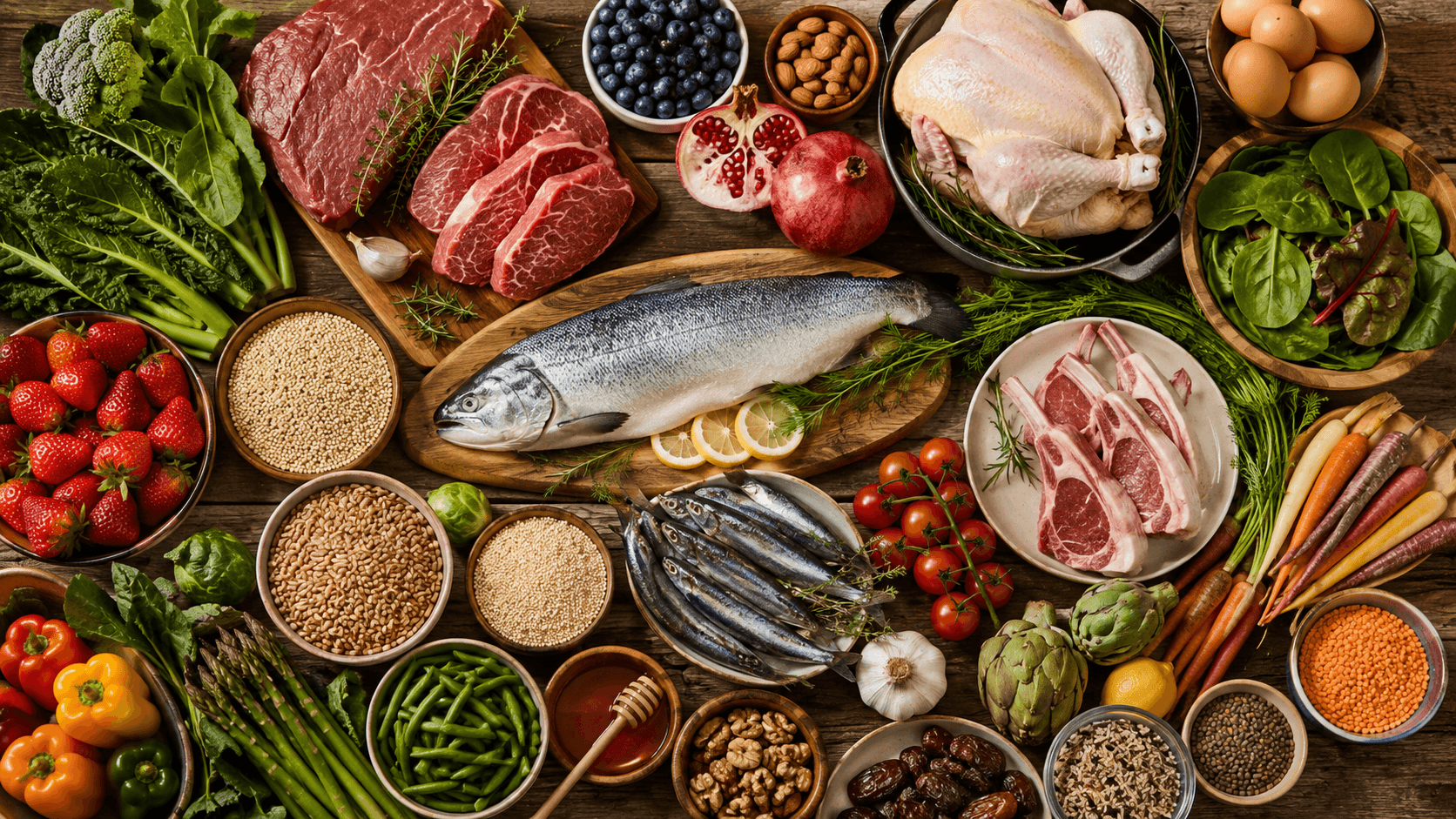
- Beef — the most common protein in my diet. Grass-fed when possible. Steaks, ground beef, the occasional roast. Ruminant, cloven-hoof, biblically clean.
- Salmon — wild-caught when I can. Fins and scales. Excellent omega-3 content, vitamin D, B12, and clean protein. One of the cleanest foods on the entire site.
- Chicken and turkey — pasture-raised when available. Foraging birds, biblically clean. Affordable, versatile, and paired well with the cooking applications covered across the other Health articles.
- Lamb and goat — occasionally. Both are ruminants with cloven hooves, biblically clean. The fatty acid profiles of pasture-raised lamb and goat are particularly favorable.
- Eggs — yes, regularly. From foraging birds in the clean category. One of the best whole-food sources of choline, B vitamins, and quality protein. Mentioned across the B-vitamins, B12, and zinc articles for this reason.
- Deer (venison) — only a handful of times in my life, when it has come through family or friends who hunt. Cloven hoof, ruminant, biblically clean. Among the cleanest red meats available because of the wild diet and low industrial exposure.
What I do not eat: pork in any form — no bacon, no ham, no pepperoni, no pork chops, no pork roast, no pulled pork, no chorizo, no pancetta, no prosciutto, no lard. Shellfish of any kind — no shrimp, crab, lobster, oysters, clams, mussels, scallops, crawfish. Catfish and other scaleless fish. Squid, octopus. Anything bottom-feeding or scavenging by classification. No predator birds. No reptiles or amphibians.
I want to be explicit: I am not telling anyone to go vegan. The vegan path is a legitimate and respected one within Adventism and outside it, and there are real arguments for it. But it is not my path. Most of the civilizations through history that have lived long and well have done so on diets that include the right meats — clean, well-sourced ruminants, foraging birds, and clean fish — in appropriate amounts, alongside an abundance of vegetables, fruits, legumes, whole grains, healthy fats, herbs, and spices. The biblical dietary frame doesn't push toward veganism. It pushes toward eating the right animals, properly raised and properly prepared, in the context of an otherwise plant-rich diet. That is my approach.
Quality, sourcing, and the modern complication
One honest complication worth surfacing: even the biblically clean animals are not, in modern industrial agriculture, what they were when the laws were written. Industrial feedlot beef raised on grain in cramped conditions, dosed with antibiotics and growth hormones, finished with corn that drives an inflammatory fatty-acid profile — this is a biblically clean animal, but it is a meaningfully degraded version of one. The same applies to factory-raised chicken, farmed salmon fed on questionable feed, and conventional eggs from caged hens fed on industrial diets.
The biblical category is the floor, not the ceiling. The clean/unclean distinction tells you which animals were designed for human consumption. How those animals are raised, fed, and finished still matters enormously for the quality of the food you actually end up eating. Where it's feasible:
- Grass-fed, grass-finished beef and lamb over grain-finished feedlot meat.
- Pasture-raised chicken and eggs over caged industrial alternatives.
- Wild-caught salmon (Alaskan in particular) over farmed Atlantic salmon, which is fed on grain-based and sometimes questionable feed.
- Small, mid-water, lower-trophic fish (sardines, herring, mackerel) regularly — extremely clean, cheap, high-omega-3, and minimal mercury accumulation relative to larger predator fish.
- Local, small-farm sourcing where possible — the same approach covered in the honey article applies to most animal products.
Cost is a real factor and not everyone has access to the ideal version of every food. The point is direction. Within the biblically clean categories, push toward the cleanest available sourcing you can sustainably afford.
Honest objections — and honest answers
"This is just ancient cultural taboo."
The cross-cultural recognition discussed earlier — Islam, Hinduism, Ethiopian Christianity, Pacific Islander cultures, and independent traditional African and Middle Eastern societies all flagging substantially the same animals — is hard to explain as cultural taboo. Real arbitrary taboos don't independently converge on the same biology across unrelated civilizations. The cross-cultural pattern fits a biological reality much better than it fits a cultural coincidence.
"Modern cooking and refrigeration solve the problem."
Cooking and refrigeration solve some of the problem and not others. Trichinella spiralis can survive ordinary cooking; modern outbreaks still occur. Tapeworm cysticerci can survive undercooking; modern neurocysticercosis cases are well documented. The bioaccumulated heavy metals in shellfish and predatory fish are not affected by cooking at all — cooking does nothing to mercury or cadmium. The pandemic-incubator function of pigs is not addressed by refrigeration. The omega-6 inflammatory load in pork tissue is unaffected by cooking method. Cooking is a partial defense, not a complete one.
"It was just for Israel."
Refer back to the Genesis 7 section. The categories predate Israel by centuries. Noah is not Jewish. The Israel-specific argument doesn't survive contact with the text.
"We're under grace, not law."
The grace/law dynamic in Christian theology addresses the basis of salvation — and there is wide consensus across Protestant, Catholic, and Orthodox traditions that salvation comes through grace, not through observance of any dietary code. That's not in dispute. What's in dispute is whether grace abolishes the underlying physical and biological realities the dietary laws describe. Grace doesn't make trichinella disappear. Grace doesn't change the heavy metal content of shellfish. The grace/law axis answers a different question than the biology/eating axis. You can be fully under grace and still benefit from eating in a way consistent with how human bodies are actually designed.
"What you eat is between you and God."
This is true and is part of why this article is written as a personal account rather than as a demand. I'm not the one who can or should tell anyone what to eat — that's between each person, their conscience, their reading of scripture, and their physician. What I can do is share my reading of the text, the biological evidence, the historical practice, and my own approach, and let you do the work of deciding for yourself.
How to start, if you're considering it
- Read Leviticus 11 and Deuteronomy 14 for yourself. They take about ten minutes to read together. The criteria are simple and the lists are short. Most of what circulates online about these chapters is filtered through one interpretive tradition or another — reading the actual text is a useful corrective.
- Start with the easy removals. Pork and shellfish are the two largest categories of unclean food in the modern Western diet. Removing them is the highest-impact change for the lowest cognitive load. Most pork meals have obvious substitutions (chicken, beef, turkey, lamb); most shellfish meals have clean-fish equivalents (salmon, tuna, cod, halibut).
- Don't perfectionism-trap yourself. If you've been eating pork your whole life and you switch on a Monday, that is a meaningful change. The fact that you don't have a kosher-certified kitchen and may have eaten shrimp at a wedding three months ago is not a reason to quit. Direction matters more than perfection.
- Read the Acts 10, Mark 7, Romans 14, and 1 Timothy 4 passages in your Bible, with the context, and form your own opinion. If you're a Christian, the question of whether the laws still apply is a serious one and worth settling on your own terms.
- Upgrade quality alongside the category change. Replacing factory bacon with factory chicken is a partial upgrade. Replacing factory bacon with pasture-raised eggs, grass-fed beef, and wild-caught salmon is a much larger one. The category change opens the door; the quality upgrade is what produces the noticeable difference in how you feel.
- Pay attention to how you feel. Many people who remove pork and shellfish report noticeable changes within weeks — better digestion, fewer headaches, less fatigue, less inflammatory sensation. Your body, in many cases, will tell you something useful that no laboratory study can.
Closing
The biblical clean and unclean food laws are not what most modern Christians think they are. They are not a Jewish ceremonial code abolished at the cross. They are a pre-Mosaic, cross-culturally recognized, biologically grounded taxonomy of which animals were designed for human consumption and which weren't. The science of the last two centuries has steadily vindicated the lists — pig as parasite host and pandemic incubator, shellfish as bioaccumulation filter, sharks as urea and mercury concentrators, scavenger birds as toxic-load accumulators — with almost no exceptions and almost no examples of the inverse (no one has produced biological evidence that the biblically clean animals are unsafe in any general way).
The Seventh-day Adventist health record — Loma Linda among the world's five Blue Zones, decades of cohort-study data showing meaningful longevity advantages — is one more piece of supporting evidence. It is not the central reason to eat this way. The central reason, for someone reading scripture seriously, is that the text describes a creation order and a covenant with the body God gave each of us. The longevity data is the predictable downstream consequence of taking that seriously.
For me, the practical version is straightforward. I eat beef, chicken, turkey, salmon, eggs, sometimes lamb or goat, and have had deer only a handful of times, all from the cleanest sources I can afford, in the context of an otherwise vegetable- and fruit-rich diet that includes the other foods covered across this section — real olive oil, garlic and onion, ginger, turmeric, beets, citrus, raw honey, and the rest. I drink water, get sun, walk daily, and sleep. I don't smoke. I don't drink alcohol. I'm Seventh-day Adventist, and I'm not personally vegan — not because I'm opposed to it, but because I believe the modern soil-depletion problem makes plant-only diets unreliable without very precise supplementation that most people don't sustain. The clean-meat-plus-abundant- vegetables approach has worked well for me.
The Bible got the food list right. The science just took three and a half thousand years to catch up. Read the text for yourself. Look at the biology. Make your own decision. That's the whole article.
Sources & further reading
- Leviticus 11 (KJV) — the primary text on clean and unclean animals
- Deuteronomy 14 (KJV) — the parallel passage with additional detail
- Genesis 7:2–3 (KJV) — clean/unclean distinction before Moses
- Acts 10 (KJV) — Peter's vision, with the explanation in verse 28
- Mark 7 (KJV) — the handwashing dispute
- Romans 14 (KJV) — meat offered to idols
- 1 Timothy 4:1–5 (KJV) — sanctified by the word of God
- Adventist Health Studies — Loma Linda University School of Public Health (long-running nutritional epidemiology research on Adventist populations)
- Blue Zones — Loma Linda profile (the only religious-community Blue Zone)
- CDC — Trichinellosis (Trichinella spiralis) factsheet
- CDC — Taeniasis (Taenia solium / pork tapeworm) factsheet
- CDC — Cysticercosis and neurocysticercosis
- CDC — Hepatitis E and pork-product transmission
- WHO — Influenza in pigs (the mixing-vessel role in pandemic emergence)
- WHO — MERS-CoV and camel reservoir transmission
- CDC — Vibrio species and shellfish-associated illness
- CDC — Norovirus and shellfish outbreaks
- FDA — Mercury levels in commercial fish and shellfish (with shark, swordfish, king mackerel, and tilefish flagged as highest-mercury)
- Ciguatera Fish Poisoning: Impact for the Military Health Care Provider — Military Medicine (Oxford Academic), 2007
- Ciguatera Fish Poisoning: Treatment, Prevention and Management — PMC review
- US Navy survival reference (NETC P1552-16) — open-ocean survival material referenced for the naval-survival section
- Dr. Don Mackay — biblical clean/unclean foods and modern food science (representative of the longer Adventist treatment of these topics)