Real extra-virgin olive oil is one of the most medicinal foods on earth. A tablespoon of the genuine product, taken daily, delivers a polyphenol load comparable to high-dose pharmaceutical antioxidants, supports the cardiovascular system more reliably than any other dietary fat, and forms the literal backbone of the longest-lived diet ever documented. There is just one problem. Most of what is sold as olive oil in the United States isn't actually olive oil.
The olive oil category is the most corrupt single shelf in your grocery store. Industry-wide fraud, organized crime involvement, blended adulterants, fake harvest dates, and regulatory failure have combined to produce a market where even brands that look reputable can fail basic chemical tests for what "extra virgin" actually means. Before we get into what olive oil does for your body, we have to get into why almost no one is actually getting any of that benefit from what they're buying.
The olive oil fraud — and why the cheap stuff isn't olive oil
In 2010, researchers at the UC Davis Olive Center tested samples of imported olive oils sold in the United States and labeled "extra virgin." 69 percent of the samples failed to meet the internationally accepted standards required to be called extra virgin olive oil. Not "mediocre." Not "slightly off-spec." Failed outright. They were either adulterated with cheaper oils, oxidized past the threshold, or refined oils relabeled as virgin.
The journalist Tom Mueller documented the scope of the problem in his 2012 book Extra Virginity: The Sublime and Scandalous World of Olive Oil — the definitive piece of investigative work on the industry — and his estimate of how much "extra virgin" olive oil on the American market is actually adulterated comes in at around 70 percent. Dr. Eric Berg, working from the same body of evidence, puts the number at "approximately 80% of the olive oil sold is fake or low-quality." Whichever estimate you anchor on, the shape is the same: the default bottle on the grocery-store shelf is not what it claims to be.
The fraud is not casual. It is large-scale, organized, and frequently criminal. In 2008 the Italian Carabinieri ran an investigation called Operation Golden Oil that resulted in 23 arrests and the confiscation of 85 farms. A subsequent investigation produced 40+ arrests for adding chlorophyll to sunflower and soybean oil and selling it as extra virgin olive oil. The Italian Mafia is heavily involved in the trade — the margins on counterfeit olive oil are reportedly higher than on cocaine, with less prosecution risk.
Olive oil fraud may be the most lucrative agricultural crime in Europe.
The math, once you know it, is obvious. A bottle of real extra-virgin olive oil represents the labor of harvesting olives by hand or with specialized machinery, cold-pressing them within 24 hours, careful storage in temperature- controlled stainless steel, dark-glass bottling, and international shipping. It is structurally impossible to produce real EVOO and sell it for five dollars a bottle. If the price is suspiciously low, the product is suspicious — full stop.
What real extra-virgin olive oil actually is
The "extra virgin" designation has a specific technical definition that almost no consumer is taught. To qualify, olive oil must be:
- Cold-pressed from fresh olives, with mechanical pressure only — no heat, no chemical solvents.
- Below 0.8% free fatty acidity — a chemical measure of how much the oil has degraded. Lower is fresher.
- Free of defects in taste panel evaluation — meaning no rancid, fusty, musty, or muddy notes detected by trained tasters.
- Produced from a single pressing, not blended with refined oils.
The grades, in descending order of quality:
- Extra-virgin olive oil (EVOO) — the gold standard, when it's real. Highest polyphenol content, fullest flavor, the form with documented health benefits.
- Virgin olive oil — a step down. Still mechanically pressed, but with higher free fatty acidity (up to 2%) and some minor defects allowed.
- "Olive oil" (without the virgin qualifier), "light olive oil," "pure olive oil" — chemically refined oils. These have been treated with industrial solvents, deodorized, and stripped of nearly all the polyphenol content that makes olive oil healthful in the first place. They are functionally just another seed-oil-tier cooking oil dressed up in olive branding.
- "Pomace olive oil" — the chemical solvent extraction of what's left after pressing. Avoid.
The headline takeaway: "olive oil" without "extra virgin" or "virgin" on the label is not the food you think it is. It is a refined oil that has lost almost everything that justified buying olive oil in the first place.
The polyphenols — what real EVOO does for you
The reason real EVOO is medicinal is one word: polyphenols. Refined oils don't have them. Adulterated oils don't have them. Real, fresh, well-stored EVOO has them in dense concentration, and they are the active ingredients responsible for almost every documented benefit:
- Oleocanthal — the polyphenol responsible for that peppery, slightly stinging bite at the back of the throat in fresh EVOO. Oleocanthal has been shown in published research to function as a natural anti-inflammatory similar to ibuprofen, inhibiting the same COX-1 and COX-2 enzymes that pharmaceutical NSAIDs target. A daily tablespoon of high-polyphenol EVOO delivers a meaningful anti- inflammatory dose — without the gastrointestinal side effects of long-term ibuprofen.
- Hydroxytyrosol and oleuropein — the two polyphenols most responsible for EVOO's cardiovascular benefits. They reduce LDL oxidation, improve endothelial function, and contribute to the lower cardiovascular mortality consistently observed in Mediterranean populations.
- Squalene and tocopherols — the secondary antioxidants in olive oil, contributing to skin health and free-radical scavenging.
The Mediterranean diet — consistently the most-studied and most-validated dietary pattern in nutritional epidemiology — is built on real olive oil. Populations that consume two to four tablespoons of EVOO daily have dramatically lower rates of heart disease, stroke, type 2 diabetes, and dementia than otherwise-similar populations that don't. When researchers try to identify which single component is doing the most work, real EVOO with its polyphenol load is consistently near the top of the list.
The smoke point myth — yes, you can cook with EVOO
One of the most persistent pieces of bad cooking advice of the last fifty years is that you should not cook with extra-virgin olive oil because its smoke point is too low. The argument: EVOO smokes around 350–405°F, while refined oils like canola or avocado oil smoke at 450°F+, so the refined oils must be safer for high-heat cooking.
This is wrong. Peer-reviewed research, including studies published in Food and Chemical Toxicology and the Journal of Agricultural and Food Chemistry, has repeatedly demonstrated that high-polyphenol extra-virgin olive oil is actually more stable under heat than most of the refined "high smoke point" oils people have been told to cook with instead. The reason is that smoke point isn't actually a great measure of cooking safety — what matters is the formation of harmful oxidation byproducts (aldehydes, peroxides, polar compounds), and the polyphenol antioxidants in fresh EVOO actively suppress that formation.
The practical result: fresh, high-polyphenol EVOO is one of the safest cooking oils available, including for sautéing and shallow frying. The refined "vegetable oils" — soybean, canola, corn — are the ones that produce alarming amounts of oxidative byproducts when heated, no matter how high their stated smoke point is. The smoke point myth has steered an entire generation of cooks toward worse choices.
How to identify real olive oil
Given the rate of fraud, you cannot rely on the words "extra virgin" on the label alone. The criteria that actually predict quality:
A harvest date on the bottle
Not a "best by" date — those are essentially meaningless. A harvest date tells you when the olives were actually picked and pressed. Real producers are proud of their harvest date and put it on the bottle. Fraudulent producers print only the "best by." If you can't find a harvest date, that's a strong signal — and look for oil from the most recent harvest available (within the last 12 to 18 months).
Single origin, not "bottled in Italy"
Italian olive oil culture is famous for a reason — but the phrase "bottled in Italy" on a label tells you almost nothing about where the olives were grown. Bottling in Italy is legal even when the actual oil was sourced from Tunisia, Greece, Spain, Morocco, or anywhere else, mixed in industrial vats, and packaged for export. Real single-origin oil names the actual estate, region, or country of origin clearly. Look for "100% [Country] olives" or a named single estate.
Dark glass bottles
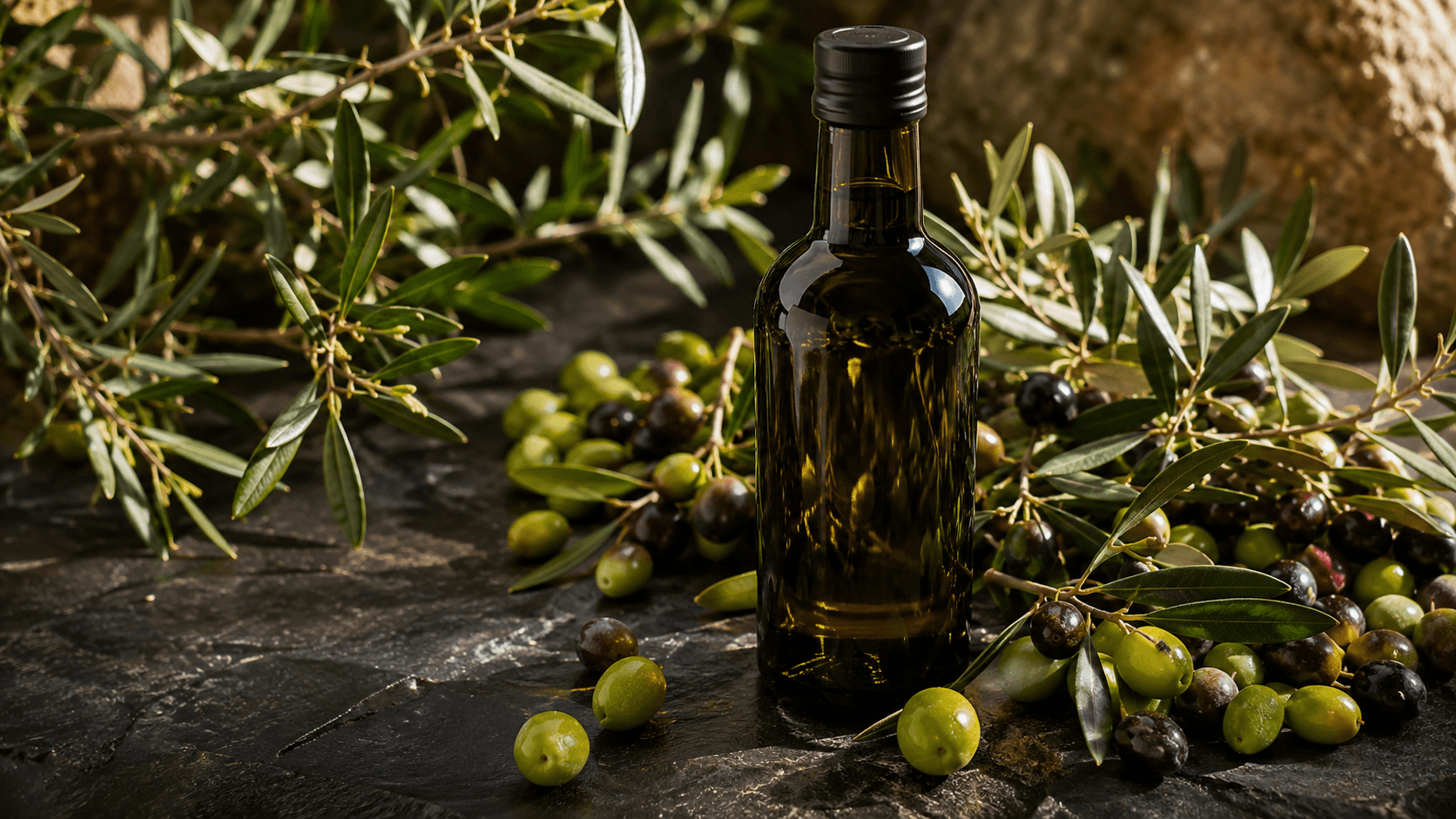
Olive oil oxidizes rapidly in light. Real producers package in dark green or amber glass — or in stainless tins — to slow oxidation. Clear glass bottles on a brightly lit grocery shelf are a serious red flag, regardless of what the label says.
The taste test — bitter and pungent is good
Dr. Berg points to this as the single most accessible test: "High-quality, authentic olive oil should have a slightly bitter, pungent taste at the back of your throat, indicating freshness and the presence of polyphenols." That peppery sting that makes you want to cough on the first sip is oleocanthal — the natural anti- inflammatory polyphenol. The pungency is the polyphenols working. Smooth, buttery, mild "olive oil" with no bite is almost always either old, refined, or adulterated.
Price — under $15 a bottle is a warning sign
Berg's range for legitimate olive oil is $10 to $40 per bottle. I would tighten the lower bound: anything under $15 for a 500 mL bottle in the US in 2026 is a warning sign. The economics simply do not support producing real EVOO at that price. Premium single-estate oils run $25–50; the truly high-end estate oils can run higher. This is one of the few food categories where paying more genuinely correlates with getting more.
Certifications worth looking for
- PDO (Protected Designation of Origin) / DOP (Italian equivalent) — European certifications that guarantee both origin and production methods. Reliable when present.
- COOC (California Olive Oil Council) certification — strong, well-audited certification for California producers.
- NAOOA (North American Olive Oil Association) — weaker, industry-funded, not as trustworthy as the above.
My approach
A tablespoon a day, almost every day. The form changes depending on the day and the bottle:
- One tablespoon of olive oil, taken neat or on salad. If by spoon, I use Morocco Gold — a more expensive single-estate Moroccan oil that I reserve for direct consumption because the polyphenol density is worth the price when nothing is competing with it on the palate. A tablespoon straight is a serious medicinal dose.
- On a salad, I'm honest — I drizzle a pretty big amount. For salad use I switch to Corto Truly, a 100% California EVOO that holds up beautifully on greens, and that I don't feel guilty using generously. The flavor pairs perfectly with real sea salt, Himalayan salt, or Celtic salt (never the iodized table-salt kind) plus apple cider vinegar — three ingredients, more health benefits than the average bottled dressing, no inflammatory seed oils.
- If not olive oil that day, then a tablespoon of high-quality coconut oil or grass-fed butter. The daily-tablespoon-of-quality-fat habit matters more than which specific fat. Coconut oil, grass-fed butter, and real EVOO are all excellent — sometimes more than one in the same day. The cases for the other two get their own articles.
Two trusted brands, two roles, and the willingness to spend a bit more on the one I take by the spoonful. Both brands are available on Amazon at the time of writing, and with a bit of research the reader can absolutely find other excellent brands that work for them — the criteria above (harvest date, single origin, dark glass, pungency, fair price) will steer you correctly regardless of which specific producer you end up with.
How to start
- Buy one good bottle. Don't try to overhaul your kitchen overnight. One quality bottle, drunk by the tablespoon or used as your daily salad oil, will teach you what real EVOO is supposed to taste like — and once you know, you can't unknow it. The cheap supermarket stuff will taste flat and oily by comparison.
- Do the pungency test. When you open the bottle, take a small sip neat. If it makes you want to cough at the back of your throat, that's the polyphenols. If it's smooth and mild, you got the wrong thing.
- Use it within 2 to 3 months of opening. Polyphenols degrade with exposure to air and light. The fresher you use it, the more medicinal it is.
- Store it in a dark cupboard. Not next to the stove, not on a sunny counter. Cool, dark, sealed.
- Cook with it freely. The smoke point myth has been refuted. Sauté with it, roast with it, drizzle it on finished dishes. EVOO is more stable than the refined oils you've been told to use instead.
- Take a tablespoon neat once a day if you can. This is the practice the Mediterranean elders have done for centuries. It tastes like nothing else and it does things almost nothing else does.
What I actually buy
With more research you can find other excellent brands — Cobram Estate (Australian), Kosterina (Greek), McEvoy Ranch (California), Brightland (California), and Bariani (California) are all producers worth investigating, among many others. The criteria above will steer you well regardless of which specific producer ends up working for your kitchen.
Closing
Olive oil is one of the rare foods where the gap between the best version and the worst version is enormous — and where the worst version is masquerading as the best version on almost every grocery shelf in the country. Buy carefully, spend a little more than feels comfortable, look for the harvest date, take it by the tablespoon when you can. A year of that habit will do more for your cardiovascular system, your inflammation levels, and your long-term metabolic health than almost any other dietary intervention available for the same money.
Paired with daily walking, adequate sun, the right mineral stack, and the rest of the simple practices in this section, a daily tablespoon of real EVOO is one of the cheapest, most enjoyable, and most underrated longevity tools in the kitchen.
Just don't buy the fake stuff.
Related reading on this site: the natural testosterone article covers olive oil's documented testosterone-supporting effect in men, both through direct enzymatic mechanisms and through the broader anti-inflammatory effects of the polyphenols. The women's cycle article covers why real fats — including olive oil — are foundational for female hormone production, and why low-fat dieting (pushed particularly hard at women) crashes the entire endocrine system. The clean foods article covers the broader real-food framework olive oil sits inside.
Sources & further reading
- Tom Mueller — Extra Virginity: The Sublime and Scandalous World of Olive Oil (book)
- UC Davis Olive Center — Tests of Imported Olive Oil (2010 study, the canonical citation on EVOO fraud)
- Dr. Berg — How to Tell If Olive Oil Is Really Olive Oil
- Dr. Berg — The Olive Oil Scam That You Need to Know About
- NPR — Losing 'Virginity': Olive Oil's 'Scandalous' Industry (Mueller interview)
- Beauchamp et al., 'Phytochemistry: Ibuprofen-like activity in extra-virgin olive oil' — Nature, 2005 (the oleocanthal paper)