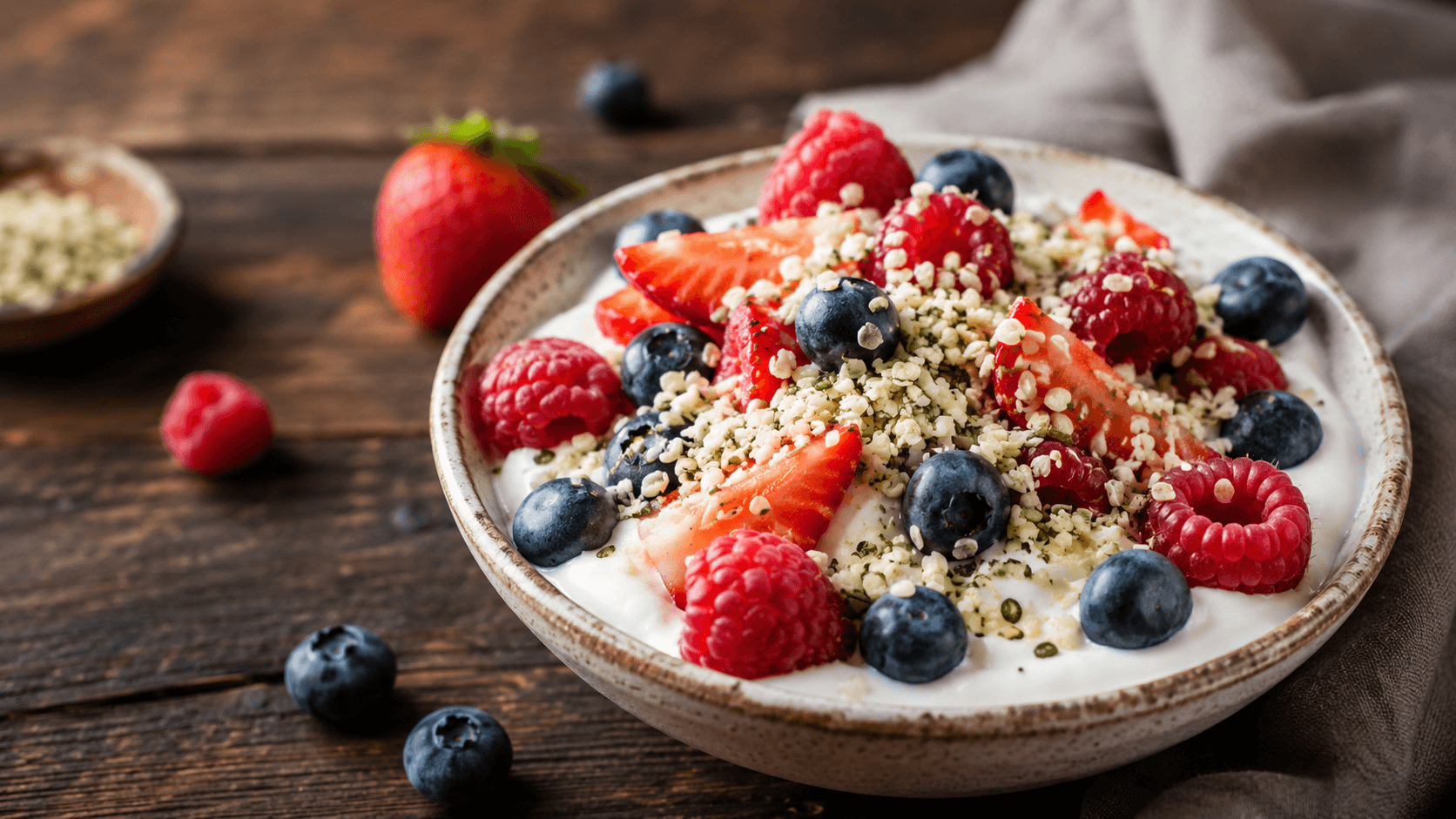
Hemp hearts — the shelled inner kernels of the hemp seed — are one of the most nutritionally complete single foods in any kitchen. They are about 30% complete protein by weight, with all nine essential amino acids present in meaningful proportions. They deliver omega-6 and omega-3 fatty acids in a 3:1 ratio that closely matches the ratio considered optimal for human health — versus the modern Western diet, which sits at a dramatically inflammatory 10:1 or worse. They contain rare and valuable fatty acids (gamma- linolenic acid and stearidonic acid) that most other plant foods don't provide at meaningful levels. They are rich in magnesium, phosphorus, manganese, zinc, iron, and several B vitamins. And — perhaps most usefully for people in protein-focused diets — they are hypoallergenic and highly digestible in a way most plant proteins aren't.
For most of the last century, hemp was difficult to study in the United States because growing it was illegal until the 2018 Farm Bill removed industrial hemp from the Controlled Substances Act. That legal history is the reason the research base on hemp hearts is smaller than what their nutritional profile would otherwise have generated — and why most Americans still know hemp hearts primarily through their association with the cannabis plant rather than as the serious whole-food protein source they actually are. This article covers what hemp hearts are (and aren't), the impressive nutritional case, the fatty acid story that makes them genuinely distinctive, the documented health benefits, the practical cooking applications, and the daily protein-shake protocol I personally use.
What hemp hearts actually are
Hemp hearts are the soft inner kernels of seeds from the hemp plant — Cannabis sativa L., the same botanical species as marijuana but a different cultivar. The whole seed has a hard outer shell; the "heart" is what remains after that shell is removed mechanically. The result is a small, pale-green, slightly chewy kernel with a mild, nutty flavor — much easier to eat in quantity than the harder whole seed.
A few clarifications worth making up front:
- Hemp hearts are not marijuana. Industrial hemp cultivars are legally defined as containing less than 0.3% THC (the psychoactive compound in cannabis). The seeds themselves contain essentially no THC — only trace contamination from handling, well below any meaningful threshold. You cannot get high from eating hemp hearts, and they will not cause a positive result on a standard drug test in any realistic dietary use.
- Hemp hearts are not CBD or hemp oil. CBD is extracted from the flowers and leaves of the hemp plant. Hemp oil (cold-pressed hemp seed oil) is extracted from the seeds and is a separate product from hemp hearts. Hemp hearts are the whole shelled kernel — fat, protein, fiber, minerals, and vitamins all intact.
- "Hemp seeds" and "hemp hearts" are often used interchangeably in modern grocery settings, though technically hemp hearts specifically refers to the hulled inner kernel rather than the whole shelled seed.
The legal history — and why the research is still catching up
Hemp has one of the strangest legal histories of any food crop. It was grown widely in the United States from the colonial era through World War II (the government actively promoted hemp cultivation during the war for industrial purposes — rope, sailcloth, canvas). Then, in the postwar era, hemp was conflated with marijuana under the Controlled Substances Act and effectively banned for cultivation in the US for over 50 years.
The 2018 Farm Bill finally removed industrial hemp (defined as Cannabis sativa containing less than 0.3% THC) from the controlled substances schedule, legalizing both cultivation and the food and textile products derived from it. Hemp seeds and hemp hearts had been legally importable from Canada and Europe before 2018, but the legal complexity kept hemp out of mainstream American nutrition research for decades.
The practical implication: the modern clinical research base on hemp hearts is smaller than their actual nutritional value warrants. Most of what we know about hemp's health effects comes from European, Canadian, and Russian research — plus a growing body of US research since 2018. The fundamentals — the protein profile, the fatty acid composition, the mineral and vitamin content — are well-documented. Larger long-term randomized clinical trials are still emerging.
The complete protein case
This is the headline. Hemp hearts are one of the few plant foods that deliver complete protein — meaning all nine essential amino acids in meaningful proportions. Most plant foods are deficient in one or more essentials (legumes are low in methionine; grains are low in lysine), which is why vegetarians traditionally have to combine complementary plant proteins to get a complete amino acid profile. Hemp hearts deliver the complete profile in a single food.
The specifics:
- 25–35% protein by weight, depending on cultivar and growing conditions. Three tablespoons (about 30 g) of hemp hearts delivers roughly 10 grams of complete protein.
- All nine essential amino acids in meaningful amounts.
- Edestin and albumin — the two main hemp proteins. Both are highly digestible and hypoallergenic. Edestin in particular has a structure very similar to globulin proteins in human blood, which contributes to its exceptional bioavailability.
- Hypoallergenic. Hemp hearts are not among the major food allergens (no gluten, dairy, soy, peanut, or tree-nut cross-reactivity). One of the few plant proteins that almost everyone can tolerate.
- Comparable in protein quality to egg whites per Dr. Eric Berg's framing — high digestibility, complete amino acid profile, easy on the gut.
For someone building a high-protein diet, particularly a plant-leaning one, hemp hearts are one of the most efficient single foods available. A generous 4- tablespoon serving in a protein shake delivers around 13–14 grams of complete protein — on par with two large eggs, but in a form that mixes cleanly into a smoothie and pairs naturally with banana, cocoa, berry, or any other smoothie base.
The essential fatty acid case — and the ratio that matters
The other half of hemp hearts' nutritional case is the fatty acid profile. Hemp hearts are about 50% fat by weight, almost all of it unsaturated, and the ratios are unusual in a way that turns out to matter a great deal.
The omega-6 to omega-3 ratio
The single most important fatty acid fact in modern nutrition is the omega-6 to omega-3 ratio in the diet. Both fatty acids are essential — meaning the body cannot make them and must get them from food — but the balance between them determines whether the body's inflammatory signaling runs hot or cool.
- Omega-6 fatty acids are generally pro-inflammatory at the metabolic level. They're not "bad" — they're necessary — but the body uses them to construct inflammatory signaling molecules. Excess omega-6 = excess inflammatory tone.
- Omega-3 fatty acids are generally anti-inflammatory. They construct the resolution molecules (resolvins, protectins) that turn inflammation off when its job is done.
- The optimal ratio per most modern nutrition science is somewhere in the 1:1 to 4:1 range (omega-6 to omega-3). This is roughly what the human ancestral diet provided for most of human history.
- The modern Western diet sits at a 10:1 to 25:1 ratio, depending on the population. Industrial seed oils (soybean, corn, sunflower, safflower, canola) are the primary driver — they're dominated by omega-6 linoleic acid and have flooded the food supply since the 1960s.
The chronic inflammatory tone that underlies most modern chronic disease — cardiovascular, metabolic, autoimmune, neurodegenerative — is, in significant part, downstream of this omega ratio inversion. Most people aren't getting too little omega-3 alone; they are getting catastrophically too much omega-6 relative to omega-3.
Hemp hearts deliver omega-6 and omega-3 in a roughly 3:1 ratio — squarely inside the optimal range and almost the opposite of what the modern food system pushes most people toward. This alone makes hemp hearts one of the more anti-inflammatory daily foods available.
Gamma-linolenic acid (GLA)
Here is the part that genuinely sets hemp hearts apart from most other plant foods. Hemp hearts contain 1–6% gamma-linolenic acid (GLA) — a rare omega-6 fatty acid with documented anti-inflammatory effects despite being in the omega-6 family. GLA is the active compound that makes evening primrose oil and borage oil valuable.
GLA has documented benefits for:
- Inflammatory skin conditions — psoriasis, atopic eczema, acne. Multiple studies show meaningful improvements with daily GLA supplementation.
- Premenstrual syndrome (PMS) — traditional and clinical use for breast tenderness, mood swings, and other premenstrual symptoms.
- Menopausal symptoms — particularly hot flashes and hormonal mood disruption.
- Rheumatoid arthritis — GLA has shown anti-inflammatory effects comparable to some NSAIDs in controlled studies.
- Vascular tone and cardiovascular health through prostaglandin signaling.
Most people get essentially zero GLA from their diet because it's only present at meaningful levels in a small number of foods (evening primrose, borage, black currant, hemp, and a few others). Adding hemp hearts to your daily routine is one of the easier ways to get a real food-based GLA dose.
Stearidonic acid (SDA)
The other rare fatty acid in hemp is stearidonic acid (SDA) — an omega-3 that converts to EPA (the marine omega-3 found in fish oil) several times more efficiently than the more common plant omega-3 alpha-linolenic acid (ALA) does. For people who don't eat much fish, the SDA in hemp hearts is one of the better plant-source pathways to actually elevating the omega-3 index in the blood — which is the marker that matters most for cardiovascular benefit.
The mineral and vitamin profile
Three tablespoons of hemp hearts deliver, alongside the protein and fat:
- Magnesium — about 50% of daily requirement per 3-tbsp serving. One of the most magnesium-dense plant foods available — relevant given how much of the population is magnesium deficient.
- Phosphorus, manganese, zinc, iron, copper, potassium in meaningful amounts.
- Vitamin E — particularly gamma- tocopherol, the form most associated with cardiovascular and anti-inflammatory benefit.
- B vitamins — thiamine (B1), riboflavin (B2), B6, folate. (Like most plant foods, hemp hearts are not a reliable source of true B12 — see the B12 article for why this matters.)
- Fiber — modest in shelled hearts (the fiber is mostly in the discarded shell), but still a small contribution.
The documented health benefits
Cardiovascular health
The combination of the optimal omega ratio, the GLA and SDA fatty acids, the magnesium content, and the complete amino acid profile gives hemp hearts a notably strong cardiovascular case. Research in both animals and humans suggests hemp seeds support:
- Reduced blood pressure through both the magnesium content and the GLA-mediated vascular effects.
- Improved LDL/HDL ratio — modest reductions in LDL cholesterol and triglycerides in controlled studies.
- Reduced platelet aggregation — mild natural blood-thinning effect from the omega-3 content.
- Improved vascular endothelial function — the inner lining of blood vessels responds better to the anti-inflammatory fatty acid profile.
- Reduced post-ischemic injury markers in animal models of cardiac stress.
Anti-inflammatory effects
The combination of the optimal omega ratio, GLA, SDA, and the antioxidant vitamin E creates a substantial anti-inflammatory contribution. GLA specifically has been shown in research to have anti-inflammatory effects similar in direction (though milder in magnitude) to ibuprofen, without the GI side effect profile of long-term NSAID use.
This translates to documented benefits for inflammatory conditions including arthritis, autoimmune flares, chronic skin conditions, and the chronic low-grade inflammation that underlies most modern metabolic disease.
Skin health
The GLA content makes hemp hearts particularly relevant for inflammatory skin conditions:
- Atopic eczema — multiple studies show improvement with daily GLA-rich food or supplementation.
- Acne — the anti-inflammatory effect of the omega-3 and GLA combination has been documented to help with inflammatory acne.
- Psoriasis — both topical and internal omega-3 / GLA approaches have been studied.
- General skin barrier function — the essential fatty acids contribute to the skin's lipid barrier and moisture retention.
Hormonal balance — particularly for women
The GLA content makes hemp hearts one of the more useful daily foods for hormonal-symptom support. GLA is a precursor to certain prostaglandins — fatty-acid compounds with hormone-like signaling functions in the body. Specific applications:
- PMS symptoms — particularly breast tenderness, mood swings, bloating.
- Menopausal hot flashes and mood symptoms.
- Polycystic ovary syndrome (PCOS) — emerging research on GLA for the inflammatory component of PCOS.
Brain function
The omega-3 content (both ALA and the more readily convertible SDA) contributes to brain function. The brain is roughly 60% fat by dry weight, with omega-3s making up a substantial portion of neuronal cell membranes. The magnesium content adds an additional brain-function contribution (see the magnesium article).
Muscle building and recovery
The complete amino acid profile combined with the anti-inflammatory fatty acid composition makes hemp hearts particularly useful as a recovery food. The protein supports muscle protein synthesis; the omega-3 and GLA reduce the inflammatory tone that follows intense training. For someone using hemp hearts in a post-workout shake, both effects stack.
My approach
I lean heavier on hemp hearts than most people would. Honestly: three to four tablespoons stirred into a protein shake for one application, and sometimes a more generous amount drizzled on oatmeal for another. I'm comfortable using them as a meaningful protein source, not a sprinkle garnish.
A 3-to-4 tablespoon serving delivers:
- Roughly 10–14 grams of complete protein
- Roughly 170–225 calories, mostly from healthy fats
- A meaningful dose of magnesium, GLA, omega-3 ALA and SDA, plus the rest of the mineral profile
For context, the standard "recommended serving" on most hemp heart packaging is about 2–3 tablespoons. My use is on the higher end. I'd describe my pattern as using hemp hearts as a primary protein and essential-fatty-acid source, not as a topping. This is reasonable for someone consciously building their meals around hemp hearts as a centerpiece ingredient, but it's not what most people need or should start with.
For most readers, 1–3 tablespoons per serving is plenty — enough to deliver the fatty acid profile, GLA, magnesium, and a meaningful chunk of protein. The 3-to-4 tablespoon dose I use is a personal calibration that fits how I structure my shakes and breakfasts. Start lower, build up if it works for you.
On the taste — actually pretty good
Worth addressing directly because this is the question that stops a lot of people from trying hemp hearts in the first place: they taste good. Mild, nutty, slightly sweet, slightly grassy in a pleasant way — closer in flavor to sunflower seeds or pine nuts than to anything you'd associate with the word "superfood." The texture is soft and tender, not crunchy or hard like most seeds. They're easy to chew, easy to swallow, and don't have the bitter or chalky aftertaste that some other plant-protein additions (looking at you, hemp protein powder and most pea protein isolates) tend to carry.
You can eat them straight from the spoon and genuinely enjoy it. That's not a stretch — they're pleasant on their own as a quick snack, the way a small handful of nuts is. No masking ingredients required, no elaborate preparation. I will sometimes just take a spoonful straight from the bag during a break in the day — a few seconds of effort for a meaningful dose of protein, essential fatty acids, and magnesium.
If you've put off trying hemp hearts because the words "raw seed superfood" sound off-putting, this is one of the rare cases where the food and the marketing are saying very different things. Hemp hearts taste like food, not like medicine. That makes the daily habit dramatically easier to maintain than for foods that require you to push through the flavor to get the benefit.
How to use hemp hearts in cooking
Beyond eating them straight, hemp hearts are one of the most versatile single ingredients to add to almost any food. The mild nutty flavor blends into almost any savory or sweet preparation:
- Protein shakes and smoothies. The simplest and most efficient use. Mixes cleanly, blends smooth, adds protein and essential fatty acids without dramatically changing flavor. Pairs well with banana, cocoa, berry, or any fruit-forward smoothie.
- Sprinkled on oatmeal or breakfast bowls. A generous spoonful on hot or overnight oats, yogurt bowls, or any breakfast grain bowl. The slight crunch and nutty flavor work beautifully.
- On salads. Sprinkled over green salads, grain bowls, or roasted vegetable salads as a finishing protein and texture.
- Stirred into yogurt or kefir. Adds substantial protein and the omega-3 content. Pairs naturally with berries.
- Sprinkled on roasted vegetables — especially turmeric-spiced cauliflower or sweet potatoes.
- In homemade granola or trail mix. Either added before baking or mixed in afterward.
- In baked goods — energy bars, muffins, breads. Particularly good in protein- oriented baking.
- Ground into homemade hemp milk. Blend hemp hearts with water and strain (similar to almond milk). One of the easier plant milks to make at home.
- As a vegan parmesan substitute — blended with nutritional yeast, garlic powder, and salt to make a savory sprinkle for pasta or roasted vegetables.
How to buy and store
- Organic when affordable. Hemp is often grown without heavy pesticide use (the plant is naturally resilient), so the organic gap is smaller than with some other foods — but still worth it when budget allows.
- Reputable brands: Manitoba Harvest (the dominant brand, widely available, generally good quality), Nutiva, Bob's Red Mill, Now Foods, Terrasoul. Most large grocery stores carry at least one of these in the natural-foods section.
- Refrigerate after opening. This is important and most people don't do it. Hemp hearts are about 50% polyunsaturated fat, which oxidizes (goes rancid) more quickly than saturated or monounsaturated fats. Unopened bags are stable at room temperature, but once opened, the bag should go in the refrigerator (or freezer for long-term storage). Rancid hemp hearts taste sharp and bitter — if you taste that, throw the bag out.
- Color should be pale green to grey-green. Brownish hemp hearts are oxidized and past their prime.
- Look for "shelled hemp seeds" or "hemp hearts" on the label. Whole unshelled hemp seeds also exist (and are useful), but they're harder to eat in quantity and have more fiber/less protein per gram than the shelled hearts.
- Smell test on opening. Fresh hemp hearts smell mildly nutty and grassy. Anything sharp, fishy, or off is a sign of oxidation.
Honest cautions
- Caloric density. Hemp hearts are calorie-dense — roughly 170 calories per 3- tablespoon serving. For someone tracking calories carefully, the 3-to-4 tablespoon serving I use is 500+ calories in one shake addition. Worth being aware of, even though the calories are coming from high-quality fats and protein.
- Blood thinners. The omega-3 content has mild anti-platelet effects, similar to garlic and ginger. People on prescription blood thinners should discuss with their doctor before adding large daily doses.
- Drug testing. Hemp hearts contain essentially no THC and have not, in normal dietary use, been documented to cause positive drug-test results. Extreme cases (consuming very large quantities of low-quality hemp products) have occasionally been reported. For people in professions with strict drug testing (military, certain government positions, professional sports with strict THC limits), the safer move is to confirm with the testing authority. For everyone else, this is a non-issue.
- Digestive sensitivity. Most people tolerate hemp hearts beautifully — they're widely considered one of the most digestible plant proteins available. A small fraction of people may experience mild GI discomfort at the higher serving sizes (gas, loose stool) due to the fat content. Start with a smaller serving and build up if you're sensitive.
- Oxidation risk if stored poorly. See the storage section above. Old or improperly stored hemp hearts can have oxidized fats that contribute to (rather than reduce) inflammation. Fresh hemp hearts only.
How to start
- Buy a bag this week. A 1-pound bag of Manitoba Harvest hemp hearts is widely available at any grocery store with a natural-foods section. Cost is comparable to a bag of premium nuts.
- Start with 1 tablespoon per serving for the first week. Get a sense of how the flavor integrates with your usual smoothie or oatmeal base.
- Build to 2–3 tablespoons per serving once you've confirmed taste tolerance. For most people, this is the standing dose to settle on.
- Refrigerate immediately after opening. The single most common mistake with hemp hearts is leaving them at room temperature. The fatty acids oxidize faster than people expect.
- Pair with the rest of the breakfast or shake stack. Hemp hearts work particularly well alongside the spirulina, creatine, and (for those who use it) the ashwagandha that round out a serious protein-shake protocol.
- Higher dosing is fine if you're using hemp hearts as a primary protein source — building to 3–4 tablespoons per serving as I do — but don't start there. Build into it once you know how it sits with you.
Closing
Hemp hearts are one of the cleanest plant-protein stories in modern nutrition. Complete amino acid profile. Optimal omega ratio. Real GLA. Real SDA. Significant magnesium and other minerals. Hypoallergenic and easy to digest. Versatile across almost any meal context. And — most usefully — they integrate into a modern food protocol without requiring a new recipe category or a dramatic change in eating patterns.
The research base will continue to deepen now that legal cultivation has been restored in the United States. The fundamentals don't depend on that research, though — the nutritional case is straightforward enough to stand on its own. A bag of hemp hearts in the fridge and a few tablespoons added to whatever breakfast you're already eating is one of the easier food-protocol upgrades available.
Combined with the rest of the protein-and-fat-medicine stack on this site — real olive oil, grass-fed animal fats, the right whole-food B-vitamin sources, the rest of the mineral foundation — hemp hearts fill in the plant-protein and essential-fatty-acid niche that almost nothing else in a typical Western kitchen handles as efficiently.
A bag in the fridge. A spoonful on whatever you're already eating. The rest is detail.
Sources & further reading
- Callaway, 'Hempseed as a nutritional resource: An overview' — Euphytica, 2004 (the foundational nutritional review)
- Dietary hempseed and cardiovascular health: nutritional composition, mechanisms and comparison with other seeds — Frontiers in Nutrition, 2025
- The cardiac and haemostatic effects of dietary hempseed — Nutrition & Metabolism, 2010
- Precision Nutrition — All About Hemp (comprehensive evidence summary)
- Cleveland Clinic — 5 Health Benefits of Hemp Seeds
- Healthline — 6 Proven Health Benefits of Hemp Seeds
- Manitoba Harvest — Hemp Heart product and nutrition reference