We have been taught to picture cancer as an invader — something that strikes from outside, at random, against which the body is helpless and the only answer is to cut, burn, or poison it out. There is a truth missing from that picture. Cancer does not grow in a vacuum; it grows in a terrain— an internal environment of blood sugar, oxygen, inflammation, toxins, hormones, and repair signals — and that terrain is built, every single day, by what we eat, drink, and do. The body already carries its own anti-cancer machinery: cells that hunt abnormal cells, a clean-up system that recycles damaged parts, a repair crew that fixes broken DNA. The real question is not only how to attack the tumor, but how to change the terrain that let it grow — and to feed the body's own defenses instead of starving them.
A word about where this comes from. The thinking here leans on Dr. Otto Warburg, the Nobel laureate who showed that cancer cells feed on sugar in a broken, oxygen-starved way; Dr. Thomas Seyfried, who carried that metabolic view into the modern era; Dr. Valter Longo and Dr. Jason Fung on fasting and cancer; Dr. Mark Sircus on iodine and natural oncology; and Dr. Eric Berg on the daily mechanics of sugar, sleep, and fasting. None of this replaces oncology. It sits beside it, working on the soil while medicine works on the weed — and it rests on one conviction this whole section is built around: the body, given what it actually needs, is built to heal.
Cancer grows in a terrain — and terrain can change
Almost a century ago Otto Warburg noticed something strange about cancer cells: they don't breathe like normal cells. A healthy cell burns fuel cleanly with oxygen. A cancer cell, even when oxygen is plentiful, ferments sugar instead — fast, greedy, and inefficient. This is the Warburg effect, and it is why a PET scan finds tumors by lighting up the places in the body that are gulping the most glucose. Cancer is, in large part, a metabolic disturbance: cells that have lost the ability to burn fuel properly and now depend on a constant flood of sugar to survive and multiply.
That single fact reframes everything. If cancer cells are obligate sugar-burners living in low-oxygen, inflamed, toxic tissue, then the terrain matters enormously — because terrain is exactly what diet and lifestyle control. You cannot change your genes by lunchtime. But you can change how much sugar is in your blood, how much oxygen reaches your tissues, how much inflammation you carry, how loaded your body is with toxins, and how well your repair and clean-up systems are working. Reversing cancer, in the sense this article means it, is the patient work of making the body a place where cancer struggles to grow and the body's own defenses thrive.
The pharmacy hiding on your plate
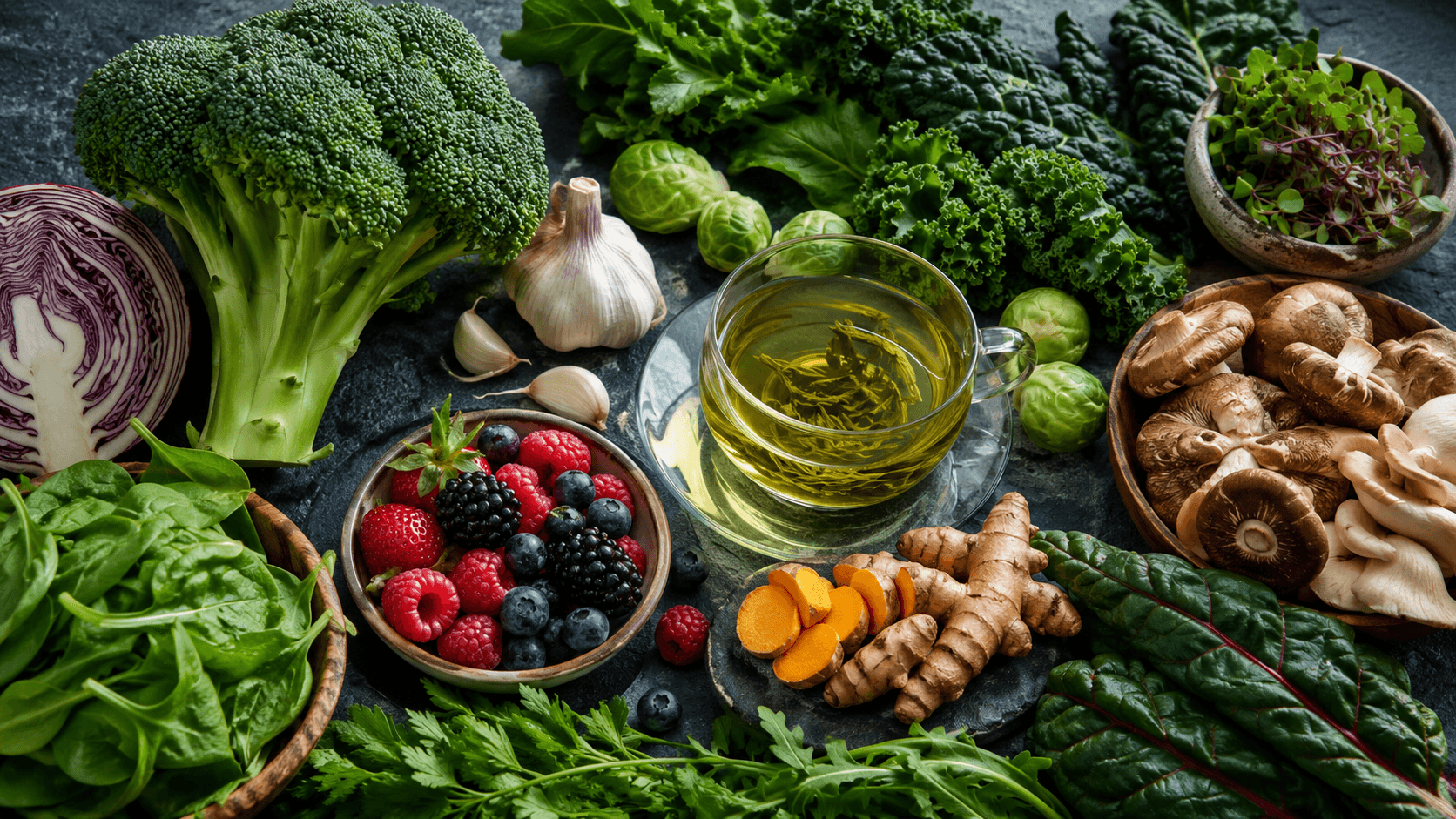
Here is something most people never realize: nearly every plant we eat from day to day is, quietly, a piece of anti-cancer medicine. Not in a vague “eat your vegetables” way — in a specific, studied, molecular way. Plants can't run from threats, so they evolved chemical defenses, and those same compounds turn out to interrupt cancer in the human body: shutting down the signals tumors use to grow, cutting off the blood vessels they build to feed themselves, and nudging damaged cells to die on schedule the way healthy cells do.
The list is long and ordinary. Cruciferous vegetables — broccoli, cauliflower, cabbage, kale, Brussels sprouts — carry sulforaphane, one of the most studied anti-cancer compounds there is. Garlic and onions release sulfur compounds that have been tied to lower rates of several cancers (see garlic and onion). Berries and dark grapes are dense with polyphenols; leafy greens bring folate, chlorophyll, and a flood of antioxidants; turmeric carries curcumin, green tea its catechins, ginger its gingerols, and mushrooms their immune-priming beta-glucans. Beets, wheatgrass, and spirulina round it out. You do not have to hunt down a rare miracle berry from a rainforest. The medicine is the produce aisle — eaten in real variety, in real quantity, every day.
We treat food as fuel and forget it is information. Every meal is a set of instructions to the body — and the plant kingdom has been writing anti-cancer instructions for a very long time.
The shift is simple to say and powerful in practice: build the plate around a wide rotation of vegetables, herbs, and low-sugar fruits, and you are not just “eating healthy” — you are dosing yourself, meal after meal, with compounds that push the terrain against cancer.
Starving what feeds it: the sugar
If cancer cells run on sugar, then the other half of the food question is what to take away. A diet built on sugar, sweet drinks, and refined carbohydrate keeps blood glucose and insulin high all day — and insulin and its cousin IGF-1 are powerful growth signals, telling cells, including cancerous ones, to grow and divide. Feeding a body sugar all day is, metabolically, pouring fuel on exactly the fire you want to put out.
This is why so much of the natural approach to cancer overlaps with the approach to reversing diabetes: cut the sugar and refined carbohydrate hard, lower insulin, and shift the body toward burning fat for fuel. Normal cells adapt to running on fat and ketones easily; many cancer cells, locked into their broken sugar-only metabolism, cannot. Lowering the sugar supply doesn't starve you — it starves the thing that depends on sugar most. Pair that with the flood of plant compounds above and you are working both levers at once: removing the fuel, and adding the medicine.
Iodine: the mineral most people are missing
Iodine is one of the most quietly important minerals in the body and one of the most widely deficient. Beyond running the thyroid, iodine concentrates in the breast, the ovaries, the prostate, and the stomach — and in those tissues it does something striking: it helps damaged cells undergo apoptosis, the orderly self-destruction that the body uses to clear cells before they can turn cancerous. Researchers and clinicians like Dr. Mark Sircus and Dr. David Brownstein have argued for years that the modern collapse in iodine intake tracks with rising rates of exactly the hormone-sensitive cancers found in the iodine-hungry tissues.
Iodine also displaces the toxic halogens — bromine, fluorine, chlorine — that compete for the same receptors and accumulate when iodine is scarce. It is, in the natural-medicine view, a foundational mineral for a cancer-resistant terrain. The full case, and the specific forms worth using, are in the dedicated piece on iodine. As always with cancer, dose and timing belong in a conversation with a practitioner — but iodine is not an exotic add-on. It is a missing basic.
Sunlight and vitamin D
The sun has been treated as an enemy for a generation, and the result is a population starved of one of the most important anti-cancer signals there is. Sunlight on skin makes vitamin D, which is less a vitamin than a master hormone — it speaks to thousands of genes, including ones that regulate cell growth and tell abnormal cells to stop dividing or die. Population after population shows the same pattern: lower vitamin D levels track with higher rates of many cancers, and the people who get more sun, within reason, tend to fare better.
Sunlight does more than make vitamin D. It sets the body's daily clock, lifts mood, and — through near-infrared light — reaches deep into tissue and supports the mitochondria, the very engines that cancer cells have broken. Sensible sun exposure — regular, not burning — is free medicine. Where the sun is weak for months, that is what vitamin D supplementation is for. See the companion piece on vitamin D.
Clean water and a lower toxic load
It sounds almost too plain to matter, but it matters: most people are chronically dehydrated and drinking water carrying a load of chlorine, fluoride, and other contaminants. Water is how the body carries nutrients in and flushes waste and toxins out. A body that is well-hydrated with clean water moves its lymph, cushions its cells, carries oxygen, and clears the metabolic garbage that inflames tissue and burdens the terrain. A body that is dry and drinking pollutants does the opposite.
The fix is unglamorous and powerful: drink enough genuinely clean water through the day, filtered of the halogens that crowd out iodine and the chemicals that add to the toxic load. Reducing what burdens the body is as much a part of changing the terrain as adding what helps it.
Sleep and the melatonin you make in the dark
Sleep is not downtime; it is when the body does its deepest repair — and it is when you make melatonin, the hormone of darkness. Melatonin is far more than a sleep signal: it is a potent antioxidant and one of the body's own anti-cancer agents, shown to slow the growth of several tumor types and to protect cells from the DNA damage that starts cancer in the first place. You make it only in real darkness — which is exactly what modern life, lit blue past midnight, destroys.
This is why night-shift work and chronic poor sleep show up in the data as cancer risks, and why protecting sleep is not a luxury but part of the treatment of the terrain. Dark, cool, consistent nights; morning light to set the clock; screens down before bed. The full protocol is in the piece on sleep. A body that sleeps deeply repairs itself and bathes its cells in melatonin every night — for free.
Walking, oxygen, and the moving lymph
Remember Warburg: cancer ferments in low oxygen. Movement is one of the simplest ways to flood the body with the thing cancer cells like least. A brisk walk raises oxygen delivery to the tissues, lowers blood sugar by pulling glucose into the muscles, calms inflammation, and lifts the mood and stress hormones that feed disease. You do not need to be an athlete. Daily walking — especially after meals, and especially outdoors in the sun — is one of the most underrated anti-cancer habits there is.
Movement also drives the lymphatic system, the body's drainage and immune-surveillance network. Unlike blood, lymph has no pump of its own — it moves only when you move. Walking, and gentle bouncing like rebounding, pump the lymph that carries immune cells to patrol the body and ferries waste away. A sedentary body is a stagnant one. A moving body is oxygenated, drained, and patrolled.
Fasting: switching on the body's clean-up
If there is one tool in this whole article with the deepest effect, it is fasting — and its power against cancer comes down to two mechanisms. The first is the sugar story again: fasting drops blood sugar, insulin, and IGF-1 to the floor, pulling the growth signals and the fuel away from cells that depend on them most. The second is autophagy— literally “self-eating” — the body's recycling program, in which it breaks down and clears out damaged, dysfunctional, and pre-cancerous cell parts. Autophagy idles when we are constantly fed and switches on strongly during a fast. It is the body's own quality-control and clean-up crew, and fasting is how you call it to work.
This is the territory that healers like Dr. Sebi built their entire approach around — prolonged fasting and plant-based cleansing to let the body detoxify and repair — and that researchers like Dr. Valter Longo and Dr. Jason Fung have since studied seriously, including how fasting can make healthy cells more resilient while leaving cancer cells more exposed. But here is the part people most need to hear: you do not have to fast for thirty or forty days to benefit. Tremendous repair begins far sooner. A well-run fast of even one or two weeks — or a rhythm of shorter repeated fasts — can produce remarkable results, because autophagy and the metabolic shift kick in within days, not weeks.
If you do fast, two things are non-negotiable. First, your sleep has to be on point — fasting is a repair process, and the repair happens during deep sleep; fasting on no sleep is fighting yourself. Second, your electrolytes must be constantly replenished. When insulin falls, the body sheds water and minerals fast, and the sodium, potassium, and magnesium you lose must be put back — with good salt and electrolytes — or you will feel terrible and can put real strain on the heart. Done with sleep protected and electrolytes replenished, fasting is one of the oldest and most powerful tools the body has. The full how-to is in the dedicated piece on fasting — and for cancer especially, it should be done under the eye of someone who knows your case.
Rest and the healing state
There is one more terrain factor people skip: the nervous system. The body has two modes — the stressed “fight or flight” state, and the calm “rest and repair” state — and it can only do deep healing in the second. Chronic stress keeps cortisol and adrenaline high, raises blood sugar, suppresses the immune cells that hunt abnormal cells, and inflames the body. A terrain soaked in stress hormones is a terrain that favors disease.
This is not soft advice; it is physiology. Genuine rest, time outdoors, prayer, gratitude, and peace are not extras layered on top of the “real” treatment — they shift the body into the state where its own repair and immune defenses do their work. A healing body is a calm body. You cannot heal in a constant state of alarm.
Putting it together
None of these is a magic bullet, and that is the point — they are not meant to be taken one at a time. They are the many sides of a single shift: making the whole body a place where cancer struggles and health thrives. Practically, it looks like this.
Build every plate around plants — a wide daily rotation of cruciferous vegetables, garlic and onions, leafy greens, berries, herbs, and mushrooms. Cut the sugar and refined carbohydrate to pull the fuel and the growth signals away. Get sensible daily sun, and supplement vitamin D when the sun is weak. Fix the iodine deficiency most people carry. Drink genuinely clean water through the day. Protect deep, dark sleep so the body makes its melatonin and does its repair. Walk every day, outdoors when you can, to oxygenate and move the lymph. Use fasting— even one or two weeks, or repeated shorter fasts — with sleep protected and electrolytes replenished, to switch on the body's clean-up. And get out of the constant state of alarm so the body can enter the state where it heals. Each one tilts the terrain. Together they change it.
The honest cautions
Because this is cancer, the cautions are not fine print — they are part of the message.
This is support for the body, not a magic cure. Some cancers are slow and some are aggressive, and the difference can matter enormously — so don't delay getting a clear diagnosis, and make your treatment decisions informed and unhurried rather than frightened into them. I won't push anyone toward radiation and chemotherapy. I believe much of conventional cancer treatment does more harm than good, and those are heavy choices to weigh honestly, with people you trust, knowing the real costs on both sides.
But if you do undergo radiation therapy — as many feel pressured to under the weight of modern medical convention — then at the very least, defend yourself while you do. Take high amounts of iodine throughout the period you are being treated, and for the days and weeks surrounding it. Iodine is the body's classic radioprotection — it helps shield the thyroid and the other iodine-hungry tissues from radiation damage — and a body flooded with it is far better defended than a body deficient in it.
Tell anyone treating you everything you are doing. Fasting, iodine, and concentrated supplements can interact with treatments and medications, and some are wrong for certain people — anyone pregnant, underweight, frail, or with a history of disordered eating should not fast without supervision. None of this is a guarantee, and “reversing” describes a direction to move the body, not a promise of the outcome. What it is, is the unglamorous, well-founded work of giving the body back the conditions it needs to defend itself — done with your eyes open.
Closing
The story we are usually handed is that cancer is pure bad luck and the body a bystander. The deeper truth is that the body is never a bystander — it is fighting for us constantly, clearing damaged cells, repairing broken DNA, hunting down what goes wrong, every hour of every day. What it needs is for us to stop feeding the fire and start feeding the firefighters: the sugar down, the plants up, the sun on the skin, the iodine restored, the water clean, the sleep deep, the body moving, the fast doing its ancient work, the alarm finally switched off.
That is the whole reason this section exists — not to manage sickness, but to point at the truth that the body, given what it actually needs, is built to heal. If you or someone you love is facing this, that is the news worth holding onto. Get informed, weigh your choices with people you trust, and whatever path you take, change the terrain — because the body that grew sick under one set of conditions can begin to turn under another.
Sources & further reading
This article reflects the work of researchers and clinicians who study cancer's metabolism and the body's own defenses. Read them directly, and act in partnership with a practitioner who knows your case.
- Dr. Thomas Seyfried — Cancer as a Metabolic Disease (the modern metabolic theory of cancer)
- Dr. Valter Longo — fasting, the fasting-mimicking diet, and cancer (USC Longevity Institute)
- Dr. Jason Fung — The Cancer Code: a new understanding of a deadly disease
- Dr. Mark Sircus — natural oncology, iodine, magnesium, and the body's terrain
- Dr. David Brownstein — Iodine: Why You Need It, Why You Can't Live Without It
- Dr. Eric Berg — sugar, fasting, autophagy, and the daily mechanics of healing